

Republican leaders vow to keep fighting as new legislative session begins
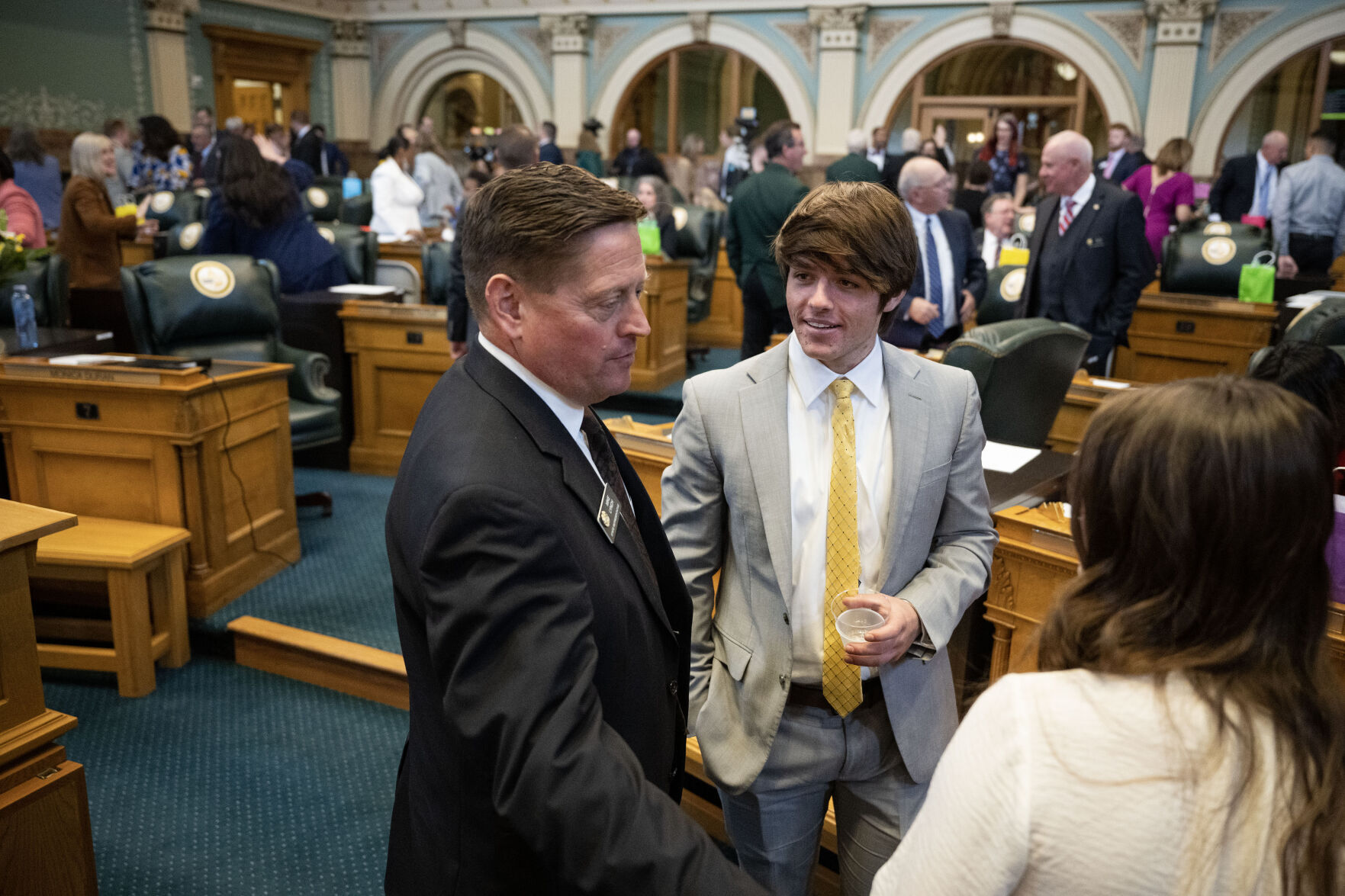
Only 31 Republicans filled the seats of the Colorado General Assembly on opening day for the 2023 legislative session – the fewest the state has seen in more than 80 years.
Republican leaders, however, remained optimistic.
After Democrats flipped seven seats from red to blue in November, Democrats are set to dominate the state Capitol this year, achieving a 46-19 supermajority in the House and a 23-12 split in the Senate. This makes Republicans all but powerless to stop Democrat-backed legislation.
Still, Senate Minority Leader Paul Lundeen said this will not prevent the party from having an impact.
During his opening day speech on Monday, Lundeen, R-Monument, said the Republican Party will make an honest effort to work with Democrats. He added he is hopeful that Democrats will incorporate Republican ideas into their legislation.
“I have been asked, ‘Can a team of 12 – the minority caucus in this august chamber – make a difference?’ The answer rings clear: Yes,” Lundeen said. “We will help this chamber lift up its head, look to the far horizon, and take on the basic issues that will provide extraordinary opportunities to our grandchildren and their children with a willingness to thoughtfully discern priorities and a laser focus that dismisses unsustainable political pet projects.”
Lundeen listed his caucus’ primary issues as increasing affordability for products and services, decreasing crime, creating a “student focused” education system, and lowering energy costs by utilizing alternative energy options, such as nuclear power.
Lundeen also vowed to stand against Democratic legislation that he views would burden future generations with debt or cause Coloradans to surrender their money, beliefs, livelihoods or Constitutional protections.
“It is our duty that the voices of people who find themselves in the minority in this season of Colorado’s history be heard and shared,” Lundeen said. “The saying in this body is that the minority gets their say, and the majority gets their way. But we are intent to do more than just talk. We insist to be full participants in the legislative process in this chamber, and will offer our best, constructive suggestions for making the future laws of this state better.”
In the House, Minority Leader Mike Lynch, R-Wellington, echoed similar legislative goals: Increasing affordability, decreasing crime and increasing parental choice in education.
In a press conference after the opening speeches, Lynch said the Republicans will “put some roadblocks” in the way of the Democratic agenda. This precedent began Monday with eight Republican representatives voting against Democratic House Speaker Julie McCluskie’s designation, breaking the state tradition that both parties come together to unanimously support the new speaker.
“We’re not going to make this easy,” Lynch said. “We feel good that the leadership has given us an olive branch to say that they will allow our voices to be heard and we’re going to hold them to that. And if they don’t, well, they will still hear our voices.”
Lynch also praised the freshmen Republican representatives in his speech, calling them “the most accomplished group of Republicans” he’s ever seen in the state House, representing military members and rural parts of the state that he says are often ignored by Democratic legislators.
“I implore you to remember it is not you that sits in those seats, it is the thousands of people who put you there,” Lynch said. “Most of them you agree with, but some of them you do not. Those voices are important, as well. Those voices are the ones the minority represents here today. The voices you may not agree with, but are still there to be heard from in each one of your districts. I ask only one thing of you, the super majority, let those voices be heard.”



Colorado Politics Calendar Aug. 3-9
Rachael Wright, Special to Colorado Politics
rachael.wright@coloradopolitics.com
Updated 3 days ago
CoPo’s weekly political calendar will help you find political and public-policy events throughout Colorado. It includes candidate and issue campaign events, public policy meetings, court hearings, state and local party conventions, assemblies, debates, rallies, parades, speaking engagements, traveling dignitary appearances,...
The primary political reform and precondition for all others | SONDERMANN
Eric Sondermann
eric-sondermann@coloradopolitics.com
Updated 3 days ago
In its current state, the American political system has no end of ailments. Far too many factors accelerate polarization and work against moderation and narrowing the differences. Media, and the way so many citizens limit themselves to agreeable, reinforcing sources,...
Susemihl wins surprise victory to replace Steve Durham as Colorado Springs state senator | A LOOK BACK
Rachael Wright, Special to Colorado Politics
rachael.wright@coloradopolitics.com
Updated 3 days ago
Forty-five years ago this week: In a closed session, the vacancy committee for Colorado’s Senate District 12 selected attorney Peter Susemihl to complete Sen. Steve Durham’s, R-Colorado Springs, term. Durham resigned his seat to become Region 8 Director of the...

10th Circuit partially revives lawsuit over 2020 Denver protest injuries
Michael Karlik
michael.karlik@coloradopolitics.com
Updated 1 day ago
The Colorado-based federal appeals court revived a man’s claims against Denver on Friday after concluding a trial judge resolved the case in the city’s favor without analyzing two of the three instances of alleged excessive force and other constitutional violations....

At conservative summit, Colorado Republican leaders concede Democrats’ election edge
Marissa Ventrelli
marissa.ventrelli@coloradopolitics.com
Updated 11 hours ago
Four Republican state lawmakers told attendees at a gathering of conservative leaders on Friday they doubt their party can win statewide races, noting that Colorado’s electorate has been shifting toward Democrats but adding they see an opening in several pockets....
Federal judges find Colorado immigration judge violated several orders
Michael Karlik
michael.karlik@coloradopolitics.com
Updated 5 hours ago
Multiple federal judges in Colorado have freed people from immigration custody after determining that one immigration judge violated their directives for properly conducting bond hearings. For nearly a year, Colorado’s U.S. District Court has faced a flood of habeas corpus petitions...
Q&A with Mike Pence | Former vice president says GOP’s populist turn from conservatism isn’t permanent
Ernest Luning
ernest.luning@coloradopolitics.com
Updated 9 hours ago
Former Vice President Mike Pence says he’s concerned that the Republican Party has taken a populist turn away from bedrock conservative principles during President Donald Trump’s second term, but he believes the party will return to its roots when Trump...
New federal plan sets short-term rules for Colorado River management
Marianne Goodland
marianne.goodland@coloradopolitics.com
Updated 1 day ago
Interior Department’s plan spares Colorado from mandatory cuts for now After years of stalled negotiations among the seven states that rely on the Colorado River, the federal government on Friday released its own plan for managing the drought-strained system. Calling...
Fauci’s diary details blooming outrage toward ‘far right,’ softness toward Biden and China
Hudson Crozier
hudson.crozier@washingtonexaminer.com
Updated 1 day ago
Dr. Anthony Fauci increasingly railed against “far right” critics of his approach to COVID-19 issues while describing strong support from the Biden White House in his pandemic-era diary, which was recently released by Congress. The former National Institute of Allergy...

Colorado is spared mandatory cuts under federal Colorado River proposal
The Associated Press
the-associated-press@coloradopolitics.com
Updated 1 day ago
California, Arizona and Nevada to take less water under plan While Colorado has been spared from mandatory reductions, Arizona, California and Nevada would take less water from the Colorado River under a proposal announced Friday by the federal government to...
PREV
PREVIOUS

Opening day in the Colorado General Assembly brings cheers and shenanigans
Colorado’s 2023 legislative session got off to a somewhat slow start on Monday due to shenanigans in the speaker of the House race. But in the Senate, it was much smoother sailing. The Senate, now at a 23-12 Democratic advantage, saw eight new members added, six Democrats and two Republicans. “I always start on time,” […]

State Supreme Court hands down business-friendly ruling in hospital liability case
The Colorado Supreme Court clarified on Monday that plaintiffs suing limited liability companies are constrained in where they may file lawsuits and ordered two medical negligence cases be transferred to Arapahoe County because that is where the plaintiffs’ injuries occurred. The justices agreed to decide the proper venue for suing LLCs after two Boulder County […]