

By 5-2, state Supreme Court rules Thornton mayor not a council member
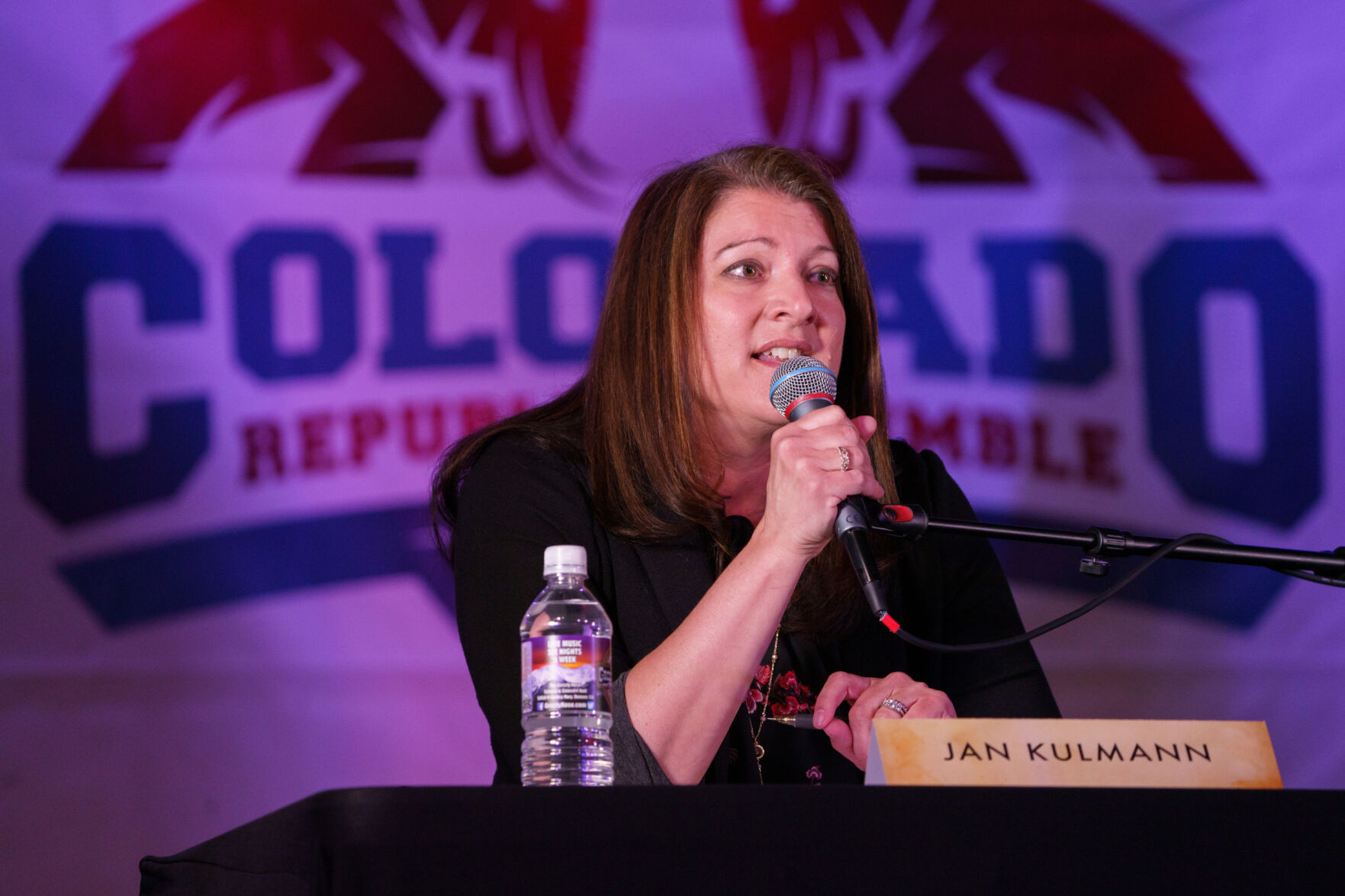
Thornton Mayor Jan Kulmann may serve two terms as the city’s top elected official after the Colorado Supreme Court ruled on Monday that her time spent as a council member does not bar her from further service on the city’s nine-member council.
By 5-2, the court found Thornton’s charter distinguished the mayor and eight ward council members to a sufficient degree that they do not belong to the same “office.” The dividing line was key, as a 1994 constitutional amendment known as Section 11 prohibits local elected officials from serving more than “two consecutive terms in office” without taking a time-out between stints in the government.
“Accordingly, on the undisputed facts before us, we further conclude that Kulmann will soon complete her first term as Thornton Mayor, and, consistent with section 11, she may seek one more consecutive term in that office,” wrote Justice Richard L. Gabriel for the majority.
In analyzing the issue, the majority and the dissenting justices frequently appeared to rely on entirely different grounds for interpreting the term limits.
For instance, Gabriel honed in on the wording of Thornton’s charter, pointing out the concrete instances of the mayor being treated differently than a ward council member. The dissent, however, dug into the notion that the mayor is fundamentally a council member by zooming out to how the other branches of government treat their leaders.
“The speaker of the Colorado House of Representatives has additional responsibilities, but the speaker is still a representative. The chief justice of the Colorado Supreme Court has additional duties, but the chief justice is still a justice,” wrote Justice William W. Hood III for himself and Justice Maria E. Berkenkotter. “In these situations, a single government official occupies two positions simultaneously.”
The Colorado Municipal League, which represents 270 of the state’s 272 cities and towns, celebrated the decision, which it characterized as permitting voters to continue to choose their own representatives within the limits of the state constitution.
“Voters still have the last word and can decide whether a particular candidate should be elected. Voters in municipalities can still change how the amendment applies locally by having an election to make term limits more or less restrictive,” said Kevin Bommer, executive director of CML.
The underlying lawsuit, brought by Thornton resident Cherish Salazar, sought a finding that Kulmann had to vacate her office due to the term limits imposed in Section 11.
Thornton’s charter establishes a city council of nine members, “one of whom shall serve as Mayor.” Under Salazar’s reading of the charter, the mayor and eight ward council members were of the same “office.” Because Kulmann had been elected to two four-year terms as a council member before her 2019 election as mayor, she had allegedly reached her two-consecutive-term limit for any position on the city council.
A trial judge agreed in part with Salazar. Because Section 11 did not define what an “office” is, Adams County District Court Judge Teri L. Vasquez looked to the overall purpose of the constitutional amendment, which was to broaden opportunities for public service and deter “careerism” in elected office. Considering all of the responsibilities and functions laid out in the charter, she found Thornton’s ward council members and mayor were, in fact, elected to the same office.
However, Vasquez did not believe Section 11 applied to partial terms. Because Kulmann resigned midway through her second council term to be inaugurated as mayor, Kulmann did not have to step aside immediately.
The Supreme Court subsequently agreed to hear the appeal directly. During oral arguments in October, some members of the court were wary of unilaterally defining the roles of local elected officials for municipalities.
“My concern is getting into a situation where courts are being asked to get in the weeds and decide, ‘What does a mayor do day-to-day? Is it really different than a council person?'” said Gabriel.
The Colorado Municipal League warned that reading Section 11 too restrictively would bar experienced elected officials from ascending from a council seat to the mayor’s office or vice versa. The group argued the problem would be particularly acute in less populous jurisdictions with a smaller candidate pool.
“By itself, the existence of a separately elected mayoral office shows that voters did not intend to treat that office the same as other council or board offices for term limits purposes,” the league wrote.
The Supreme Court’s majority determined “office” was not an ambiguous word and instead referred to specific positions instead of membership on a governing body. Under that interpretation, Thornton’s mayor is different from a council member: She presides over council meetings, has authority in emergencies, makes some appointments and gets paid slightly more.
Importantly to the majority, the mayor is the only person on Thornton’s council who is elected at large, unlike some municipalities where the mayor’s seat rotates among council members.
“The Mayor is not elected to be a Councilmember, nor does one become Mayor by being elected to the City Council and then being selected to serve as Mayor. Rather, the voters specifically choose the individual whom they want to serve as their Mayor,” Gabriel wrote.
The dissent, meanwhile, worried about the implications of permitting a council member to become mayor once they reach their term limit, only to run again for council when they hit the term limits for the mayor’s office.
“If reelected, Kulmann will serve fourteen years on the City Council by the end of her term (six years longer than the two four-year terms contemplated by section 11),” Hood cautioned. “By alternating between eight-year stints as a ward-elected and an at-large councilmember/mayor, an individual could hold the same legislative position in the city of Thornton forever.”
A spokesperson for Thornton said that since the adoption of term limits, no one has served more than two full terms as a mayor and council member.
The case is Kulmann v. Salazar.



Routt County DA’s office faces multiple investigations after it drops high-profile rape case
Jenny Deam
jenny.deam@gazette.com
Updated 1 hour ago
Routt County’s district attorney and deputy district attorney are now under increasing scrutiny on multiple fronts for their handling of the alleged drugging, rape and strangulation of a nationally ranked cross-country skier. The fallout from their decision not to prosecute...
Federal judge postpones CU regent’s request to lift censure restrictions
Michael Karlik
michael.karlik@coloradopolitics.com
Updated 4 hours ago
A federal judge on Thursday canceled an upcoming hearing to decide whether to block the restrictions the University of Colorado’s governing body has placed on one of its members, indicating that he would instead pivot to the defendants’ motion to...
Appeals court reverses ‘particularly brutal’ sex assault convictions due to flawed warrant
Michael Karlik
michael.karlik@coloradopolitics.com
Updated 5 hours ago
Colorado’s second-highest court reversed a Jefferson County defendant’s sexual assault and kidnapping convictions last month after concluding that police relied on an unconstitutionally broad search warrant to obtain evidence from the man’s cell phone. Jurors convicted Joseph Gabriel Van Eck...
Colorado Supreme Court intervenes in 3 ongoing cases
Michael Karlik
michael.karlik@coloradopolitics.com
Updated 21 hours ago
The Colorado Supreme Court recently intervened in the prosecution of a juvenile defendant and will decide whether he is entitled to have prosecutors demonstrate probable cause at a hearing after a grand jury already determined probable cause existed. The justices...
Appeals court clarifies meaning of ‘at-risk’ victim based on breathing disability
Michael Karlik
michael.karlik@coloradopolitics.com
Updated 1 day ago
Colorado’s second-highest court clarified last month that victims qualify as “at-risk” under state law if they required mechanical assistance to breathe on the date of the offense against them. El Paso County prosecutors charged Jon Claude Crow with third-degree assault,...
Ex-attorney cannot remain anonymous while suing Colorado judicial branch, says 10th Circuit
Michael Karlik
michael.karlik@coloradopolitics.com
Updated 2 days ago
The Denver-based federal appeals court concluded last month that a former attorney cannot mask her identity while suing the Colorado Judicial Department for alleged improprieties in her disability and disbarment proceedings. “Jane Roe,” representing herself, sued the Judicial Department and...
Appeals court reverses convictions after judge blocked defendant’s character witnesses
Michael Karlik
michael.karlik@coloradopolitics.com
Updated 2 days ago
Colorado’s second-highest court reversed a defendant’s convictions for forgery and attempting to influence a public servant last month because a Boulder County judge improperly blocked him from calling witnesses who could testify about his truthfulness. A three-judge Court of Appeals...
Colorado Supreme Court accepts child neglect, unlawful search appeals
Michael Karlik
michael.karlik@coloradopolitics.com
Updated 2 days ago
The Colorado Supreme Court recently announced that it will decide whether a series of missteps led an El Paso County judge to improperly terminate a father’s parental rights, and whether a police officer defendant bears the burden of proving that...

Colorado Attorney General sues HUD over changes to homeless funding
Matt Kyle
matt.kyle@denvergazette.com
Updated 3 days ago
Colorado Attorney General Phil Weiser on Tuesday joined the attorneys general of several other states to sue the federal government over an attempt to cap funding for permanent housing projects. The change would result in tens of thousands of people...
10th Circuit upholds dismissal of ex-Teller County fire chief’s First Amendment lawsuit
Michael Karlik
michael.karlik@coloradopolitics.com
Updated 2 days ago
The Denver-based federal appeals court agreed on Tuesday that the former chief of the Florissant Fire Protection District could not prevail on the claim that his 2023 firing was retaliation for his First Amendment-protected activity. Erik Holt alleged the Teller...
PREV
PREVIOUS

Q&A with Paul Lundeen | Veteran Republican lawmaker takes the helm of the Senate GOP
With the opening of the 2023 session, state Sen. Paul Lundeen will ascend to the top of the food chain in the Senate GOP caucus as its next minority leader. Lundeen, R-Monument, has a long history of elected office, beginning with the state board of education a decade ago. That was followed by two terms in […]

Tina Peters may not force judge to testify about courtroom recording incident, Supreme Court rules
The Colorado Supreme Court has swatted down an attempt by Mesa County Clerk and Recorder Tina Peters to force the judge presiding over her criminal case to provide testimony about Peters’ alleged misconduct – specifically, that she video-recorded court proceedings and lied about it. The sprawling controversy in Mesa County originated with the allegations that Peters […]