

10th Circuit reinstates lawsuit alleging false statements of Denver officers

Following a decision of the U.S. Supreme Court earlier this year easing the burden for people to sue for a wrongful prosecution, the federal appeals court based in Colorado has reinstated a man’s lawsuit against several Denver police officers.
Wyatt T. Handy Jr. claimed he was arrested on Dec. 13, 2018 on suspicion of domestic violence after the alleged victim reported Handy had punched her and destroyed her personal property. But after prosecutors dismissed the charges against him, Handy sued the officers involved for malicious prosecution, claiming they failed to verify the accuracy of the allegations when applying for a warrant.
In February 2021, U.S. Magistrate Judge Gordon P. Gallagher recommended dismissing Handy’s lawsuit. Gallagher quoted the requirements for a malicious prosecution claim as recognized by the U.S. Court of Appeals for the 10th Circuit. Handy needed to establish the officers caused his prosecution, there was no probable cause to support his arrest and, notably, the criminal proceedings “were dismissed for reasons indicative of innocence.”
“Plaintiff does not assert that he was acquitted based on his innocence in the domestic violence case. He states only that the ‘charges were dismissed against him’,” Gallagher wrote.
Handy then asked for a reconsideration of the dismissal. The Supreme Court, he pointed out, had recently agreed to hear the case of Thompson v. Clark, which would answer the question of whether a lawsuit for malicious prosecution simply requires the lack of a conviction, or if there must be evidence of innocence as well. U.S. District Court Senior Judge Lewis T. Babcock refused to reopen the case, again insisting Handy had not alleged any finding of his innocence.
While Handy’s appeal was pending, the Supreme Court ruled 6-3 in April that plaintiffs suing for malicious prosecution only need to show that criminal proceedings ended in their favor, regardless of whether there was any indication of their innocence.
Consequently, a three-judge panel of the 10th Circuit on Wednesday reinstated Handy’s lawsuit, acknowledging the Thompson ruling contradicted the appellate court’s prior requirement for innocence.
“(T)hat interpretation is no longer correct,” wrote Judge Timothy M. Tymkovich in an Oct. 5. order.
The case is Handy v. Dobbin et al.



Denver murder conviction reversed for incomplete self-defense instruction
Michael Karlik
michael.karlik@coloradopolitics.com
Updated 2 hours ago
Colorado’s second-highest court reversed a defendant’s murder conviction last week because a Denver judge gave an incomplete instruction to the jury about the man’s right to self-defense. Donald R. Gonzales and Gary McLaughlin met up in a Capitol Hill parking...
Colorado lawmaker, House leaders named in workplace-retaliation lawsuit
Marianne Goodland
marianne.goodland@coloradopolitics.com
Updated 4 hours ago
A former legislative aide has filed a lawsuit alleging she was mistreated, illegally directed to perform campaign work and harmed by a House leadership structure she charged was fragmented, politicized and ineffective at protecting employees. The lawsuit, filed by Jennifer...
Federal judge hears arguments about Colorado’s 3-day gun purchase waiting period
Michael Karlik
michael.karlik@coloradopolitics.com
Updated 9 hours ago
A federal judge heard arguments on Monday about the constitutionality of a 2023 Colorado law that generally imposes a three-day waiting period on firearm purchases after the initiation of a background check. The test that the U.S. Supreme Court created...
Colorado Supreme Court intervenes in Weld County prosecution dismissed due to Missy Woods misconduct
Michael Karlik
michael.karlik@coloradopolitics.com
Updated 1 hour ago
The Colorado Supreme Court ordered a Weld County trial judge last week to respond to the district attorney’s claim that he improperly dismissed a criminal case because of “outrageous” conduct by the Colorado Bureau of Investigation. Daniel Lee Eatinger stood...
Schoolchildren’s presence at child sex-related trial did not harm Arapahoe County defendant, appeals court says
Michael Karlik
michael.karlik@coloradopolitics.com
Updated 3 days ago
Colorado’s second-highest court decided on Thursday that the presence of a group of schoolchildren on the first day of a child sexual exploitation trial did not violate an Arapahoe County defendant’s constitutional right to a fair trial. Prosecutors charged Jerry...
Appeals court cites week-old Colorado law to reinstate child neglect case at child, father’s request
Michael Karlik
michael.karlik@coloradopolitics.com
Updated 3 days ago
Colorado’s second-highest court invoked a new state law for the first time on Thursday and reinstated a child neglect case that both the child and her father wished to reopen. House Bill 1227 took effect on Aug. 12, reversing a...
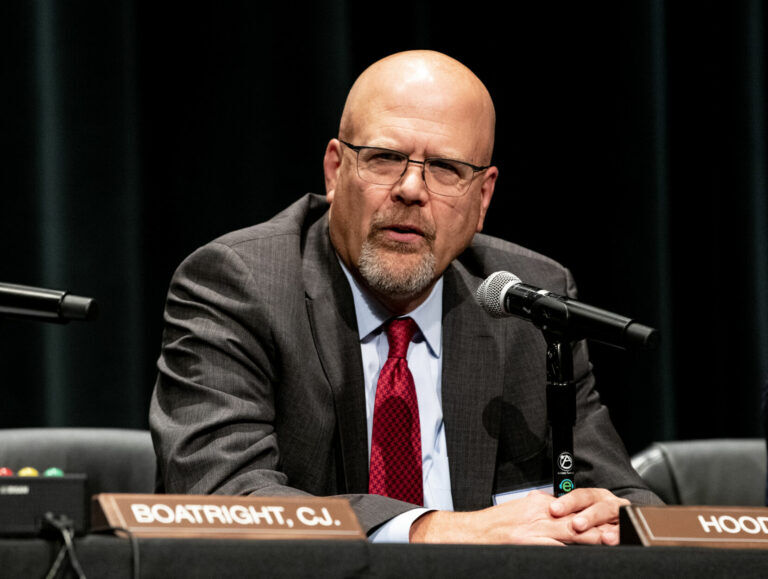
Colorado Supreme Court names William Hood as next chief justice
Michael Karlik
michael.karlik@coloradopolitics.com
Updated 4 days ago
The Colorado Supreme Court has selected Justice William W. Hood III to be the next chief justice, the judicial branch announced on Friday. Hood will succeed Chief Justice Monica M. Márquez, who took over the role in July 2024. “I...
Family of slain Lakewood teacher releases statement as murder suspect makes first court appearance
Matt Kyle
matt.kyle@denvergazette.com
Updated 1 day ago
Patrick Theodore Barnett, the Lakewood man accused of killing his wife, a Jeffco Public Schools art teacher, made his first court appearance Friday morning as his wife’s family looked on. The status conference hearing was held before District Court Judge...
Appeals court upholds Park County trophy hunting conviction
Michael Karlik
michael.karlik@coloradopolitics.com
Updated 4 days ago
Colorado’s second-highest court clarified on Thursday that a defendant may stand convicted under the state’s trophy hunting laws if he abandons a bear carcass but returns later to remove the meat. Under Colorado law, it is a felony to detach...
Judge grants partial injunction to GEO in fight against state health inspection law
Kyla Pearce
kyla.pearce@gazette.com
Updated 5 days ago
A judge ruled Thursday that The GEO Group does not have to follow parts of a new state law requiring more frequent health and safety inspections at the U.S. Immigration and Customs Enforcement processing center in Aurora. Under the order...
PREV
PREVIOUS

GOP groups outspending Democratic allies in Colorado Senate races
The latest campaign finance reports show the “soft money” group dedicated to supporting Republicans running in Colorado Senate races is outspending its Democratic counterpart by nearly a 2-to-1 margin. The Senate Majority Fund’s independent expenditure committee, which backs Senate Republican candidates, and All Together Colorado, the Democrats’ soft side IEC, collectively spent about $6 million on […]

Colorado issue committees raise nearly $30 million to influence vote on ballot measures
The handful of groups seeking your vote on statewide ballot measures in November are expected to raise more than $30 million by mid-October. As of Sept. 30, ten issue committees have raised a total of $29.3 million, with a decidedly-lopsided advantage for those who back three liquor-related ballot measures and another supporting the measure to […]