

Appeals court overturns Jeffco murder conviction after interrogators failed to clarify Miranda rights
A man who shot his victim multiple times allegedly based on hallucinations will receive a new trial because the state’s second-highest court found Jefferson County law enforcement misled him about the constitutional right to an attorney prior to his confession.
A three-judge panel for the Court of Appeals reviewed the video from Erik Jamal Newton’s interrogation with two Jeffco Sheriff’s Office personnel and concluded that Newton remained unsure of his Miranda rights, in particular the right to speak with a court-appointed attorney if he could not afford one. Instead, the interrogators left Newton with the impression that he needed to pay for his own lawyer.
“(A)ny Miranda advisement that either contains an affirmative misrepresentation of a defendant’s rights or misleads a defendant about a material fact regarding those rights, such as a defendant’s right to an attorney regardless of his ability to pay, is inherently insufficient,” wrote Judge Matthew D. Grove in the June 2 opinion.
Because prosecutors relied heavily on Newton’s unconstitutionally-obtained confession during trial, the appellate court reversed Newton’s convictions for murder and evidence tampering.
A psychiatrist who evaluated Newton found that he likely suffered from hallucinations around June 17, 2016 when he shot and killed Zachary Greenstreet, who lived at the family home of Newton’s high school friend. Newton said that, at the time, he was plagued by voices taunting and threatening him. He underwent treatment, during which he received antipsychotic medication.
However, Newton stopped taking the medicine due to the side effects. He reportedly believed that shooting Greenstreet or another member of Greenstreet’s family would cause the voices to cease.
After gunning down Greenstreet in his driveway, Newton buried the gun in a cemetery. An officer saw him and arrested Newton for trespassing. Upon his release from the Jefferson County jail, Newton returned to the cemetery and retrieved the gun. Around that time, police arrested him again, but for the murder of Greenstreet.
At the police station, sheriff’s employees Vernon Woodin and Elias Alberti began questioning Newton. Woodin first provided Newton a list of his Miranda rights and read them aloud. He initially told Newton that if Newton could not afford to hire an attorney, “one will be appointed to represent you before questioning if you wish.”
Before signing the form indicating he understood his rights, Newton hesitated.
“Um, well, I do wish to talk to you and I, I can’t afford a lawyer, and an attorney – when I go to court, wouldn’t he be there anyway?” Newton asked.
Woodin responded, erroneously, “An attorney would be appointed after, um – the only way that you would get an attorney now is if you were able to pay for one.”
“Right, I can’t,” Newton said.
Alberti attempted to clarify that Newton did have the right to answer questions with an attorney present, and he would receive an attorney when he went to court.
“And I’d have to pay for that one, right?” Newton asked.
“I think you’re confused,” Alberti answered. “The right is that you, you can have an attorney sitting here if you want one. So, my question is to you, just so we’re on the same page, are you willing to talk to us without an attorney present or would you like to have an attorney present before you answer any questions?”
“Um, no, I think it’s fine,” Newton said.
He signed the form indicating he was waiving his Miranda rights and proceeded to confess to shooting Greenstreet.
The defense subsequently asked the trial court to suppress Newton’s statements made during the interrogation, based on Newton’s representation that he “couldn’t really comprehend what was going on.” The defense claimed Newton did not understand he had the right to an attorney before and during the interrogation, even if he could not afford one.
“You’re probably going to get some clarification from the Court of Appeals,” mused then-District Court Judge Christie A. Bachmeyer before denying the motion. Although Newton attempted to show at trial that his hallucinations meant he could not form the intent required for first-degree murder, a jury found him guilty and he received a life sentence.
Newton appealed his conviction and the government maintained that he had voluntarily waived his Miranda rights with full awareness of the consequences.
“Before any substantive questioning, the officers clarified Newton’s right to an attorney; they told him that he had the right to have an attorney present for any questioning, if he wanted to have one present; and they made clear that he could refuse to answer any questions without his attorney present,” wrote Senior Assistant Attorney General Jacob R. Lofgren to the Court of Appeals.
But the appellate panel disagreed that Woodin and Alberti made Newton’s rights clear to him, finding it “obvious” that Newton was unsure of his right to counsel.
“Woodin affirmatively misinformed Newton about his Miranda rights, telling him that ‘the only way’ he could have an attorney present for questioning would be if he was able ‘to pay for one’,” wrote Grove. “Notably, despite Newton’s obvious confusion, at no point during the conversation did either officer correct Woodin’s affirmative misrepresentation.”
Grove explained that prosecutors relied on Newton’s confession throughout all phases of the trial. Further, because the confession supported the prosecution’s argument that Newton intended to kill Greenstreet, it likely provided a basis for his conviction. The panel ordered a new trial with directions to exclude Newton’s confession to the police.
The appellate judges declined to address Newton’s other challenges to his convictions, including his claim that a relative of Greenstreet’s yelled “he’s lying” during the trial, and that it was wrong for the psychiatrist to read aloud from “The Satanic Bible” to the jury.
The case is People v. Newton.


Dismissal sought in Michael Clark’s second trial
Jenny Deam
jenny-deam@coloradopolitics.com
Updated 21 hours ago
The murder conviction of Michael Clark should be dismissed due to a 32-year delay that led to crucial evidence being lost or destroyed, a bungled police investigation and “outrageous conduct” at the state crime lab, according to defense motion filed...
Denver law students create AI-powered tools in federal judge’s ‘design sprint’
Michael Karlik
michael.karlik@coloradopolitics.com
Updated 2 days ago
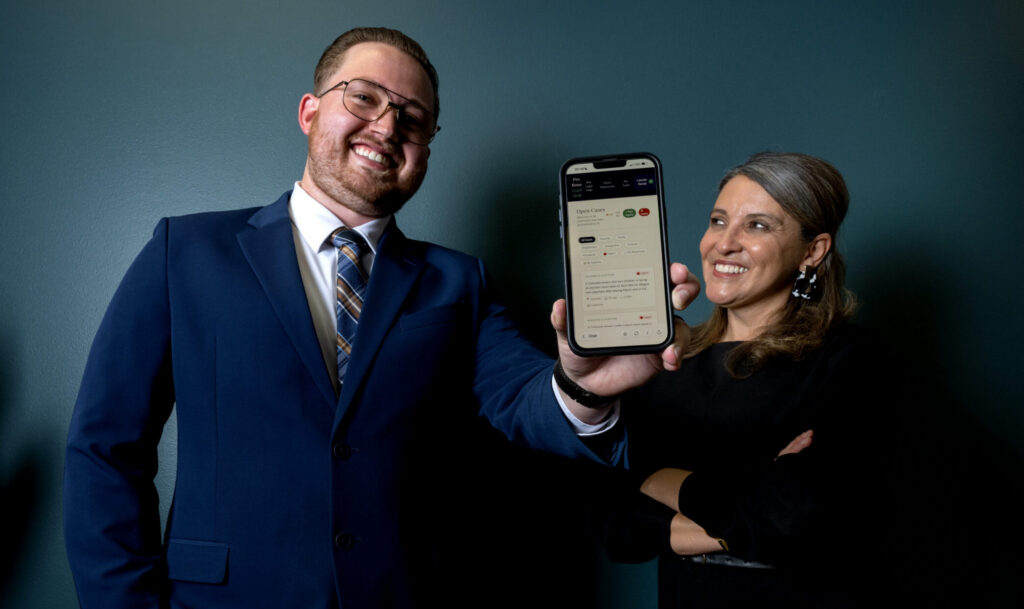
A tenant discovered a handwritten note on his door stating he had 48 hours to move out. The landlord changed the locks without notice or court proceedings. The tenant paid rent on time and had never received any complaints about...
First ever disciplinary trial of a Colorado judge scheduled under new system
Michael Karlik
michael.karlik@coloradopolitics.com
Updated 4 days ago
A disciplinary panel on Thursday scheduled a mid-August hearing to adjudicate the alleged misconduct of Montezuma County Court Judge Ian J. MacLaren. Following voters’ passage of constitutional Amendment H in November 2024, adjudication of serious judicial misconduct allegations is open to public...
Appeals court recognizes weekend, holiday rule applies to judicial review deadline
Michael Karlik
michael.karlik@coloradopolitics.com
Updated 4 days ago
Colorado’s second-highest court clarified for the first time on Thursday that the rule extending deadlines in civil cases when the final day falls on a weekend or holiday also applies to litigants seeking review of governmental decisions. Nicholas A. Rigato...
SCOTUS arguments, varied workload: 6 Colorado solicitors general talk about job
Michael Karlik
michael.karlik@coloradopolitics.com
Updated 4 days ago
Six current and former solicitors general of Colorado, including two who have since become members of the bench, spoke to attorneys on Wednesday about how the role has changed over time, what the workload entails, and their experiences arguing at...
Federal judge declines to end Denver sheriff employee’s sex discrimination suit
Michael Karlik
michael.karlik@coloradopolitics.com
Updated 4 days ago
A federal judge tentatively green-lit a former Denver Sheriff Department sergeant’s sex discrimination lawsuit for trial last month, based upon allegations that three female employees were promoted ahead of him despite his qualifications. U.S. District Court Judge Nina Y. Wang...
Corrections officials may be sued for employee’s alleged abuse of detainee, federal judge rules
Michael Karlik
michael.karlik@coloradopolitics.com
Updated 5 days ago
High-level corrections officials may be sued for their own alleged failures to prevent or respond to an employee’s sexual misconduct toward a detainee, a federal judge decided last month. Rajae Bouhamidi was incarcerated at the Denver Women’s Correctional Facility. In...
Colorado GOP request to block unaffiliated voters from receiving Republican primary ballots denied by judge
Ernest Luning
ernest.luning@coloradopolitics.com
Updated 5 days ago
A federal judge on Tuesday denied the Colorado Republican Party’s request for an emergency injunction barring unaffiliated voters from participating in the state’s upcoming Republican primary election. U.S. District Court Judge Philip A. Brimmer said that preventing unaffiliated voters from...
Aurora not liable for suspended officer’s attack on woman, federal court rules
Michael Karlik
michael.karlik@coloradopolitics.com
Updated 6 days ago
The Denver-based federal appeals court decided on Monday that the city of Aurora cannot be held liable for an officer’s attack on a woman while he was serving a suspension for shooting a different person. Wyoma Martinez filed suit against...

Colorado’s unprecedented AI law can’t be enforced yet, judge rules
Marianne Goodland
marianne.goodland@coloradopolitics.com
Updated 5 days ago
A federal judge on Monday issued a delay in enforcing Colorado’s artificial intelligence law, touted by backers as a tool to protect consumers and residents from algorithmic discrimination but which critics called heavy-handed and unworkable. The lawsuit against Senate Bill...
PREV
PREVIOUS

GAO releases full report on U.S. Space Command relocation from Colorado Springs
A Trump administration decision to uproot U.S. Space Command and move it to Alabama lacked credibility and transparency, the Government Accountability Office concluded in a report released Thursday. The GAO findings confirm what congressional insiders who’d gotten an early look at the report told The Gazette in April – as well as exclusive reporting by the […]

Appeals panel reverses Jeffco sex assault conviction based on improper testimony
A man convicted in Jefferson County for sexual assault will receive a new trial after the state’s Court of Appeals determined his jury heard improper testimony from an expert witness. Prosecutors called an expert in sex assault, trauma and behavior dynamics to testify at the 2018 trial of Alfonso McGregor. The prosecutor asked the expert […]