

LIVE UPDATES: Senate debates fentanyl bill

LATEST: Senate gives House Bill 1326, on fentanyl, preliminary approval
6:15 p.m. – Senate members minutes ago gave preliminary to the sweeping legislation policymakers hope would confront Colorado’s fentanyl crisis.
Procedurally, once a bill has gone through second reading debate, there’s one more piece of business to be conducted – what’s known as approval of a committee of the whole report. That’s an opportunity for lawmakers who want another shot at the amendments to ask for a formal, recorded vote on them.
However, a quick negotiation among leadership resulted in an agreement to avoid doing COW amendments.
So, it will be up to the House to decide whether it agrees with the Senate amendments, in particular the change on the bill’s “knowing” provisions. The Senate’s final vote on the bill is expected on Friday.
Senate rejects amendment targeting bill’s provision on distribution resulting in death
5:30 – An amendment from Gardner sought to strike a portion of the bill’s language tied to distribution resulting in death. The bill’s current language provides for mandatory prison time for those with more than 50 grams, or in distribution resulting in death, but the amendment would change that to result in mandatory prison time for any distribution, including as little as one pill. It failed.
Gardner’s next two amendments, which also failed, would have changed the bill’s language tied to the misdemeanor charges for possession of 1 gram of fentanyl or a mixture containing the drug. The bill currently says someone charged three times with misdemeanor possession would be charged with a felony for the fourth offense. Gardner tried an amendment that lowered it to what he called three strikes – two possessions, with the third a felony, and two strikes – one possession, with the second a felony.
Amendment on zero tolerance for simple possession fails
One of the biggest fights is over making any possession of fentanyl a felony, which Gardner is pursuing through another amendment.
Advocates, including district attorneys and law enforcement, have been clamoring for the change since the House took up the bill. They argue that a felony charge accomplishes two things: it acts as a deterrent and serves as a lever for encouraging those arrested to turn in the dealers.
The harm reduction community opposes the approach, arguing Colorado cannot convict its way out of the fentanyl crisis, that it will drive up incarceration numbers, and that there is no evidence that zero tolerance policies result in better outcomes.
Pettersen and Cooke are on opposite sides on this amendment. Pettersen is opposed to zero tolerance, while Cooke supports it.
The amendment failed on a voice vote.
Amendment on sunset repeal fails
3:45 – The Gardner amendment to repeal the felony provision after three years also got a close vote but failed.
Pettersen has been lukewarm on the issue of repeal, based on concerns that stronger opiates – isotonitazene or ISO, an even deadlier substance, is mentioned most often – will force a future legislature to take the issue up again in three years. She told Colorado Politics that “everything is carefully negotiated.”
“It will be a more difficult conversation in three years, but it was also important for advocates [in favor of repeal] to make their case. Every word matters,” she said.
At least two Democrats – Ginal and Sen. Nick Hinrichsen of Pueblo – voted with Republicans to support the amendment.
Gardner pursues repeal of sunset provision
3:25 p.m. Gardner’s next amendment would remove the three-year auto repeal language in the bill. That language is tied to the possession of 1 to 4 grams of fentanyl or a combination drugs. Once the repeal takes place, possession of 1 to 4 grams would go back to being a misdemeanor. The hurdle for those who want the repeal out is tougher because Sen. Kevin Priola, a Henderson Republican, is opposed to the amendment.
Three Democrats join Republicans in adopting fentanyl amendment favored by law enforcement
The vote to adopt the Gardner amendment included three Democrats: Sens. Chris Hansen, Joann Ginal and Rachel Zenzinger. Sen. Rhonda Fields of Aurora, who was originally in favor, voted against. She’s considered something of a swing vote on this bill. The Democrats joined 15 Republicans in supporting the amendment. Zenzinger, who was chairing the committee of the whole, which is what the second reading debate is called, told reporters she broke the tie.
Earlier efforts to repeal that language had failed. If the final bill ultimately includes this amendment, it would be a win for prosecutors and law enforcement officials, who argued that requiring knowledge makes it impossible for them to prosecute.
Gardner amendment passes
3:15 p.m. – The amendment passed after a standing vote. As the bill is now written, possessing more than a gram of any substance containing fentanyl – whether that person knew they had fentanyl or not – is a felony.
Experts have warned that much of the drug supply – from meth to cocaine to heroin – has been contaminated with fentanyl, typically without the knowledge of the users of those drugs. As a result, those experts and advocates have said, a broad swath of users are at risk of felony charges. Someone who has 2 grams of meth, for instance, faces only a misdemeanor for possessing it. But if there’s a detectable amount of fentanyl in there, the bill as written now would increase that to a felony.
Gardner proposes amendment to strike ‘knowing’ language from new possession charge
3:10 p.m. – Sen. Barbara Kirkmeyer, R-Brighton, repeatedly returned to the front of the chamber to read comments provided by district attorneys. She quoted a message apparently from the head of the Colorado District Attorneys Council, who said that every elected prosecutors from across the state opposed the language and wanted it stripped.
Lee got up next and said that if the legislature wanted to make it easier for district attorneys to get convictions, then lawmakers should just nullify the 5th and 6th amendments. He asked how people could be convicted for possessing something they didn’t know they had, calling it the “essence of injustice.”
Kirkmeyer rose right after him and reiterated what she said district attorneys were telling her: that people caught with more than 1 gram of something containing fentanyl would have to admit to it for prosecutors to charge them with felony possession. That, she repeatedly said, made it unworkable and would “eviscerate” prosecutors’ ability to charge people possessing fentanyl in low quantities.
The amendment only affects possession, not distribution. A person caught with any amount of a substance containing fentanyl and who is convicted of intending to distribute it faces felony charges under current law. The bill would further tighten those laws.
2:10 p.m. – Sen. Bob Gardner, R-Colorado Springs, rose and, after responding to comments from previous legislators, proposed an amendment that would strike key language from the bill. As it stands now, the bill makes it a felony to have 1 gram of fentanyl – but only if the person knew it had fentanyl, or should’ve known. Otherwise, it remains a misdemeanor if it’s below 4 grams.
Gardner, and other lawmakers critical of that language, said that law enforcement say that language makes the bill unworkable. They’ve argued that a person who is caught with more than 1 gram of a substance containing fentanyl could simply say they didn’t know what they had, and law enforcement has said that language doesn’t exist elsewhere in the state’s drug laws.
“We need to take that mental state out, so we can give some strength to law enforcement, to DAs, and to the addicts, the users, to help them get out,” added Cooke, the bill’s co-sponsor.
Kirkmeyer, who appeared to be reading directly from a message sent to her by Adams and Broomfield counties district attorney Brian Mason, told senators that prosecutors needed the language stripped so they could do their job.
The language is considered key by other lawmakers because of fentanyl’s presence in other drugs. Without that language, a person caught with more than 1 gram of meth that has fentanyl would be charged with a felony; were they caught with only meth, it’d be a misdemeanor. Experts and lawmakers on both sides of the aisle have said that users of other drugs often don’t know that their drug of choice has been contaminated with fentanyl.
While Cooke support the amendment, his co-sponsor, Pettersen, opposed it and said the language gave people the opportunity to argue in court they didn’t know what they had.
Democratic Sen. Kerry Donovan argued that the amendment would “grab more people who are struggling with addiction or mental health issues, or, as we’ve told the story numerous times, unknowingly get fentanyl in another drug use, instead of trying to get the truly bad guys: the dealers.”
The bill as written now also prohibits prosecutors from using the presence of Narcan or test strips, if a person has them when they’re arrested, as evidence that the person knew what they had contained fentanyl. Gardner’s amendment would strip that language, which drew criticism from Pettersen, Gonzales and Lee.
Gonzales, who has been critical of some of the additional criminal penalties in the bill, read the names of several people who’d fatally overdosed – and whose deaths were described by family members during earlier testimony.
With this amendment, she said, lawmakers are saying that “if you’re lucky enough to live and survive, we’re going to charge you with a felony.”
Senators cite life experiences to support dueling arguments
12:45 p.m. – Minority Leader Chris Holbert, R-Douglas County, said he wants the bill to pass in a form where it truly gets tough on fentanyl. He lauded Attorney General Phil Weiser for “getting it right” when Weiser called the 2019 bill a mistake, but noted the Weiser did not ask for that law to be repealed.
The 2019 bill did not cause this problem in Colorado, Holbert said.
“Our nation is under attack from people who manufacture fentanyl,” he said.
The “knowingly” language in the bill allows someone shopping for fentanyl, and who gets arrested, to simply say “I didn’t know,” he said.
People talk to each other, and the word has gotten around that, if the bill passes, people should just say “I didn’t know,” Holbert said, adding no other crime allows someone to determine the outcome of that crime by uttering the phrase. Ignorance is not an escape from the law, Holbert argued, adding that including “knowingly” in the bill is not getting tough on fentanyl.
Holbert also revealed that his father, who died last year of old age and abuse, was addicted to drug and alcohol, and his sister died last fall from an overdose. He suspects fentanyl was the cause.
That was followed by Sen. Nick Hinrichsen, D-Pueblo, who shared his family’s story, as well. An uncle with whom he was close turned to drugs after his wife died from cancer. The uncle died from an overdose – a mix of fentanyl and cocaine – three years ag, he said, adding it is unlike any other drug and “we should treat it accordingly.” But the scariest part of the drug is that people don’t always know that fentanyl is mixed with what they’re using, people like his uncle, he said.
To prosecute someone for taking a drug they didn’t know they had and to force them into rehab for a drug that is not their drug of choice won’t help, he said.
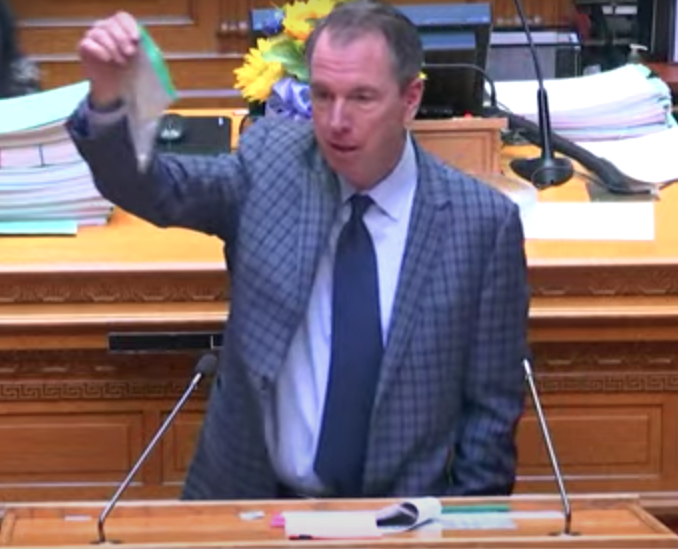
Holding up a packet of sugar that he had put into a plastic bag, Sen. Paul Lundeen, R-Monument, said that amount, a teaspoon of fentanyl, is enough to kill 1,700 people. And fentanyl does it quickly, Lundeen said, calling it a shock to the system.
“We need a policy response that is a shock to the system to get a handle on this, and that can only happen at the wholesale level.”
Sen. Pete Lee, D-Colorado Springs, said lawmakers can agree that the harm reduction component of HB 1326 are critical and necessary. He argued against zero tolerance, which would come with “draconian penalties for any amount.” But moving to zero tolerance won’t get the desired results, either, Lee said.
Sen. Don Coram, R-Montrose said rehab isn’t one and done – it’s a lifetime, no matter what drug. Yes, if one gets caught, that person will go to court but with the choice of a treatment program rather than incarceration, he said.
Kirkmeyer cited a Weiser statement that the bill’s approach to possession needed further improvement, the same views as the district attorney’s council.
Cooke, citing a Colorado Politics story on former drug dealer Marshall Weaver, said the claim that people could not change their lives based on the criminal portion of the bill is an illusion.
Senators offer amendments
The first amendment to be introduced and adopted took out pharmacies as a location to obtain opiate antagonists, such as Naloxone.
A more substantial amendment adds to the bill an overdose trends review committee in the Department of Public Health & Environment. That committee, according to Pettersen, would come up with policy recommendations, based on the causes of overdoses and overdose-related deaths, and which could include a review of other factors such as housing status or criminal justice involvement. The committee would be in place by Sept. 1, 2023 with its first report due a year later.
That amendment got challenges from Democrats, including Sen. Julie Gonzales of Denver and Rhonda Fields of Aurora. Gonzales questioned where the data would come from: law enforcement, coroners or hospitals? Pettersen replied that those groups are already researching those deaths, and it’s expensive and time-consuming to analyze. This would just come up with a process on how to obtain meaningful data on systemic failures and to sound the alarm for the next wave of opioids, known as ISO.
If you have the data, don’t wait two years, Fields said. “If you know where the overdose trends are, do something about it; don’t wait for this commission” to address it. “Don’t wait for people to die,” she added. The amendment passed.
Cooke’s first amendment was from the sheriffs. It seeks the funds the state gets from opiate-related settlements – the upcoming Purdue Pharma multi-state settlement comes to mind – to fund medication-assisted treatment in jails. Pettersen supported the amendment and it passed.
Another Pettersen amendment addressed the need for immediate data on overdoses. Under the amendment, emergency medical service providers, law enforcement and coroners would be required to immediately report overdose deaths to CDPHE’s mapping application program, no more than 24 hours after the death or the toxicology report. That amendment also passed.
As the Senate moved into debating the bill as amended, Gonzales raised the issue families pointed out in committee testimony; even with video evidence, law enforcement did not investigate those deaths. In the aftermath of tragedy, one looks for accountability, she said. “Let’s treat this crisis like the public health crisis it is.”
Cooke countered that the bill is not the war on drugs or the people using them. “This is a war on a killer – half a pill will kill someone. It’s a war on one particular drug.” Don’t follow the rhetoric of a “new war on drugs,” he said.
Where the discussion needs to go today, said Kirkmeyer, is how to give law enforcement the tools it needs. This bill, however, is skirting around the edges, she said.
If the higher burden of proof – knowing – remains for prosecutors, this will be a bill to be decriminalize fentanyl, thundered Sen. Bob Gardner, R-Colorado Springs.
Senate begins fentanyl debate
Sen. Brittany Pettersen, a Lakewood Democrat serving as the bill’s co-sponsor, said unfortunately, no matter how much work the legislature has put into dealing with opioids, Colorado is now struggling with a third wave in an opioid epidemic.
She blamed the pharmaceutical industry for starting that crisis in the 1980s by causing prescriptions for opioids for more than what people needed. Heroin was the second wave, she explained.
Starting in 2014, fentanyl became the third wave. It has completely taken over drug supplies, she said.
“It’s not a Colorado problem. It’s a global problem,” she said.
People addicted to fentanyl have to use it every two to three hours to avoid withdrawal, she said, a much higher rate than heroin.
She also told her own family’s story: her mom was addicted to opioids for years.
Her number one priority in HB 1326 is educating the public, Pettersen said. She also addressed the bill’s provisions to stop the flow of fentanyl through social media, to provide harm reduction treatments, and testing strips and Naloxone.
The bill’s co-sponsor, Sen. John Cooke, R-Greeley, talked about the bill’s enforcement side, predicting there will be more attempts to amend that section.
“We all know (government’s) first role is to protect the health and safety of its citizens. We haven’t done that yet.”
He discussed House Bill 19-1263, which lowered possession of four grams or less of several Schedule 1 drugs, including fentanyl, to a misdemeanor. He said he doesn’t want to be back in a year or two to address more deaths from fentanyl.
“We can’t change the past but we can work toward the future,” he said.
Cooke also pointed out that 80% of the bill deals with its harm reduction efforts, as is the bulk of the funding.
The Senate first adopted the reports from the judiciary and appropriations committees, without discussion. Those reports contain amendments put on House Bill 1326 by those committees.
A clear pattern has emerged in the last few weeks, based on debates among legislators. Broadly speaking, legislators appear amenable to a compromise legislation that makes possession of 1 gram of a drug that contains fentanyl a felony. They are also open to allocating additional money to law enforcement to investigate fentanyl overdoses.
Legislators must decide on two other questions – whether to eliminate a three-year sunset provision that applies to the bill’s felony language and whether to delete the bill’s provision that triggers the felony charge only if the person knew or should have known there’s fentanyl in the drug.
The appropriations committee work follows last week’s hearing in the Senate Judiciary Committee.
The major changes to HB 1326 as approved by the appropriations committee Wednesday addressed money. The committee approved an amendment to add $10 million to the bill, to pay for treatment and detox programs. Another $5.8 million is directed to the state Department of Public Health & Environment, for opiate detection tests, the bill’s education campaign, regional training and a study on the health effects of the bill’s enhanced criminal penalties, And $7 million will go to the division of criminal justice in the Department of Public Safety.
Hospitals and emergency rooms will receive opiate antagonists – that includes Naloxone and Narcan – without charge, and the state will pursue federal funding for those antagonists, under another amendment approved Wednesday.

marianne.goodland@coloradopolitics.com


marianne.goodland@coloradopolitics.com


Cherry Creek School District paid law firm $114K, including $40K for political consultant, over superintendent allegations
Nico Brambila
nico.brambila@denvergazette.com
Updated 5 hours ago
The Cherry Creek School District paid $114,000 to hire outside counsel to provide the Board of Education with legal advice as it navigated the allegations that were swirling around the former superintendent. Fisher Phillips invoices obtained through a Colorado Open...
Ex-attorney cannot remain anonymous while suing Colorado judicial branch, says 10th Circuit
Michael Karlik
michael.karlik@coloradopolitics.com
Updated 47 minutes ago
The Denver-based federal appeals court concluded last month that a former attorney cannot mask her identity while suing the Colorado Judicial Department for alleged improprieties in her disability and disbarment proceedings. “Jane Roe,” representing herself, sued the Judicial Department and...
DOJ announces ‘inmate tablets’ despite California prison pornography scandal
Rena Rowe
rena.rowe@washingtonexaminer.com
Updated 6 hours ago
The Justice Department’s Federal Bureau of Prisons announced Wednesday that it is rolling out a new inmate tablet program designed to expand communication, education, and rehabilitative services across federal prisons, despite growing scrutiny over similar technology used in California’s prison...

Mark Carney says Trump has ‘won the argument’ on NATO defense spending
Brady Knox
brady-knox@coloradopolitics.com
Updated 7 hours ago
Canadian Prime Minister Mark Carney said that President Donald Trump has “won the argument” on NATO defense spending, successfully pushing members to spend more on defense. Carney, one of Trump’s most articulate critics, conceded on Wednesday that he had been...
Convicted ex-Judge Hannah Dugan sentenced to no prison time for helping illegal immigrant evade arrest
Jack Birle
jack-birle@coloradopolitics.com
Updated 7 hours ago
Former Milwaukee County Circuit Judge Hannah Dugan was sentenced to a $5,000 fine Wednesday for helping an illegal immigrant evade arrest last year but avoided prison time in her criminal case. U.S. District Judge Lynn Adelman, a Clinton appointee, declined to give Dugan a...
DPS Superintendent Alex Marrero misses cut for Miami-Dade job
Nico Brambila
nico.brambila@denvergazette.com
Updated 6 hours ago
Denver Public Schools (DPS) Superintendent Alex Marrero did not make the short list of candidates vying for the top job with the Miami-Dade County Public School District. The Miami-Dade school board narrowed the field from 21 applicants to six semifinalists....
Appeals court reverses convictions after judge blocked defendant’s character witnesses
Michael Karlik
michael.karlik@coloradopolitics.com
Updated 10 hours ago
Colorado’s second-highest court reversed a defendant’s convictions for forgery and attempting to influence a public servant last month because a Boulder County judge improperly blocked him from calling witnesses who could testify about his truthfulness. A three-judge Court of Appeals...
Aspen Acres fire damage footage released, residents seek reentry
Savannah Eller
savannah-eller@coloradopolitics.com
Updated 6 hours ago
First looks at the damage path are emerging in the Aspen Acres fire, as more than 11,000 people wait for news on when they can return. Tuesday afternoon, the Pueblo County Sheriff’s Office released a nine-minute video showing fire damage...
Uncertain status of McConnell could create legal firestorm over possible replacement
Kaelan Deese
kaelan-deese@coloradopolitics.com
Updated 15 hours ago
Sen. Mitch McConnell’s (R-KY) extended hospitalization is drawing new attention to an unresolved legal question in Kentucky that could trigger a high-stakes court battle if the longtime Republican senator were unable to complete the remainder of his term. The question...
Colorado Supreme Court accepts child neglect, unlawful search appeals
Michael Karlik
michael.karlik@coloradopolitics.com
Updated 5 hours ago
The Colorado Supreme Court recently announced that it will decide whether a series of missteps led an El Paso County judge to improperly terminate a father’s parental rights, and whether a police officer defendant bears the burden of proving that...
PREV
PREVIOUS

Attorney general's office accuses Colorado Springs charter school board of financial, ethics violations
A Colorado Springs school is under investigation by the legislative body that governs the state’s charter schools, according to a letter from Senior Assistant Attorney General Joseph Peters. Peters issued a cease-and-desist order to the Colorado Springs Charter Academy on April 22, alleging that the school’s board committed several violations of the Colorado Charter School […]

State Supreme Court attempts to illuminate meaning of tail light law
Could drivers change their vehicles’ tail lights to match the Denver Broncos’ colors? Or emit a kaleidoscope of colors from their cars? Colorado’s Supreme Court on Thursday repeatedly raised those far-fetched scenarios as they grappled with the meaning of a state law governing tail lamp colors. As written, drivers must have “a red light plainly […]