

SONDERMANN | On Robert Bork, Ketanji Brown Jackson and a new verb
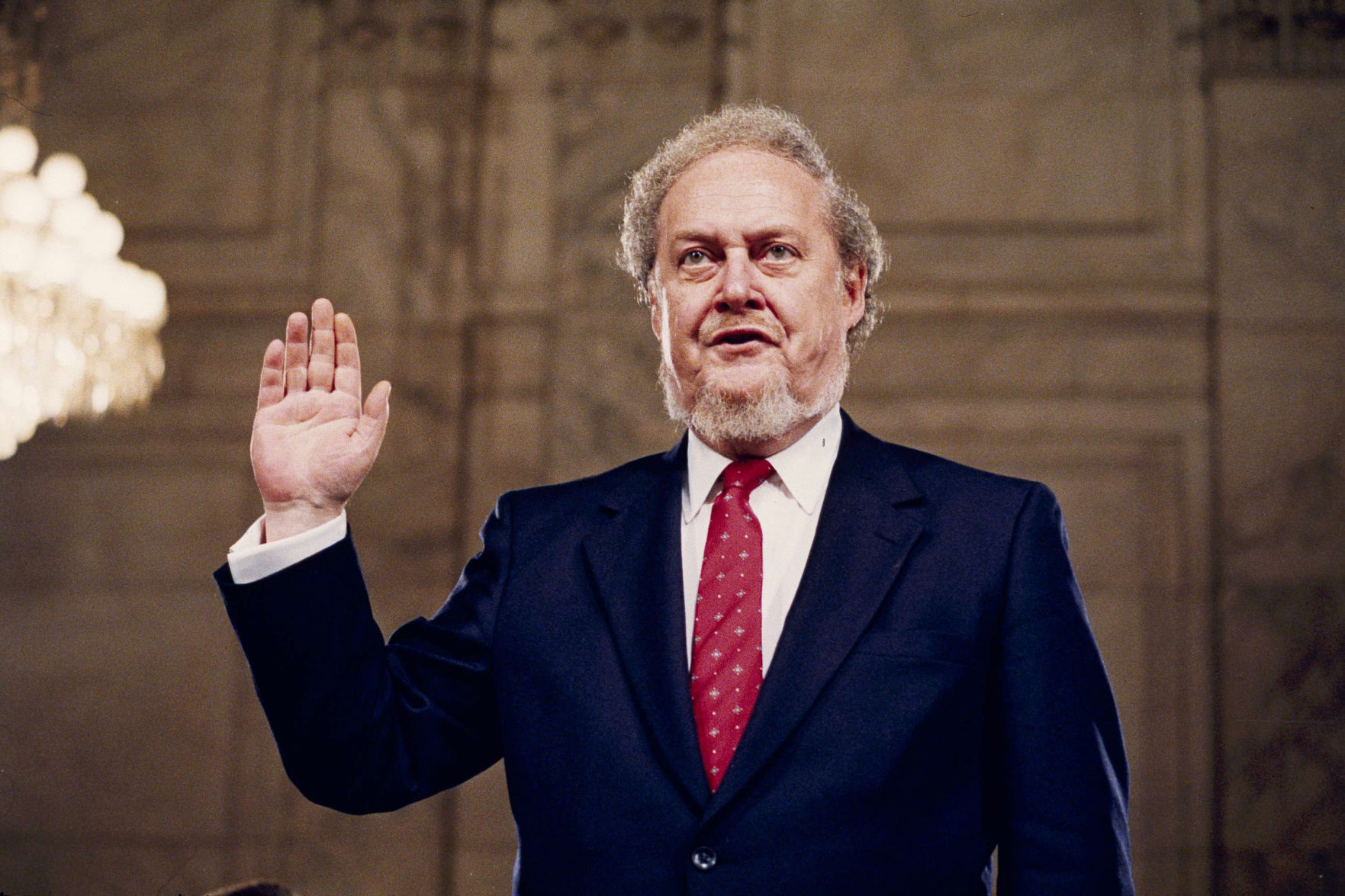

Jeff Blattner was there at what many regard as the beginning.
That origin point, though Blattner would dispute it, was the 1987 nomination of Robert Bork to the U.S. Supreme Court and the all-out assault that ensued.
Today’s deep, consuming polarization has many fathers. More than a few observers point to the Bork hearings as a starting line. Republicans, of course, are fond of this version of history as one feature of the divide is the assignment of blame to those evil types across the aisle for firing the first shot.
Now a Coloradan dividing his time between Boulder and Edwards, Blattner was front and center in the effort, successful in the end, to derail Bork’s candidacy.
Many of us fancy ourselves leaving a mark on the world. But how many have actually added a word to the English language?
The Merriam-Webster dictionary now includes “bork” and defines it as a transitive verb meaning, “to attack or defeat a nominee or candidate for public office unfairly through an organized campaign of harsh public criticism or vilification.”
Suffice to say, Blattner takes exception to that “unfairly” part.
He correctly notes that roughly one in every four Supreme Court nominations over the country’s history has been rejected. That list includes George Washington’s nomination of John Rutledge to serve as just the nation’s second chief justice.
More proximately to the Bork drama, President Lyndon Johnson’s attempt to elevate his good buddy, Justice Abe Fortas, to chief justice went down in flames.
Richard Nixon then suffered the indignity of having two nominees for the same seat, Clement Haynsworth and Harrold Carswell, voted down, one after another.
Fun trivia: During Carswell’s Senate process, he was roundly criticized as mediocre. Nebraska Republican Roman Hruska rose to defend him, memorably asserting, “Even if he is mediocre, there are a lot of mediocre judges and people and lawyers. They are entitled to a little representation, aren’t they?”
Fast forward to 1987. Attorney Blattner had recently joined the staff of the Senate Judiciary Committee as counsel to Sen. Edward “Ted” Kennedy. Joe Biden, then a spry 44 years of age, though already 14 years into his Senate tenure, had just taken over the gavel as the committee chair.
Toward the end of his two White House terms, Ronald Reagan selected Bork, an appellate judge and conservative scholar, to fill a vacancy on the Supreme Court. Sen. Kennedy, with Blattner as his earnest, young staffer, had been preparing for this possibility. He wasted no time in laying down a marker and making clear this would be no ordinary confirmation.
Forty-five minutes after Reagan’s announcement, Kennedy took to the Senate floor. Relying heavily on Blattner’s research, Kennedy boomed, “Robert Bork’s America is a land in which women would be forced into back-alley abortions, blacks would sit at segregated lunch counters, rogue police could break down citizens’ doors in midnight raids, schoolchildren could not be taught about evolution.”
And more. The fight had been instantly joined.
It was a bare-knuckles brawl. An intellectual heavyweight, though carrying the added weight of his role in Watergate’s “Saturday Night Massacre,” Bork did not back down. Ultimately, his nomination was defeated by a Senate vote of 58-42 with six Republicans joining in opposition.
Where previous nominations had most often failed due to ethical issues or just political pique, Blattner notes that judicial philosophy had always been an undercurrent.
With the Bork fight, it became the main current and a tumultuous, tempestuous one at that.
Four years later, the nation was treated to the spectacle of the Clarence Thomas nomination and the jaw-dropping testimony of Anita Hill. With Thomas set to take the seat of retiring Justice Thurgood Marshall, a civil rights icon, the confirmation was a war about philosophy no matter what form it took.
Of more recent vintage, the ceaseless escalation gave us the non-consideration of Merrick Garland during the final year of Barack Obama’s term. Any such election-year principle was of course then violated with Amy Coney Barrett’s confirmation just days prior to Donald Trump’s losing reelection bid.
In between were the Brett Kavanaugh hearings complete with testimony as to copious amounts of beer and another unruly he-said, she-said dispute that did nothing to mask the high stakes philosophical conflict at the root of it all.
For his part, Blattner continued to occupy a key role in these confirmation fights. During the presidency of the second Bush, Blattner played the part of nominees John Roberts and Samuel Alito as Kennedy prepared and rehearsed for the hearings and his moments.
For those nominees put forth by Democratic presidents, Blattner was one of those coaching them in the refined, unilluminating art of careful, evasive answering. Some might liken this practice, employed by selectees of both the left and right, to coach Dean Smith’s patented four-corners stall.
Now a senior fellow and adjunct professor at the University of Colorado Law School, Blattner remains more than a casual observer of this process.
With the coming hearings for Biden nominee Ketanji Brown Jackson, Blattner gauges that the venom might be dialed back ever so slightly in that her confirmation will not change the Court’s ideological balance. Still, look for Republican senators to go after her hard on resonant issues of crime.
Blattner predicts that Jackson will be confirmed by the votes of all 50 Democratic senators plus anywhere from two to six Republicans joining in support. Such nominal bipartisanship might be impressive in this era. But it pales next to the 96-3 vote of approval in 1993 for Ruth Bader Ginsburg, hardly a milquetoast appointee.
Respect is due to Blattner for being in the arena. He ran toward the flame when others back away. Asked for reflections on the Bork fight given everything that followed, he sincerely insists that there are “no regrets.”
In his graying years, as Blattner and I are the same age, he worries about the declining reputation of the Court in the eyes of a jaded, angry, warring public. Restoring that essential legitimacy will prove a far heavier lift than coaching a like-minded nominee or shooting down one of an opposing judicial mindset.
Eric Sondermann is a Colorado-based independent political commentator. He writes regularly for ColoradoPolitics and the Gazette newspapers. Reach him at EWS@EricSondermann.com; follow him at @EricSondermann


Denver murder conviction reversed for incomplete self-defense instruction
Michael Karlik
michael.karlik@coloradopolitics.com
Updated 10 minutes ago
Colorado’s second-highest court reversed a defendant’s murder conviction last week because a Denver judge gave an incomplete instruction to the jury about the man’s right to self-defense. Donald R. Gonzales and Gary McLaughlin met up in a Capitol Hill parking...
Colorado lawmaker, House leaders named in workplace-retaliation lawsuit
Marianne Goodland
marianne.goodland@coloradopolitics.com
Updated 14 minutes ago
A former legislative aide has filed a lawsuit alleging she was mistreated, illegally directed to perform campaign work and harmed by a House leadership structure she says was fragmented, politicized and ineffective at protecting employees. The lawsuit, filed by Jennifer...
Secret Service confirms awareness of Iranian state media video threatening Barron Trump’s life
The Associated Press
the-associated-press@coloradopolitics.com
Updated 2 hours ago
WASHINGTON (AP) — The U.S. Secret Service has confirmed it is aware that Iranian state media has aired a video that appears to threaten the life of Barron Trump, President Donald Trump’s youngest son. “The U.S. Secret Service is aware...

Federal judge hears arguments about Colorado’s 3-day gun purchase waiting period
Michael Karlik
michael.karlik@coloradopolitics.com
Updated 2 hours ago
A federal judge heard arguments on Monday about the constitutionality of a 2023 Colorado law that generally imposes a three-day waiting period on firearm purchases after the initiation of a background check. The test that the U.S. Supreme Court created...
US set for largest mass visa revocation in history targeting up to 200,000 foreigners, officials say
The Associated Press
the-associated-press@coloradopolitics.com
Updated 2 hours ago
WASHINGTON (AP) — The Trump administration is preparing to revoke the business and tourism visas of up to 200,000 foreigners who have applied for or are currently seeking asylum status in the United States. If it happens, the move would...

U.S. Supreme Court clears way for Trump mail voting order in advance of midterms
Wire Services
wire-services@coloradopolitics.com
Updated 17 hours ago
WASHINGTON • The U.S. Supreme Court on Monday cleared the way for President Donald Trump to move ahead with an executive order that seeks to restrict the mailing of ballots to American citizens in an eligible voters list. The executive...
Colorado Supreme Court intervenes in Weld County prosecution dismissed due to Missy Woods misconduct
Michael Karlik
michael.karlik@coloradopolitics.com
Updated 17 hours ago
The Colorado Supreme Court ordered a Weld County trial judge last week to respond to the district attorney’s claim that he improperly dismissed a criminal case because of “outrageous” conduct by the Colorado Bureau of Investigation. Daniel Lee Eatinger stood...

Trump opens ‘economic D-Day’ offensive against Iran as war nears six-month mark
Christian Datoc
christian-datoc@coloradopolitics.com
Updated 22 hours ago
President Donald Trump is seeking to increase the financial pressure on Iran with new secondary sanctions on nations and foreign actors propping up the regime’s economy as the war between the United States and Tehran nears the six-month mark. Treasury...

Trump announces 50% tariffs on Canadian cars, auto parts, and steel
Naomi Lim
naomi-lim@coloradopolitics.com
Updated 22 hours ago
President Donald Trump escalated the trade war with Canada after talks collapsed last week, announcing Monday that the United States would impose 50% tariffs on cars, trucks, automotive components, and steel starting Jan. 1, 2027. “Canada has been ripping off...
Iran puts out propaganda video tracking Barron Trump’s location, offering $10 million for his assassination
Timothy Nerozzi
timothy-nerozzi@coloradopolitics.com
Updated 23 hours ago
The Islamic Revolutionary Guard Corps is putting a hit out on President Donald Trump’s son, Barron Trump, with an inflammatory video claiming to track his location. State-run television in Iran is broadcasting a propaganda video claiming to show the locations...
PREV
PREVIOUS

America's 1st statewide prison radio launches in Colorado, seeks to build bridges: 'Feeling human again'
America’s first statewide prison radio station, Inside Wire, launched March 1 in Limon Correctional Facility’s education and library building. A project of the University of Denver’s Prison Arts Initiative, Inside Wire: Colorado Prison Radio originally was envisioned as a first-of-its kind project that could help build trust and connections among the more than 14,000 incarcerated […]

OUT WEST ROUNDUP | Utah state lawmakers limit press access to House floor
UTAH Legislators pass media restrictions for House floor SALT LAKE CITY – The Utah House of Representatives approved new rules on Feb. 28 that limit where members of the press can film and interview lawmakers, following similar action taken by the Utah Senate two weeks earlier. The rules extend pandemic-era restrictions on when journalists can […]