

Senate advances law enforcement accountability legislation with promise of more work on the bill

The Senate on Thursday advanced legislation seeking to build on last year’s police accountability package to a final vote after adding a trio of amendments at the behest of stakeholders.
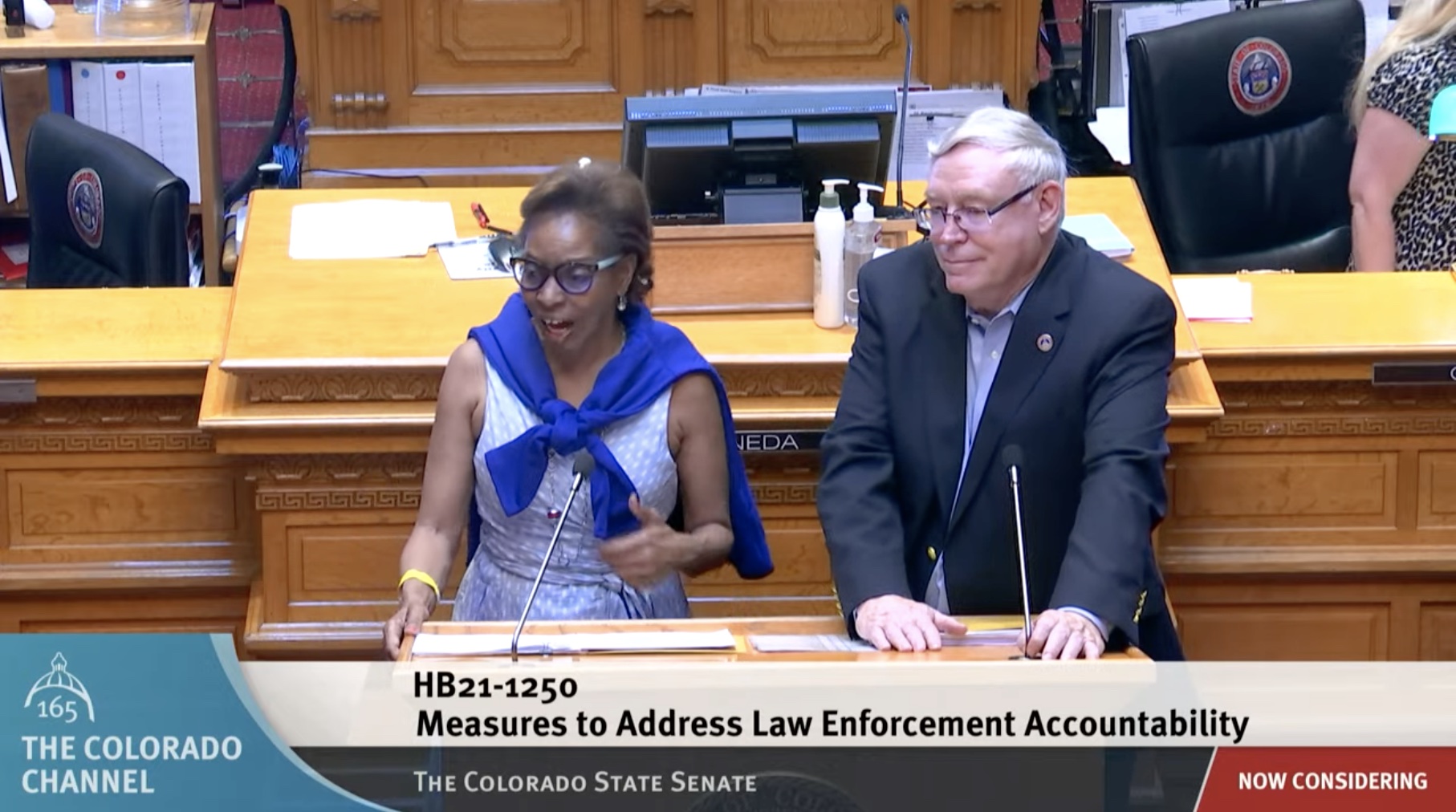
Sen. Rhonda Fields, the prime sponsor of House Bill 1250 in the Senate, labeled the legislation “[Senate Bill] 217 2.0.” That’s a reference to the historic package approved by lawmakers last year in the aftermath of George Floyd’s death that among other things banned law enforcement officers from using chokeholds, required the use of body cameras when dealing with the public and removed qualified immunity.
“Since we introduced that legislation last year, we’ve heard from law enforcement and we’ve been having ongoing conversations with the variety of advocates and law enforcement about what we can do to make this bill stronger and better,” the Aurora Democrat said.
“This is not anything to say, ‘We’re trying to get after the police.’ They have asked us to make some changes as it relates to transparency so everyone’s going about their work in a standard way, and so that’s what this bill attempts to do.”
The bill as it currently stands includes provisions that seek to:
- broaden the requirement for law enforcement officers to use body-worn cameras;
- expand data collection requirements;
- add flexibility to consequences delivered by the Peace Officer Standards and Training Board for officers who use unnecessary force; and
- remove qualified immunity for Colorado State Patrol troopers, a protection that was stripped from local law enforcement officers by SB 217.
Fields’ co-prime sponsor on the bill, Colorado Springs Republican Sen. Bob Gardner, added that the legislation was the product of “very close and difficult negotiations” yet remained a work in progress. To that end, he introduced three amendments that he said had been negotiated with stakeholders on all sides of the issue.
Those changes addressed incident reporting for Peace Officer Standards and Training Board certification, pushed back the required start date for data collection to next April and tweaked the definition of “exoneration” as it applies to law enforcement officers throughout the bill to ensure “that negative action would not be taken.” All three amendments were approved by the chamber.
While Gardner said the amendment reflected “the consequence of agreements that we have,” he added there were likely more amendments to come.
“I am going to not hide the ball and say that there will be further work on this bill,” he said. “Even still, it differs from the House version. We are very proud of the work that has been done in this chamber and are going to stick with that work and do some more.”
The Senate approved advancing the bill past the second reading stage and on to a final vote.

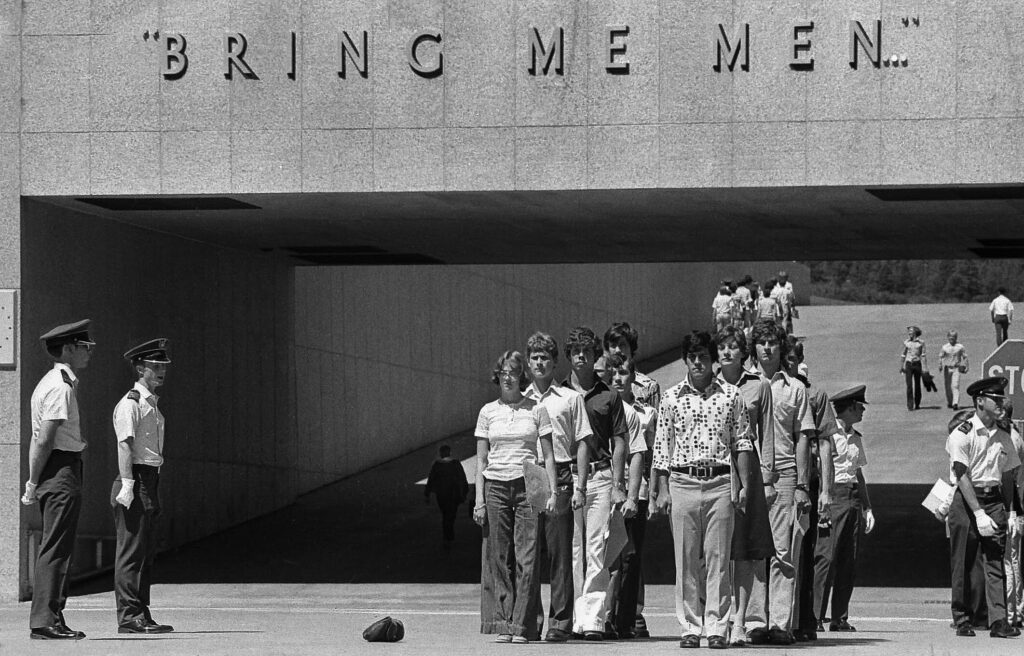
Fifty years later, women reflect on first coed class at the Air Force Academy, struggle for equality
Mary Shinn
mary-shinn@coloradopolitics.com
Updated 2 days ago
When the first female Air Force Academy cadets arrived 50 years ago this summer, they stood in front of an enormous sign on campus that read “Bring me men.” In the shadow of that sign, Kathleen Utley Kornahrens, one of...

As Lake Powell shrinks, marinas are having to adapt to dwindling water levels | OUT WEST ROUNDUP
The Associated Press
the-associated-press@coloradopolitics.com
Updated 4 days ago
ARIZONA Reservoirs near record lows PAGE — The Colorado River’s Lake Powell, the second largest reservoir in the U.S., is shrinking. A record-dry winter and extreme heat — as well as decades of overuse, chronic drought and climate change —...

A new day? Colorado’s troubled guardianship office pursues ‘cultural reset’
Marianne Goodland
marianne.goodland@coloradopolitics.com
Updated 4 days ago
Colorado’s guardianship program, long criticized for mismanagement and high staff attrition, is undergoing a “cultural reset,” as its new director works to repair partnerships and prepare for a major expansion under recent legislation. Created by lawmakers in 2017, the Office...
U.S. Senate OKs funding bill to avoid government shutdown
Wire Services
wire-services@coloradopolitics.com
Updated 2 days ago
Hemp provision became point of contention WASHINGTON • The U.S. Senate in an overnight vote Saturday approved a short-term measure to fund federal agencies into early December and avoid a government shutdown during the middle of campaign season. The late-summer...

The relevance of Watergate more than a half-century later | SONDERMANN
By Eric Sondermann
by-eric-sondermann@coloradopolitics.com
Updated 4 days ago
It was the scandal for which all other scandals are now named. In June 1972, a small group of Cuban burglars with high-level connections broke into the headquarters of the Democratic National Committee. Those headquarters were located in the Watergate...
Wirth downplays Social Security disaster talk | A LOOK BACK
Rachael Wright, Special to Colorado Politics
rachael.wright@coloradopolitics.com
Updated 4 days ago
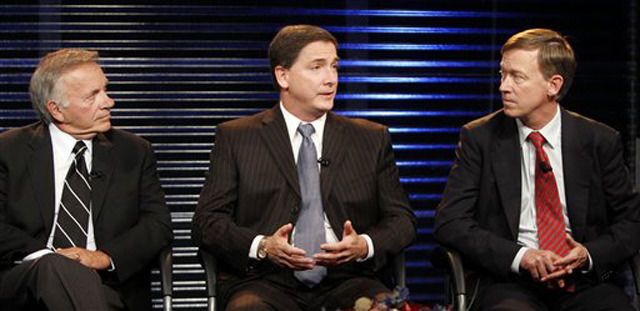
Forty-five years ago this week: “As time goes on,” said Democratic U.S. Rep. Tim Wirth, of the 2nd Congressional District, “we are finding that the safety net, which was proposed earlier this year, has some very large holes in it,”...

Colorado Politics Calendar Aug. 10-16
Rachael Wright, Special to Colorado Politics
rachael.wright@coloradopolitics.com
Updated 4 days ago
CoPo’s weekly political calendar will help you find political and public-policy events throughout Colorado. It includes candidate and issue campaign events, public policy meetings, court hearings, state and local party conventions, assemblies, debates, rallies, parades, speaking engagements, traveling dignitary appearances,...

Democratic group aims Spanish-language TV ad at Gabe Evans in Colorado’s battleground 8th CD
Ernest Luning
ernest.luning@coloradopolitics.com
Updated 2 days ago
A national group tied to House Democratic leadership launched a six-figure Spanish-language TV ad in Colorado this week targeting Republican U.S. Rep. Gabe Evans and the GOP’s signature budget legislation. The 30-second spot is part of $15 million in new...

Colorado School of Mines lands major share in Trump’s $100M mining-education plan
Thelma Grimes
thelma.grimes@coloradopolitics.com
Updated 2 days ago
President Donald Trump on Friday named the Colorado School of Mines among roughly a dozen institutions that will share in a $100 million commitment “to train the next generation of American miners.” Paul Johnson, the university’s president, said he is...
Local party leaders, incoming judge among members of judicial performance commission that violated law
Michael Karlik
michael.karlik@coloradopolitics.com
Updated 2 days ago
A local Democratic leader and 2024 presidential elector. A legislative aide and leader in the Young Republicans. An incoming county court judge freshly appointed by the governor. They are among the eight members of the northeastern Colorado judicial performance commission...
PREV
PREVIOUS

High-potency marijuana legislation unanimously clears the Senate
The Senate on Thursday unanimously voted to give final passage to a measure aimed at keeping high-potency THC products out of the hands of teenagers after making a number of changes to the version of the bill approved by the House last week. “This is not a perfect piece of legislation, haven’t seen one yet […]

School Finance Act clears the House, with focus on poverty, literacy and risks
The bill that funds Colorado’s school districts and charter schools passed the state House 60-5 Thursday, promising to send more money to schools with more at-risk students, those who need help speaking English and children living in poverty. The School Finance Act, Senate Bill 268, exceeds the current year’s school budget by $750.8 million, making […]