

Pre-trial reform bill clears the Senate despite bipartisan opposition
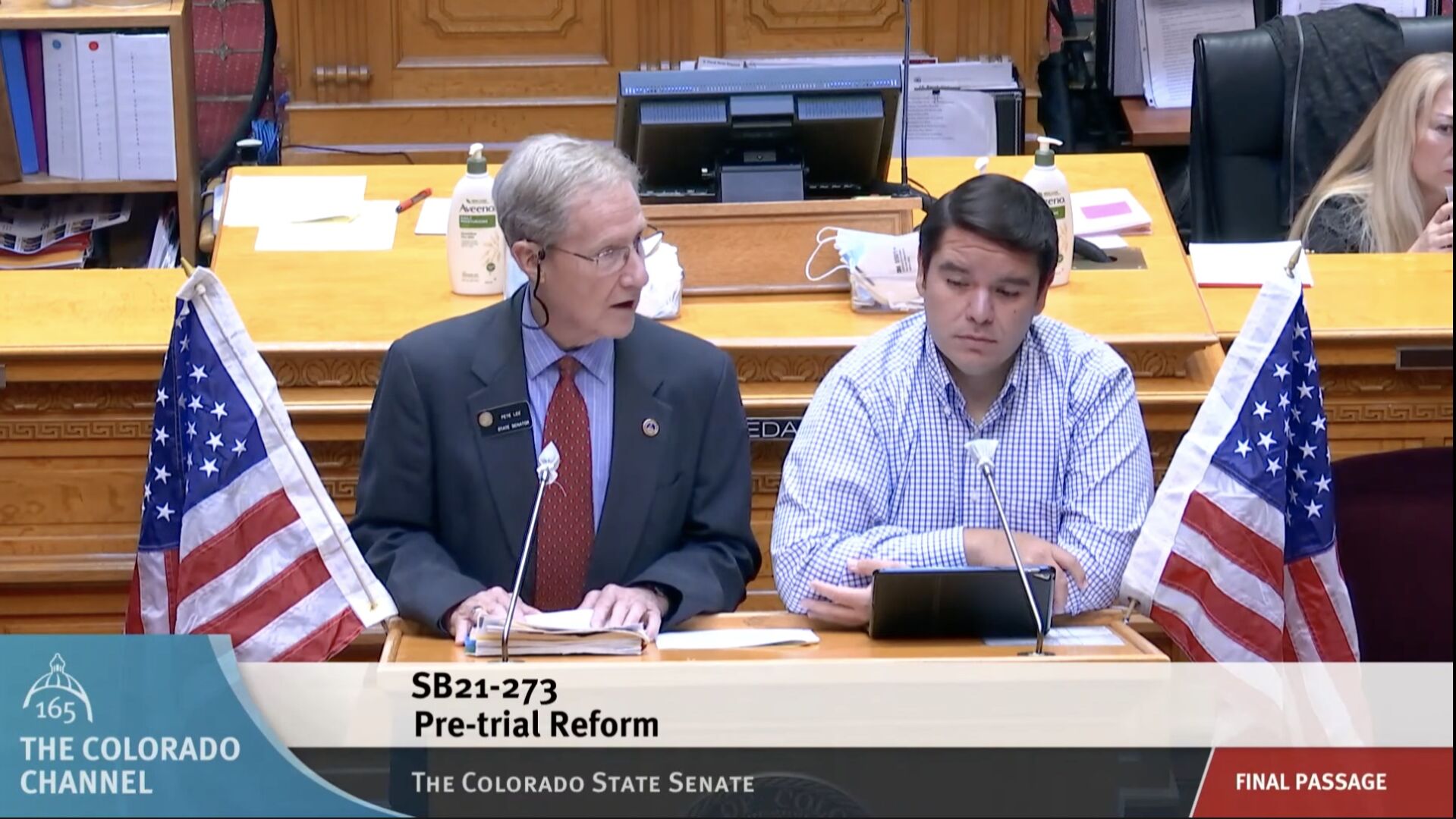
An effort to clamp down on the use of arrests and cash bail in the name of community safety on Thursday cleared the Senate on the strength of Democratic votes.
But Sen. Pete Lee’s Senate Bill 273 faced strident opposition from the chamber’s Republican minority, who re-litigated many of the objections they had raised in earlier debates on the bill. And they weren’t alone. Sen. Joann Ginal, D-Fort Collins, joined her Republican colleagues in voting against it.
The main provisions of the Colorado Springs Democrat’s second effort this year to reform the pre-trial criminal justice system seek to:
- ban law enforcement arresting alleged perpetrators solely for crimes rising up to the level of misdemeanor, with certain exceptions including victim rights crimes, unlawful sexual behavior and illegal possession or use of a firearm, among others, and
- prohibit courts from issuing monetary bonds for alleged offenses that rise to the level of class 4, 5, or 6 felonies unless the court determines the defendant is a flight risk or threatens the safety of a member of the community.
The bond provisions remained unchanged from Senate Bill 62, Lee’s initial effort this session. SB 62 also included those low-level felonies in the arrest prohibition as well, but Lee stripped those out of SB 273 in hopes to move people to support the latest version of the legislation.
The latest bill would also create what Lee described as a working group that would evaluate, assess and make legislative recommendations on co-responder models akin to Denver’s STAR program.
The bill is also sponsored in the Senate by Sen. Dominick Moreno, D-Commerce City.
According to Lee, the bill as written seeks to “alter the mindset of police when they’re going into an encounter from one of arrest, subdue and incarcerate to one of ticket and summons.”
But Lee’s GOP colleagues still objected to the bill. Senate Republicans were led by Sen. John Cooke of Greeley, who on Wednesday evening spent 90 minutes a filibuster the bill after previously expressing concerns over it during a Senate Judiciary Committee hearing.
As he had the previous evening, Cooke, a former Weld County sheriff, said Lee’s two bills were “nearly identical” and read off a list of offenses for which a summons in lieu of an arrest would be allowed under SB 273.
“Most of us don’t know anything about law enforcement or jails but we don’t listen to the professionals,” he said. “If we listen to the professionals, we’d be voting ‘no’ on this bill.”
A bulk of the testimony before the Judiciary panel from law enforcement was in opposition to the bill.
Sen. Rob Woodward, R-Loveland, said the bill “starts down a good path” and recognized “there are some folks who deserve some grace.”
“At the same time, this bill will clearly result in many criminals being released back into the community,” he said. “Some of the folks who are released back into the community because of this bill will steal, rob, rape and murder.
“The people of Colorado will see crime rates increase because of this bill.”
Ginal’s objections were more narrowly tailored. She told Colorado Politics she voted against the bill because she objected to the arrest provision excluding animal cruelty offenses.
“I just want to make it clear to the public the reason why I was a ‘no’ vote on SB 273 was because I draw the line at issues that involve animal cruelty,” she said.
The Fort Collins Democrat said she discussed those concerns with Lee ahead of the final vote and drafted a pair of amendments aimed at addressing the issue but he asked her not to bring them, as he preferred the legislative text remain intact as it stood. Ginal indicated she will run a bill next session ensuring animal cruelty offenses are arrestable.
Lee countered in a floor speech that “all instances of repeated cruelty to animals are arrestable.”
“When I heard the recitation of some 53 crimes — many of them victim rights crimes, motor vehicle theft or involving unlawful sex acts, repeated abuse of animals — and claims that they did not qualify for custodial arrest, I wondered what bill had been read and what bill was being referred to,” he said, adding that each of those crimes would still be arrestable under his bill.
He also said “recitations of present crime as a predictor of future crime is invalid and inappropriate, particularly with regard to a bill that hasn’t gone into effect.”
The bill now heads to the House, where it will need to work its way through the legislative process.


Colorado Politics Calendar Aug. 3-9
Rachael Wright, Special to Colorado Politics
rachael.wright@coloradopolitics.com
Updated 3 days ago
CoPo’s weekly political calendar will help you find political and public-policy events throughout Colorado. It includes candidate and issue campaign events, public policy meetings, court hearings, state and local party conventions, assemblies, debates, rallies, parades, speaking engagements, traveling dignitary appearances,...
Susemihl wins surprise victory to replace Steve Durham as Colorado Springs state senator | A LOOK BACK
Rachael Wright, Special to Colorado Politics
rachael.wright@coloradopolitics.com
Updated 3 days ago
Forty-five years ago this week: In a closed session, the vacancy committee for Colorado’s Senate District 12 selected attorney Peter Susemihl to complete Sen. Steve Durham’s, R-Colorado Springs, term. Durham resigned his seat to become Region 8 Director of the...

The primary political reform and precondition for all others | SONDERMANN
Eric Sondermann
eric-sondermann@coloradopolitics.com
Updated 3 days ago
In its current state, the American political system has no end of ailments. Far too many factors accelerate polarization and work against moderation and narrowing the differences. Media, and the way so many citizens limit themselves to agreeable, reinforcing sources,...

10th Circuit partially revives lawsuit over 2020 Denver protest injuries
Michael Karlik
michael.karlik@coloradopolitics.com
Updated 1 day ago
The Colorado-based federal appeals court revived a man’s claims against Denver on Friday after concluding a trial judge resolved the case in the city’s favor without analyzing two of the three instances of alleged excessive force and other constitutional violations....

At conservative summit, Colorado Republican leaders concede Democrats’ election edge
Marissa Ventrelli
marissa.ventrelli@coloradopolitics.com
Updated 11 hours ago
Four Republican state lawmakers told attendees at a gathering of conservative leaders on Friday they doubt their party can win statewide races, noting that Colorado’s electorate has been shifting toward Democrats but adding they see an opening in several pockets....

Federal judges find Colorado immigration judge violated several orders
Michael Karlik
michael.karlik@coloradopolitics.com
Updated 5 hours ago
Multiple federal judges in Colorado have freed people from immigration custody after determining that one immigration judge violated their directives for properly conducting bond hearings. For nearly a year, Colorado’s U.S. District Court has faced a flood of habeas corpus petitions...
Q&A with Mike Pence | Former vice president says GOP’s populist turn from conservatism isn’t permanent
Ernest Luning
ernest.luning@coloradopolitics.com
Updated 9 hours ago
Former Vice President Mike Pence says he’s concerned that the Republican Party has taken a populist turn away from bedrock conservative principles during President Donald Trump’s second term, but he believes the party will return to its roots when Trump...

New federal plan sets short-term rules for Colorado River management
Marianne Goodland
marianne.goodland@coloradopolitics.com
Updated 1 day ago
Interior Department’s plan spares Colorado from mandatory cuts for now After years of stalled negotiations among the seven states that rely on the Colorado River, the federal government on Friday released its own plan for managing the drought-strained system. Calling...
Fauci’s diary details blooming outrage toward ‘far right,’ softness toward Biden and China
Hudson Crozier
hudson.crozier@washingtonexaminer.com
Updated 1 day ago
Dr. Anthony Fauci increasingly railed against “far right” critics of his approach to COVID-19 issues while describing strong support from the Biden White House in his pandemic-era diary, which was recently released by Congress. The former National Institute of Allergy...

Colorado is spared mandatory cuts under federal Colorado River proposal
The Associated Press
the-associated-press@coloradopolitics.com
Updated 1 day ago
California, Arizona and Nevada to take less water under plan While Colorado has been spared from mandatory reductions, Arizona, California and Nevada would take less water from the Colorado River under a proposal announced Friday by the federal government to...