

Bill seeking to limit teen access to high-potency THC clears House with broad bipartisan support
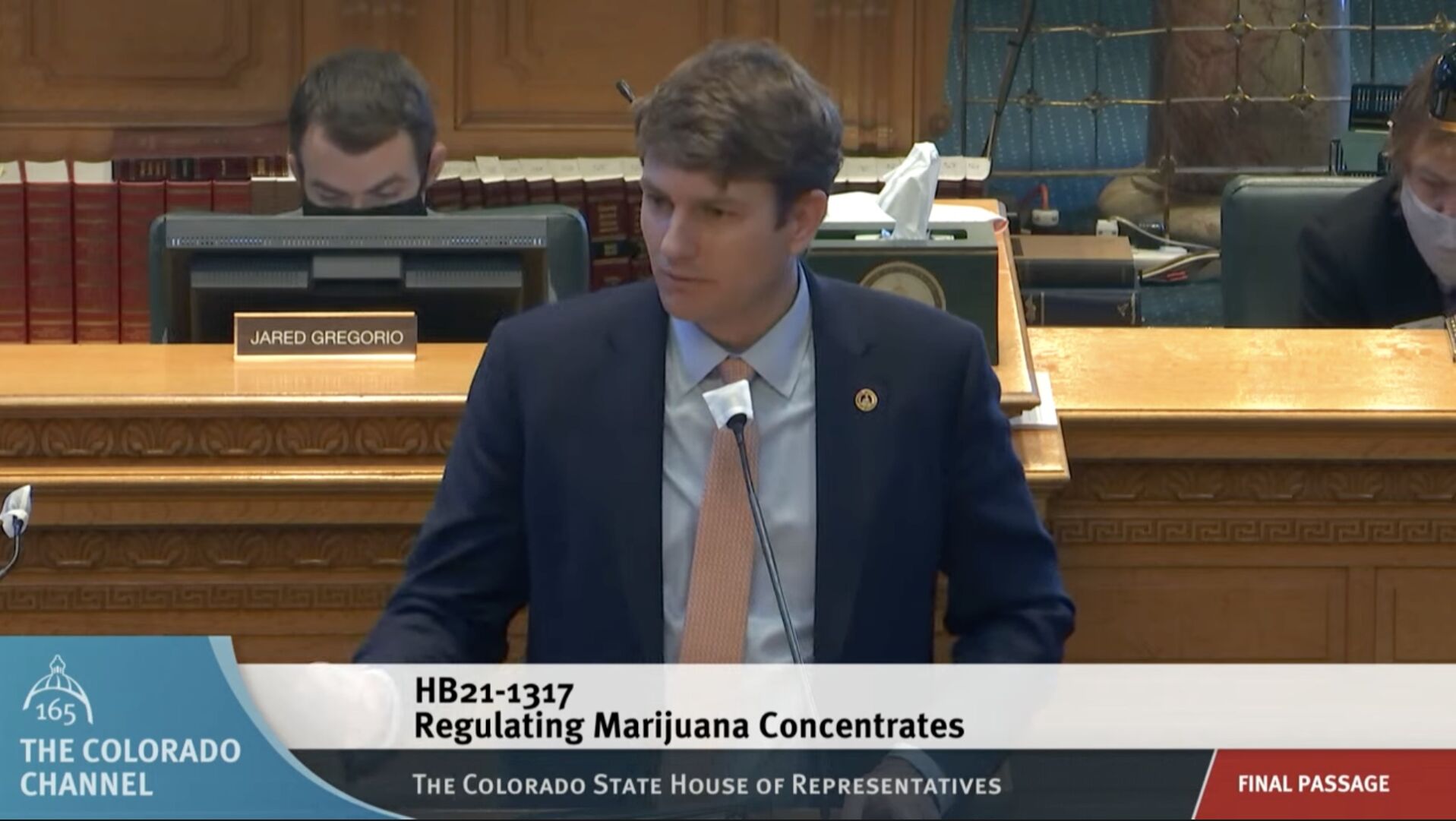
An effort to keep high-potency marijuana concentrates out of the hands of teenagers on Thursday cleared the House and is now on to the Senate with broad bipartisan support as well as a smattering of bipartisan opposition.
But even among those who supported House Bill 1317, debate ahead of the final vote was at times contentious with a Republican lawmaker contending one of his Democratic colleagues accused him of racism.
The bill brought by Speaker Alec Garnett, D-Denver, and Reps. Yadira Caraveo, D-Thornton, and Tim Geitner, R-Falcon, seeks to pump funding into research efforts to study the effect of high-potency THC products on the developing brain. Among a host of other provisions, the bill also lowers the daily purchase limits on concentrates for medical patients and recreational consumers and requires the Metrc seed-to-sale tracking system to be updated to tie purchases to a medical patient’s identification number in real time, rather than at the end of each day.
That’s the main provision of the bill designed to prevent “looping,” when a patient buys up to their daily limit at one dispensary before heading to another to again buy up to their daily limit before the system updated.
According to Garnett, looping by 18-year-old medical card holders is the main way high-potency THC products are making their way into the hands of underage students.
“Colorado has been at the forefront of legalization, that means that we are on the forefront of being responsible when it comes to regulating the products that come out of legalization,” Garnett said. “This body has not done enough to make sure that we aren’t creating a gray market on our high school campuses.”
The bill passed on a 56-8 vote with one member excused. The opponents included two Democrats — Reps. Chris Kennedy of Lakewood and Edie Hooton of Boulder — and six Republicans. Eighteen of the House’s 24 Republican lawmakers voted in favor of the legislation, joining 38 of the chamber’s 41 Democrats. The one member who was excused from the final vote, Broomfield Democratic Rep. Matt Gray, voted against the bill when it was before the House Finance Committee.
Ahead of the final vote, Rep. Leslie Herod, D-Denver, delivered a stinging rebuke of the war on drugs. She pointed to 1940s-era anti-marijuana crusader Harry Anslinger, who she said kicked off the war on drugs “using fear and racist rhetoric to scare the public about cannabis.”
“It is because of the racist roots of prohibition and the poisonous rhetoric and policies that destroyed communities and families of color for generations that I caution my colleagues that we must be mindful of that history when we work together to improve upon the historic policies that Colorado has created,” she said. “We should not be a body that embraces the politics of fear and echoes in rhetoric or agitation and alarm to our constituency.”
Rep. Shane Sandridge also cited the war on drugs among his reason for voting against the bill.
“What I’m concerned about is that we understand history and don’t go back and make the same mistakes twice,” the Colorado Springs Republican said. “It seems like in many ways we’re having conversations that we’ve had decades ago that have failed.”
Unlike Sandridge, Herod praised the legislation as “a step forward” and was among the broad bipartisan coalition of lawmakers voting in support.
So was Rep. Andres Pico, R-Colorado Springs, who indicated “strong support” for the bill. But Pico, who said he spent a couple decades fighting the war on drugs, took exception to Herod’s comments.
“We keep hearing about how this is disproportionate on communities of color, we hear about how the war on drugs and those of us who were involved in it were racist and I’ve had it,” he said ahead of calling for the chamber’s rules on decorum and impugning the motives of fellow lawmakers to be enforced against Herod.
“I’m not going to tolerate without a response the continued accusations of racism against those of us who were involved in enforcing this nation’s laws. Racism has absolutely nothing to do with what we did.”
Speaker Pro Tem Adrienne Benavidez, D-Denver, proceeded to move on debate on the bill on Geitner and then to Garnett, who addressed the concerns Pico raised.
“What was being said was nothing about any one individual. It was about a culture of the past and that culture of the past is not reflected in [HB] 1317 and is certainly not a place that we all want to go back to,” he said ahead of offering to speak with Pico personally about the matter.
The bill now heads to the Senate, where it will still need to work through the legislative process.


Colorado can’t forget the lessons of COVID | Jon Caldara
Jon Caldara
jon-caldara@coloradopolitics.com
Updated 2 days ago
We are finally getting a clearer picture of what happened during COVID. Not because the people who locked us up, masked our faces and forced unproven chemicals into our bodies have suddenly become transparent, but because Anthony Fauci’s COVID-era diary...
Historic preservation supporters organize to oppose Trump changes | Bob Loevy
Tom Cronin
tom-cronin@coloradopolitics.com
Updated 1 day ago
Historic preservation organizations in Colorado Springs, the remainder of Colorado and across the nation are organizing to resist a recent effort to relax and weaken historic preservation laws in the United States. In Washington, D.C., the Advisory Council on Historic...

Colorado Politics Calendar Aug. 3-9
Rachael Wright, Special to Colorado Politics
rachael.wright@coloradopolitics.com
Updated 4 days ago
CoPo’s weekly political calendar will help you find political and public-policy events throughout Colorado. It includes candidate and issue campaign events, public policy meetings, court hearings, state and local party conventions, assemblies, debates, rallies, parades, speaking engagements, traveling dignitary appearances,...
Susemihl wins surprise victory to replace Steve Durham as Colorado Springs state senator | A LOOK BACK
Rachael Wright, Special to Colorado Politics
rachael.wright@coloradopolitics.com
Updated 4 days ago
Forty-five years ago this week: In a closed session, the vacancy committee for Colorado’s Senate District 12 selected attorney Peter Susemihl to complete Sen. Steve Durham’s, R-Colorado Springs, term. Durham resigned his seat to become Region 8 Director of the...

The primary political reform and precondition for all others | SONDERMANN
Eric Sondermann
eric-sondermann@coloradopolitics.com
Updated 4 days ago
In its current state, the American political system has no end of ailments. Far too many factors accelerate polarization and work against moderation and narrowing the differences. Media, and the way so many citizens limit themselves to agreeable, reinforcing sources,...

10th Circuit partially revives lawsuit over 2020 Denver protest injuries
Michael Karlik
michael.karlik@coloradopolitics.com
Updated 1 day ago
The Colorado-based federal appeals court revived a man’s claims against Denver on Friday after concluding a trial judge resolved the case in the city’s favor without analyzing two of the three instances of alleged excessive force and other constitutional violations....

At conservative summit, Colorado Republican leaders concede Democrats’ election edge
Marissa Ventrelli
marissa.ventrelli@coloradopolitics.com
Updated 17 hours ago
Four Republican state lawmakers told attendees at a gathering of conservative leaders on Friday they doubt their party can win statewide races, noting that Colorado’s electorate has been shifting toward Democrats but adding they see an opening in several pockets....

Federal judges find Colorado immigration judge violated several orders
Michael Karlik
michael.karlik@coloradopolitics.com
Updated 11 hours ago
Multiple federal judges in Colorado have freed people from immigration custody after determining that one immigration judge violated their directives for properly conducting bond hearings. For nearly a year, Colorado’s U.S. District Court has faced a flood of habeas corpus petitions...
Q&A with Mike Pence | Former vice president says GOP’s populist turn from conservatism isn’t permanent
Ernest Luning
ernest.luning@coloradopolitics.com
Updated 14 hours ago
Former Vice President Mike Pence says he’s concerned that the Republican Party has taken a populist turn away from bedrock conservative principles during President Donald Trump’s second term, but he believes the party will return to its roots when Trump...

New federal plan sets short-term rules for Colorado River management
Marianne Goodland
marianne.goodland@coloradopolitics.com
Updated 1 day ago
Interior Department’s plan spares Colorado from mandatory cuts for now After years of stalled negotiations among the seven states that rely on the Colorado River, the federal government on Friday released its own plan for managing the drought-strained system. Calling...