

Misconduct allegations against Arapahoe judge more extensive, document shows
The Arapahoe County judge who resigned last week after allegations of racist behavior and other workplace misconduct had a much broader set of accusations against her than the Colorado Supreme Court originally disclosed.
A statement of charges from the Colorado Commission on Judicial Discipline revealed probable cause existed to initiate formal proceedings against District Court Judge Natalie T. Chase for violating multiple professional standards. On April 16, the Supreme Court censured Chase and accepted her resignation after she stipulated to using the N-word in front of a Black court employee, directed her office staff to perform personal assignments and called a fellow judge a derogatory name.
But the complaints against Chase encompassed several incidents beyond the Court’s narrative. In early 2020, Chase drove two 18th Judicial District employees to Pueblo for a work event. On the way back, Chase mentioned that a minor relative had gotten in trouble for saying the N-word at school. Chase, who is white, allegedly used the N-word “at least seven or eight times” in asking why Black people could use the word but white people could not.
One of the employees in the car, who was Black, “felt she was being interrogated as if she were a representative for all Black people,” according to the statement of charges dated March 9 of this year.
Subsequently, Chase was in her courtroom and sitting on the bench when she again brought up the minor relative’s use of the N-word at school. In the presence of others, Chase used the word “numerous times.” Her clerk reportedly told the judge later that “the N-word should never be used in any context,” and asked her to refrain from using it.
(Although the statement of charges provided the full names of the employees who witnessed Chase’s conduct, Colorado Politics is withholding their identities given their status as potential whistleblowers.)
Under the Colorado Rules of Judicial Discipline, all proceedings against a judge are confidential unless the commission files a recommendation for sanctions with the Supreme Court, as it did in this case. Only then do the recommendation and related proceedings become public. The handling of complaints deemed to have merit approximates the procedure for civil court cases.
Shandea J. Sergent, a lead state public defender in Jefferson County, speaking for herself and not on behalf of her office, expressed surprise that the complaint against Chase had gotten to the public stage. Nevertheless, she believed the type of conduct at issue was not isolated to one Colorado judge.
“No one forces you to be a judge. You’re taking an oath and agreeing to be held at a higher standard of care,” Sergent said. “You’re agreeing that some of these commentaries that she believes were appropriate is not something you get to entertain, even if you did in a previously timeline.”
Chase is a 2014 appointee of then-Gov. John Hickenlooper, whom 77% of voters in Arapahoe, Douglas, Elbert and Lincoln counties retained in 2016. But since then, she accumulated other complaints about her behavior in the workplace, from the minor to the egregious.
For instance, the statement noted the judge allegedly asked a lawyer appearing before her to help with the parental controls on her son’s computer at the bench. Chase also shared her personal and family matters with her staff, to the point that they felt they were her “therapists.”
In 2019, Chase reportedly became “upset” when she received judicial performance reviews from lawyers, and began asking attorneys individually what they wrote about her, “even though she knew the judicial reviews were filled out anonymously.”
“It’s totally improper,” responded Chris Melonakis, a retired judge in the neighboring 17th Judicial District and a former judicial performance commission member in Adams County. “The inference is, ‘if you wrote something negative about me, there’s going to be retaliation.’ It’s a form of intimidation.”
Had she not offered her resignation, Chase would have faced voters for retention in 2022.
Although the Supreme Court noted Chase had directed her law clerk to research a “personal family legal issue that was unrelated to the Judge’s official case load,” the statement of charges revealed the nature of the project. The judge allegedly assigned the clerk to investigate teachers’ and principals’ immunity from lawsuit because Chase had planned to sue her son’s school.
Another clerk allegedly received the task of editing an email intended for the cheerleading coach of Chase’s daughter, and editing other emails to her son’s school. The discipline commission noted this behavior would violate the rule against judges using their offices to advance their own personal or economic interests.
Finally, in the category of “un-judicial behavior,” Chase reportedly closed a hearing by wishing everyone a “Happy Father’s Day.” The quip came after she had just terminated a father’s parental rights. The episode, the judicial discipline commission alleged, showed Chase “did not act dignified or courteously.”
Ann Roan of the Colorado Criminal Defense Bar worried the Supreme Court’s public disclosure of the reasons for Chase’s resignation might inadvertently set a threshold against which to measure other judicial misconduct. As a consequence, judges may fly below the radar if their behavior is less obviously inappropriate.
“I fear that the message of the Court’s opinion is that unless you have a judge who repeatedly uses the N-word, nothing’s going to happen to that judge,” she said. “And that shouldn’t be the only set of circumstances in which discipline is actually given out.”
Chase’s attorney had no comment on the charges. The Judicial Department has already advertised the vacancy for Chase’s district court seat.

Colorado’s chief federal judge orders return of wrongfully deported man, second judge to explore ‘series’ of violations
Michael Karlik
michael.karlik@coloradopolitics.com
Updated 25 minutes ago
Colorado’s chief federal judge took the extraordinary step of directing the government on Tuesday to do everything it can to return a man it deported in violation of his order. At the same time, Colorado’s chief magistrate judge has set...
Denver murder, assault convictions reversed due to faulty jury instructions
Michael Karlik
michael.karlik@coloradopolitics.com
Updated 4 hours ago
Colorado’s second-highest court reversed a defendant’s convictions for murder and assault last week after concluding a Denver judge incorrectly omitted key jury instructions that could have affected the verdict and sentencing. Stephen C. Swainson fatally stabbed Israel Casillas in downtown...
‘Understand people for who they are’: 2 federal judges talk about compassion in courtroom
Michael Karlik
michael.karlik@coloradopolitics.com
Updated 6 hours ago
Before taking the bench in 2022, U.S. District Court Judge Charlotte N. Sweeney was an employment discrimination attorney. While the cases could be emotionally charged, they were different from the criminal proceedings she is now handling. “It wasn’t necessarily affecting...
Denver murder conviction reversed for incomplete self-defense instruction
Michael Karlik
michael.karlik@coloradopolitics.com
Updated 24 hours ago
Colorado’s second-highest court reversed a defendant’s murder conviction last week because a Denver judge gave an incomplete instruction to the jury about the man’s right to self-defense. Donald R. Gonzales and Gary McLaughlin met up in a Capitol Hill parking...
Colorado lawmaker, House leaders named in workplace-retaliation lawsuit
Marianne Goodland
marianne.goodland@coloradopolitics.com
Updated 1 day ago
A former legislative aide has filed a lawsuit alleging she was mistreated, illegally directed to perform campaign work and harmed by a House leadership structure she charged was fragmented, politicized and ineffective at protecting employees. The lawsuit, filed by Jennifer...
Federal judge hears arguments about Colorado’s 3-day gun purchase waiting period
Michael Karlik
michael.karlik@coloradopolitics.com
Updated 1 day ago
A federal judge heard arguments on Monday about the constitutionality of a 2023 Colorado law that generally imposes a three-day waiting period on firearm purchases after the initiation of a background check. The test that the U.S. Supreme Court created...
Colorado Supreme Court intervenes in Weld County prosecution dismissed due to Missy Woods misconduct
Michael Karlik
michael.karlik@coloradopolitics.com
Updated 23 hours ago
The Colorado Supreme Court ordered a Weld County trial judge last week to respond to the district attorney’s claim that he improperly dismissed a criminal case because of “outrageous” conduct by the Colorado Bureau of Investigation. Daniel Lee Eatinger stood...
Schoolchildren’s presence at child sex-related trial did not harm Arapahoe County defendant, appeals court says
Michael Karlik
michael.karlik@coloradopolitics.com
Updated 4 days ago
Colorado’s second-highest court decided on Thursday that the presence of a group of schoolchildren on the first day of a child sexual exploitation trial did not violate an Arapahoe County defendant’s constitutional right to a fair trial. Prosecutors charged Jerry...
Appeals court cites week-old Colorado law to reinstate child neglect case at child, father’s request
Michael Karlik
michael.karlik@coloradopolitics.com
Updated 4 days ago
Colorado’s second-highest court invoked a new state law for the first time on Thursday and reinstated a child neglect case that both the child and her father wished to reopen. House Bill 1227 took effect on Aug. 12, reversing a...
Colorado Supreme Court names William Hood as next chief justice
Michael Karlik
michael.karlik@coloradopolitics.com
Updated 5 days ago
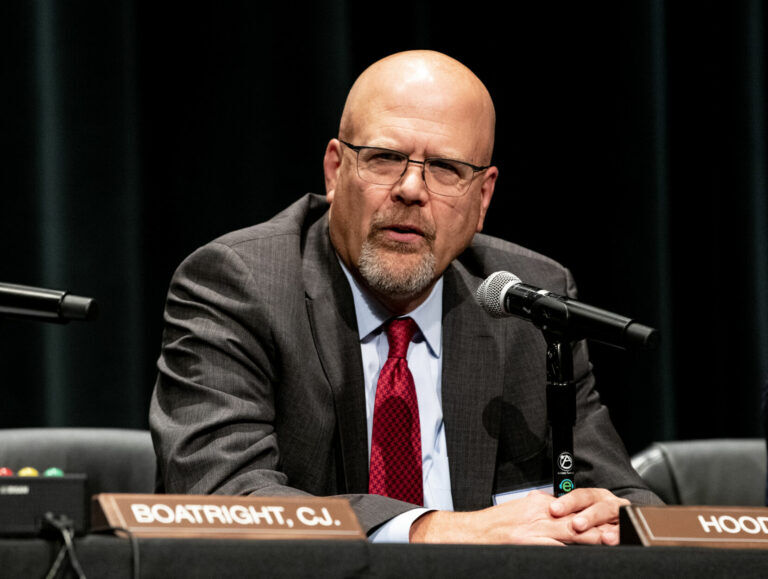
The Colorado Supreme Court has selected Justice William W. Hood III to be the next chief justice, the judicial branch announced on Friday. Hood will succeed Chief Justice Monica M. Márquez, who took over the role in July 2024. “I...
PREV
PREVIOUS

Man with overturned conviction not eligible for exoneration payments, court rules
Although a man succeeded in overturning his felony conviction, he is ineligible to benefit from the law designed to compensate exonerated persons for their time served, the Colorado Court of Appeals decided on Thursday. In reaching its conclusion, a three-judge appellate panel determined the reason for the reversed conviction — a trial court judge neglected to […]

Court: No exemption for out-of-state police to Colorado's criminal rules
Out-of-state police departments are not exempt from the rule requiring prosecutors to hand over evidence to the defense, the Colorado Court of Appeals decided on Thursday. A three-judge appellate panel found it violated legal procedure to disclose in the middle of a defendant’s murder trial that he implied he was the suspect in a Colorado […]