

Worries about future of policing dominate discussion on law enforcement retention, recruitment
Some sheriffs and police chiefs in Colorado say officer shortages have increased as they are seeing fewer people choose careers in law enforcement and in some instances experienced officers are leaving law enforcement altogether.
Insights from various agency heads seem to reveal that officers’ concerns about the public tone toward policing has been a common motivation for leaving their departments. A recent report on a survey sent to members of the County Sheriffs of Colorado and the Colorado Association of Chiefs of Police showed 65% of survey respondents cited concerns about Senate Bill 20-217, the police accountability measure that was enacted in the wake of protests surrounding the death of George Floyd in the custody of Minneapolis police. Sixty percent cited concerns about the future of policing when asked about reasons for officer departures. Sixteen percent cited safety concerns during COVID-19.
Data from the police departments in Colorado’s three biggest cities at first seem to paint varied pictures about the departments’ experiences with retention in 2020. The Denver Police Department lost just over 2.5% of its total officer force to resignations, early retirements and terminations in 2020, according to data provided by the agency. The Colorado Springs Police Department lost about 10% of its officers. The Aurora Police Department had a turnover rate of nearly 20% in 2020, according to reporting by Sentinel Colorado.
“Our attrition rate has nearly doubled since mid 2020. There are varying reasons, but numerous exit interviews suggest that public perception and risks of civil litigation are among the top concerns,” said El Paso County Sheriff Bill Elder in the report.
In response, lawmakers are setting up bills this year that would not roll back SB 217 but instead focus on tweaks and clarifying terms within the law.
Departures among veterans, rookies
Although Denver’s rate of officers leaving the department was small compared to the total size of the DPD’s force, Chief Paul Pazen has told The Gazette he saw more officers on both ends of the experience spectrum – early retirements and officers with just a few years of experience – leave the DPD in the last year.
“Some of the information that I got was the stress of law enforcement … made the decision for them,” Pazen said, saying one young officer “was just having trouble sleeping and eating, and he decided to move on from the profession altogether.”
Pazen said he knew them through their college career and went to the same high school, so it was someone he “was really hoping would stay on the department; I saw a lot of great qualities.”
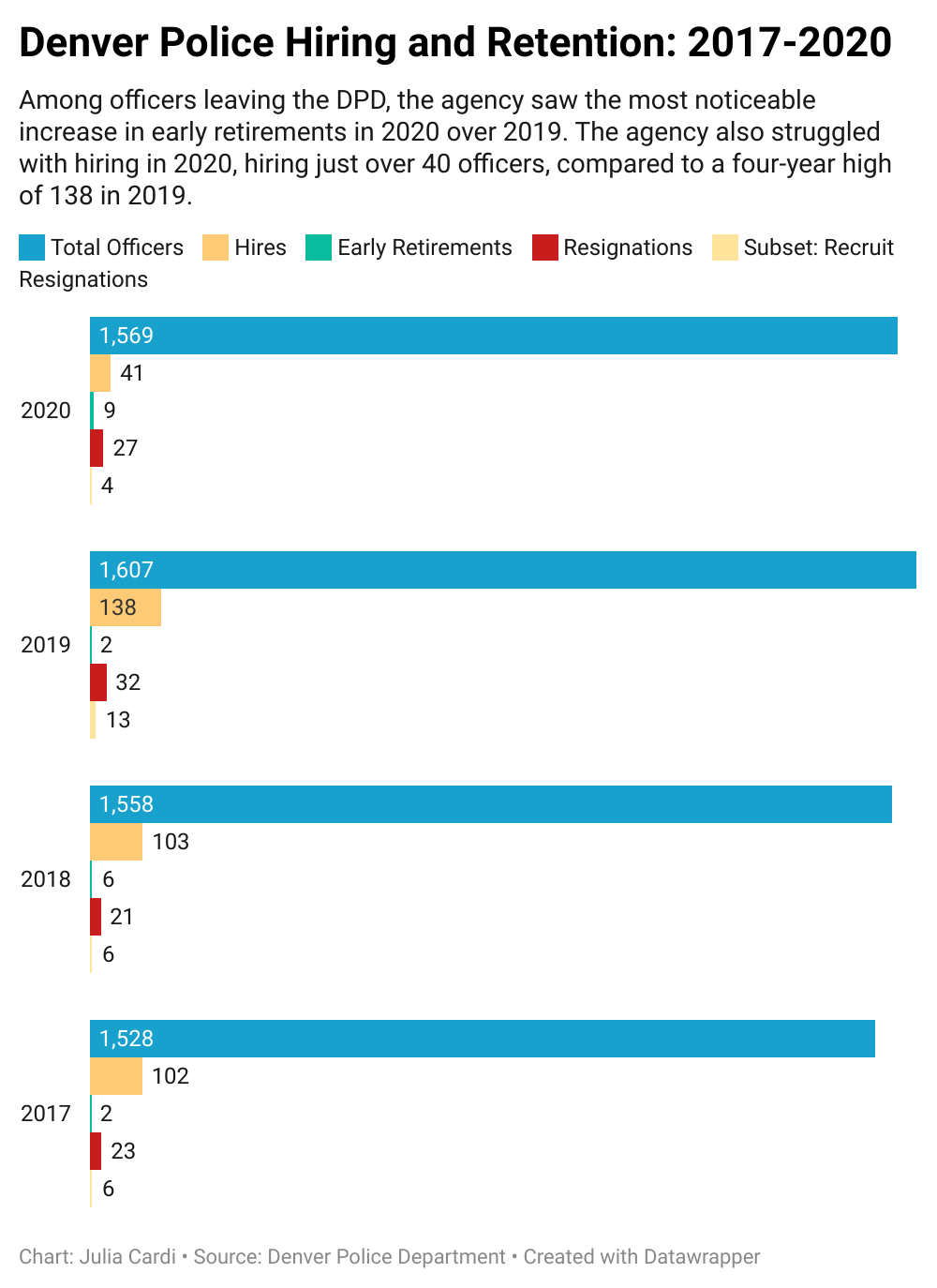
Among officers leaving the DPD, the agency saw the most noticeable increase in early retirements in 2020 over 2019, according to four years of data provided by the department. The DPD had nine early retirements last year compared with three in 2019, and had 27 resignations in 2020 compared with 32 in 2019.
Although the number of officers that left the DPD’s force of well over 1,500 officers in 2020 is starkly smaller than what Aurora and Colorado Springs saw, Pazen told the Denver Gazette last fall that officer resignations, including new recruits, jumped after May last year. According to data the department provided, seven officers resigned by the end of May, and the number had climbed to 25 by the end of October.
Natashia Kerr, a spokesperson for the Colorado Springs Police Department, told the Gazette in an email following an interview request that officers left the agency mostly due to retirement, another job in law enforcement, not passing the academy, spouse relocations or they “realized that law enforcement is not the job for them.”
The increase in departures coincides with the department’s goal to have 800 uniformed officers by 2022. Last year, the department hired 33 people compared to 71 in 2019 and 98 in 2018.
CSPD Chief Vince Niski previously said social unrest had hurt the department’s recruitment efforts, making it more difficult to fill vacancies and to hire Black officers. He said one of the biggest challenges to attracting minority officers is “convincing their families that this is still an honorable profession” because of the national tone toward policing.
The DPD also struggled with hiring in 2020. The agency hired just over 40 officers as of Dec. 31, 2020, according to data provided by the department, compared to a four-year high of 138 in 2019.
The 2020 law on policing
Mesa County Sheriff Matt Lewis, the president of the County Sheriffs of Colorado, cautioned against pinning agencies‘ challenges with recruitment and retention last year solely on SB 217. He said officers’ choices to leave the profession could also be due to pressure from family members because of the portrayals of policing shown on the news, a general shift in their perception of their careers because of how the profession has changed over time, and concerns about the risks of COVID-19 because of their front-line roles.
“I don’t want to connect that people are leaving law enforcement because Senate Bill 217 passed; I think it’s much more than that,” Lewis said.
“I don’t think you can connect it to any one single thing, nor can you put it in any one age bracket or experience bracket.”
County Sheriffs of Colorado and even the most conservative of state senators haven’t signaled intentions to significantly roll back the law.
Republican Sen. Paul Lundeen introduced a bill, Senate Bill 21-183, on March 16 that adds language to portions of the law passed last year. Fellow Republican Sens. John Cooke and Bob Gardner, key conservative supporters of the version of Senate Bill 217 that became law last year, have also signed on as sponsors.
SB 183 clarifies officers’ duty to intervene to prevent illegal use of force by other officers. It also expands the law to include Colorado Bureau of Investigation agents in body-worn camera requirements, and allows civil actions against CBI and state patrol officers for deprivation of rights.
It also says that any suspension or revocation of a peace officer’s certification doesn’t take effect until the officer has exhausted all their internal, contractual, and legal rights to review, challenge and appeal the underlying decision.
The bill also adds a definition of a law enforcement “contact”: an interaction initiated by a peace officer with a person who is the subject of a possible law violation for the purpose of investigation or enforcement. The definition excludes routine interactions with the public at points of entry or exit from controlled areas, and non-investigatory and consensual interactions with the public.
Lewis said clear guidelines for defining a contact by law enforcement has been a key clarification to SB 217 that agencies have been seeking. He said having a clear understanding of what defines a contact under the law will help agencies comply with aspects of the law such as when officers have to have their body cameras turned on and accurate data reporting about contacts, especially if officers from more than one agency respond to a situation.
“What we’re seeking, really, is clarifications to make sure that we’re … implementing it the way it was intended by the legislature, and that it’s being implemented consistently across the state,” he said. “As we go through the implementation process, some things that maybe none of us considered earlier on, but are very important right now so that we can do it right.”
Democratic Rep. Leslie Herod, who championed SB 217 last year, said the House has a draft of a bill also clarifying portions of the measure that hasn’t yet been introduced. She said while it has small differences from SB 183, Herod doesn’t see the Senate Republicans’ bill as trying to significantly roll back the 2020 measure. She plans to work with legislators across the aisle to get to a version of the bill they can move forward on together, she said.
“We’re going to work in good faith to try to get on the same page, ideally, and not have a Democrat versus Republican bill but instead have one that we can all move forward with together,” Herod said. “I don’t see much in their bill as an attempt to roll back the work of Senate Bill 217. I do see it as providing that needed clarification.”
Cooke and Gardner did not respond to interview requests.
Pazen said he’d like for conversations about tweaking SB 217 to include more of a “voice” about what the law’s impact on crime and public safety may be, but said the direct legislative work has been done for the most part by the police chief and sheriff associations.
“I think that we can get there with accountability; with improving policing. We also have to realize that you have to keep our community safe and these things are not mutually exclusive.”
The COVID effect
The precipitous decreases in hiring seem to be at least partially attributable to the COVID-19 pandemic. Denver originally planned two classes of lateral hires – veteran officers coming from other departments – and two classes of brand-new recruits in 2020, but once the pandemic hit, the departments only had one of each.
El Paso County Sheriff’s Office spokesperson Jaqueline Reed told the Gazette in an email that COVID-19 had the most severe effect on the agency’s staffing. As the Sheriff’s Office saw dozens of employees retire between March and December 2020, they were unable to hold academies to backfill the positions, she said.
“We do have a shortfall that we have to make up for because COVID absolutely stopped us in our tracks,” Reed said. In 2021 the Sheriff’s Office will hold five non-certified academies and two POST-certified academies to help fill the shortage.
She said Sheriff Bill Elder was not available for an interview.


Colorado Politics Calendar July 27-Aug. 2
Rachael Wright, Special to Colorado Politics
rachael.wright@coloradopolitics.com
Updated 4 days ago
CoPo’s weekly political calendar will help you find political and public-policy events throughout Colorado. It includes candidate and issue campaign events, public policy meetings, court hearings, state and local party conventions, assemblies, debates, rallies, parades, speaking engagements, traveling dignitary appearances,...

The through line from Donald Trump to Victor Marx | SONDERMANN
By Eric Sondermann
by-eric-sondermann@coloradopolitics.com
Updated 4 days ago
Over 10 years ago, before Donald Trump could ever defeat Hillary Rodham Clinton, he had to first engineer a hostile takeover of the Republican Party. Prior to his descent of that golden escalator, the previous seven Republican presidential nominees had...

Colorado districts prepare for school year amid mental health cuts. But will less cellphone distractions help?
Marissa Ventrelli
marissa.ventrelli@coloradopolitics.com
Updated 2 days ago
The signs of a new school year are everywhere — buses in the shop, teachers unpacking boxes, families ticking through supply lists — but behind the familiar rituals, Colorado districts are preparing for a year defined less by routine than...

Armstrong staffer considers congressional bid, DeGette angers rural communities with wilderness act | A LOOK BACK
Rachael Wright, Special to Colorado Politics
rachael.wright@coloradopolitics.com
Updated 3 days ago
Forty-five years ago this week: If the lines were drawn just right, Republican Sen. Bill Armstrong stood the chance of losing his office manager, Ruth Fountain. Fountain admitted she was seriously thinking about running for Colorado’s new congressional seat in...
10th Circuit dismisses woman’s lawsuit following 10-year attempt to undo restraining order
Michael Karlik
michael.karlik@coloradopolitics.com
Updated 2 days ago
The Denver-based federal appeals court rejected a woman’s challenge on Friday to a restraining order imposed on her more than a decade ago, finding that she cannot credibly claim she will be prosecuted for violating the restraining order through her...
10th Circuit dismisses woman’s lawsuit following 10-year attempt to undo restraining order
Michael Karlik
michael.karlik@coloradopolitics.com
Updated 2 days ago
The Denver-based federal appeals court rejected a woman’s challenge on Friday to a restraining order imposed on her more than a decade ago, finding that she cannot credibly claim she will be prosecuted for violating the restraining order through her...
Surprise candidate Shimon Blau cleared to face off against Melat Kiros in November
Ernest Luning
ernest.luning@coloradopolitics.com
Updated 2 days ago
Unaffiliated congressional candidate Shimon Blau, a Denver doctor, has qualified by petition for the general election in Colorado’s 1st District, where Democrat Melat Kiros defeated 15-term U.S. Rep. Diana DeGette in last month’s primary, the Colorado Secretary of State’s Office...

Colorado produce not tied to nationwide cyclospora outbreak, agriculture officials say
Marissa Ventrelli
marissa.ventrelli@coloradopolitics.com
Updated 1 day ago
There is no indication that the recent outbreak of cyclospora, a fecal parasite that has contaminated food and water across nearly every state, can be linked to produce grown in Colorado, according to the state’s Department of Agriculture. “Colorado growers...

UNC opens College of Osteopathic Medicine
Marissa Ventrelli
marissa.ventrelli@coloradopolitics.com
Updated 2 days ago
The University of Northern Colorado held a grand opening for its new College of Osteopathic Medicine on Friday, with Gov. Jared Polis in attendance to celebrate the culmination of a two-year, $127.5 million project. The project was funded through legislation...
Colorado equal pay law does not require plaintiffs to allege gender-based retaliation, appeals court finds
Michael Karlik
michael.karlik@coloradopolitics.com
Updated 1 day ago
The 2019 Colorado law aimed at rooting out pay discrimination on the basis of sex does not require a plaintiff to allege their employer retaliated against them for sex- or gender-related reasons, the state’s second-highest court decided on Thursday. Lawmakers...
PREV
PREVIOUS

Suspect who set length of interrogation was not in custody, Supreme Court rules
An El Paso County judge mistakenly suppressed evidence from a police interview of a sexual assault suspect, the Colorado Supreme Court ruled on Monday, finding the suspect was not in custody because he was able to impose a time limit on his interrogation. “While no one factor is determinative, this fact is significant because a […]

Mass COVID vaccine clinic opens at Dick’s Sporting Goods Park in Commerce City
Colorado’s latest mass COVID-19 vaccination clinic opened Monday at Dick’s Sporting Goods Park in Commerce City, vaccinating about 500 people on its first day. This is one of six state-operated mass vaccination clinics expected to open in the coming weeks. Gov. Jared Polis said the drive-thru clinic will distribute 2,000 vaccines Tuesday and up to […]