

Senate panel unanimously backs expanding medical cannabis access at schools

A Senate panel on Wednesday took the first step to expand students’ access to medical marijuana while at school.
The bipartisan bill from Senate Minority Leader Chris Holbert, R-Parker, and Sen. Julie Gonzales, D-Denver, would build on two pieces of legislation previously approved by the General Assembly: Jack’s Law and Quintin’s Amendment. Those measures, passed in 2016 and 2018 respectively, allow non-smokable medical marijuana to be administered to a student. Jack’s Law allows parents or caregivers to administer the medicine while Quintin’s Amendment gave principals the authority to allow it to be stored on campus and administered by school nurses and designated personnel.
Despite that discretion allowed under law, policy makers in some districts have opted against allowing on-campus storage or administration by school officials – including the Douglas County school board in Holbert’s district. That left a pair of his constituents entangled in a legal battle to provide potentially life-saving medication to their high school-age son.
Brad and Amber Wann told lawmakers at the hearing their son, Ben, an epileptic, uses hemp oil to prevent seizures and relies on a nasal spray with THC to stop seizures if they occur. But he was banned from keeping the nasal spray at school, a move Holbert found especially troubling because Ben is severely allergic to the nasal pharmaceutical rescue paramedics normally apply to treat seizures.
“If there’s not some adult there to say, ‘Wait, timeout, don’t hit him with the standard procedure,’ that might kill him,” Holbert said. “It pisses me off that my school board would somehow assume to decide which kid in our school district lives and which dies.”
When reached for comment, a spokeswoman said the Douglas County School District is “following the legislative session as it affects schools and school districts.”
“If there are changes to the law, we will adjust our policies and practices as necessary and appropriate,” spokeswoman Paula Hans said in an email.
A Colorado Civil Rights Division complaint filed by the Wanns eventually determined probable cause that the Douglas County School District’s policy discriminated against Ben.
Still, both the family and Holbert said they didn’t want others to be forced to pursue legal action in order to get their kids the medicine they need. His bill is designed to take the discretion out of a principal’s hands and require school boards to create policies on storage and administration of cannabis-based medicine by school personnel similar to pharmaceutical prescriptions like Adderall or Ritalin.
Amber Wann said the bill was exactly what’s needed to “protect all students in the state.”
“We do know that teachers that are on the ground want to do this and help kids, and I feel like if we can get the blockades out of the way and just allow them to, volunteers will step up,” she said.
And she wasn’t alone in that sentiment. The bill received universal acclaim from the nearly two dozen witnesses who appeared before the Senate Education Committee. Those included a number of advocacy groups and families, many of whom moved to Colorado from out of state so their children could access medical marijuana to treat epilepsy, autism and Crohn’s disease.
That perspective, Holbert said in emotional closing comments, was one he did not understand when he initially opposed marijuana legalization.
“I thought that medical marijuana was an excuse for people to get high, sit around and smoke pot,” he said. “That’s wrong, and if I did my job at all well, maybe you can avoid the mistake that I made.”
The panel’s seven members voted unanimously to advance the bill out of their committee and on to the Senate Appropriations Committee.
This article has been corrected to reflect Ben Wann’s allergy and the Wann family’s legal action.

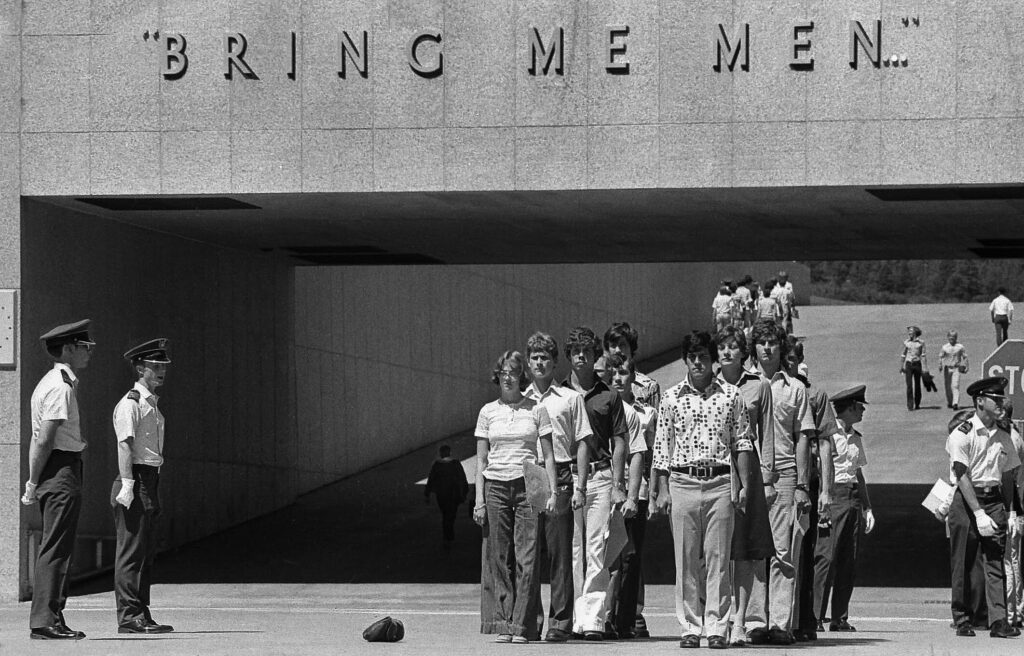
Fifty years later, women reflect on first coed class at the Air Force Academy, struggle for equality
Mary Shinn
mary-shinn@coloradopolitics.com
Updated 20 hours ago
When the first female Air Force Academy cadets arrived 50 years ago this summer, they stood in front of an enormous sign on campus that read “Bring me men.” In the shadow of that sign, Kathleen Utley Kornahrens, one of...

As Lake Powell shrinks, marinas are having to adapt to dwindling water levels | OUT WEST ROUNDUP
The Associated Press
the-associated-press@coloradopolitics.com
Updated 4 days ago
ARIZONA Reservoirs near record lows PAGE — The Colorado River’s Lake Powell, the second largest reservoir in the U.S., is shrinking. A record-dry winter and extreme heat — as well as decades of overuse, chronic drought and climate change —...

A new day? Colorado’s troubled guardianship office pursues ‘cultural reset’
Marianne Goodland
marianne.goodland@coloradopolitics.com
Updated 3 days ago
Colorado’s guardianship program, long criticized for mismanagement and high staff attrition, is undergoing a “cultural reset,” as its new director works to repair partnerships and prepare for a major expansion under recent legislation. Created by lawmakers in 2017, the Office...

U.S. Senate OKs funding bill to avoid government shutdown
Wire Services
wire-services@coloradopolitics.com
Updated 1 day ago
Hemp provision became point of contention WASHINGTON • The U.S. Senate in an overnight vote Saturday approved a short-term measure to fund federal agencies into early December and avoid a government shutdown during the middle of campaign season. The late-summer...

The relevance of Watergate more than a half-century later | SONDERMANN
By Eric Sondermann
by-eric-sondermann@coloradopolitics.com
Updated 4 days ago
It was the scandal for which all other scandals are now named. In June 1972, a small group of Cuban burglars with high-level connections broke into the headquarters of the Democratic National Committee. Those headquarters were located in the Watergate...

Wirth downplays Social Security disaster talk | A LOOK BACK
Rachael Wright, Special to Colorado Politics
rachael.wright@coloradopolitics.com
Updated 3 days ago
Forty-five years ago this week: “As time goes on,” said Democratic U.S. Rep. Tim Wirth, of the 2nd Congressional District, “we are finding that the safety net, which was proposed earlier this year, has some very large holes in it,”...

Colorado Politics Calendar Aug. 10-16
Rachael Wright, Special to Colorado Politics
rachael.wright@coloradopolitics.com
Updated 3 days ago
CoPo’s weekly political calendar will help you find political and public-policy events throughout Colorado. It includes candidate and issue campaign events, public policy meetings, court hearings, state and local party conventions, assemblies, debates, rallies, parades, speaking engagements, traveling dignitary appearances,...

Democratic group aims Spanish-language TV ad at Gabe Evans in Colorado’s battleground 8th CD
Ernest Luning
ernest.luning@coloradopolitics.com
Updated 2 days ago
A national group tied to House Democratic leadership launched a six-figure Spanish-language TV ad in Colorado this week targeting Republican U.S. Rep. Gabe Evans and the GOP’s signature budget legislation. The 30-second spot is part of $15 million in new...

Colorado School of Mines lands major share in Trump’s $100M mining-education plan
Thelma Grimes
thelma.grimes@coloradopolitics.com
Updated 2 days ago
President Donald Trump on Friday named the Colorado School of Mines among roughly a dozen institutions that will share in a $100 million commitment “to train the next generation of American miners.” Paul Johnson, the university’s president, said he is...

Local party leaders, incoming judge among members of judicial performance commission that violated law
Michael Karlik
michael.karlik@coloradopolitics.com
Updated 19 hours ago
A local Democratic leader and 2024 presidential elector. A legislative aide and leader in the Young Republicans. An incoming county court judge freshly appointed by the governor. They are among the eight members of the northeastern Colorado judicial performance commission...
PREV
PREVIOUS

RTD suspends certification program for small construction businesses
RTD temporarily suspended its Small Business Certification (SBE) program this week, providing enhanced business opportunities to local small construction businesses. RTD will no longer accept or process new certifications for the time being. Businesses already certified as SBEs through RTD will continue to have access to updates, renewals, projects and contracts. The SBE program provides […]

Former Denver elections chief Amber McReynolds tapped for USPS board of governors
Amber McReynolds, former head of the Denver elections division, has been nominated by President Joe Biden to the US Postal Service board of governors, according to the Washington Post. Her nomination has since been confirmed by U.S. Rep. Joe Neguse, D-Lafayette. McReynolds, who now heads the Denver-based National Vote at Home Institute, is one of […]