

Trust, messaging is the key to increasing vaccine uptake in communities of color, providers say
When Terri Richardson talks to people in her community who don’t want to get the vaccine, she hears some myths and conspiracy theories.
The inoculation will insert a microchip. No people of color were included in the clinical trials, so who knows how it’ll affect those populations? Those aren’t true, but another frequent concern is much more valid and speaks to the legitimate distrust in the medicine by members of the Black community.
“Overwhelmingly what came up most was Tuskegee, Tuskegee, Tuskegee,” said Richardson, an internal medicine physician with Kaiser Permanente. She was referring to the deeply unethical and immoral experiment in which Black men infected with syphilis were not treated so researchers could study the disease.
“That was supposed to be a three-month study and the experiment went on for 40 years,” she said during a Thursday night event featuring a panel of providers of color. “Some (modern day people) have even said … ‘Why can’t Black people just get over it and realize it’s a different day?’ Well, you don’t forget 40 years of not being treated. … If the government can participate in that way for 40 years, how do we know that things have changed?”
The providers – members of the Latino, Black and Indigenous communities – participated in a UCHealth forum Thursday night about how to promote the safety of the new COVID vaccine in their communities, many members of which are hesitant about the inoculation. How to best improve uptake in those communities has been much discussed at the state and national level, and Colorado officials have said they’re prioritizing education and outreach to those populations.
The overwhelming solution discussed by the providers Thursday night: trust.
“That voice will only be trusted by the Hispanic people if it comes from people they trust,” said Fernando Holguin, a UCHealth physician.
“We see a huge effort being made right now to take the materials that are being presented from the medical professionals and really boil that down into a way, and through images, arts and language, be able to re-message that back to communities in a way they understand and that resonates with the community. The most sacred of our communities are the elder. There’s a lot of effort going on right now to make sure our elders are protected.”
“Even right now, in some communities like the Oglala Sioux tribe, they’re putting first in line those folks that are not only elders but are language-keepers,” said Jerreed Ivanich, and assistant professor at the Centers for American Indian and Alaska Native Health within the Colorado School of Public Health. “They’re getting first priority, and that signals to a lot of other people that this can be trusted and this is something worth doing if it’s going to protect our most sacred and is being promoted by our leaders in the community to protect them.”
Like the distrust caused by the Tuskegee experiment, Ivanich said Indigenous peoples have their own history of being subjugated to horrific malpractice at the hands of the medical profession. Many Native women, for example, were sterilized without their consent or knowledge.
Because of those injustices perpetuated by members of the medical community against minority populations, the conversation needs to be flipped away from people of color distrusting the medical field, but rather the medical field committing “an abundance of atrocities” against their communities, said Stephanie Nwagwu, a public health expert who’s pursuing her doctorate at Harvard.
It’s on the medical community, she said, to improve that trust within communities of color.
“The medical community has an opportunity to show historically marginalized communities that they’re important,” she said. A part of that is ensuring the vaccine is being distributed equitably, particularly because communities of color have been disproportionately affected by the pandemic.
“Once the vaccine hits the general population, how are the vaccines going to be distributed?” Nwagwu asked. “Are they going to go the health clinics and communities of color? Are they going to go the rich, white clinics that all the rich people get to go to? We need to be looking at that.”
Social worker Vicky Lee-Garza said that there are inherent differences between white and Latino communities. The latter has many multi-generational homes, with younger generations living under the same roof with their grandparents or great-grandparents. That needs to be taken into account when the vaccine is distributed, she said, to ensure those older residents aren’t boxed out.
“Would it be more effective if the whole family got it?” she said.
Richardson pointed to a leading expert with the National Institutes of Health, a Black woman who helped develop the vaccine. That sentiment – of the importance of experts who reflect marginalized communities – was repeated by several other members of the panel.
“Those are trusted resources. So me, I got to be like a lay person and say I can learn from these people, they look like me,” Richardson said. “It’s very cultural. They’re saying things that people need to hear so they can start developing trust that this vaccine could be safe and get us back to a different place. You have to have those trusted messengers.”
Holguin noted that undocumented workers are scared to come forward, even to register, because of fears they could be arrested, given the current political climate. Messaging needs to clearly prove to them that they’re not in danger just because they come forward to get inoculated.
Lee-Garza echoed that sentiment. Some undocumented workers, who are essential and thus qualify for earlier vaccine access, have to show proof of where they work. That raises alarms for those people, and that’s where trust comes into play.
That trust is built by being present in the community, familiar with and to it, the experts said. Simple statewide or citywide messaging and announcements isn’t enough, and suddenly and temporarily focusing on outreach isn’t, either.
“How many times do you see your doctor out in the community?” Richardson asked. “How many times do you see your doctors with rollers in their hair at home? I’m real, I’m a human being just like you, I have fears and frailties just like the rest.”
“Being trustworthy in the community is being able to advocate for the community and helping to dismantle the systems that oppress our community,” Nwagwu added.
“Trust has to be built over time,” Holguin said. “It’s not instantaneous.”


Colorado Politics Calendar June 29-July 5
Rachael Wright, Special to Colorado Politics
rachael.wright@coloradopolitics.com
Updated 3 days ago
CoPo’s weekly political calendar will help you find political and public-policy events throughout Colorado. It includes candidate and issue campaign events, public policy meetings, court hearings, state and local party conventions, assemblies, debates, rallies, parades, speaking engagements, traveling dignitary appearances,...
Gov. Lamm’s GOP challenger gives insights into his campaign | A LOOK BACK
Rachael Wright, Special to Colorado Politics
rachael.wright@coloradopolitics.com
Updated 3 days ago
Forty-five years ago this week: “I see Gov. (Richard) Lamm is fairly popular in general,” said gubernatorial candidate and state Sen. Bill Hughes, R-Colorado Springs. “ … And he’ll be hard to beat.” Hughes was on a whirlwind campaign trail...
Giving credit to Polis where credit is due | SONDERMANN
Eric Sondermann
eric-sondermann@coloradopolitics.com
Updated 3 days ago
It is an understatement to suggest that Gov. Jared Polis has had a tough couple of months. The bloom was already off the rose and Coloradans were paying far more attention to the choice of his replacement than they were...

Bennet, Hickenlooper to vote against Trump’s 10th Circuit nominee from Colorado
Michael Karlik
michael.karlik@coloradopolitics.com
Updated 3 hours ago
Colorado’s two Democratic senators will not vote to confirm President Donald Trump’s nominee to a vacancy on the Denver-based federal appeals court. Trump has selected U.S. District Court Chief Judge Daniel D. Domenico, who he appointed as a federal trial...
Who’s spending in Colorado to get your vote?
Marianne Goodland
marianne.goodland@coloradopolitics.com
Updated 4 hours ago
Groups that raise unlimited amounts of money have spent about $20 million in May and June to try and influence Colorado voters’ choices in the upcoming June 30 primaries. By law, these groups cannot coordinate with the candidates they support....
U.S. government declines to oppose multiple challenges to immigration detention in Colorado
Michael Karlik
michael.karlik@coloradopolitics.com
Updated 19 hours ago
Multiple federal judges in Colorado granted petitions from people challenging the lawfulness of their immigration detention this week after the government took the unusual step of declining to submit arguments in opposition. Colorado’s federal trial court is facing a flood of...
Tina Peters tells supporters to ‘stand up and fight back’ at Castle Rock event
Marissa Ventrelli
marissa.ventrelli@coloradopolitics.com
Updated 18 hours ago
Tina Peters, the former Mesa County clerk recently released from prison, warned supporters that what happened to her could happen to them, too, if they did not “stand up and fight back” at an event at the Douglas County Fairgrounds....

Iran strikes cargo ship in Strait of Hormuz, endangering Trump’s peace
Christian Datoc
christian-datoc@coloradopolitics.com
Updated 1 day ago
Iran attacked a cargo ship traveling through the Strait of Hormuz on Thursday, possibly upending President Donald Trump‘s diplomatic end to the war with Iran. A U.S. official confirmed to the Washington Examiner that the Islamic Revolutionary Guard Corps “struck...
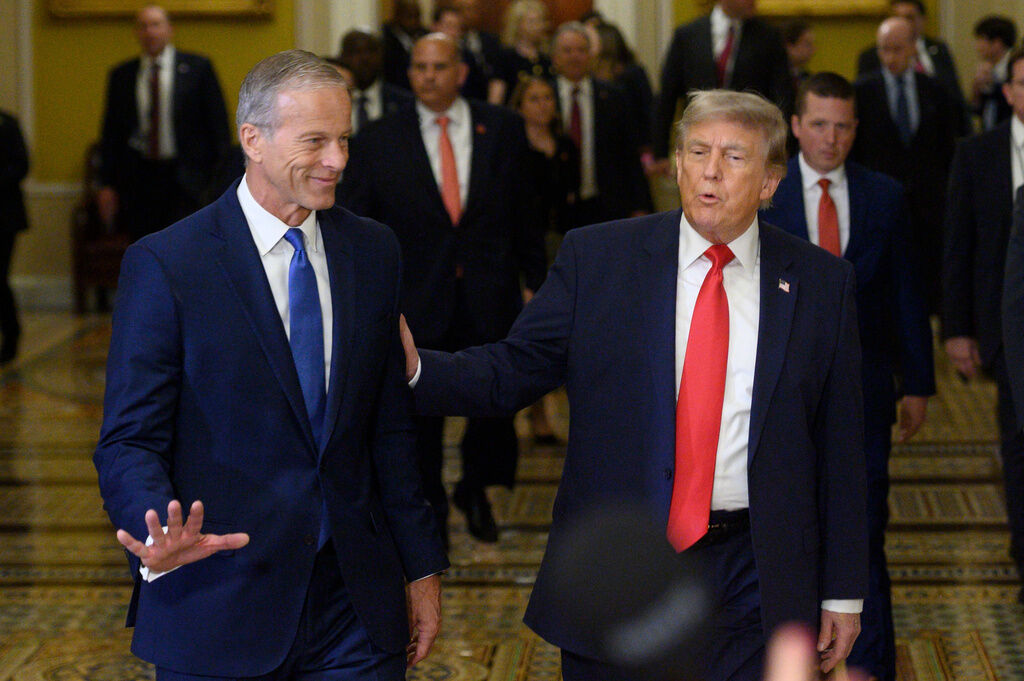
Senate GOP tries to mend fences with Trump after heated lunch
David Sivak
david-sivak@coloradopolitics.com
Updated 23 hours ago
Senate Republicans are trying to turn the page on a heated lunch with President Donald Trump that brought weeks of tensions to a new high-water mark. In a symbolic gesture, Senate Republicans took another vote on the Iran war Wednesday...
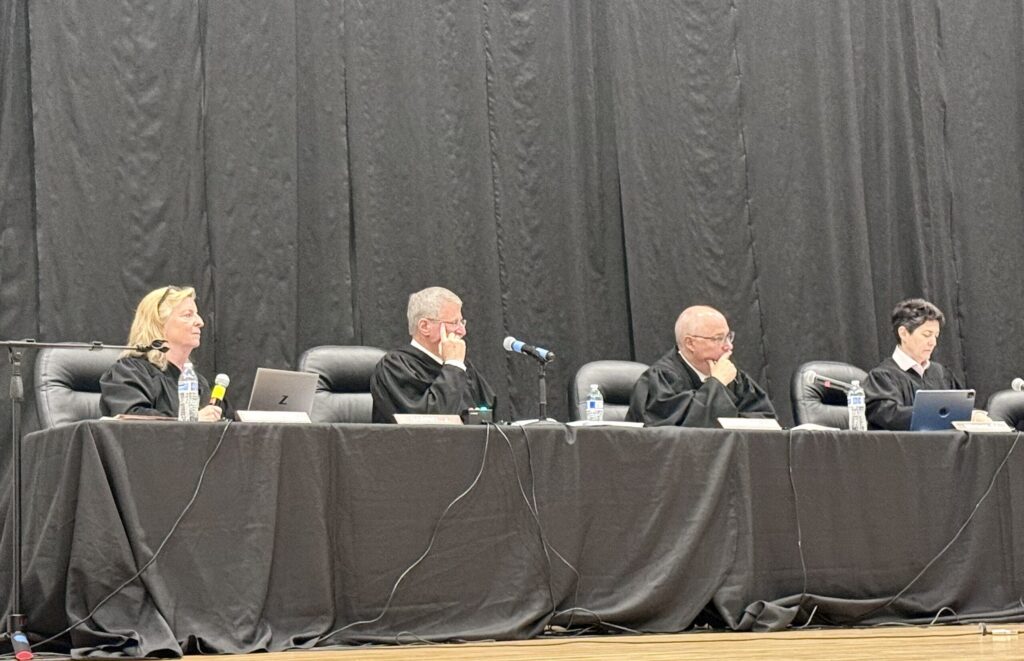
Colorado justices discuss solution to confusion from prior criminal ruling
Michael Karlik
michael.karlik@coloradopolitics.com
Updated 17 hours ago
The Colorado Supreme Court pondered the fallout on Tuesday from its nearly six-year-old decision interpreting the state’s impaired driving laws, with the justices now addressing how defendants affected by the legal change must seek postconviction relief. In contrast to other...
PREV
PREVIOUS

General Assembly completes first week of business, as House Republicans take final stand against adjournment
The 73rd General Assembly adjourned on Friday after passing seven urgent bills, although not before Republicans in the House of Representatives lodged one final protest of the planned month-long hiatus. “By scheduling our regular sessions in fits and starts during a declared disaster emergency, the General Assembly is effectively abdicating its duty to represent the […]

Denver mayor calls for extra safety measures downtown to prepare for civil unrest at Capitol
Denver Mayor Michael Hancock, out of an “abundance of caution,” ordered additional security measures be taken around the city’s downtown buildings in advance of anticipated civil unrest at the Colorado State Capitol in the coming days. Across the country, armed protests are being planned at all 50 state capitals, according to an internal FBI bulletin first […]