

Polis addresses the state as the crisis bears down
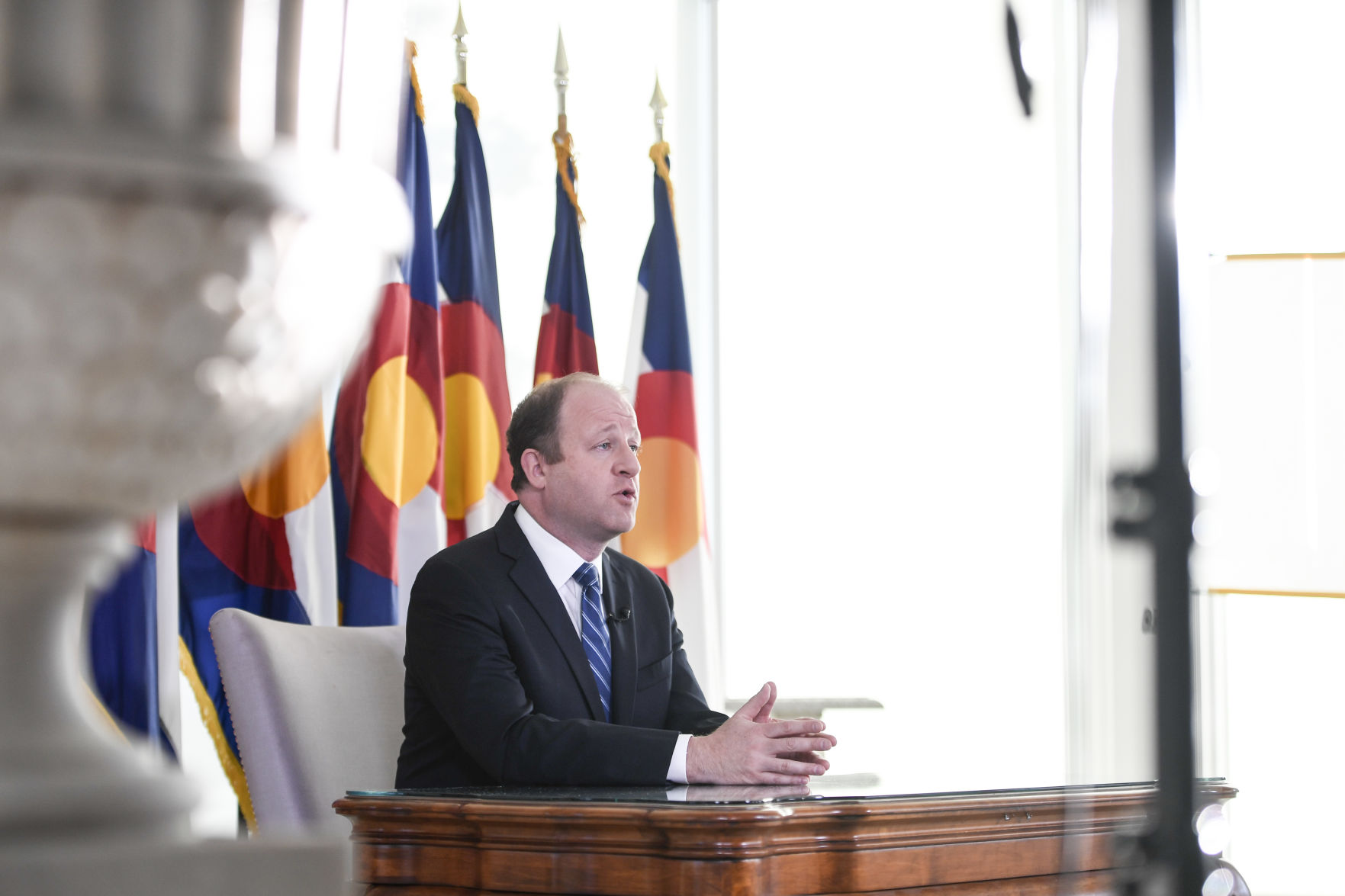
Gov. Jared Polis spoke to the state for about 18 minutes in primetime Monday night about the challenges facing Colorado in the days ahead as the casualties mount. The governor announced he would extend the stay-at-home order until April 26, two weeks past its original end date and four days ahead of the order issued by the President.
“If there is any way to safely end it sooner, then we will. And likewise if Coloradans aren’t staying at home and the numbers of the dead and dying continue to increase, then it could go longer.”
He said the science and data guided his choice, because staying home is Colorado’s best chance to save lives and restore normality.
“I know that we would all rather be going back to work tomorrow instead of collecting government stimulus checks or unemployment insurance,” the governor said.
“I know that business owners will have to make even harder decisions this month. I know we all want this to end as soon as possible. But if the choice is between a temporary shutdown and a catastrophic loss of life, the choice is clear. These closures and restrictions will be temporary. But when you lose a life, you lose it forever.”
Polis pointed to the changes in the spread of the virus, due to the social distancing and stay-at-home measures. Instead of cases doubling every two days, it’s now at five to six days.
“That is a remarkable achievement by the people of this state. I want to thank each and every one of you who has been taking this seriously. You are truly helping to turn the tide against this virus,” Polis added. So this is not the time to abandon what has been working.
“We need to keep up this good work for a while longer so we can eventually return to a level of normalcy in our economy and our society.”
Recovery from the virus and its economic devastation is possible, “and we will get there,” he pledged, but these efforts will be in vain and many lives will be lost, if we fail to do our crucial patriotic duty and stay home.” He pleaded with Coloradans to continue to stay at home, practice social distancing, asking people to stay more than six feet apart, and to continue to practice good handwashing.
Polis also pointed to deregulation and other efforts to help Coloradans get through the crisis.
“What matters now is not what you believe politically, your religious faith, your occupation, your age, your race… none of that matters here, none of that matters to the virus. What matters is that the more we stay home, the better chance we have of beating this virus so we can all go back to the things that make life worth living.”
“This April will be known as the lost month,” Polis said. “We won’t get it back,” but there will be many more. He asked Coloradans to do their best to remain positive. “None of this is permanent.”
Public health officials with the Colorado Department of Public Health and Environment said Monday afternoon that while state had logged 5,172 cases via testing, the number could be as high as 18,000 cases, or as much as 0.03% of the state’s total population.
“We are still at the beginning of this epidemic,” Dr. Jill Hunsaker Ryan, executive director of the state health department, said in the news conference Monday afternoon.
State and federal officials are planning to put 2,000 beds at the Colorado Convention Center later this month, if necessary, and Denver Mayor Michael Hancock sent a letter Monday to hotel and motel operators across the city asking for their help.
House Speaker KC Becker of Boulder held a telephone town hall Monday for constituents of her sprawling Boulder-based district. She isn’t expecting the legislature, which suspended deliberations on March 14, to return until mid-May.
She said they are expecting a $2 billion shortfall in the current fiscal year that ends on June 30 that must be dealt with by cuts, beyond what federal money can backfill.
“We don’t have answers right now,” she said of the future.
State Rep. Edie Hooton, a fellow Democrat, joined her on the call and lauded the state’s leadership for its response.
“I think we’re incredibly fortunate to have the leadership of the governor, of course, our speaker and the Senate leadership in addressing as quickly as possible this incredible crisis,” Hooton said of another Boulder Democrat. “It’s meeting us on so many levels.”
Republicans in the legislature think the governor, however, is hoarding information.
House Republicans sent Polis a letter Monday asking for “clarity and transparency” in providing data on the outbreaks, saying it had been hard to follow and at times, they felt, misleading.
“Coloradans need accurate and clear numbers regarding the progression of COVID-19,” House Republican Leader Patrick Neville of Castle Rock said in a statement. “We need to know what methods and models are being used. We should know confirmed cases as well as recovered cases. Most importantly, Governor Polis needs to provide his metrics for success with real, obtainable goals.
“If we are trying to ‘flatten the curve’ which metric is most important right now? Is it the amount of overall cases or the rate of increased cases? Is it the amount of available hospital beds? If the amount of recovered patients exceed new cases, will he start lifting shelter in place in a measured way? We don’t know and this is concerning.”
State Sen. Ray Scott, a Republican from Mesa County, said before Monday evening’s address that he wanted to hear straight answers from the governor.
“We need the governor to be open and honest about any data or modeling he has, but more specifically we need to know by county and city who is at the most risk so people can avoid those areas,” Scott said. “This crisis is devastating people emotionally and financially and his decisions must take into account each regions population in a more surgical manner if at all possible, and as the virus curve flattens to begin moving towards a more normal existence across Colorado’s counties.
“With changes in his policy comes hope and we need hope now.”


Colorado Parks and Wildlife Commissioner Murphy Robinson resigns
Marianne Goodland
marianne.goodland@coloradopolitics.com
Updated 5 hours ago
Murphy Robinson, who has served on the Colorado Parks and Wildlife Commission for just over a year, announced his resignation on Wednesday. In a statement, Gov. Jared Polis thanked Robinson, saying he is “incredibly grateful for Murphy’s service to the...

Colorado Supreme Court’s opinion output drops by two-thirds amid justice’s absence
Michael Karlik
michael.karlik@coloradopolitics.com
Updated 6 hours ago
The Colorado Supreme Court has released significantly fewer new opinions in recent months compared to the previous two years, even as the judicial branch insisted that a member’s open-ended absence is not causing delays. Justice Melissa Hart has been on...

Adams County officials call for resignation of county treasurer after ‘inappropriate behavior’
Kyla Pearce
kyla.pearce@gazette.com
Updated 6 hours ago
Adams County Commissioners requested the resignation of the county’s treasurer after multiple allegations of inappropriate behavior toward staff members. Treasurer Alex Villagran has declined to step down. An independent investigation by Employment Matters LLC Flynn Investigations Group found multiple allegations...

Aurora’s consent decree monitor reviews fatal pursuit crash, notes ‘inherent risk’ of police chases
Kyla Pearce
kyla.pearce@gazette.com
Updated 8 hours ago
Two people died in a crash that resulted from an Aurora police pursuit last week, which the city’s decree monitor is reviewing. The monitor said the incident underscores the “inherent risks” of pursuits. Meanwhile, the city police department said it...
Colorado’s universal preschool enrollment begins for upcoming school year
Marissa Ventrelli
marissa.ventrelli@coloradopolitics.com
Updated 6 hours ago
Enrollment is now open for Colorado’s universal preschool program, which provides up to 15 hours of free education for four-year-old children across the state. The $344 million program has served nearly 90,000 children since its creation in 2023, the Governor’s...

Divided 10th Circuit rules bank customer must arbitrate discrimination-related claims
Michael Karlik
michael.karlik@coloradopolitics.com
Updated 6 hours ago
The Denver-based federal appeals court ruled on Monday that a mandatory arbitration clause in the fine print of a customer’s bank account agreement prohibited her from pursuing claims of racial discrimination in court. Jeanetta Vaughn filed suit against JPMorgan Chase...

Colorado’s federal trial court denies admission to lawyer owing tens of thousands in dues, penalties
Michael Karlik
michael.karlik@coloradopolitics.com
Updated 8 hours ago
Colorado’s U.S. District Court declined last month to allow an attorney to practice before the court due to his failure to pay enrollment fees and penalties to another state’s bar association for years. The federal trial court requires attorneys to...
Douglas County businesses to pay fines for unreported thefts under proposed ordinance
Noah Festenstein
noah.festenstein@denvergazette.com
Updated 5 hours ago
Douglas County commissioners on Tuesday advanced an ordinance aimed at curbing retail theft by penalizing businesses that refuse to report shoplifters to law enforcement. The proposal is notable in that it shifts the onus of responsibility to businesses. Officials said...

Federal judge labels appeal ‘frivolous,’ state Supreme Court to hold arguments | COURT CRAWL
Michael Karlik
michael.karlik@coloradopolitics.com
Updated 13 hours ago
Welcome to Court Crawl, Colorado Politics’ roundup of news from the third branch of government. A federal judge deemed a government defendant’s appeal “frivolous,” and the state Supreme Court will have an abbreviated oral argument schedule next week. Heard on...

Humane Colorado bids fond farewell to its CEO at Celebration of Compassionate Leadership | NONPROFIT REGISTER
Joanne Davidson Special to Colorado Politics
joanne-davidson-special-to-colorado-politics@coloradopolitics.com
Updated 15 hours ago
HUMANE COLORADO Denver News: Veterinarian Apryl Steele is not one to toot her own horn, so the general public might have no idea of the depth and scope of the role she has played in elevating the standard of care for companion animals and for expanding the socially...
PREV
PREVIOUS

BARTELS | Clerks keep the business of government rolling
Nurses, doctors, grocery store checkers, postal workers, truck drivers. The accolades continue for these heroes during the coronavirus crisis. Add this profession to that list: your county clerk and recorder. It is amazing how many duties clerks perform and what they have done in recent weeks to try to do their jobs as calls from […]

King Soopers announces additional distancing, employee protection measures
Beginning on Tuesday, King Soopers will implement measures to limit the number of customers in its stores and take steps to boost employee protections. The grocery chain announced that it will temporarily institute a store capacity of 50% of the international building code’s calculation. Employees will monitor the number of customers that enters and exits, […]