

Q&A with Elias Moo | An education that ‘values the soul’
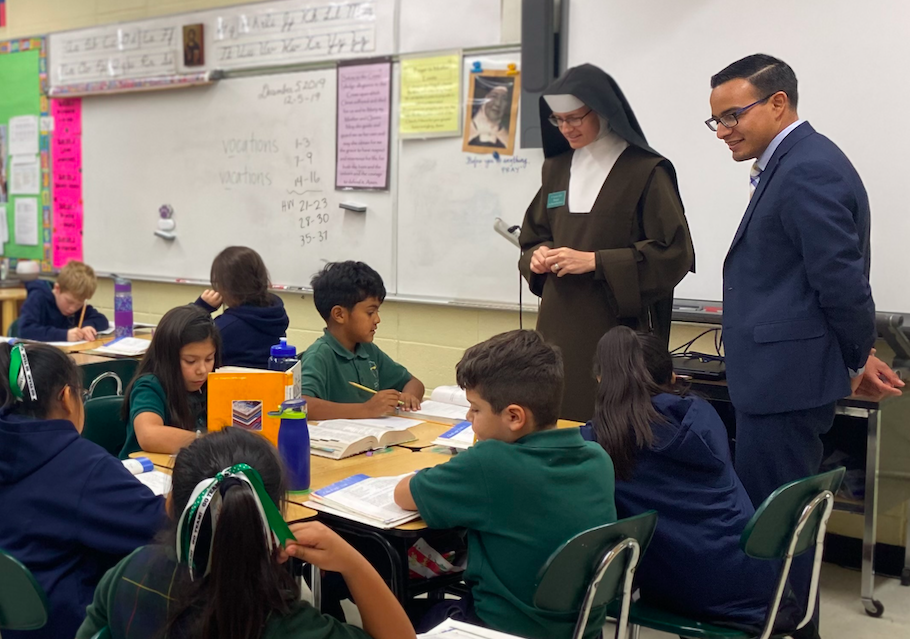
As in many American communities, the Denver area’s venerable Catholic school system is, in a sense, very much a part of the public education mosaic. Though parochial by definition and thus distinct from public ed per se, Catholic schooling, like the church itself, is so tightly tethered to some cornerstone Colorado cultures – most notably Latino – as to be a default path for many of their young. Unlike elite, private, non-sectarian prep programs, Catholic schools have always been rooted deeply in ethnic America, serving not just its upper echelon but even more so, its sizable middle class, its backbone working class and its many, many poor.
That’s why Q&A is talking to Elias Moo this week. He’s the dynamic, young and relatively new superintendent of schools for the Archdiocese of Denver – the Notre Dame grad, K-through-grad-school-Catholic-educated, California-born son of, as he puts it, a produce “picker” dad and mom who emigrated from Mexico.
Moo covers a vast amount of territory with us about his own background; the role of Catholic schools in today’s metro Denver; the most acute challenges facing today’s K-12 kids – and the true meaning of a Catholic education.
Colorado Politics: You aren’t the first school superintendent to be profiled in Q&A, and a lot of the daily challenges you face resemble those of the supers serving in the public school system. One thing you have in common with public schools in metro Denver’s inner-urban core – perhaps unknown to a lot of public school parents – is you serve a lot of the same kinds of students as those who attend nearby public schools. That includes low-income and at-risk students and students of color. Do the Denver area’s diocesan schools wind up acting as a kind of relief valve for public education – providing an alternative for kids and their parents who have run out of options at neighborhood public schools? How well do you serve low-income families in that regard?
Elias Moo: Some people perceive that our Catholic schools are out of reach for low-income families and students. In the Denver metro area, we have a number of schools from Lakewood to Aurora where at least 50% of their communities are low-income families and students of color. These schools offer their families an educational experience that is superior to what they would receive in their neighborhood public schools. Before becoming the superintendent of Catholic Schools, I was a principal at St. Rose of Lima Catholic Academy, a school located in the heart of the southwest side of Denver. St. Rose of Lima serves a community predominantly Hispanic community where 90% of families are free- and reduced-lunch qualifying. Here I saw firsthand that for many of the families in our Catholic schools, their “choice” was reduced to deciding to enroll in schools where at best three out of four students were not proficient in math or reading.
Yet, in our schools, which serve the same demographic as the struggling urban public schools, we see math and reading proficiencies at least three or four times greater. Many of our schools also receive students coming from the public school that are significantly behind grade level, including students who have been diagnosed with learning disabilities. Our research has found that the longer students are with us, the more quickly the achievement gap closes. This past year in three of our urban schools we saw over two-thirds of students making growth in reading and math – higher than 55% of their grade-level peers, regardless of their demographic profile. Same students, same socioeconomic circumstances, with the same challenges, and the same labels found in many of the city’s failing schools, but stronger results.
Naturally the question is, but why? The answer: It’s not funding. In fact, our cost-per-pupil on average is about $7,000, which is still a few thousand dollars shy of the cost-per-pupil in public schools. Our schools have mastered the art of maximizing resources and putting what we do have available to maximum and efficient use. I would argue that the secret sauce is our mission; our Catholic schools hold a view of the educational enterprise and of the student that is fundamentally different than our public-school counterparts.
The aim and purpose of our schools is not merely to form young men and women who are college and career ready. I’m convinced that’s shooting too low.
Only an education that properly values the soul of the human person can lead a student on the road to know true human freedom. Frederick Douglas put it best when he wrote, “Education…means emancipation… It means light and liberty. It means the uplifting of the soul of man into the glorious light of truth, the light only by which men can be free.” Catholic education is about authentic human freedom. The freedom to be moral and ethical people. The freedom to do what we ought, not merely what we desire. The freedom to seek what is true, what is good, and what is beautiful.
This is the key difference maker that sets us apart from other forms of education.
Elias Moo
- Superintendent of Catholic schools for the Archdiocese of Denver, since 2018.
- Principal, St. Rose of Lima Catholic Academy in southwest Denver, 2014-2018.
- Teacher, basketball coach at St. Rose of Lima, 2007-2018.
- Member of Archdiocsese of Denver Archbishop’s Pastoral Council, 2014-2016.
- Holds bachelor’s degree in theology and sociology and master’s degrees in education and educational leadership from the University of Notre Dame.
CP: Tell us a little about your own background and how your upbringing and your formal education launched you onto your current trajectory.?
Moo: I am the product of Catholic education. As immigrants from Mexico, my parents knew right away that the greatest inheritance they would be able to leave my four siblings and me would be our education. However, for them the public schools were not an option for many reasons. As such, they sacrificed many things to send us to Catholic school. My dad came to the US when he was 17 years old and has worked the produce fields of southern California for nearly 50 years. In fact, he has been working for the same produce company that he started with as “picker” when he was 17! His model of hard work, tenacity, and grit is certainly something that I aspire to. ??Like so many of the families in our Catholic schools in the Archdiocese of Denver, he worked countless hours and multiple shifts to make ends meet and to send all five of us to Catholic school from kindergarten to 12th grade – no easy feat, but certainly the greatest gift my parents gave me.
Following high school, I continued my academic career at the University of Notre Dame. Upon graduating with my Bachelor’s degree I was accepted to the Alliance for Catholic Education Teaching Fellows Program, a two-year fellowship similar to Teach for America, but in the Catholic school world. I was placed in Denver, where I landed as a fifth-grade teacher at St. Rose of Lima Catholic Academy. I will say teaching was not part of my initial plan! What I originally thought was just a two -year post-graduate opportunity to give back through the education of a community like the one I was raised in, ended up becoming my life’s passion. Upon meeting my first class of 25 fifth-graders, I knew working to support the education and formation of children was what I was meant to do. It was a transformative, life-giving experience not because of what I gave, but rather because what I received and learned from the community was far greater than anything I could have offered them as a “teacher.” The students, the parents, my colleagues, the educational journey with them – they were a formative aspect of my maturation and growth as a professional and as man. I have no doubt that my preparation to become superintendent began in that fifth-grade corner classroom in southwest Denver.
CP: When you look at the many Hispanic children in Denver’s Diocesan schools, do you see glimpses of yourself as a schoolchild – and does that offer you insights into the education of Hispanic children?
Moo: In our Catholic schools we have so many students and families that remind me of my family. When they share their dreams and hopes for their children, their challenges and sufferings, and when I see the sacrifices they make for their children, I see so much of what my parents dreamt and hoped for, and see a reflection of what my parents did for me. I also see in many of the children a reflection of myself as well, although their children are much brighter and hardworking than I was at their age! As such, I think it offers me insight into what an effective family partnership must be for the successful education of children.
CP: How closely do Denver’s Catholic schools work with public schools? What common interests, and policy positions would you have with the public-school system at either the local or state levels?
Moo: In my time as superintendent, our greatest areas of collaboration come with accessing federally funded services for low-income students through Title 1, teacher development through Title 2, support for English language Llearners via Title 3, and health and wellness supports through Title 4. These supports require close communication and consultation with public school representatives according to the law as established by the Every Student Succeeds Act (ESSA). Another form of significant collaboration with public school officials comes in the form of support for students with learning needs. By law, districts are obligated to identify, evaluate, and track students with diagnosed disabilities, even those whose families have chosen to send them to our Catholic schools. The Child Find service puts in place the local public-school district’s duty to support students with learning needs and is one of the ways that our schools engage regularly with their public school colleagues.
Most recently through the announcement of the suspension of in-person learning, we have been in communication with local public-school district officials to exchange information and to try to identify the extent to which we could have a united effort. Similar communication took place last year with the unfortunate situation of an active threat to schools that resulted in schools having to close for the day. During this crisis, we were able to join district leaders from across the state to discuss a strategy and make joint statements about the decision to close our schools until the threat was found and neutralized. ??
CP: Do you think publicly funded school vouchers – eligible for use at parochial schools like yours – ever will come to Colorado? An attempt to implement vouchers in a pilot program in 2003 was halted by the Colorado Supreme Court and attempts by state lawmakers to fine-tune the program to meet court approval were cut short when Democrats won control of the legislature. Will the political chemistry of our state ever allow for vouchers? Should it?
Moo: Given the political makeup of the state of Colorado, vouchers might continue to be a long shot for us. However, I do believe that we will still see the day when we are able to give families, especially low-income families, the ability to truly choose to give their children the education they deserve to have. True empowerment of parents is only realized when they have all the means at their disposal to choose to send their children to the school that will best serve their children and their family’s needs, public or non-public alike. Low-income families and families of color are disproportionately affected by the lack of educational choices and they are stuck with either failing schools or putting their child’s educational future up to a game of chance by entering a lottery for an opportunity to enroll their child at a school outside of their neighborhood school. This is a travesty, and I believe it is one of the greatest inequities and injustices that we are faced with today. It is heartbreaking to know that there are still families in our city and state who must resign to the fact that their only choice for the education of their child is a failing school. It’s disappointing that this has become a partisan issue. Allowing families to give their children the education that is best for them and their family should not be a partisan issue. ?
I think there are many legislators who are torn because of the long-standing partisanship that is deeply entrenched in this issue. As such, I would personally make an appeal to any of them to consider the legacy they want to leave behind and consider the voters who elected them to office. Many of their voters are battling for their children against the poor educational options available for them. Our current legislators can be the generation that abolishes educational inequity and injustice.
CP: What do you feel is the biggest challenge facing Colorado schoolchildren today – whether in Catholic schools, public schools or any other?
Moo: I think the biggest challenge facing Colorado schoolchildren – both public and private – is the rising tide of anxiety. Some research indicates that one of every five students is experiencing some form of anxiety. Certainly, this leads us to immediately want to identify solutions, most notably through mental health supports for students in school, which are important. But I think we have to be willing to truly diagnose the root of the problem to truly identify where we have to go to really address the issue.
Prior to the outbreak of COVID19, screens had already become the means for human interaction and engagement with the world. I’m of the perspective that as a society we had already started to move towards becoming more and more socially distant and as a consequence, we have started to lose the human interaction that is necessary for human flourishing. Further, as social media has become the primary means by which we interact with one another, children in particular are losing a sense of reality and in turn placing greater regard for the false realities and false portrayals of self on social media that are being internalized as their identity. In some cases when this reality can’t be lived up to, it can cause severe distress and anxiety, which in turn leads to greater problems.
Our Catholic schools are attempting to respond to this reality: first by caring for the soul as part of the overall wellness of a child, and secondly by being communities of human encounter. The challenge before for us as schools will be how well we can support our young men and women with the challenge of anxiety. I do think that we must strive to the best extent possible to help children detox from the influences of social media and constant screen time by providing moment of encounter with their peers and with the natural world.


What courageous citizenship really looks like | Vince Bzdek
Vince Bzdek
vince.bzdek@gazette.com
Updated 30 minutes ago
By Vince Bzdek What exactly is courage? Ernest Hemingway famously called it grace under pressure. Mark Twain wrote that “courage is resistance to fear, mastery of fear — not absence of fear.” C.S. Lewis refined that even more: “Courage is...
The coming election and mischief in the making | SONDERMANN
Eric Sondermann
eric-sondermann@coloradopolitics.com
Updated 3 days ago
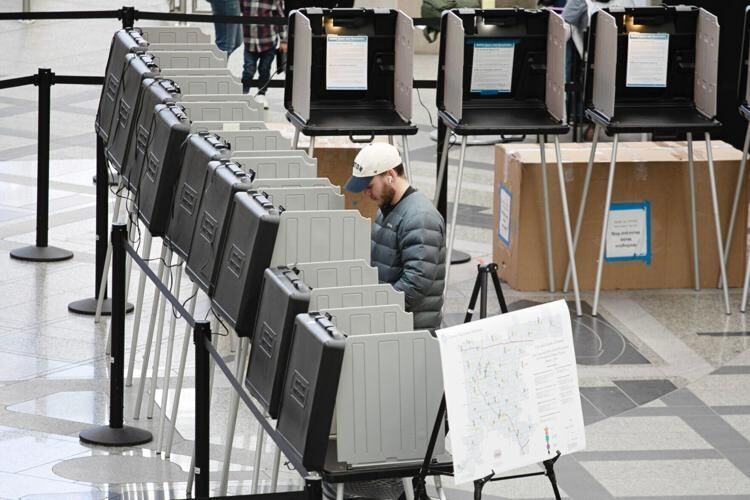
America’s tribalism is such these days that we struggle to even agree on the basic rules. Elections have always been hotly contested. As the saying goes, “Politics ain’t beanbag.” The process has long involved elements of nastiness and underhanded conduct....
Colorado Politics Calendar Aug. 31-Sept. 6
Rachael Wright, Special to Colorado Politics
rachael.wright@coloradopolitics.com
Updated 3 days ago
CoPo’s weekly political calendar will help you find political and public-policy events throughout Colorado. It includes candidate and issue campaign events, public policy meetings, court hearings, state and local party conventions, assemblies, debates, rallies, parades, speaking engagements, traveling dignitary appearances,...
Tancredo in Running for Dept. of Ed. Position | A LOOK BACK
Rachael Wright, Special to Colorado Politics
rachael.wright@coloradopolitics.com
Updated 3 days ago
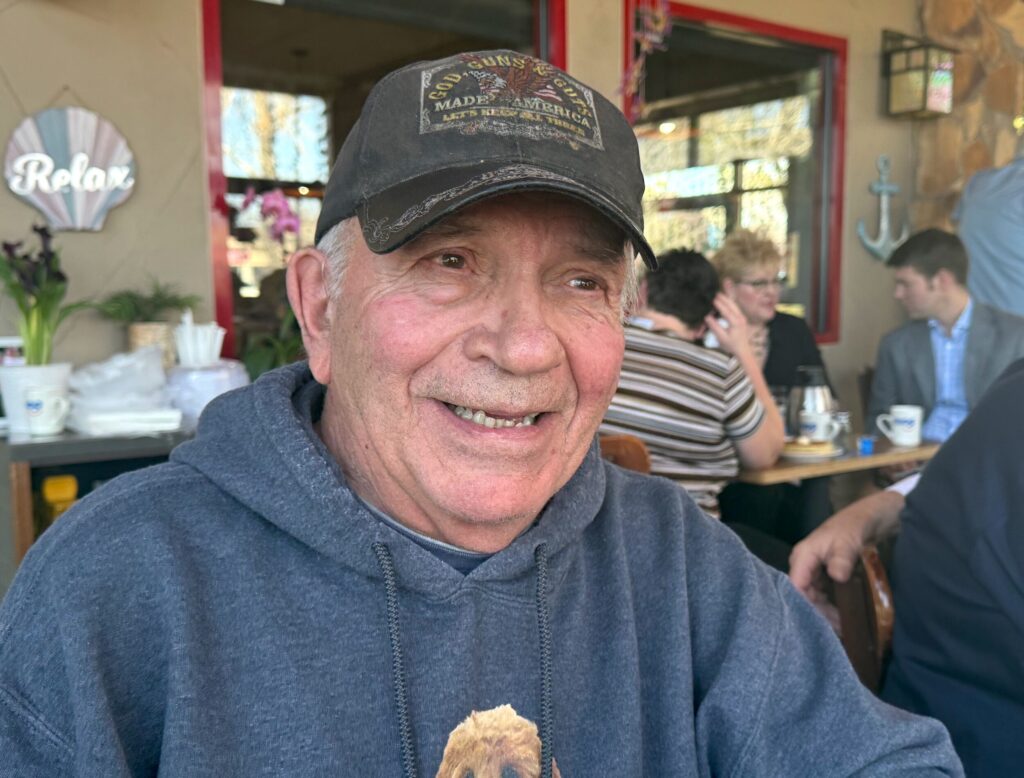
Forty-five years ago this week: “I know that my name has been placed before the Secretary of Education, and I know that I’m one of three or four being considered for the Department of Education’s Region 8,” said state Rep....
Colorado measure adding ID checks to mail-in voting qualifies for ballot
Marissa Ventrelli
marissa.ventrelli@coloradopolitics.com
Updated 20 hours ago
A ballot initiative that would require voters to include additional information on mail-in ballots has qualified for the November election, according to the Secretary of State’s Office. Backed by El Paso County Treasurer Chuck Broerman and former Deputy Secretary of...
Colorado election website error exposes personal data of confidential voters
Marissa Ventrelli
marissa.ventrelli@coloradopolitics.com
Updated 21 hours ago
A system update accidentally lifted protections on confidential records in Colorado, exposing dozens of voters’ personal information, according to the Secretary of State’s Office. The limit that normally blocks access to confidential voter profiles was inadvertently disabled during an update...

PUC adds weekly comment after killing private talks
Scott Weiser
scott.weiser@gazette.com
Updated 21 hours ago
The Colorado Public Utilities Commission will take public comment at the start of every commissioner’s weekly meeting beginning Sept. 9 as part of its new transparency mandate, the commission announced, expanding a slot previously limited to the second Wednesday of...
10th Circuit overturns framework for sentencing probation violators by 11-1
Michael Karlik
michael.karlik@coloradopolitics.com
Updated 22 hours ago
In a rare decision by all 12 of its full-time judges, the Denver-based federal appeals court ruled in a lopsided vote on Friday that one of its members created a sentencing process for probation violators that was out of step...
Federal judge dismisses excessive force lawsuit against Colorado Springs, officer
Michael Karlik
michael.karlik@coloradopolitics.com
Updated 4 hours ago
A federal judge concluded last week that a Colorado Springs police officer could not be held liable for shooting a suspect three times after the man menaced two victims with a gun and fled the scene. Al’morion Germany was involved...
DeFlock started from one man’s curiosity — now Flock cameras are a midterm issue
Claire Carter
claire.carter@washingtonexaminer.com
Updated 1 day ago
Will Freeman wasn’t looking to start a national movement when he launched DeFlock after noticing Flock Safety’s automatic license plate readers along the side of the road. The software engineer was driving across the country in 2024 when the cameras...
PREV
PREVIOUS

State urges consumers to be mindful of SNAP, WIC recipients while purchasing groceries
The state is urging people visiting grocery stores at the beginning of the month to be mindful of Coloradans receiving federal food assistance, some of which is only valid for specifically-designated items. Approximately 431,415 individuals in Colorado receive benefits through the Supplemental Nutrition Assistance Program, commonly called food stamps, and 80,000 individuals are enrolled in […]
INSIGHTS | Mental health is the next coronavirus wave
The cost of the pandemic that can’t be calculated is the toll of mental illness. While policymakers and the private sector sort out the debris of the global coronavirus tragedy, the mental health of many will factor heavily into the losses, as certainly as a washed-out bridge in a flood. When this gets sorted out, […]