

Local governments work to counter misinformation about coronavirus
After Thornton residents sent him screenshots of someone claiming online that the city’s water supply was unsafe due to the COVID-19 coronavirus, Todd Barnes fired back on Nextdoor in all caps.
“YOUR WATER IS SAFE!” wrote Barnes, the communications director for the city. “Please people, let’s be responsible with the information that is shared during this difficult time.”
Barnes, who has worked for Thornton for 20 years, is one of the many public employees seeking to swat down misinformation and rumors on social media that can be routinely conspiratorial on a good week and alarmist during a pandemic. He is not able to see everything, particularly on Nextdoor, where only those who are verified neighborhood residents can post to their community’s message board.
“Sometimes it’s a matter of just putting the facts out there and you get a lot of people who back you,” he said. “I don’t think some people are going to believe what we put out no matter what.” The original message, which the poster since deleted, implied that local government could not be trusted to keep people safe. (The Centers for Disease Control and Prevention has clarified that municipal filtration systems should remove the virus from drinking water.)
“Right now in certain Facebook groups there are rumors that circulate claiming I will abuse some emergency powers that a mayor has,” said Greg Mills, the mayor of Brighton. “Some thought I was going to shut down restaurants and bars when I never planned on doing this. Now that the governor has done that instead, the people won’t need to blame me anymore.”
Not every jurisdiction has encountered misinformation or dedicates time to seeking it out. Instead, many officials prefer to simply push out factual details and hope that residents will gravitate to reputable sources.
“Must be honest that I am – and we are – spending our time learning [about the virus] and messaging appropriately as we learn,” Central City Mayor Jeremy Fey said. “No time to explore the clutter of poor information that is out there.”
“You guys are lying”
Sometimes, though, online commenters calling into question the severity of coronavirus measures can earn a rebuke from local experts.
“The sky is NOT falling! The sky is NOT falling! It is the media having a field day with new flu,” wrote one person below a Facebook post from the city of Denver about service cancellations.
“This is not necessary. Come on!!!!!!” commented another person after the city announced the closure of motor vehicle offices. To that statement, the city’s social media workers replied: “These measures are necessary. Please do not disseminate false information like this online or in person,” read the message from the city’s account.
Despite the occasional clarification, Alton Dillard, a media relations employee for Denver’s joint information center, said that the city does not engage in dialogue with commenters over social media, nor does it delete misinformed comments.
Elisabeth Lawrence disagreed with the notion that a one-way flow of accurate information to residents was the limit of her role as a Summit County commissioner.
“I can’t always wait for the people to come to me. Sometimes I need to go to the people,” she said on Tuesday, immediately after posting a Facebook live video to her page with a coronavirus update. “I have seen a lot of, ‘you guys aren’t telling us everything’ or ‘you guys are lying.’ “
The largest category of misinformation that Lawrence encountered pertained to testing for the virus. She has seen people allege that no tests are occurring or that the tests have run out. Some of what people say, she realized, was simply misinterpretation of governmental directives.
Elected officials play a role in counteracting falsities. Barnes said that above a certain “threshold,” Thornton’s mayor or the chiefs of police and fire might have to convey a message, such as after the December 2017 mass shooting in a city WalMart. Otherwise, alert residents bring concerns directly to him.
“We had several people do screenshots and send us information,” he said. “Nextdoor is a very valuable tool for us. I can reach 50,000 people via Nextdoor.”
He did not characterize Nextdoor as being more prone to rumors than other forms of social media, saying that people most often want to be helpful to their neighbors on the platform. Nevertheless, his staff of seven people monitors replies to their posts.
Cooperation from online administrators
Lawrence said that Summit County employees generally do not ask her to intercede publicly on behalf of the government, but more often she contacts staff to verify whether details she has seen are true.
“I am willing to serve as the public face of doom and gloom if I need to be,” she added. She understood the potential downside of social media, saying that the details in traditional press releases can leak out in the time it takes to formulate an accurate announcement.
On other occasions, the immediacy of social media can create, then retract concerns in a matter of minutes. In Montrose County, Katie Yergensen received a text message on Monday containing a Facebook screenshot declaring two positive coronavirus cases in her county. In reality, the state had reported zero.
“It’s a team effort” to combat false stories, said Yergensen, the media relations manager for the county. “We are a small town. Rumors spread rather quickly, and I think one of the biggest challenges of a communicator is we’re doing our best to reassure the public.”
The county, she said, has a good relationship with local Facebook group administrators. Indeed, the post was removed within a short time of Yergensen receiving the image. Still, she is wary to describe what she is seeing as purposeful misinformation designed to mislead the public.
“I think this is just a very rapidly evolving and rapidly changing situation, and I think it’s hard for businesses and the general public to stay up to date on new mandates,” she said.


Colorado Politics Calendar Apr. 6-12
Rachael Wright, Special to Colorado Politics
rachael.wright@coloradopolitics.com
Updated 4 days ago
CoPo’s weekly political calendar will help you find political and public-policy events throughout Colorado. It includes candidate and issue campaign events, public policy meetings, court hearings, state and local party conventions, assemblies, debates, rallies, parades, speaking engagements, traveling dignitary appearances,...

Democrats rebounding without learning necessary lessons | SONDERMANN
Eric Sondermann
eric-sondermann@coloradopolitics.com
Updated 16 hours ago
“When we fight, we win!” That, reportedly, was the chant heard over and over again at the Colorado Democratic Assembly a week ago. It suggests that pugilism has been the piece missing from the Democratic toolkit. Perhaps it was just...
An April Fool’s Day to remember | Capitol M | Week of April 4, 2026
Marianne Goodland
marianne.goodland@coloradopolitics.com
Updated 2 days ago
The lighter side of the Capitol, and if light were weight, the Capitol would have lifted off better than the Artemis II rocket on April Fool’s Day. There was a plethora of Fools at the Capitol for April Fool’s Day...
Federal judge sides with Mesa County school district in ex-student’s First Amendment claims
Michael Karlik
michael.karlik@coloradopolitics.com
Updated 1 day ago
A federal judge concluded last week that Mesa County Valley School District 51 and three of its administrators did not violate the First Amendment rights of a former student when they imposed minor discipline in response to disruptive behavior. In...

Colorado Supreme Court intervenes in 4 ongoing cases
Michael Karlik
michael.karlik@coloradopolitics.com
Updated 1 day ago
The Colorado Supreme Court recently moved to intervene in four ongoing cases, including two criminal prosecutions, a civil lawsuit, and a child welfare proceeding. At least four of the court’s seven members must agree to hear a case outside of...
Colorado ski resorts announce early closures amid historic snowpack lows, high temperatures
Kyla Pearce
kyla.pearce@gazette.com
Updated 14 hours ago
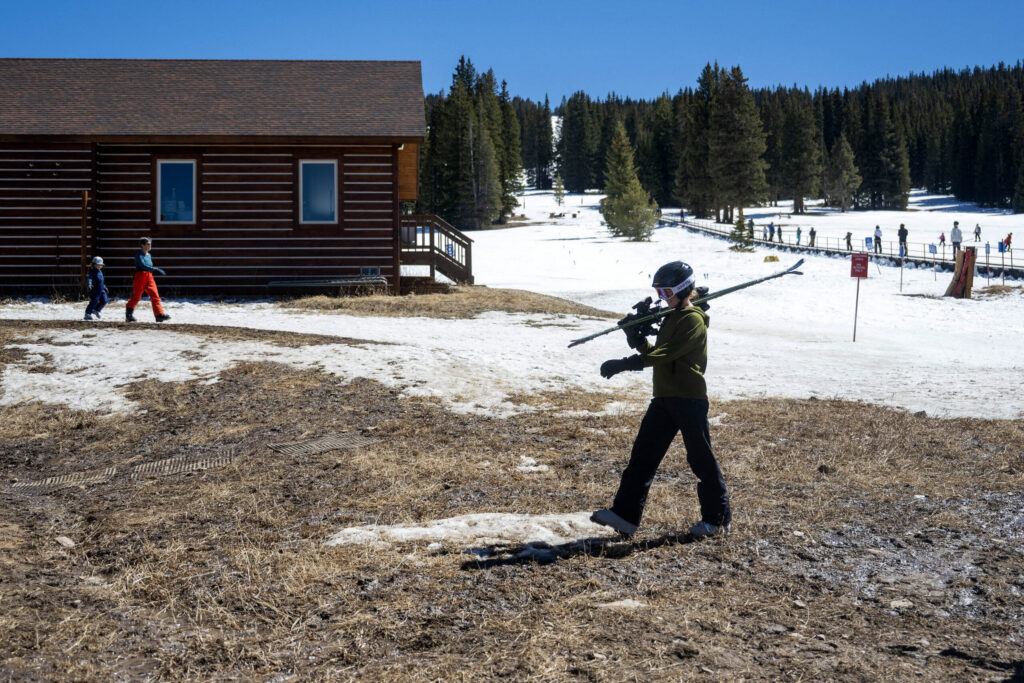
Vail Resorts is the latest area to announce season closure Wednesday As Colorado’s historically low snowpack year comes to a close and spring conditions take over the mountains, the state’s major ski resorts are announcing closing dates — some of...

Kentucky Gov. Andy Beshear set to headline Colorado Democrats’ annual fundraising dinner
Ernest Luning
ernest.luning@coloradopolitics.com
Updated 1 day ago
Kentucky Gov. Andy Beshear, one of the Democrats’ top 2028 presidential prospects, is scheduled to deliver the keynote address at the Colorado Democratic Party’s annual fundraising dinner in June in Denver, the party said Friday. Serving his second term as...
Gov. Polis names new leaders for Colorado health agencies in wake of Medicaid turmoil
Marianne Goodland
marianne.goodland@coloradopolitics.com
Updated 1 day ago
Gov. Jared Polis, on Thursday, announced he was appointing Gretchen Hammer to serve as acting executive director of the Colorado Department of Health Care Policy and Financing, and deputy executive director Stephanie Beasley to become the next commissioner of the...
Federal judge releases man immediately as consequence for immigration judge disobeying orders
Michael Karlik
michael.karlik@coloradopolitics.com
Updated 1 day ago
A federal judge ordered a man’s immediate release from immigration detention on Thursday after finding an immigration judge disregarded his prior orders requiring a bond hearing. For the past year, Colorado’s federal district court has faced a flood of “habeas corpus”...
Colorado sues Trump administration, calling new election order ‘unconstitutional’
Marissa Ventrelli
marissa.ventrelli@coloradopolitics.com
Updated 14 hours ago
Colorado Attorney General Phil Weiser has joined a multistate coalition suing President Donald Trump over a new executive order on elections, arguing the directive unlawfully intrudes on states’ authority to run their own voting systems and threatens access to mail...
PREV
PREVIOUS

As Denver City Council changes rules to allow emergency meeting cancellations, some members push for virtual meetings
Denver City Council on Monday voted to extend the declaration of a state of emergency until May 11 in response to the coronavirus outbreak. The decision came in a 9-0 vote with council members Candi CdeBaca, Kevin Flynn, Debbie Ortega and Amanda Sandoval absent. The legislation prevents Denver Mayor Michael Hancock’s state of emergency declaration from […]
Gardner, Bennet and Colorado reps (minus Buck) ask FEMA to clarify how they're helping
U.S. Sens. Cory Gardner and Michael Bennet, along with six Colorado U.S. representatives, on Tuesday signed a letter asking FEMA to reach out to and further clarify coronavirus safety resources for state, local, territorial, tribal governments. “Many counties across Colorado have expressed frustration over what they perceive as a lack of clear guidance as to what […]