

Colorado Supreme Court to take up case on cruel and unusual punishment for juvenile sex offenders

The state Supreme Court announced on Monday its intention to hear the issue of whether mandatory, lifetime sex-offender registration constitutes cruel and unusual punishment under the Constitution for minors who offend multiple times.
T.B. is a juvenile who had to register as a lifetime sex offender under the Colorado Sex Offender Registration Act, which mandates the consequence for minors who offend twice. His first conviction was in 2001, at age 12, for unlawful sexual contact. Four years later, T.B. pleaded guilty to sexual assault.
He attempted to de-register twice, shortly after turning 18 and then after turning 26. He cited the lifetime registration as a violation of the Eighth Amendment.
In June 2019, the Colorado Court of Appeals decided to send the case to juvenile court for resolution.
The divided 2-1 panel found that first, the registration for juveniles was indeed a punishment because it sought to accomplish the goals of traditional punishment – “retribution and deterrence.”
This was a departure from previous decisions of the appeals court, which had consistently held that registration was not punitive. In this instance, though, the majority recognized that there had never been any direction from the high court.
“Although our supreme court has not weighed in on the issue we are addressing today, we are not writing on a blank slate,” wrote Judge Craig R. Welling for himself and Judge Elizabeth L Harris. Because the juvenile court was operating under a different precedent, the appeals court majority returned the case to it to render a decision on the “cruel and unusual” nature of the lawsuit.
In the minority was Judge John R. Webb, who found that the U.S. Supreme Court had not sufficiently defined the nature of cruel and unusual punishment in this area. Existing cases, he wrote, “provide little guidance in answering the preliminary question whether mandatory registration is punishment at all. So, I discern insufficient reason to disavow our unanimous precedent.”
Webb pointed out that previous justifications for sex offender registrations included the need to aid law enforcement, not to punish the registrant by making his name public. “That the public may overreact to this information,” Webb wrote, “is not a rational basis defect.”



Immigration reporting measure fuels debate over Colorado’s role with ICE
Marissa Ventrelli
marissa.ventrelli@coloradopolitics.com
Updated 8 hours ago
A coalition of advocacy groups and several district attorneys rallied outside the Colorado Capitol on Thursday to oppose a ballot measure that, if approved by voters in November, would require state and local law enforcement to cooperate with federal immigration...

Colorado Politics Calendar Sept. 14-20
Rachael Wright, Special to Colorado Politics
rachael.wright@coloradopolitics.com
Updated 3 days ago
CoPo’s weekly political calendar will help you find political and public-policy events throughout Colorado. It includes candidate and issue campaign events, public policy meetings, court hearings, state and local party conventions, assemblies, debates, rallies, parades, speaking engagements, traveling dignitary appearances,...
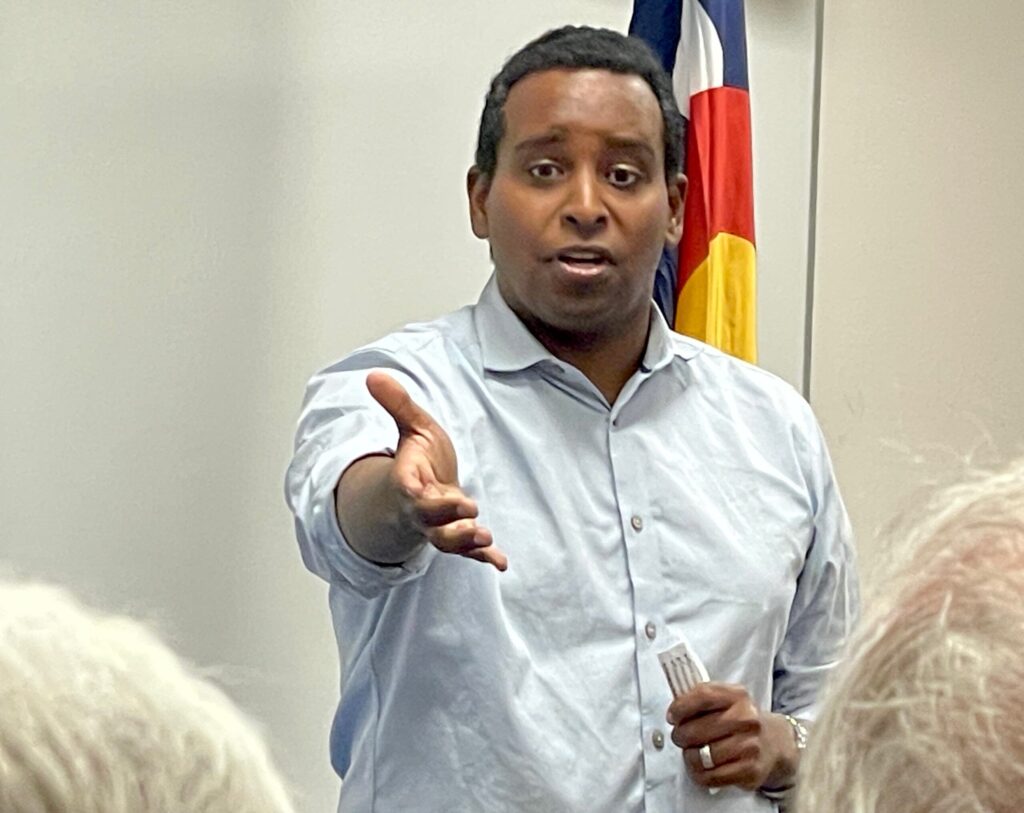
The African roots of three Colorado leaders | SONDERMANN
Eric Sondermann
eric-sondermann@coloradopolitics.com
Updated 3 days ago
Colorado’s political transformation is measured in many ways. A once reliably red state (with asterisks) became purple and is now a rather deep blue. For better or worse, probably the latter, power is ever more consolidated along the Front Range...
Federal judge green-lights civil trial against ex-Fort Collins DUI officer
Michael Karlik
michael.karlik@coloradopolitics.com
Updated 1 day ago
A federal judge ruled on Thursday that Fort Collins’ former “DUI officer” will face a civil trial for allegedly investigating a motorist for impaired driving without any reasonable suspicion to do so. In recent years, several people arrested by Officer...

Denver police reopen 13 sex assault cases after retesting Missy Woods’ CBI work
Jenny Deam
jenny.deam@gazette.com
Updated 1 day ago
Thirteen previously closed Denver sexual assault cases have been reopened after the city’s crime lab retested DNA evidence once analyzed by former Colorado Bureau of Investigation forensic analyst Yvonne Woods. A police spokesperson told The Denver Gazette the once-closed cases...

Ballot measure aims to shift Colorado sporting goods tax revenue to land, water and wildfire projects
Marissa Ventrelli
marissa.ventrelli@coloradopolitics.com
Updated 7 hours ago
Colorado voters this November will decide whether to direct a share of sales tax revenue from sporting goods — including bicycles and skiing equipment — toward land and water conservation, wildfire prevention and expanding outdoor recreation. Supporters say the measure...

Colorado Supreme Court suspends Mesa County judge pending misconduct investigation
Michael Karlik
michael.karlik@coloradopolitics.com
Updated 10 hours ago
The Colorado Supreme Court suspended Mesa County Court Judge Michael J. Grattan on Thursday amid a misconduct investigation. The court’s Sept. 10 order gave Grattan 21 days to explain why his paid suspension should not continue through the end of...

Trump honors the fallen of the 9/11 terrorist attacks during Pentagon speech
Mabinty Quarshie
mabinty-quarshie@coloradopolitics.com
Updated 2 days ago
President Donald Trump and first lady Melania Trump honored the roughly 3,000 Americans killed during the Sept. 11, 2001, terrorist attacks during a ceremony at the Pentagon. The event marking the 25th anniversary of the deadliest attack on American soil...
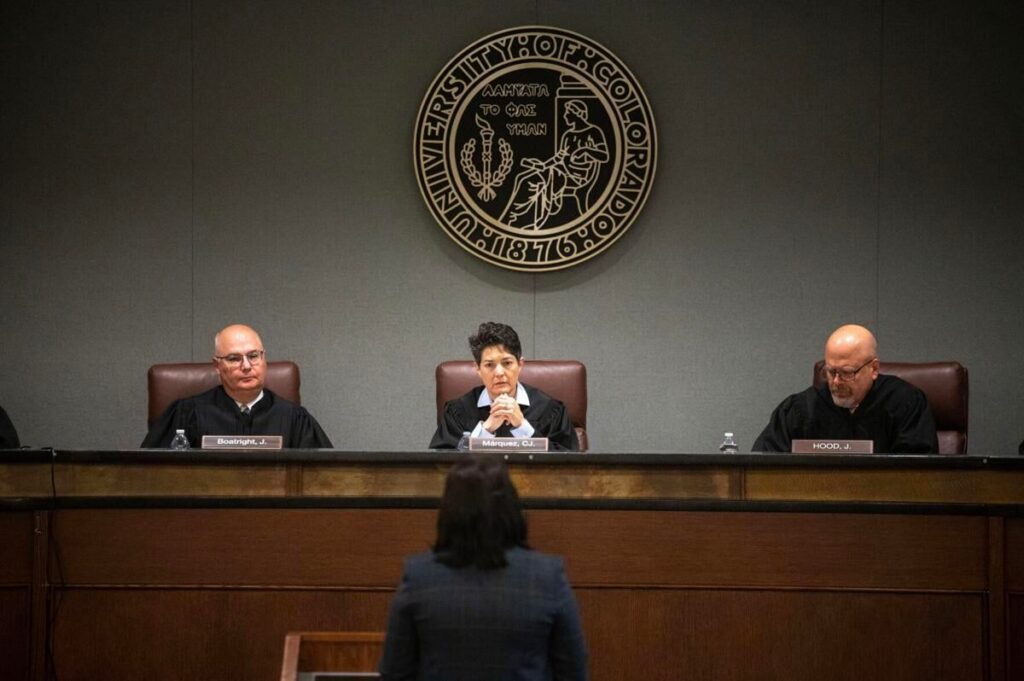
Colorado Supreme Court changes course, dismisses case about special district bonds
Michael Karlik
michael.karlik@coloradopolitics.com
Updated 10 hours ago
The Colorado Supreme Court declined on Friday to decide a dispute between a large-scale Commerce City development and the various districts financing it, after initially showing interest in the ongoing case. Colorado has roughly 2,800 special districts, which are local...

Colorado leaders express outrage and pain following 9/11 attacks | A LOOK BACK
Rachael Wright, Special to Colorado Politics
rachael.wright@coloradopolitics.com
Updated 2 days ago
Twenty-Five Years Ago This Week: “Responding to the 9/11 terrorist attacks, Colorado Gov. Bill Owens told reporters in a statement, “I join all Coloradans in expressing outrage and horror at the senseless terrorist bombings in New York and Washington D.C....
PREV
PREVIOUS
Snow puts General Assembly on two-hour delay for Tuesday
The Colorado General Assembly has announced it will be on a two-hour delay for Tuesday. As of Monday evening, both the House and Senate will gavel in at 11 a.m. Tuesday. The governor’s office also canceled a 9 a.m. Tuesday news conference, to be led by Lt. Gov. Dianne Primavera and scheduled in the west […]

Colorado officials release plan to encourage banks to serve legal marijuana industry
Colorado Gov. Jared Polis and the state Department of Regulatory Agencies released an initiative on Monday aimed at increasing the number of financial services available in the state to businesses in the recreational marijuana and industrial hemp industries. “As the first state to establish a legal marijuana industry and one of the first to implement […]