

Green technology could replace the graveyard in Colorado under 2020 bill

It’s got a bit of the creepy factor (don’t kick the dirt, that’s Uncle Joe!), but the idea of turning people into compost has arrived in Colorado.
State Rep. Brianna Titone (D-Arvada) and Sen. Robert Rodriguez (D-Denver) have latched onto an idea that’s getting a foothold in Washington state: a process to convert dead bodies into compost that can then be used to fertilize a garden, or in conservation efforts.
The process is the brainchild of Katrina Spade of Washington, president and CEO of ReCompose Seattle.
It borrows on what farmers, ranchers and horse owners have been doing for decades: putting their dead animals into a place where the animal decomposes naturally. On farms and ranches, that’s often a manure pile. Transportation agencies have done the same for years with roadkill.
That wouldn’t work for humans, Spade said in a news conference Monday at Feldman Mortuary in Denver. So her plan is to use organic materials such as wood chips, alfalfa and straw.
It works like this: The body is placed in a container on top of the organic materials, covered with another layer of it, and sealed up for 30 days or so. Within two days, Spade said, microbial activity will heat up the inside of that container to 130 to 150 degrees. The heat kills pathogens, and Mother Nature does the rest.

After three weeks, what’s left is little more than soil and large bone fragments, which are ground up and put back inside to finish the process.
Once the 30 days are up, nonorganic materials that are left over — think metal hip or knee joints or a pacemaker — are sifted out and what’s left can be used for compost.

Washington State lawmakers approved a bill in the 2019 session to do just that, and the company goes live in 2021. Spade said they did a pilot in 2018 with six bodies – she met with the people who donated their bodies for the project before they died — to study the process.
Wendy DeBosky of Denver wants to try it when her time comes. She said the process produces carbon savings by replacing one metric ton of CO2. And it’s going to be a great business opportunity, according to Titone.
Jamie Sarche of Feldman, which focuses on gentle and humane ways of dealing with the deceased, pointed out that cremation is really not an environmentally friendly process. One recent study pointed out that cremation requires “the burning of natural gas, and therefore the release of greenhouse gases, as well as the vaporization of other chemicals” such as mercury and dioxins.
A “recomposed” human will produce about one cubic yard of organic compost, according to Spade.
Rodriguez said he did some digging (yup, there will be jokes about this) on the process and believes it will be a safe and environmentally conscious way of disposal. “There’s no reason this can’t be a viable choice,” he said during the news conference.
The cost? At around $5,500, it’s a little more pricey than cremation, which can run between $1,000 and $7,000, depending on whether there’s caskets and other expenses. A burial can run upwards of $12,000.
Once decomposed, it’s up to the family to decide what to do with the soil. According to Spade, they can donate it or use it in their own gardens or property. One person told his grandchildren he wanted them to use it to plant a tree, and once the tree is large enough, put a swing on it so that their grandchildren could use it. Sarche said that people are already showing an interest in “natural organic reduction” (its formal name) in Colorado.
If the measure is successful, Colorado would be the second in the nation to adopt it.
Colorado Politics Must-Reads:


Colorado Politics Calendar Apr. 6-12
Rachael Wright, Special to Colorado Politics
rachael.wright@coloradopolitics.com
Updated 4 days ago
CoPo’s weekly political calendar will help you find political and public-policy events throughout Colorado. It includes candidate and issue campaign events, public policy meetings, court hearings, state and local party conventions, assemblies, debates, rallies, parades, speaking engagements, traveling dignitary appearances,...

Democrats rebounding without learning necessary lessons | SONDERMANN
Eric Sondermann
eric-sondermann@coloradopolitics.com
Updated 13 hours ago
“When we fight, we win!” That, reportedly, was the chant heard over and over again at the Colorado Democratic Assembly a week ago. It suggests that pugilism has been the piece missing from the Democratic toolkit. Perhaps it was just...
An April Fool’s Day to remember | Capitol M | Week of April 4, 2026
Marianne Goodland
marianne.goodland@coloradopolitics.com
Updated 2 days ago
The lighter side of the Capitol, and if light were weight, the Capitol would have lifted off better than the Artemis II rocket on April Fool’s Day. There was a plethora of Fools at the Capitol for April Fool’s Day...
Federal judge sides with Mesa County school district in ex-student’s First Amendment claims
Michael Karlik
michael.karlik@coloradopolitics.com
Updated 1 day ago
A federal judge concluded last week that Mesa County Valley School District 51 and three of its administrators did not violate the First Amendment rights of a former student when they imposed minor discipline in response to disruptive behavior. In...

Colorado Supreme Court intervenes in 4 ongoing cases
Michael Karlik
michael.karlik@coloradopolitics.com
Updated 1 day ago
The Colorado Supreme Court recently moved to intervene in four ongoing cases, including two criminal prosecutions, a civil lawsuit, and a child welfare proceeding. At least four of the court’s seven members must agree to hear a case outside of...
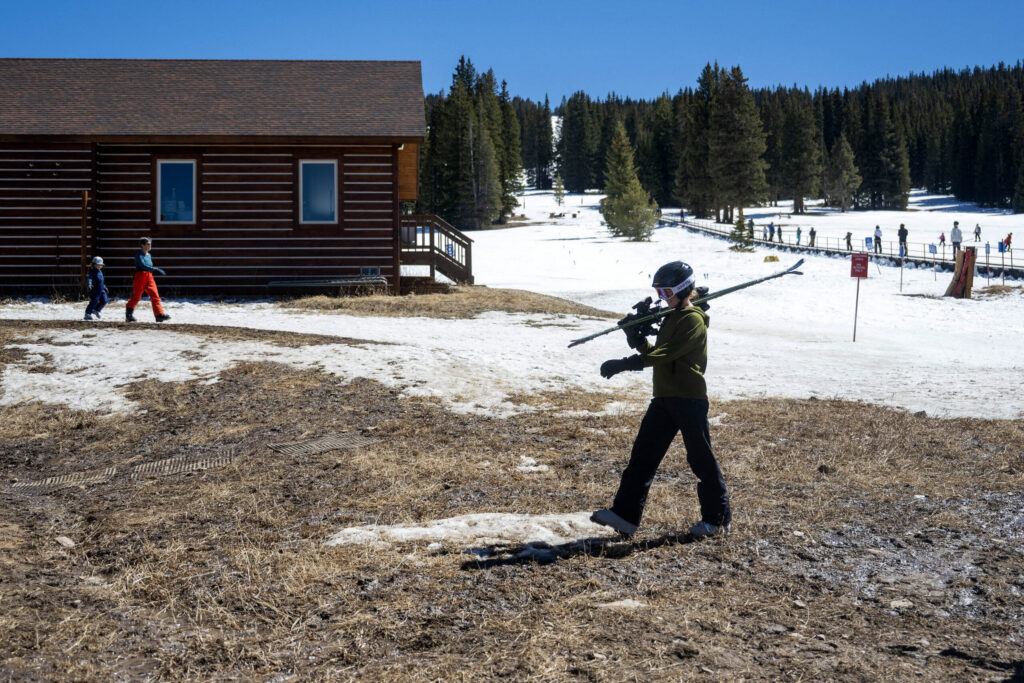
Colorado ski resorts announce early closures amid historic snowpack lows, high temperatures
Kyla Pearce
kyla.pearce@gazette.com
Updated 12 hours ago
Vail Resorts is the latest area to announce season closure Wednesday As Colorado’s historically low snowpack year comes to a close and spring conditions take over the mountains, the state’s major ski resorts are announcing closing dates — some of...

Kentucky Gov. Andy Beshear set to headline Colorado Democrats’ annual fundraising dinner
Ernest Luning
ernest.luning@coloradopolitics.com
Updated 1 day ago
Kentucky Gov. Andy Beshear, one of the Democrats’ top 2028 presidential prospects, is scheduled to deliver the keynote address at the Colorado Democratic Party’s annual fundraising dinner in June in Denver, the party said Friday. Serving his second term as...
Gov. Polis names new leaders for Colorado health agencies in wake of Medicaid turmoil
Marianne Goodland
marianne.goodland@coloradopolitics.com
Updated 1 day ago
Gov. Jared Polis, on Thursday, announced he was appointing Gretchen Hammer to serve as acting executive director of the Colorado Department of Health Care Policy and Financing, and deputy executive director Stephanie Beasley to become the next commissioner of the...
Federal judge releases man immediately as consequence for immigration judge disobeying orders
Michael Karlik
michael.karlik@coloradopolitics.com
Updated 1 day ago
A federal judge ordered a man’s immediate release from immigration detention on Thursday after finding an immigration judge disregarded his prior orders requiring a bond hearing. For the past year, Colorado’s federal district court has faced a flood of “habeas corpus”...
Colorado sues Trump administration, calling new election order ‘unconstitutional’
Marissa Ventrelli
marissa.ventrelli@coloradopolitics.com
Updated 12 hours ago
Colorado Attorney General Phil Weiser has joined a multistate coalition suing President Donald Trump over a new executive order on elections, arguing the directive unlawfully intrudes on states’ authority to run their own voting systems and threatens access to mail...
PREV
PREVIOUS

Q&A with Heather Lamm | 'It's about public school choice'
To listen to Heather Lamm passionately enunciate the virtues of educational choice; to hear her challenge the educational reform movement’s current detractors among her fellow Democrats — it’s easy to forget she was first Dick and Dottie’s daughter. She was the kid who grew up in the historic Denver mansion reserved for governors and their […]
Polis modifies executive order to green-up state government
In the effort to move the state forward to a goal of 100% renewable energy by 2040, Colorado’s state government has to be a good role model, according to Gov. Jared Polis. Toward that aim, Polis on Monday put his stamp on the latest in series of gubernatorial executive orders, dating back to 2005, on […]