

CU Regents reject fossil-fuel divestment over objections of student activists
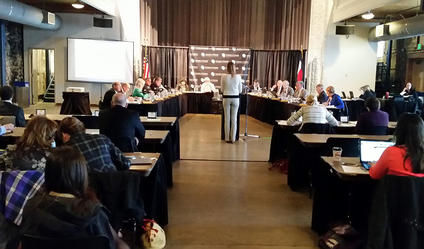
This was a tough week for Fossil Free CU, the University of Colorado’s pro-divestment student group. First its protest camp on Boulder’s Norlin Quad was snowed out, and then the Board of Regents voted against divesting the endowment from oil, natural gas and coal.
The board rejected calls for divestment in a 7-2 vote at Thursday’s meeting, citing state law and university policy that require the prudent and non-political investment of public funds. Minutes later, the board voted down a motion from Regent Linda Shoemaker to create a sustainable investment advisory committee.
Regent John Carson, who introduced the motion to reject fossil-fuel divestment, cited a board policy on investment that calls for “the principle of institutional neutrality on social and political matters.”
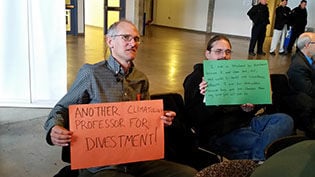
Supporters of fossil-fuel divestment make their views known during the CU Board of Regents’ meeting at the Auraria Campus.Photo by Valerie Richardson/The Colorado Statesman

“Clearly that’s directed at not allowing our investment decisions to be influenced by politics and movements of the day,” said Carson, a Republican. “We want our investment decisions, our treasurer to be basing those decisions on the best interests of the university and the return to the university. The University of Colorado’s investment decisions must first and foremost advance the institution’s financial interests and support its academic mission.”
Fossil Free CU responded with a statement saying that “we expect better of our decision-makers.”
“The Board made clear today whose side they have chosen, and is not the side of students,” said the group on Facebook. “In light of today’s meeting, we are committed to continue escalating this campaign, because Fossil Free CU organizers know that our university cannot falter on climate justice.”
The outcome wasn’t unexpected. Not only do Republicans hold a 5-4 majority on the board, but dozens of top universities nationwide, including Harvard, Yale and the University of California, have already rejected similar student-driven divestment drives.
The campus movement’s biggest victory came March 31, when Syracuse University agreed to prohibit direct investment of its $1.2 billion endowment in publicly traded companies whose primary business is fossil-fuel extraction.
Still, divestment advocates are playing catch-up. Prior to Thursday’s vote, about 47 U.S. universities with a combined endowment of more than $101 billion had turned down calls for divestment. On the other end, 23 U.S. higher-education institutions with a combined $2.8 billion endowment have embraced it, according to the International Petroleum Association of America’s DivestmentFacts website.
Among those that have agreed to divest is Naropa University in Boulder, which announced in October 2013 that it had sold off its holdings in companies “identified by 350.org as having the highest potential greenhouse gas emissions, based on their carbon reserves.”
Naropa has an endowment estimated at $6.25 million, while the University of Colorado’s endowment, including funds managed by the CU Foundation, comes in at nearly $2.7 billion.
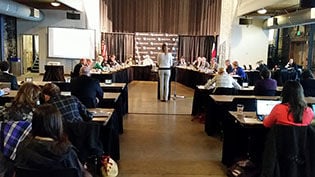
Anna Vallad of CU College Republicans testifies against divesting from fossil fuels at the University of Colorado Board of Regents meeting at the Auraria Campus.Photo by Valerie Richardson/The Colorado Statesman

Despite the passion of Fossil Free CU organizers, only about two dozen students and other activists showed up for the board meeting. Students chalked up the lackluster attendance to bad weather: The meeting took place during Thursday’s heavy spring snowstorm, making driving conditions difficult.
Frustration on both sides during the meeting was evident. Regent Sue Sharkey said she was exasperated by the divestment movement’s “demonization of energy companies. They’re not our enemy.”
“It is a ridiculous case I think to make that this university divesting from fossil fuels is going to make a difference toward climate change or global warming or whatever the term is—I can’t keep up,” said Sharkey, a Republican. “Whatever it is, divesting is not the answer.”
During public comment, Bob Moody, director of the Denver Energy Network, said divestiture by a public university “should be an economic decision, not a political statement promoted by radical extremists,” which brought a rebuke from Regent Stephen Ludwig.
“We want to be careful about that sort of charged language. That’s all,” said Ludwig, a Democrat.
Other speakers touted the benefits of inexpensive, abundant energy from fossil fuels, including Stacy Alexander, director of Flatirons Responsible Energy Action, who said, “We believe there is a moral and ethical case for oil and gas development because everyone deserves affordable energy.”
The presentation by Fossil Free CU focused on the economic viability of divesting from fossil fuels. Financial consultants from Green Alpha Advisors in Boulder speaking on behalf of divestment said that investing in renewables versus fossil fuels was a more sensible strategy, given the growth of the green energy sector.
“It’s certainly true that fossil fuel have brought us to the advanced technological economy we live in today, and they’re going to continue to be a part of the global economy for decades. That’s not in dispute,” said Green Alpha co-founder Garvin Jabusch. “And yet from a perspective of long-term care client assets, it’s now clear that globally the growth phase of fossil fuels has come to an end.”
Regent Michael Carrigan, a Democrat, praised the group’s approach.
“I just want to compliment you all on presentation, and just to [follow] Regent Ludwig’s comments, this demonstrates that what you’re talking about isn’t a bunch of crazy left wing radicals, but there’s an honest dialogue and respectful dialogue by all parties and all sides,” Carrigan said.
Later, however, Fossil Free CU took a swipe at Carson and Sharkey, calling her a “denier.”
“We’re disappointed in the Board’s failure to take meaningful action on this issue, and regard incredulously the statements made by climate-denier Regent Sue Sharkey and Regent John Carson. We expect better of our decision makers,” said the statement.
Carson argued that voting to divest would not only threaten the board’s ability to carry out its fiduciary duty, but also compromise the academic freedom of professors and researchers, particularly those working on climate change.
“The laws of the regents further require that members of the faculty must have complete freedom to study, to learn, to do research, and communicate the results of these pursuits to others, and to engage in academic freedom,” Carson said. “And so taking positions on issues of the day by the board of regents could potentially have an impact on academic freedom.”
He pointed to the recent case of CU Boulder environmental studies professor Roger Pielke Jr., one of seven professors nationwide whose funding sources and congressional testimony was the subject of a House Democrats’ investigation launched in February.
Carrigan added a friendly amendment to the anti-divestment resolution directing the board’s investment advisory committee and treasurer to report back in November on “what options are available” in terms of promoting sustainability.
“I do not envision a scenario in which we will support total divestment, but I don’t see this as a black and white issue,” said Carrigan shortly before the vote. “I do think that there are ways that this university can express its commitment, not only through on campus policies but through investment strategy.”
After the anti-divestment vote, Shoemaker proposed creating a sustainable investment advisory committee, emphasizing that “this is not a resolution asking the university to divest.”
“I do not think that this board is at all interested in that,” said Shoemaker, a Democrat. “It is a moderate, middle-ground resolution because I believe that the right economic decision for this university is to move out of fossil fuel investments and to move toward renewables.”
Regent Steve Bosley noted that the university already has an active investment advisory committee that considers “all opportunities, all investments,” but Shoemaker said the committee may have too much on its plate.
“My understanding is that that committee is very active, very busy—it meets eight times a year–and that I guess is why I propose another committee, or subcommittee, that could specifically look at these issues,” Shoemaker said. “I don’t think this university is currently looking at the kind of sustainable investing I would like to see.”
Her motion failed 6-3. Shortly after the meeting, Fossil Free CU organizers announced the end of its three-day “occupation” of Norlin Quad, which was covered with snow, but warned that the student push for divestment was far from over.
“We feel that the Board’s actions have necessitated escalating student-driven action,” the statement said, “and we are prepared to implement the knowledge gained at nonviolent direct action and civil disobedience trainings given at the occupation.”
Twitter: @ValRichardson17

Fifty years later, women reflect on first coed class at the Air Force Academy, struggle for equality
Mary Shinn
mary-shinn@coloradopolitics.com
Updated 2 days ago
When the first female Air Force Academy cadets arrived 50 years ago this summer, they stood in front of an enormous sign on campus that read “Bring me men.” In the shadow of that sign, Kathleen Utley Kornahrens, one of...

As Lake Powell shrinks, marinas are having to adapt to dwindling water levels | OUT WEST ROUNDUP
The Associated Press
the-associated-press@coloradopolitics.com
Updated 5 days ago
ARIZONA Reservoirs near record lows PAGE — The Colorado River’s Lake Powell, the second largest reservoir in the U.S., is shrinking. A record-dry winter and extreme heat — as well as decades of overuse, chronic drought and climate change —...

A new day? Colorado’s troubled guardianship office pursues ‘cultural reset’
Marianne Goodland
marianne.goodland@coloradopolitics.com
Updated 4 days ago
Colorado’s guardianship program, long criticized for mismanagement and high staff attrition, is undergoing a “cultural reset,” as its new director works to repair partnerships and prepare for a major expansion under recent legislation. Created by lawmakers in 2017, the Office...
U.S. Senate OKs funding bill to avoid government shutdown
Wire Services
wire-services@coloradopolitics.com
Updated 2 days ago
Hemp provision became point of contention WASHINGTON • The U.S. Senate in an overnight vote Saturday approved a short-term measure to fund federal agencies into early December and avoid a government shutdown during the middle of campaign season. The late-summer...
The relevance of Watergate more than a half-century later | SONDERMANN
By Eric Sondermann
by-eric-sondermann@coloradopolitics.com
Updated 5 days ago
It was the scandal for which all other scandals are now named. In June 1972, a small group of Cuban burglars with high-level connections broke into the headquarters of the Democratic National Committee. Those headquarters were located in the Watergate...

Wirth downplays Social Security disaster talk | A LOOK BACK
Rachael Wright, Special to Colorado Politics
rachael.wright@coloradopolitics.com
Updated 4 days ago
Forty-five years ago this week: “As time goes on,” said Democratic U.S. Rep. Tim Wirth, of the 2nd Congressional District, “we are finding that the safety net, which was proposed earlier this year, has some very large holes in it,”...

Colorado Politics Calendar Aug. 10-16
Rachael Wright, Special to Colorado Politics
rachael.wright@coloradopolitics.com
Updated 4 days ago
CoPo’s weekly political calendar will help you find political and public-policy events throughout Colorado. It includes candidate and issue campaign events, public policy meetings, court hearings, state and local party conventions, assemblies, debates, rallies, parades, speaking engagements, traveling dignitary appearances,...

Democratic group aims Spanish-language TV ad at Gabe Evans in Colorado’s battleground 8th CD
Ernest Luning
ernest.luning@coloradopolitics.com
Updated 2 days ago
A national group tied to House Democratic leadership launched a six-figure Spanish-language TV ad in Colorado this week targeting Republican U.S. Rep. Gabe Evans and the GOP’s signature budget legislation. The 30-second spot is part of $15 million in new...

Colorado School of Mines lands major share in Trump’s $100M mining-education plan
Thelma Grimes
thelma.grimes@coloradopolitics.com
Updated 2 days ago
President Donald Trump on Friday named the Colorado School of Mines among roughly a dozen institutions that will share in a $100 million commitment “to train the next generation of American miners.” Paul Johnson, the university’s president, said he is...
Local party leaders, incoming judge among members of judicial performance commission that violated law
Michael Karlik
michael.karlik@coloradopolitics.com
Updated 2 days ago
A local Democratic leader and 2024 presidential elector. A legislative aide and leader in the Young Republicans. An incoming county court judge freshly appointed by the governor. They are among the eight members of the northeastern Colorado judicial performance commission...
PREV
PREVIOUS
House ‘Coup’ Fails
House Republicans attempted to challenge the authority of Speaker of the House Dickey Lee Hullinghorst, D-Boulder, on Wednesday morning. It was a procedural move that long-time Capitol observers said they’d never seen before. The move came during the reading of the previous day’s House Journal. The Tuesday journal contained the report of the House State, […]
“A New Birth of Freedom”
Sen. Chris Holbert, R-Parker, is contributing a column to this week’s print edition. The Colorado Statesman is publishing the column in serial form online this week. On Wednesday, April 15, 2015, Sen. Rollie Heath, D-Boulder, and I shared the honor of introducing Senate Joint Resolution 15-024 commemorating the 150th anniversary of the death of President […]