

AG hopefuls face the Bars

Three candidates for Attorney General engaged in a spirited debate before the Colorado Bar Association this week. David Williams, Libertarian, Cynthia Coffman, Republican, and Don Quick, Democrat, were afforded a three-minute opening, followed by a series of questions submitted from various interest group bar associations. Fred Brown, former columnist and editor with The Denver Post now teaching journalism ethics at the University of Denver, served as moderator. Perhaps a hundred attorneys filled the room, undistinguishable from any similar group assembled along the 16th Street Mall in downtown Denver. Three piece suits for men and power skirts and jackets for women together with high heels appear to be disappearing uniforms for our legal profession. Fleece vests, sneakers and open necked shirts were more common than coats and ties.
The candidates used their introductions to outline their legal careers. David Williams, although raised for a few years in Fort Collins while his parents pursued graduate degrees at CSU, attended both college and law School at the University of North Carolina. He was effusive in expressing his appreciation for being included in this debate, after much exclusion as a minor party candidate during the 2014 campaign. Born in Arkadelphia, Arkansas, he spent most of his legal career practicing in North Carolina, both as a magistrate and defense attorney. After returning to Colorado he recently became involved as one of the lawyers representing most of the Colorado sheriffs in their lawsuit against the legislature for gun control measures it approved in 2013.
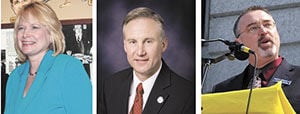
From left, AG Candidates Cynthia Coffman, Don Quick and David Williams.

Cynthia Coffman also immigrated to Colorado from Georgia after working as a litigator there in the state Attorney General’s office. Arriving in 1997, she accepted a position with the Legislature’s legal services office, leaving to enter a private practice as a securities specialist once she passed the Colorado bar exam. In 2004 she joined the staff of Governor Bill Owens in his office of legal counsel, accepting the position in 2005 as Chief Deputy Attorney General to John Suthers where she has served since.
Don Quick emphasized his Colorado roots, including his degree from the University of Colorado law school. Following graduation, he then went to work in 1986 as a prosecutor in the Adams County District Attorney’s office, eventually advancing to chief prosecutor for the office. He later joined Ken Salazar as his chief deputy in the Attorney General’s office prior to running for District Attorney in Adams County, where he now serves.
The first question addressed to the candidates by the Colorado Bar Association was to identify their priorities for the Attorney General’s office if elected. Coffman responded by saying she intended to operate a first rate law firm on behalf of the people of Colorado. She pointed out that the AG must serve as lawyer for state agencies as well as other elected officials, while defending the state constitution and upholding legislative statutes. She singled out data privacy as an emerging challenge for the office.
Quick indicated he wanted to be a “good attorney” for Colorado voters, pointing out the pride he takes each time he appears in court and states that he is appearing “…for the people.” He identified veterans, victims (particularly sexual assault victims), seniors (fraud), kids and the environment as areas on which he would focus office resources. He also proposed the creation of a public corruption unit.
David Williams shook up the proceedings, as he would continue to do throughout the afternoon, by stating that he viewed the AG’s primary responsibility as enforcing provisions of the U.S. and Colorado constitutions — “…not the nonsense passed by the Legislature.” He railed against further infringements on individual rights and noted that Colorado is a “…sovereign entity and should act like it.” In rebuttal Coffman objected to his characterization of state statutes as nonsense and pointed out that the AG was obliged to defend state law.
A representative from the Colorado Women’s Bar then asked the candidates about their positions on pay equity. Williams responded by indicating that everyone should be paid what they are worth, objecting to state-imposed red tape and regulatory requirements. Coffman emphasized her support for equal pay for equal work and pointed out that the current AG’s staff is evenly split between male and female attorneys with identical pay scales for both. She also touted a “legal inclusiveness pilot project” undertaken by the Suthers administration. Don Quick confirmed his commitment to pay parity and suggested that job sharing should be introduced to assist attorneys with growing families. Williams would not back away, referring to George Washington’s observation that government is not reason but force. Coffman then pointed out that equal pay is not a question of policy, but one of enforcing existing law.
A member of the Asian Bar inquired when the AG should enter into lawsuits filed outside Colorado. Coffman indicated that a suit should meet one of two tests: One, does it affect Colorado residents? Two, does Colorado have a similar law that justifies joining with other states? Don Quick objected that this had not been Coffman’s position when she was nominated at the Republican state assembly. There Coffman reportedly promised to resist infringements on Second and Tenth Amendment liberties, as well as federal rules governing the use of public lands. Coffman resisted Quick’s characterization by explaining she was inveighing against “federal overreach” such as the EPA’s expansion of the definition of navigable waters to include seasonal drainages and irrigation ditches. Williams enlivened things by stating that there are no such things as “state’s rights” — that only individuals have rights while the state enjoys authority.
In light of the U.S. Supreme Court action earlier in the day where the country’s highest court declined to hear cases on gay marriage and essentially allowed for marriage equality in several states including Colorado, the GLBT Bar discarded its prepared question regarding gay marriage and substituted one regarding whether the Hobby Lobby decision opens the door to the discriminatory treatment of gays. Quick replied by objecting to preferential treatment for religious views when they contravene medical science. “What if Jehovah’s Witnesses were to object to transfusions for their employees?” he proposed. He closed by declaring he would ensure full rights were available to gays. Williams objected that none of these matters were the business of government offering a history lesson linking civil marriage laws, which he claimed were introduced following the Civil War as a legal device to prevent miscegenation of the races. Coffman returned to the marriage question, defending the AG’s defense of the ban approved by Colorado voters, by pointing out that the “process worked.” She pointed to the “wedding cake” case prosecuted by the AG as an appropriate defense of Colorado civil rights’ law — ensuring that public businesses will provide their services to all.
The Hispanic Bar asked whether, as AG, the candidates would challenge the Secretary of State if the Secretary were intent on disenfranchising voters. Williams said that he supported photo ID requirements, but would object to any attempt at blocking voters, calling the vote a “sacred right.” Coffman echoed the sacred nature of the ballot, but pointed out that merely because the AG serves as attorney for the Secretary of State does not mean the client will accept their best advice. She indicated she didn’t wish to go any further or get more specific for fear of violating attorney-client privilege by breaching confidentiality. The audience snickered. Quick criticized Coffman for having addressed “True the Vote” together with current Secretary of State Scott Gessler. In rebuttal Coffman indicated she had merely recounted the peculiarities of Colorado election law and offered to provide a “very boring” transcript to anyone who wanted one.
The African American Bar offered a lengthy peroration against wrongful convictions that concluded by asking whether the candidates would act to investigate and prevent such miscarriages of justice. Coffman pointed to the AG’s investigation of 600 cases following requests from DOC inmates, which led to a single reversal for Robert Dewey. She advocated for the continued commitment of the AG’s office to a best practices policy for prosecutions.
Quick highlighted his investigation and eventual exoneration of Tim Masters based on DNA evidence. Williams called for mandatory video cameras worn by all Colorado peace officers as a win-win for everyone. He then surprised the audience by indicating his commitment to limited government principles requires him to oppose capital punishment. He offered the 146 DNA tests that have overturned death row penalties nationwide in support of his position. “Better to release them than have to dig them up,” he observed.
A pair of concluding questions asked whether the AG has a role to play in the Jefferson County School Board’s curriculum dispute and if there is a way to reconcile federal and state laws regarding marijuana. Although objecting to the “whitewashing of history,” Don Quick agreed with his opponents that there are no legal grounds for the AG to get involved in the Jeffco conflict.
Williams stated he was sure the audience already concluded that he supports more, not less, civil disobedience, but believes this particular controversy will get sorted out at the ballot box, “where it belongs.” Coffman mentioned she has heard similar objections to “Common Core” requirements during the campaign but then contrasted the local control of curriculum afforded school boards by Colorado law with specific legislative mandates for implementing Common Core.
With respect to the evident conflict between federal and state laws regarding marijuana, Quick pointed out that prohibition had been instituted with a constitutional amendment. Federal marijuana restrictions, by contrast, are merely statutes and he suggested that local authorities, primarily county sheriffs, simply quit cooperating with their federal counterparts on this issue. Coffman indicated that Colorado has now established property rights for growers and retailers and that any federal attempt at pre-emption may legally constitute a “taking.” Williams analyzed the War on Drugs as a perverse scheme that incentivizes the “bad guys.”
An audience question about the high recidivism rate in Colorado prisons also elicited a common response from the candidates. Forty percent of inmates are recycled felons, third worst in the nation. More money and mental health and drug counseling as well as evidence based parole practices are called for, but Quick pointed out that this would not necessarily be politically popular. “We have to show that prevention is cheaper than incarceration,” he emphasized. He also took this opportunity to point out that he had recently been endorsed by more than 20 law enforcement professionals, including Ari Zavaras, former Denver Police Chief and two time Director of the Department of Corrections, and a handful of Republicans including Mesa County District Attorney Pete Hautzinger.
Colorado Politics Must-Reads:

Atop taxes, here’s how much each Colorado resident pays in fees
Marissa Ventrelli
marissa.ventrelli@coloradopolitics.com
Updated 8 minutes ago
Each Colorado resident paid nearly $5,000 in state-sanctioned fees last year, according to a report by a policy think tank. The report, which analyzed how fees have affected Colorado’s economy, found that fee revenue has more than tripled since 2008...
Colorado National Guard, Swiss Armed Forces celebrate partnership
Marissa Ventrelli
marissa.ventrelli@coloradopolitics.com
Updated 2 hours ago
Colorado’s National Guard marked a year of partnership with the Swiss Armed Forces at the Governor’s Mansion on Monday. “This anniversary marks one strong year of friendship and collaboration between the State of Colorado and Switzerland,” said Gov. Jared Polis....
Judge allows Trump to refile $15 billion lawsuit against the New York Times
Emily Hallas
emily-hallas@coloradopolitics.com
Updated 2 hours ago
A federal judge declined to dismiss President Donald Trump’s multibillion-dollar lawsuit against the New York Times on Monday, giving him roughly four weeks to amend his case after the outlet moved to toss it on First Amendment grounds. District Judge...

Gov. Polis celebrates Colorado’s first-place education ranking from U.S. News
Marianne Goodland
marianne.goodland@coloradopolitics.com
Updated 42 minutes ago
Colorado officials said they have something to celebrate this week, in addition to the state’s sesquicentennial birthday on Saturday. U.S. News & World Report on Tuesday gave Colorado its top ranking for education efforts from pre-K to postsecondary, though it...

Denver detox center did not violate man’s rights with 10-hour hold, 10th Circuit says
Michael Karlik
michael.karlik@coloradopolitics.com
Updated 2 hours ago
The Colorado-based federal appeals court concluded on Tuesday that Denver’s detoxification facility did not violate a man’s rights by holding him against his will for 10 hours until his blood alcohol content was projected to reach zero. Unusually, Brian Garrett’s...
Federal judge clarifies ex-GOP treasurer candidate’s burden to prove defamation claims
Michael Karlik
michael.karlik@coloradopolitics.com
Updated 2 hours ago
A federal judge clarified last week that businessman and former Republican statewide candidate Brian Watson will need to surmount a higher hurdle in proving his claim that a party guest’s alleged description of him as a “criminal” amounted to defamation....

Denver City Council sends Xcel franchise deal to voters
Deborah Grigsby
deborah.smith@denvergazette.com
Updated 4 hours ago
This November, Denver voters will decide whether to renew the city’s longstanding franchise agreement with Xcel Energy. Members of the Denver City Council approved on Monday sending a proposed 20-year franchise agreement with Xcel that would deliver more than $180...
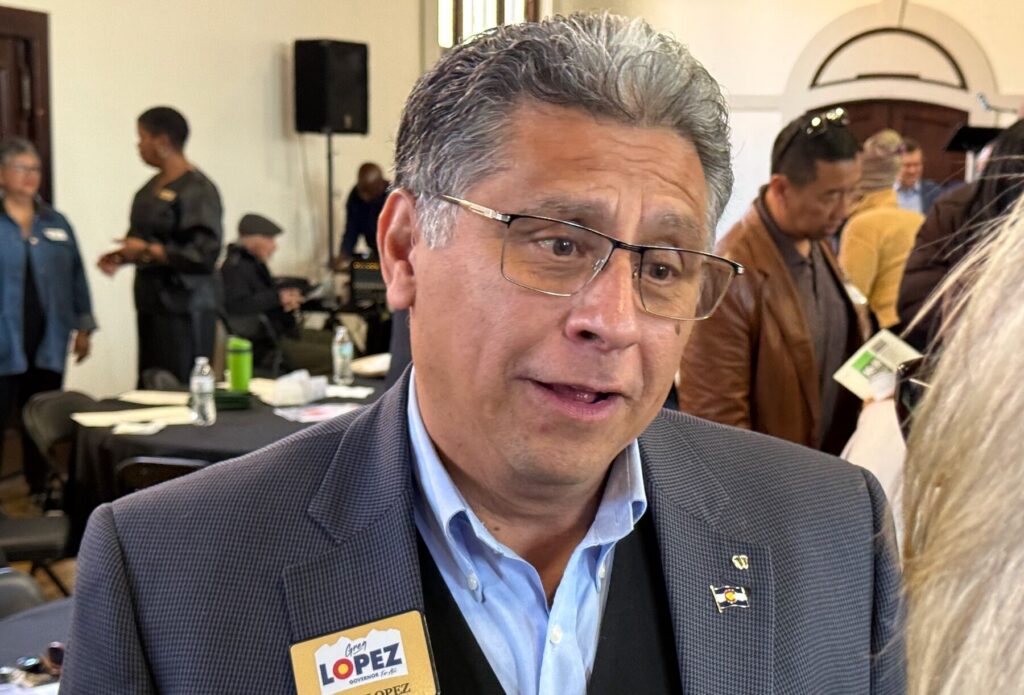
Independent gubernatorial candidate Greg Lopez, a former GOP congressman, qualifies for Colorado ballot
Ernest Luning
ernest.luning@coloradopolitics.com
Updated 2 minutes ago
Unaffiliated gubernatorial candidate Greg Lopez, a former Republican congressman from Elizabeth who left the GOP to run as an independent, has qualified for the ballot by submitting enough petition signatures, the Colorado Secretary of State’s Office said Tuesday. He’ll face...
At Colorado’s 150th anniversary, leaders offer birthday wishes
Thelma Grimes
thelma.grimes@coloradopolitics.com
Updated 6 hours ago
As Colorado’s 150th anniversary approaches, leaders from across the state reflect on the spirit that binds the plains, mountains, Western Slope and Front Range — a shared commitment, they underscored, to opportunity, community, stewardship and personal freedom. Their tributes highlight...
Fauci’s private COVID-19 diaries: Six takeaways on fame, prize money and the lab leak debate
The Washington Examiner
the-washington-examiner@coloradopolitics.com
Updated 9 hours ago
Anthony Fauci’s private writings from 2020 and beyond portray a public health official who was fixated on his growing celebrity while privately grappling with a pandemic response he believed was chaotic, leaderless and consumed by internal rivalries. The writings of...
PREV
PREVIOUS
High stakes Amendment 68 debated at local chamber
Well-known Colorado politicos debated controversial Amendment 68 at the South Metro Chamber of Commerce office in Centennial on Oct. 7. The citizen initiative, if passed by voters on Nov. 4, would provide as much as $114 million annually to improve Colorado K-12 public and charter schools by permitting expanded gaming at Arapahoe Park horse racetrack. […]

Gubernatorial candidates debate goes to pot
Gubernatorial candidates John Hickenlooper, the Democratic incumbent, and former U.S. Rep. Bob Beauprez, his Republican challenger, clashed over public safety questions and the state of Colorado’s economy at a debate in Denver on Monday, but it was an off-the-cuff quip by Hickenlooper about state voters’ decision to legalize marijuana that drew the most attention. The […]