

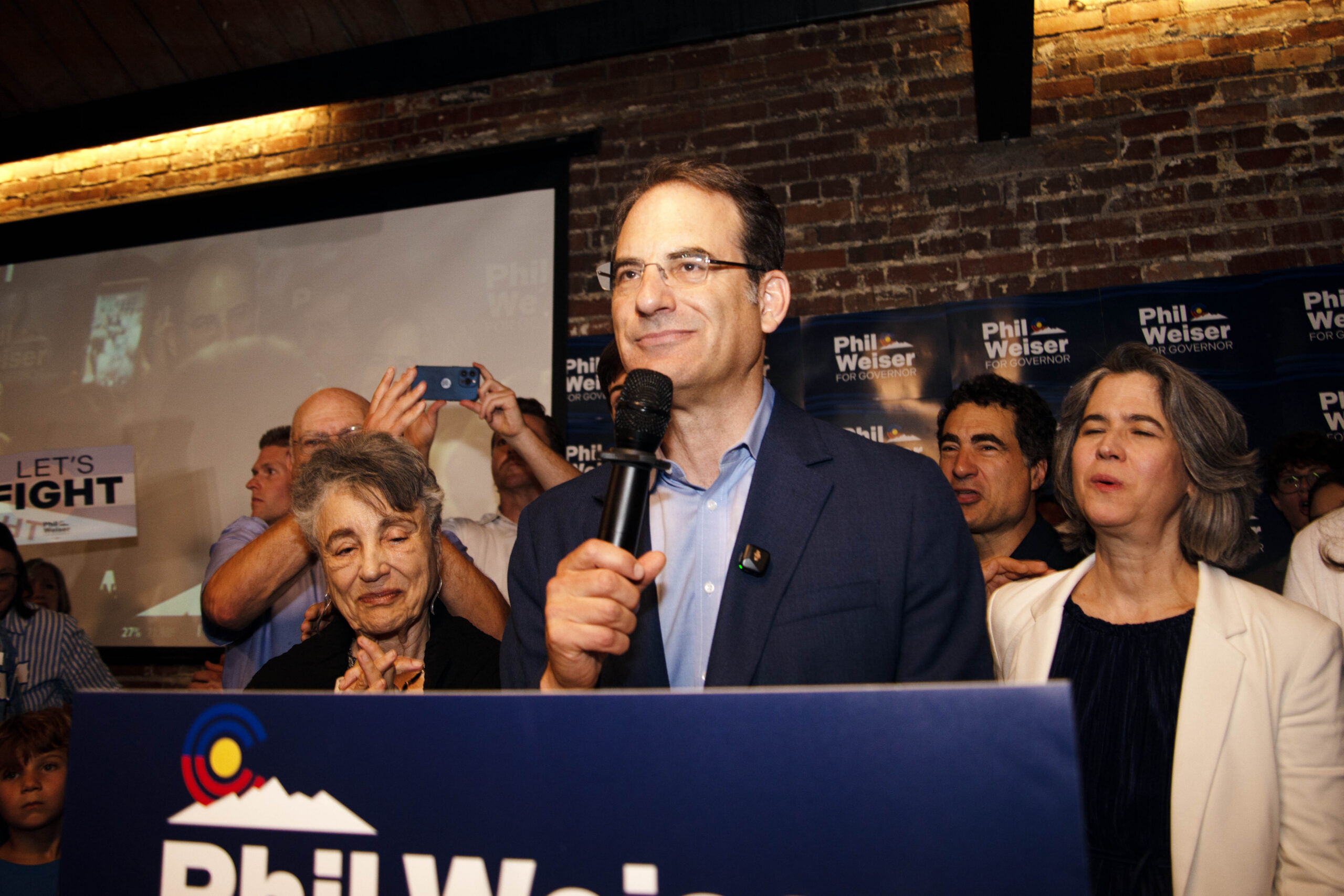
Phil Weiser’s sudden need to find the brake pedal | SONDERMANN
Indulge me with a personal story at the outset. Trust me, it relates.
Years ago, when our kids were young, we briefly had a small jalopy for a babysitter’s use. One morning, I discovered that the battery on this poor excuse for a car was dead. Our driveway sat on a bit of an incline, so I needed to push the vehicle to the bottom, where I could jump-start it from my car.
My wife was sick at the time and urged patience on this particular project. But I was headstrong and determined to get it done. In something short of a genius moment, I enlisted Katrina, our then nine or ten-year-old daughter, to be my right hand. Or right foot.
I put Katrina in the driver’s seat; showed her the brake pedal; and told her to push it as I gave the car a shove down the small hill. As the car picked up steam, I started hollering at her to hit the brake. She was coming out of her seat trying to do so. In a few seconds, there was a big thud as the car struck the tree beside the driveway.
It turns out my daughter had been pressing with every ounce of her being on the clutch. I had neglected to note that the clunker came with a manual transmission and had shown her the wrong pedal.
Better hitting the tree than rolling out into the middle of the street or striking a neighbor’s nice wheels. Admitting the obvious, this was a total parental fail. A quarter-century later, I still hear about it at family gatherings.
The point of this anecdote is to serve as a testament to the importance of brakes. Phil Weiser, Colorado’s governor-elect for all intents and purposes if not formally, is about to come to this realization.
The headline story on the first of July centered on Weiser’s stunningly large victory over Michael Bennet, the early front-runner and presumptive nominee for much of the political establishment.
But buried on the inside of those papers was news of one contested Democratic legislative primary after another being won by the more polarized, farther-left, “progressive” candidate, often endorsed by the Democratic Socialists of America and the Working Families Party representing the party’s outer perimeter.
These activist winners include Iris Halpern and Gabriel Cervantes, both of whom handily knocked off Democratic incumbents, along with Kenny Nguyen, Jamie Jackson, Chela Garcia Irlando and Consuelo Redhorse.
It was close to a clean sweep of those battleground races and a wipeout for One Main Street, the political arm of the party’s long-dominant centrist interests.
Most of these nominees come from largely Democratic districts and can be expected to take their seats next January. They will join plenty of other Democrats of similar persuasion and with a few years of legislative tenure.
Of course, these progressive wins go hand-in-hand with Melat Kiros’s ouster of Denver’s congresswoman in perpetuity, Diana DeGette. Kiros is sure to be a lightning rod and the media will seek to draw Weiser into the fire even though she will be off in Washington doing Washington things.
The progressive caucuses in both the state Senate and House will have unprecedented numbers and power in coming years. This coalition will go from being a sideshow to occupying the main legislative stage. Their policy demands will be felt on economic and regulatory matters as well as a range of issues under the heading of “social justice.”
To the surprise of many who had categorized Gov. Jared Polis as some sort of Boulder leftie, he emerged, particularly in latter years, as a backstop against legislative excesses. His veto pen was inked up and ready to go.
While Weiser ran a bit to Bennet’s left, that was mainly due to political opportunity. It was the available lane. In this political climate, it was advantageous to sit outside the established order. Though many of the campaign differences between Weiser and Bennet seemed manufactured. Both of their ideological orientations fit comfortably in the party’s mainstream.
Weiser will hardly be a replication of Polis. He will have his own agenda and style. But like his predecessor, Colorado’s governor-in-waiting understands that the state cannot prosper without a robust business sector and that the most progressive types within his party’s ranks are hardly representative of the broader population.
Moreover, Weiser gets that the majority of constituents he will soon serve are unaffiliated and disgusted with both parties and polar extremes. He may have set his sights on the governorship with an expansive agenda. But the nature of who will accompany him into office will require him to pump the brakes as much as he punches the gas.
Weiser’s role model and honorary campaign chair is former Gov. Roy Romer. Though the circumstances of their leadership could not be more at odds.
Romer, 98 in October and going strong, was a sturdy, forceful executive during his 12 years, during which his party never controlled either legislative chamber. At the time, that seemed a burden and obstacle. Weiser may soon envy the relative ease of reining in the opposition party instead of his own.
Eric Sondermann is a Colorado-based independent political commentator. He writes regularly for Colorado Politics and The Gazette. Reach him at EWS@EricSondermann.com; follow him at @EricSondermann

Colorado’s precarious position protecting from wildfires | Paula Noonan
Paula Noonan
paula-noonan@coloradopolitics.com
Updated 1 hour ago
Fourteen firefighters died in the Storm King Mountain fire west of Glenwood Springs in 1994 when 2,115 acres burned. In August 2020, the Grizzly Creek fire burned 32,631 acres along the Interstate 70 corridor east of Glenwood causing mudslides from flooding...
Blue states should avoid disasters | Hal Bidlack
Hal Bidlack
hal-bidlack@coloradopolitics.com
Updated 2 days ago
Back when I was teaching political science at the U.S. Air Force Academy (and amazingly to me, a week from this column’s publication will mark 20 years since my retirement from active duty. Where the heck did that time go?)...
Jena Griswold’s record: corruption, incompetence | Dick Wadhams
Dick Wadhams
dick-wadhams@coloradopolitics.com
Updated 5 days ago
There is no statewide elected official going back decades who is as breathtakingly corrupt and incompetent as Secretary of State Jena Griswold, who is now running for attorney general of all things. And compliant ruling Democrats know it. Their silence...

Kiros exudes why Colorado’s political times are a-changin’ at annual Denver Dems gala | Miller Hudson
Miller Hudson
miller-hudson@coloradopolitics.com
Updated 5 days ago
Among Colorado’s few remaining bipartisan rituals are county and state party dinners. I was particularly intrigued by last week’s Denver Democratic Party’s 2026 Annual Gala, a “New Deal for a New Era.” Their glossy program featured an artist’s Technicolor rendering...

Livestock grazing regulations need flexible updates | Rachel Gabel
Rachel Gabel
rachel-gabel@coloradopolitics.com
Updated 5 days ago
The Bureau of Land Management last updated their livestock grazing regulations the year I graduated from high school. I am 49. Assessing rangeland health can’t be done once and not revisited. This year is a prime example that managers must...

Taxpayers donate to tax increase campaign | Jon Caldara
Jon Caldara
jon-caldara@coloradopolitics.com
Updated 6 days ago
Give the man his due. President Donald Trump has undeniable talents. Colorado politicians are learning. Chief among The Don’s skills is taking the self-serving, ethically dubious behavior of previous politicians and putting it on steroids. Or, to borrow from the...
A summertime all-you-can-eat political buffet | SONDERMANN
Eric Sondermann
eric-sondermann@coloradopolitics.com
Updated 1 week ago
We find ourselves in the doldrums of August with a complete dearth of political news. Yeah, right. These days, that train never stops moving. It is a 24/7/365 express amplified by 24/7/365 media. Let me respond with one of my...
State money diversion scheme the unsurprising downfall of ERBOCES scam | Paula Noonan
Paula Noonan
paula-noonan@coloradopolitics.com
Updated 6 days ago
Falcon School District 49, aka El Paso County School District 49, has finally cut bait, thrown the fishing pole into the lake and sunk the canoe. The longtime enabler of the Education Reenvisioned BOCES’ (ERBOCES) schemes to fund private Christian...
Ain’t Polis’ Peters commutation a pity? | Hal Bidlack
Hal Bidlack
hal-bidlack@coloradopolitics.com
Updated 1 week ago
I am hoping that, yet again, my long-suffering and very forgiving editor will pardon my rambling thoughts today, as there are too many open tabs on my computer that deal with issues I want to talk about (Ed: pretty used...
Colorado lieutenant governor candidate Markert says early discipline and key mentors set his course
Marianne Goodland
marianne.goodland@coloradopolitics.com
Updated 1 week ago
Editor’s note: This is the first installment in a three-part series examining Colorado’s candidates for lieutenant governor. In this piece, Colorado Politics speaks with George Markert, the Republican running mate to gubernatorial candidate Victor Marx. Marx is competing against Democrat...
PREV
PREVIOUS

Colorado Politics Calendar July 13-19
CoPo’s weekly political calendar helps you find political and public policy events throughout Colorado. It includes candidate and issue campaign events, public policy meetings, court hearings, state and local party conventions, assemblies, debates, rallies, parades, speaking engagements, traveling dignitary appearances, water meetings, book signings, county commission hearings, city council meetings and more. As a subscriber, […]
Half of Americans don't know what the 250th anniversary celebrates | Vince Bzdek
Do you want the good news or the bad news, America? Let’s start with the bad: Nearly half of all Americans don’t know what America’s 250th anniversary commemorates (namely, the adoption of the Declaration of Independence), according to a new poll from the Cato institute. And here’s the good: A different national poll sponsored by […]