

Proposed data-based marketing bill would hurt small Colorado businesses | OPINION

By Angel Johnson
Six years ago, while I was serving in the military, I launched an e-commerce business selling inclusive, motivational activewear that empowers people of every shape and size throughout their fitness journeys. We offer high-performance, confidence-boosting products in sizes up to 4XL — all designed to comfortably fit and flatter real people’s bodies. We also do everything we can to ensure our products are accessibly priced.
Worryingly, however, Colorado lawmakers are considering a bill, House Bill 1210, that would make it harder for small businesses like mine to offer many of the digital discounts and promotions that help us attract and retain customers. HB 1210 aims to protect customers from unfair data-based pricing practices. As a Black woman and a veteran, that’s a goal I wholeheartedly support. My concern is the bill’s broad restrictions on data-informed pricing would prevent us from offering personalized discounts our customers love — making it harder for us to connect with new customers, keep our sales strong and grow our business.
Activewear is an extremely crowded and competitive industry. We don’t have the budget to hire pricey online influencers or run splashy ad campaigns. But we’ve been able to grow and thrive by running smart, data-informed promotions that appeal to likely customers and help us build enduring relationships with them. Data-powered digital tools help us do things like email coupons to frequent customers, send discount offers to customers we’d like to reengage and offer promotional pricing to people who’ve left items in their online shopping carts. Those personalized promotions are hugely popular with our customers — and critical to our success.
Here’s what our data-informed marketing looks like in practice: Suppose a customer purchased a pair of leggings from us. A few days later, we might send them an email featuring matching tops. The email might also contain a discount offer to encourage the customer to try out the tops. Similarly, if someone spends time browsing through our website’s athletic shorts, we might email them a small discount to encourage them to take another look and make a purchase. Personalized promotions help the customer save money on items they’re likely interested in, and help us make a sale while building loyalty.
These are tried-and-true marketing practices; they’re just updated for the digital age. If you walked into your local activewear shop and picked out a pair of leggings, it would be completely normal for the salesperson — eager to gain a new customer — to point out the shop offered a discount on the leggings if you also bought a matching top, or that running shorts were offered at $30 for one pair, or $50 for two pairs. That’s essentially what we’re doing; we’re just using data to do it. If we can no longer offer those promotions, we’ll lose some of our most potent marketing tools.
On top of that, HB 1210 contains a private right of action — meaning anyone could sue us for an alleged violation. Unfortunately, private rights of action are often an open invitation to unscrupulous lawyers who use them to extract hefty settlement fees from small businesses after threatening to sue. It’s a nightmare for small businesses.
I share lawmakers’ desire to prevent discriminatory data-based pricing practices — a serious issue that deserves serious attention. But I urge them to craft legislation that specifically targets harmful data-based pricing practices. HB 1210 may be well-intentioned, but it’s likely to hurt responsible small businesses like mine, along with the customers and communities we proudly serve.
Angel Johnson is founder and chief executive of Denver-based ICONI.


Clock is ticking on Colorado’s new AI rules | PODIUM
Colorado Politics
colorado-politics@coloradopolitics.com
Updated 17 hours ago
By Aashis Luitel On Jan. 1, organizations using covered automated systems must begin complying with Senate Bill 26-189, Colorado’s new Automated Decision-Making Technology Act. They can identify those systems and start building the processes the statute clearly requires. What they...

Atop taxes, here’s how much each Colorado resident pays in fees
Marissa Ventrelli
marissa.ventrelli@coloradopolitics.com
Updated 22 hours ago
Each Colorado resident paid nearly $5,000 in state-sanctioned fees last year, according to a report by a policy think tank. The report, which analyzed how fees have affected Colorado’s economy, found that fee revenue has more than tripled since 2008...

Gov. Polis celebrates Colorado’s first-place education ranking by U.S. News
Marianne Goodland
marianne.goodland@coloradopolitics.com
Updated 24 minutes ago
Colorado officials said they have something to celebrate this week, in addition to the state’s sesquicentennial birthday on Saturday. U.S. News & World Report on Tuesday gave Colorado its top ranking for education efforts from pre-K to postsecondary, though it...
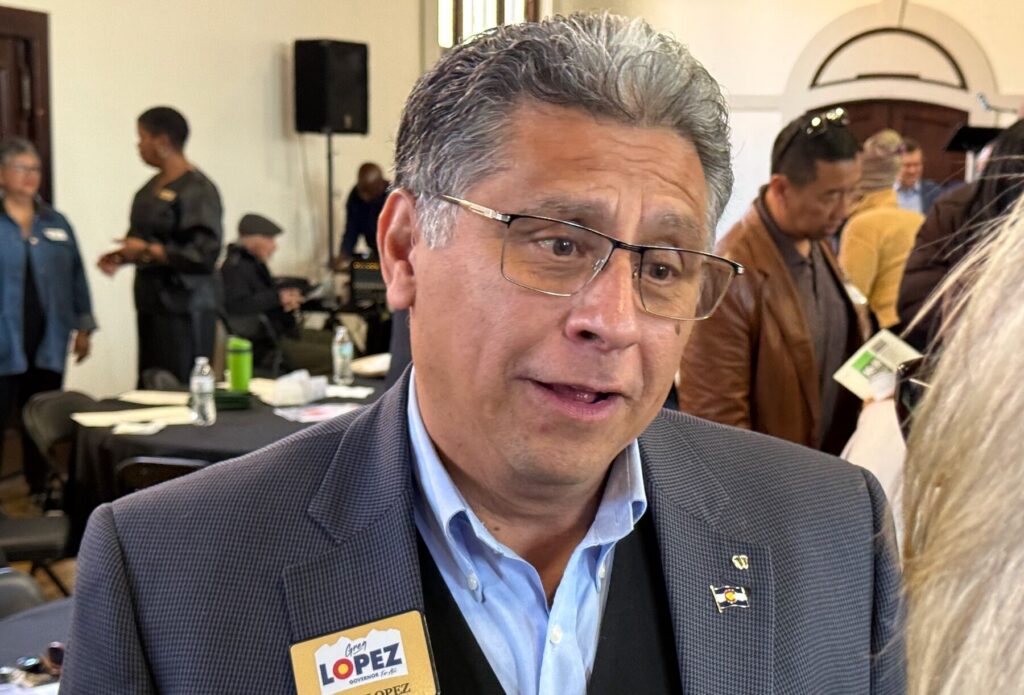
Independent gubernatorial candidate Greg Lopez, a former GOP congressman, qualifies for Colorado ballot
Ernest Luning
ernest.luning@coloradopolitics.com
Updated 22 hours ago
Unaffiliated gubernatorial candidate Greg Lopez, a former Republican congressman from Elizabeth who left the GOP to run as an independent, has qualified for the ballot by submitting enough petition signatures, the Colorado Secretary of State’s Office said Tuesday. He’ll face...

Meghan Shay on recovery, responsibility and second chances | The OpEdge Podcast
Tony Olivero
tony.olivero@gazette.com
Updated 1 day ago
Step Denver and Step Springs CEO Meghan Shay joins The OpEdge to explore addiction recovery, homelessness, and the role of accountability in lasting change. Shay tells host and investigative columnist Jimmy Sengenberger why she believes recovery is built on personal...

The outrages mount | Hal Bidlack
Hal Bidlack
hal-bidlack@coloradopolitics.com
Updated 1 day ago
My kindly and forgiving editors understand that, from time to time, I can’t help myself from leaping atop my rickety soapbox to vent. And, like many other political commentators have already done, I could easily fill this entire missive with...

Rural Colorado deserves a tax holiday | GUEST COLUMN
Eric Mulder
jstooksberry@gmail.com
Updated 2 days ago
Spend enough time in Colorado’s Eastern Plains, the San Luis Valley, or the Western Slope, and you’ll see boarded-up storefronts, schools consolidating classrooms, and small rural communities stretching every dollar to keep basic services afloat. Once the backbone of Colorado’s...
Colorado board permits state to appeal injunction against arthritis drug price cap
Marissa Ventrelli
marissa.ventrelli@coloradopolitics.com
Updated 1 day ago
A Colorado board voted Friday to allow the Attorney General’s Office to fight an injunction against a price cap on a drug that treats arthritis. A U.S. district court judge had granted the company Amgen a preliminary injunction, temporarily blocking...

Colorado schools receive $24 million for free meals program
Marissa Ventrelli
marissa.ventrelli@coloradopolitics.com
Updated 1 day ago
The Colorado Department of Education is providing Colorado schools with nearly $24 million in grant funding to implement a free lunch program. Approved by voters in 2022, the Healthy School Meals for All provides free breakfast and lunch to all...

‘Be prepared to march in the streets’ | Miller Hudson
Miller Hudson
miller-hudson@coloradopolitics.com
Updated 5 days ago
It was early in 1974 when I first met Tim Wirth as he announced his candidacy for Congress, challenging Republican incumbent Don Brotzman. Although I had only resided in Colorado two years, I was drafted to serve as a Democratic...
PREV
PREVIOUS

Colorado panel rejects 2 of 3 Polis appointees to wildlife body
A contentious hearing Wednesday saw two out of three of Gov. Jared Polis’ picks for the Colorado Parks and Wildlife Commission rejected by a panel of legislators. The Senate Agriculture and Natural Resources Committee approved, on a 7-0 vote, the appointment of Francis Blayney to represent outfitters on the commission. The panel’s members rejected, on […]

Every life has equal value; Colorado must reject House Bill 26-1281 | OPINION
By Emily Tofte Nestaval In Colorado, we have long held a simple, but absolute truth: every human life has equal value under the law. It is a principle that grounds our legal system, supports victims and their families, and reinforces public trust. House Bill 26-1281 threatens to dismantle that very foundation. As a nonprofit law […]