

Home rule has protected Colorado cities for over 125 years | Cronin and Loevy

Colorado is currently gripped by a political struggle between the governor plus the legislature in Denver and populous home-rule city governments, mainly on the Front Range, such as Colorado Springs.
In the past few years, the legislature has been passing bills that applied to city government policies, which for many years had been the sole province of mayors and city councils.
These new state laws have mainly provided for higher population densities in cities in hopes of generating more low-cost housing or affordable housing.
What is home rule? How did it come about in Colorado? And why is the legislature suddenly challenging this long-established concept of urban government?
In the late 1800s, the legislature mainly passed laws governing what happened in cities. That meant that the state representatives and state senators from the city were more powerful politically in city affairs than the mayor and the city council combined.
This conflict was particularly intense in Colorado’s largest city, Denver, which is also the state capital. For example, the governor, not the Denver mayor, appointed the members of the various boards and commissions that made policy for the city.
In 1894, this led to Denver’s famous “City Hall War.” Gov. Davis Waite tried to fire two members of the Denver Fire and Police Board, but they locked themselves in their City Hall offices and refused to leave.
Waite ordered the state militia to surround City Hall and forcefully remove the two board members, who were protected by men armed with pistols and rifles who looked ready to fight the state militia.
Cooler heads prevailed, and Waite ordered the state militia to stand down without a shot being fired. The Colorado Supreme Court sided with the governor, and the two men peacefully left their offices.
But the Denver City Hall War had perfectly illustrated the competition for power between the governor plus the legislature and Denver officials.
Ten years later, in 1904, conditions in Denver were continuing to deteriorate. Saloons and gambling houses were operating at full steam. Political machines openly bought votes on Election Day, keeping corrupt leaders in office.
Reformers believed that a major cause of the trouble was that the governor and legislators continued to wield direct control over city affairs.
A reform movement began in Denver to support a state constitutional amendment that would give Denver the right to establish a home-rule city government.
Rather than being governed by the governor and the legislature, Denver citizens would adopt a city charter that would create their own form of government tailored directly to their particular needs.
Denver would thus have a wide range of local powers to inspire citizens to look to the city government rather than the state to solve their problems.
It was a major victory for progressive local government when, at the general election in 1904, the Home Rule Amendment for Denver was adopted to the Colorado Constitution by state voters.
Then, a subsequent constitutional amendment was adopted to extend home-rule powers to other cities. Shortly thereafter, all the major cities in Colorado had adopted their own charters and become full-fledged home-rule cities.
The big point is this: The adoption of the constitutional amendment in 1904 was the most significant event in the history of local government in Colorado.
Municipal home rule was firmly instituted as the norm rather than the exception. The state became known nationally for its strong home-rule cities.
Many people think of Colorado as a land of beautiful, snow-capped Rocky Mountains and wide-open prairies.
In reality, however, Colorado is highly urbanized, and the vast majority of its citizens live in cities. That makes the strong home-rule powers even more significant.
For 120 years after 1904, home-rule powers were not seriously challenged. The more populous cities in the state were left to govern themselves as the constitution instructed.
To longtime observers of Colorado government, the recent efforts of the legislature and the governor to take control of home-rule city zoning and subdivision laws and altered them to favor population densification has been a shock.
More than a century of land-use policy favoring home-rule cities has been sharply challenged.
Legislators argue that the shortage of affordable housing in major cities on the Front Range has forced the legislature to step in.
The legislature has overridden concerns about home rule and created state requirements that residential lots be split into two and that apartments be built along major arterial streets, despite the zoning.
The final result is that, after a century and a quarter of home-rule protection for Colorado cities in the state constitution, these protections are now being challenged and set aside.
Tom Cronin and Bob Loevy are news columnists who write about Colorado and national politics.


Fashion, food and fun combine to make this event a success | NONPROFIT REGISTER
Joanne Davidson Special to Colorado Politics
joanne-davidson-special-to-colorado-politics@coloradopolitics.com
Updated 7 hours ago
arc THRIFT STORES Denver News: “Let’s Celebrate” was the theme for arc Thrift Stores’ annual fundraiser, and it’s not a stretch to say that’s exactly what everyone did at this Sept. 3 gathering held at Denver Botanic Gardens. The crowd that filled the gigantic...

With its water source dry, a southeast Colorado town’s clock is ticking
Savannah Eller
savannah-eller@coloradopolitics.com
Updated 12 hours ago
The Cucharas is not a mighty river, but the people of La Veta knew they had a problem brewing when it ran dry at the beginning of June. “We’re getting by,” said La Veta Mayor Doug Brgoch. “It’s not great.”...

Ikon Pass company Alterra to move into former Denver Post building, create downtown ‘outdoor hub’
Bernadette Berdychowski
bernadette.berdychowski@denvergazette.com
Updated 5 days ago
What was once the home of two of Colorado’s longest-running daily newspapers could soon become a central location for the state’s ski resort and outdoor companies, city and state leaders said Thursday. Alterra Mountain Co. is moving its headquarters to...
‘Until Every Woman Thrives’ campaign receives a $10 million investment | NONPROFIT REGISTER
Joanne Davidson Special to Colorado Politics
joanne-davidson-special-to-colorado-politics@coloradopolitics.com
Updated 6 days ago
WOMEN’S FOUNDATION OF COLORADO COLORADO HEALTH FOUNDATION Denver News: A $10 million gift from the Colorado Health Foundation will enhance “Until Every Woman Thrives,” a comprehensive campaign launched by the Women’s Foundation of Colorado in 2024 to transform lives, deepen relationships and amplify the impact of various...

Voices of Our Youth Gala celebrated the impact a mentor can have | NONPROFIT REGISTER
Joanne Davidson Special to Colorado Politics
joanne-davidson-special-to-colorado-politics@coloradopolitics.com
Updated 4 days ago
BIG BROTHERS BIG SISTERS OF COLORADO Denver News: When chief executive officer Elycia Cook extended an invitation to the 2026 Big Little Gala, Voices of Our Youth, it came with a note advising that it would be an evening that was “Very...

Amazon buys 70 acres in Aurora
Bernadette Berdychowski
bernadette.berdychowski@denvergazette.com
Updated 1 week ago
Amazon purchased 70 acres of land in Aurora with plans to build a distribution center, according to city and county records. The e-commerce giant bought a parcel at 825 N. Lisbon St. from a company tied to Northpoint Development for...

Colorado’s EV charging map nearly complete, state says
Scott Weiser
scott.weiser@gazette.com
Updated 2 days ago
Gov. Jared Polis and the Colorado Department of Transportation released a statement calling the state’s public fast-charging network nearly built out. The Aug. 27 news release reports there are now 486 DC fast-charging locations and 83% of the state highway...

PUC adds weekly comment after killing private talks
Scott Weiser
scott.weiser@gazette.com
Updated 2 weeks ago
The Colorado Public Utilities Commission will take public comment at the start of every commissioner’s weekly meeting beginning Sept. 9 as part of its new transparency mandate, the commission announced, expanding a slot previously limited to the second Wednesday of...

Healthcare Freefall: AI arms race hits rural healthcare as hospitals fight to keep up
Thelma Grimes
thelma.grimes@coloradopolitics.com
Updated 2 weeks ago
Editor’s Note: Colorado’s healthcare system is entering a period of accelerating instability — a “tsunami,” as multiple leaders describe it — driven by collapsing hospital finances, shrinking Medicaid reimbursements, disappearing services and a political fight over who is responsible for...
El Paso County upholds Buc-ee’s zoning appeal, clearing way for administrative approval
Savannah Eller
savannah-eller@coloradopolitics.com
Updated 2 weeks ago
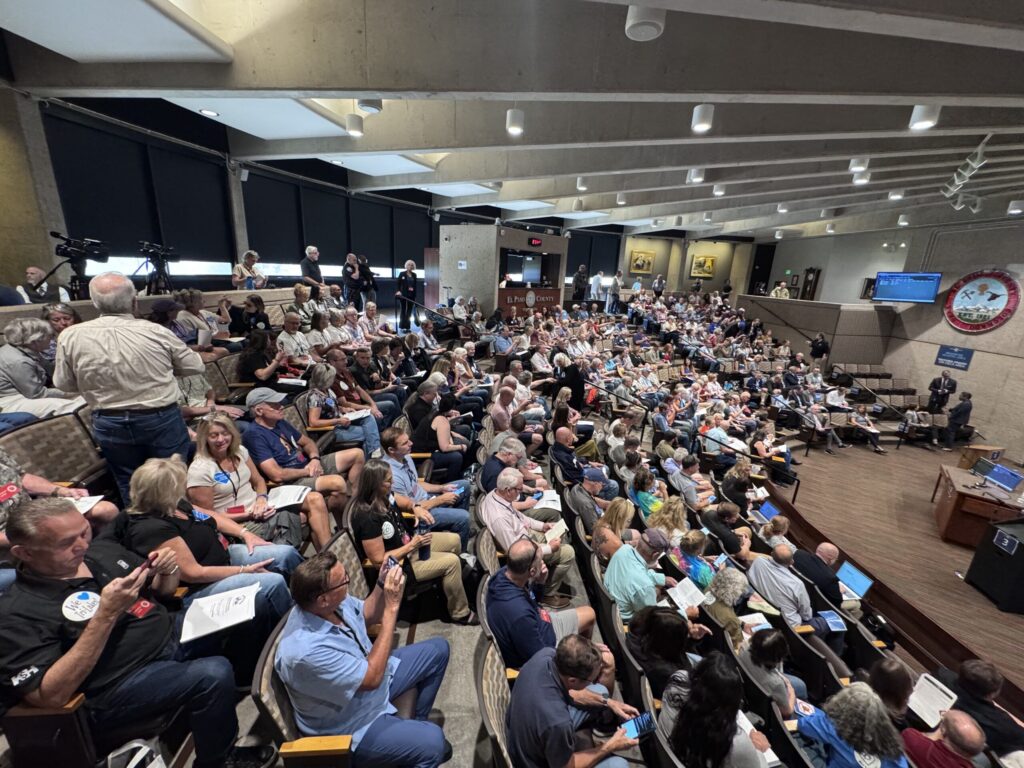
A packed, daylong meeting on Thursday resulted in a win for the Texas travel center chain Buc-ee’s, with El Paso County commissioners voting 4-1 to approve the developer’s zoning appeal. “I think the burden of proof has been met here,”...
PREV
PREVIOUS

An "-"ends tribute in a week full of "odds" | Capitol M | Week of April 11, 2026
The lighter side of the Capitol, usually… The decision to read the budget bill — the long bill, which spans 661 pages this year — put a damper on the House’s already less‑than‑festive mood. So Capitol M decided to catch up on some of the odds and ends that have been on my mind lately, […]
Colorado House finishes work on 2026-27 state budget, finally
The House on Saturday, after four days of work – it usually takes two – finished up their work and voted on the $46.8 billion 2026-27 state budget, as contained in House Bill 1410 and 64 accompanying measures designed to help balance the budget. The delay in getting to the finish line was caused by […]