

Redistricting fight escalates as Colorado Title Board clears competing ballot proposals
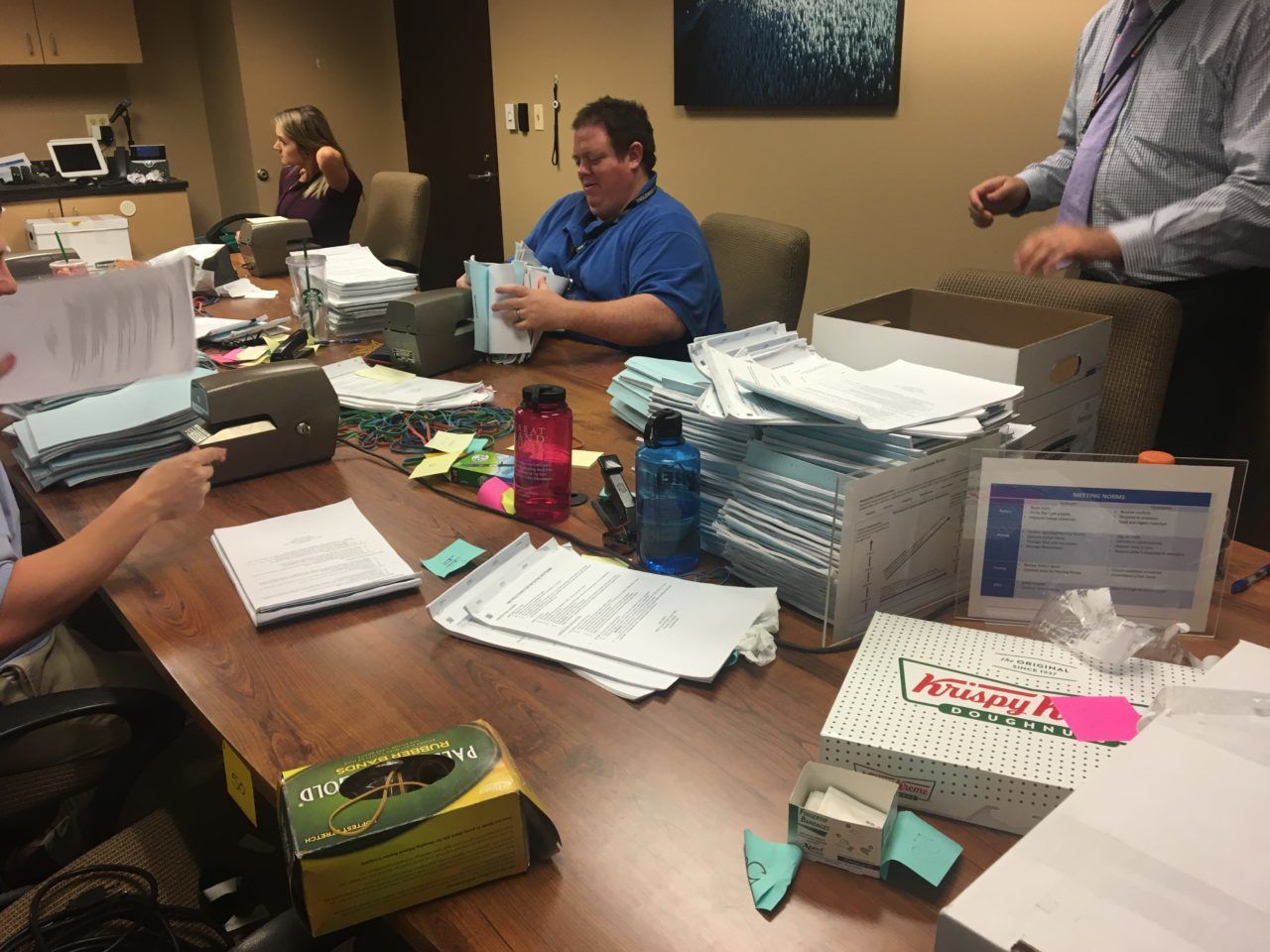
Colorado’s title board on Wednesday gave final approval to multiple ballot measures related to congressional redistricting, setting up a series of proposals that could alter how the state draws its U.S. House districts for the 2028 and 2030 elections.
The board, which has final authority over ballot measure titles and language, has one remaining meeting in April before all measures must be finalized and begin the process of collecting signatures.
Each ballot measure will need 124,238 valid signatures to appear on the November ballot. The measures changing the constitution require 2% of valid voter signatures in each of the state’s 35 Senate districts.
The board’s Wednesday meeting was a rehearing on the redistricting proposals, based on challenges filed by several individuals.
On Wednesday, the board made changes to a ballot proposal supported by Advance Colorado that, as introduced, would add criteria on competitiveness and prohibit maps from being drawn to benefit one political party.
The board reversed its earlier decision on one of four measures proposed by Coloradans for a Level Playing Field, which would redraw the 3rd, 5th, and 8th congressional districts in ways that would benefit Democrats. The group is supported by House Majority PAC, a Washington D.C.-based organization that backs Democratic candidates.
Both efforts pulled Colorado into the broader national battle over redrawing congressional districts — maps that Republicans are seeking to reshape in Missouri, North Carolina, Ohio, Texas, and Florida. Democrats are pursuing similar redistricting advantages in California, Virginia, and Maryland.
The challenge to the Advance Colorado measure, No. 251, was argued by attorney Martha Tierney, who represents the state Democratic Party and Democratic-aligned groups.
She pointed out that the measure does not include criteria for creating a district with contiguous boundaries, which could mean a district could have voters in different parts of the state and lack a common boundary. She also raised concerns about the lack of public meetings on a new map.
As unanimously approved by the title board on Wednesday, the proposal now states that No. 251 is a constitutional amendment concerning mid‑cycle congressional redistricting. It would prohibit mid‑cycle redistricting unless all of the following conditions are met:
- Three public meetings are held on the proposed map
- The map preserves whole communities of interest
- The map does not intentionally favor a political party or reduce the number of competitive districts
Finally, any new map must be approved by an independent congressional redistricting commission and adopted by the Colorado Supreme Court.
The proposal will require 55% voter approval to be added to the state Constitution, as determined by the board.
Michael Fields of Advance Colorado told Colorado Politics his group and supporters are “very happy with the outcome on (the) redistricting measure. I would encourage the other side to actually do polling because Coloradans clearly don’t want a new hyper-partisan congressional map.”

The rehearing for the other redistricting measures, backed by Coloradans for a Level Playing Field, featured a first-ever appearance before the title board by former Secretary of State Wayne Williams.
“Venues matter,” he told the title board.
That’s a reference to the court that would review the redrawn maps in the event of a challenge — the Denver District Court, rather than the Colorado Supreme Court.
Williams claimed that the change in venue violated the state’s single-subject law. He also pointed out that the map for the 2028 and 2030 elections would not be drawn by a congressional redistricting commission.
That map has already been drawn by the proposal’s proponents, without public hearings or other independent oversight.
The inclusion of both a hyper-partisan map for two elections and then the creation or recreation of an independent commission for elections six years later “is precisely the logrolling dilemma that the voters intended to avoid when they adopted the (single-subject) requirements,” Williams wrote in his appeal, citing a 2012 court ruling.
He also pointed out that certain voters would not have an opportunity to vote for their representatives on the state board of education or the University of Colorado Board of Regents.
Based on the map submitted with the proposals, voters in the newly constituted districts 1, 3 and 7 for the state board of education and districts 2, 6 and 7 for the Board of Regents “would be completely disenfranchised and never be allowed to vote on the indicated board members because these positions are elected in 2026 and would not be voted on again until new districts are created for the 2032 election,” he wrote.
For example, he told the board, the 7th district regent’s seat is up for election in November. But voters in western Adams County, which is currently not part of the 7th district, would be moved into that district with the new map and would not have a chance to vote on the seat until 2032. Similarly, certain voters in the 3rd congressional district would lose their ability to vote for their representative until 2032, as would certain voters in Jefferson County in the seventh district.
None of this is mentioned in the ballot measures, Williams said.
Tierney, who represents the proponents of the Democratic measures, pointed out that those voters are already disenfranchised when districts are redrawn.
As to the issue with the change in venue, she said the state Supreme Court will be the final arbiter of the map anyway under the appeals process. Denver was chosen because that’s where the secretary of state gets sued and that has been the jurisdiction that handled redistricting cases prior to the voter-approved independent commission.
She also stressed that, under the proposals, the redistricting commission would eventually regain its ability to draw new maps after the 2030 census.
The title board tossed the statutory proposal, No. 239, stating it violated the single subject law, but approved the other three: proposals No. 240, No. 241 and No. 242.
Coloradans for a Level Playing Field will now have to choose which proposal to take to voters for petition signatures.
- Initiative 240 asks voters to approve a temporary map for use in the 2028 and 2030 congressional elections. The process would revert to an independent redistricting commission after the 2030 Census. This measure requires 55% voter approval.
- Initiative 241 asks voters to move the congressional redistricting commission from the state constitution to statute.
- Initiative 242 asks voters to approve a new map for the 2028 and 2030 congressional elections, and revert to an independent commission after the 2030 Census. These two measures are paired, meaning both must pass with a majority vote to become law.
In applauding the title board’s approval for the three measures, Coloradans for a Level Playing Field spokesman Curtis Hubbard said, “From Trump’s attacks on mail ballots to his unprecedented call for maps to be redrawn mid-decade, our democracy faces an unprecedented emergency. Independent redistricting is an ideal — but not when one party is openly capitalizing on the inability of their opponents to fight fire with fire.”
He added, “We are asking voters to approve temporary maps to level the playing field in the face of a nationwide election-rigging effort launched by Trump and MAGA allies.”
Five ballot measures have already been approved for the November ballot. Three more, including one on a graduated income tax, have been approved for circulation of the petition. Twenty-eight more have had their titles approved by the title board and are awaiting approval of the petition formats, which are handled by the Secretary of State’s Office. Four are awaiting their initial hearings.
The board has just one more meeting left in the 2026 election cycle, on April 15.

Colorado justices accept appeals on Netflix taxation, children pursuing neglect cases
Michael Karlik
michael.karlik@coloradopolitics.com
Updated 7 hours ago
The Colorado Supreme Court announced on Monday that it will decide whether Netflix subscriptions are subject to the state’s sales tax as “tangible personal property.” At least three of the court’s seven members must agree to hear an appeal. The...
Proposal outlines $300M deal separating Pinnacol from Colorado state government
Marianne Goodland
marianne.goodland@coloradopolitics.com
Updated 7 hours ago
Colorado lawmakers are weighing a proposal that would allow Pinnacol Assurance to sever its remaining ties to the state in exchange for a $300 million payment, a long‑debated shift that supporters say could stabilize the insurer’s future and help plug...
Bill requiring employers to grant unpaid leave to Colorado lawmakers heads to governor’s desk
Marissa Ventrelli
marissa.ventrelli@coloradopolitics.com
Updated 7 hours ago
Colorado lawmakers are one step away from securing guaranteed unpaid leave from their day jobs during the legislative session after the House narrowly approved the proposal Thursday. Senate Bill 087 would require businesses to allow employees who are members of...
Colorado lawmakers propose deep cuts to close $1.2B budget gap
Marianne Goodland
marianne.goodland@coloradopolitics.com
Updated 6 hours ago
The panel of Colorado legislators in charge of crafting next year’s budget has finalized the 2026–27 spending plan built on deep cuts and one‑time cash transfers in an attempt to close a shortfall of more than $1.2 billion. The plan...
Denver judge denies Gov. Polis request to dismiss ICE-related records case
Marianne Goodland
marianne.goodland@coloradopolitics.com
Updated 10 hours ago
A year after blocking the release of state records to federal immigration agents, a Denver judge has now denied Gov. Jared Polis’ effort to end the lawsuit at the center of the dispute. The lawsuit filed against the governor in...
Colorado appeals court orders new sentencing for Tina Peters, upholds convictions
Michael Karlik
michael.karlik@coloradopolitics.com
Updated 6 hours ago
Colorado’s second-highest court determined on Thursday that a trial judge improperly sentenced former Mesa County clerk Tina Peters based upon her exercise of protected speech, while at the same time upholding her convictions. The three-judge Court of Appeals panel also...

Denver promised every school funding from $1B bond — but campuses later closed received far less | Analysis
Nico Brambila
nico.brambila@denvergazette.com
Updated 10 hours ago
Denver voters overwhelmingly approved the largest bond measure in Denver Public Schools history on the promise that every school — including charter campuses — would receive something. And they did. But the nearly $1 billion bond was not distributed evenly....

National conservation area growing by 4,000-plus acres in western Colorado
Seth Boster
seth-boster@coloradopolitics.com
Updated 15 hours ago
A formerly private, sweeping swath of western Colorado is growing a public, red rock wonderland. Spanning 4,000-plus acres, Escalante Ranch has been transferred to the Bureau of Land Management and incorporated into Dominguez-Escalante National Conservation Area, The Conservation Fund recently...

Judge rules that Colorado law makes it too hard for parties to bar unaffiliated voters from primaries
Ernest Luning
ernest.luning@coloradopolitics.com
Updated 13 hours ago
A federal judge ruled in favor of the Colorado Republican Party late Tuesday, saying that a portion of the state law that allows unaffiliated voters to cast ballots in party primaries is unconstitutional because it imposes an unrealistic burden on...

Front Range cities oppose Democratic proposal to permit lot‑splitting
Marianne Goodland
marianne.goodland@coloradopolitics.com
Updated 8 hours ago
Colorado lawmakers are pressing ahead with a plan to let homeowners split their lots to make room for smaller, less expensive houses — a proposal that has drawn sharp opposition from Aurora, Colorado Springs, Denver and other Front Range cities...
PREV
PREVIOUS

Colorado lawmakers propose deep cuts to close $1.2B budget gap
The panel of Colorado legislators in charge of crafting next year’s budget has finalized the 2026–27 spending plan built on deep cuts and one‑time cash transfers in an attempt to close a shortfall of more than $1.2 billion. The plan is leaving lawmakers frustrated with the reductions to core services. Some cited cuts to health […]
Bill requiring employers to grant unpaid leave to Colorado lawmakers heads to governor's desk
Colorado lawmakers are one step away from securing guaranteed unpaid leave from their day jobs during the legislative session after the House narrowly approved the proposal Thursday. Senate Bill 087 would require businesses to allow employees who are members of the Colorado General Assembly to take unpaid leave during the regular legislative session and special […]