

Denver advances plan to stretch developer deadlines by 3 years

City planning officials are hoping to throw a lifeline to developers with a proposed new amendment to the Denver City Code, giving them more time to secure building permits and financing.
The proposed change, if supported by the City Council, would spare roughly 22,600 planned residential units from loss due to expiring city paperwork, as Denver experiences a sharp decline in the demand for multi-unit building permits.
At a Tuesday City Council Committee meeting, Community Planning and Development officials warned that Denver risks losing thousands of new residential units if projects with city-approved site development plans cannot be accommodated with additional time, citing a sharp contraction in development activity. The officials attributed that contraction to elevated construction costs, high interest rates, and declining rents.
Under the proposed “Site Development Plan Validity Extension” amendment, any site development plan approved by the city on or before Dec. 31, 2025, would receive a 36-month extension of its validity period to obtain building permits.
A site development plan (SDP) is a document that serves as a blueprint for how a private development project complies with the Denver Zoning Code.
Site development plans are required for all new developments that are not one- and two-family homes, explained Chris Gleissner, the agency’s director of site design and neighborhood development.
“As you know, we had a huge log of projects come through, about 40,000 units worth of projects,” Community Planning and Development (CPD) Executive Director Brad Buchanan told committee members. “About half of them followed through and completed their SDPs.”
Those projects that have completed their SDPs are now approaching their 30-month SDP expiration date at a time when the city is seeing an oversupply in the marketplace.
“And so the punchline is,” Buchanan said, “we’re trying to keep those projects alive so that we can take advantage of this unique moment in time to build in pipeline as quickly as the market can.”
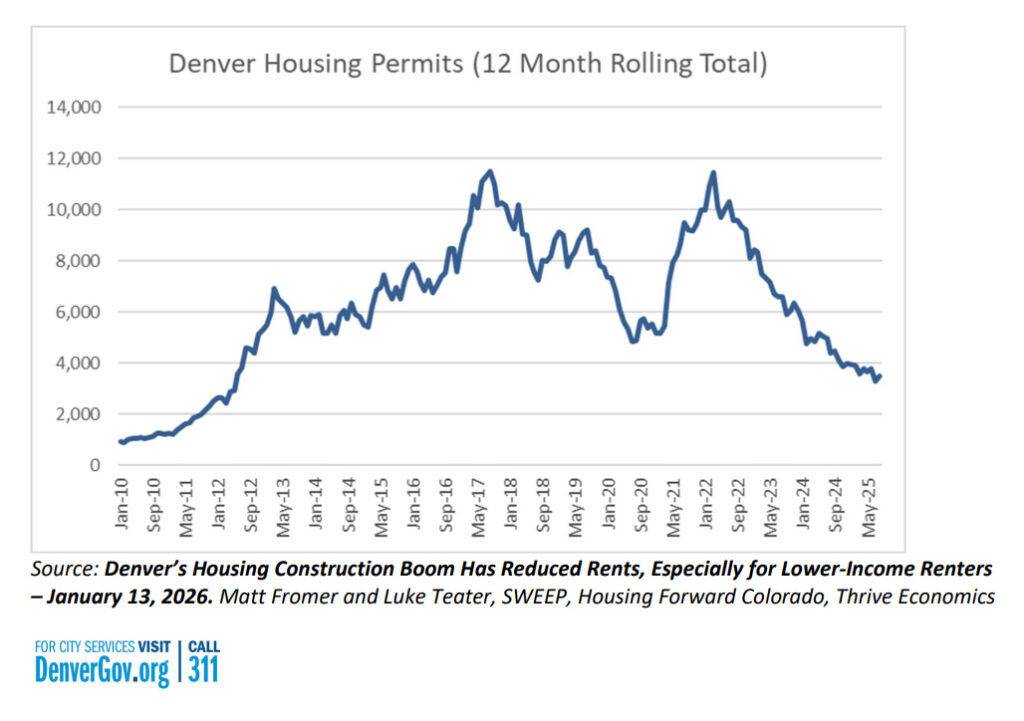
New housing permits surged to record levels in 2021 and 2022 as strong rent growth and low interest rates made it easy to finance new apartment projects.
Many of those new projects that began in 2021 and 2022 are now coming online, according to the city. That, in turn, is driving down rent across the market.
Denver’s Expanding Housing Affordability (EHA) ordinance, a major housing policy passed by the city in 2022, sought to boost affordable housing by incentivizing developers to build beyond luxury units.
When it comes to overbuilding, Denver is not unlike other major cities in the U.S., Buchanan said.
Building projects dropped during the COVID pandemic, then recovered strongly, peaking in 2022 and dropping since.
Oversupply has brought supply in line with demand, driving rental prices down, officials said.
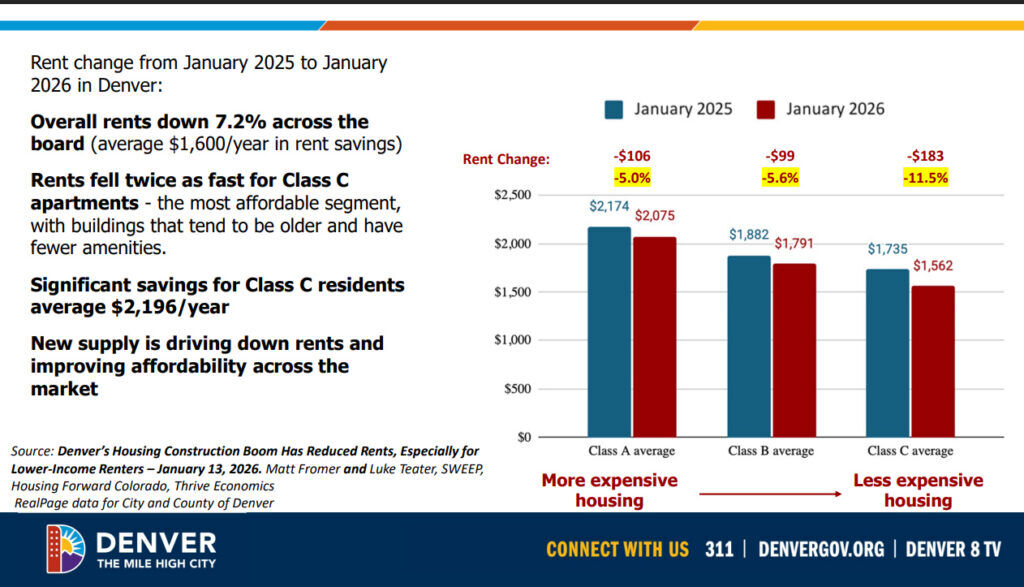
“In downtown Denver, there are market-rate rents that are in the 80 to 100% area median income range,” Buchanan said. “So, the private sector marketplace today is creating much-needed affordable housing products itself.”
In short, the new supply coming online is driving down rent and improving affordability across the market.
Over the past five years, Denver has adopted strategies to try to attract developers to invest in the Mile High City and build more housing.
Among the city’s most notable moves are the recent blanket zoning changes and fast-track permitting. Additionally, Denver Mayor Mike Johnston brought back Buchanan, a well-known development leader, to streamline the city’s Community Planning Development. Developers have applauded the moves to streamline processes, notably the efforts to make permitting more efficient.
Denver’s mayor has also set his sights on convincing middle-income families that the city is “affordable” with a new pilot program that seeks to build more units for those with annual incomes between $60,000 and $100,000.
He plans to do so by offering property tax incentives to interested builders and investors, according to the city.
In return, rental units within those projects must be deed-restricted for 30 years to remain “affordable” to households earning less than 100% of the area median income, which was $98,100 for one person and $140,100 for a four-person household in July, according to city officials.
At both the state and local levels, governments have been imposing a number of regulatory strategies to spur housing development. But builders who work with higher density projects have said that the governments’ medicine doesn’t treat what ails the market for affordable homes.
Notably, they pointed to the virtual total lack of a housing product that is a route to homeownership in other major cities as a major problem for Colorado — the condominium.
Additionally, they have cited energy requirements for large-scale buildings adopted by the state and Denver, both of which have required sweeping reductions in energy use and greenhouse gas emissions by larger commercial buildings, adding these changes would significantly add to costs, which will be passed down to consumers.
The Energize Denver ordinance, adopted in 2021 and enforced by Denver’s Office of Climate Action, Sustainability and Resiliency (CASR), requires buildings sized 25,000 square feet or larger to slash emissions 30% by 2032 and by 80% by 2040.
Meanwhile, a bill passed by the legislature in 2021, issued as Regulation 28 by Colorado’s Air Quality Control Commission in 2023, mandated 7% reductions in buildings of 50,000 square feet and larger by 2026, and 20% by 2030.
In an interview last year, Andrew Hamrick, senior vice president of the Apartment Association of Metro Denver, which represents apartment management firms, noted that apartment rents were falling slightly.
“It’s tapering off,” Hamrick said back in October, referring to apartment units currently arriving. “There is still stuff coming in, but longer term, we see far fewer permits and we see institutional money drying up.”
Helping make the situation less favorable for lower-income renters is that the newest units are often absorbed by renters overqualified for the price they pay, he said. But developers and their investors have been reading the slower absorption rate and are penciling it into their project plans. And they’re perceiving a regulatory climate here that builders said is less than inviting.
“We see institutional money drying up,” Hamrick told The Denver Gazette. “A lot of investors can get a better return by going to Utah or Texas. This money is internationally sourced, so in some ways we’re competing against Utah, Texas and anywhere on the planet.”
Some developers have also pointed to Denver’s policy requiring a portion of new housing developments with 10 or more units to apportion a share for rent or sale to lower income households. Industry representatives have complained that the policy only serves to delay development, since it translates to a rent loss of 3.2% to 4%.
Buchanan, the city official, has called Johnston’s efforts to create more housing in the city “totally right-minded.”
“Eliminating any, or reducing hurdles and challenges for creating housing in our city is our focus right now, and that’s true for every kind of investment, but certainly around housing,” he said. “And if you want to talk about affordable housing, the best way to create affordable housing is to keep the supply in line with the demand — that creates naturally occurring affordability.”
The amendment now heads to the Community Planning and Housing Committee on March 24, then to City Council for first reading on April 6 and a public hearing on May 4.
Reporter Mark Samuelson contributed to this article.


From pause to progress — a better path on AI policy | OPINION
Colorado Politics
colorado-politics@coloradopolitics.com
Updated 10 hours ago
By Brittany Morris Saunders and Loren Furman Last year, following the Special Legislative Session, we wrote in Colorado Politics that delaying Colorado’s AI Act was not a setback. It was an opportunity. We asked state leaders to pause, bring more...

Cutting Prop 123 would cost Colorado far more than it saves | OPINION
Colorado Politics
colorado-politics@coloradopolitics.com
Updated 1 hour ago
By Luke Teater Colorado’s legislative budget writers are about to receive updated revenue forecasts and begin making final cuts to close a historic budget gap, and Proposition 123’s affordable housing financing tools are on the chopping block. But in their...

Appeals court reinstates Garfield County arson charge
Michael Karlik
michael.karlik@coloradopolitics.com
Updated 17 hours ago
Colorado’s second-highest court reinstated a Garfield County defendant’s arson charge on Thursday, concluding a trial judge improperly credited a witness’s claim that she alone was responsible for starting the fire. A sheriff’s deputy responded to a brush fire near Parachute...

Democratic US Sen. John Hickenlooper qualifies for Colorado primary by petition, will skip assembly
Ernest Luning
ernest.luning@coloradopolitics.com
Updated 16 hours ago
U.S. Sen. John Hickenlooper has qualified for Colorado’s Democratic primary after the first-term incumbent submitted enough valid petition signatures to make the ballot, state officials said. Hickenlooper is facing primary challenges from state Sen. Julie Gonzales, D-Denver, and university professor...
Federal judges rebuke ex-Colorado judicial discipline director for conduct in lawsuit
Michael Karlik
michael.karlik@coloradopolitics.com
Updated 18 hours ago
A pair of federal judges expressed a desire on Thursday to break the logjam on a lawsuit by Colorado’s former judicial discipline director against the state Supreme Court and related entities, while simultaneously showing little tolerance for the plaintiff’s scorched-earth...

Democratic bill would let recipients of ‘conversion therapy’ sue Colorado providers with no statute of limitations
Marissa Ventrelli
marissa.ventrelli@coloradopolitics.com
Updated 16 hours ago
Colorado lawmakers have advanced a proposal that would allow people who underwent conversion therapy to sue licensed providers for damages, moving the measure forward on a party-line vote in the House Judiciary Committee. House Bill 1322, proposed by Democratic Reps....

Pinnacol separation bill delayed as Colorado budget remains in flux due to $1.5B deficit
Marianne Goodland
marianne.goodland@coloradopolitics.com
Updated 16 hours ago
A bill that would allow Pinnacol Assurance to formally sever its remaining ties with the state appears unlikely to emerge anytime soon, as House leaders juggle a massive budget shortfall, unresolved negotiations with key stakeholders, and growing doubts about whether...

100 days until America250: Five host cities unveiled for July 4 celebrations
Emily Hallas, Washington Examiner
emily.hallas.washington.examiner@gazetteedit.wpenginepowered.com
Updated 22 hours ago
America250, the entity tasked by Congress with marking the United States’ semiquincentennial, on Thursday revealed further details about its sweeping plans to celebrate the milestone. America250 chairwoman Rosie Rios launched the official 100-day countdown to July 4, and said the...

Comedy showcase to feature new and established talent | NONPROFIT REGISTER
Joanne Davidson Special to Colorado Politics
joanne-davidson-special-to-colorado-politics@coloradopolitics.com
Updated 23 hours ago
MIZEL ARTS AND CULTURE CENTER Denver News: A host of emerging comedians will perform along with Denver native and nationally recognized comic Noah Gardenswartz when the Mizel Arts and Culture Center hosts The Tight Five: Standup Comedy Showcase. The up-and-comers take the stage...

Iran and the US harden their positions as Tehran tightens its grip on the Strait of Hormuz
Jon Gambrell
jon.gambrell@associatedpress.com
Updated 23 hours ago
DUBAI, United Arab Emirates (AP) — Iran and the United States appeared at an impasse Thursday, with each side hardening its position over talks and setting the stage for another potential escalation in the Middle East war. Thousands more U.S....