

Artificial intelligence working group agrees on framework to replace Colorado law

A group that has been working on artificial intelligence policy has reached an agreement on a framework that would replace the regulations adopted by Colorado legislators two years ago.
The agreement has the backing of Gov. Jared Polis, who reluctantly signed the AI law in 2024.
The agreement reached by the Colorado AI Policy Work Group is meant to repeal and replace the 2024 law, whose sponsors said would protect consumers and residents from algorithmic discrimination but which critics called heavy handed and unworkable.
A multi-billion dollar technology company, which recently decided to leave Colorado, cited the new regulations on artificial intelligence as a cause of concern, comparing the “state-level oversight” to the European Union’s Artificial Intelligence Act.
In an announcement, Gov. Jared Polis said the draft will ensure that residents are aware when AI or an automated0 decision making system (ADMT) is used that impact decisions affecting their lives.
“Under this proposal, Coloradans will receive an up-front notice when AI or ADMT is being used in these life-altering decisions, and if the decision is adverse, then they will have access to more information about the decision, an opportunity to correct wrong information, and request that a human review the ultimate decision,” the governor said.
The governor’s support stands in stark contrast to his position when he signed Senate Bill 24-205 into law in May 2024. At the time, he asked policymakers to address fears raised by the industry “fueling critical technological advancement” and raised worries about Colorado “going it alone.”
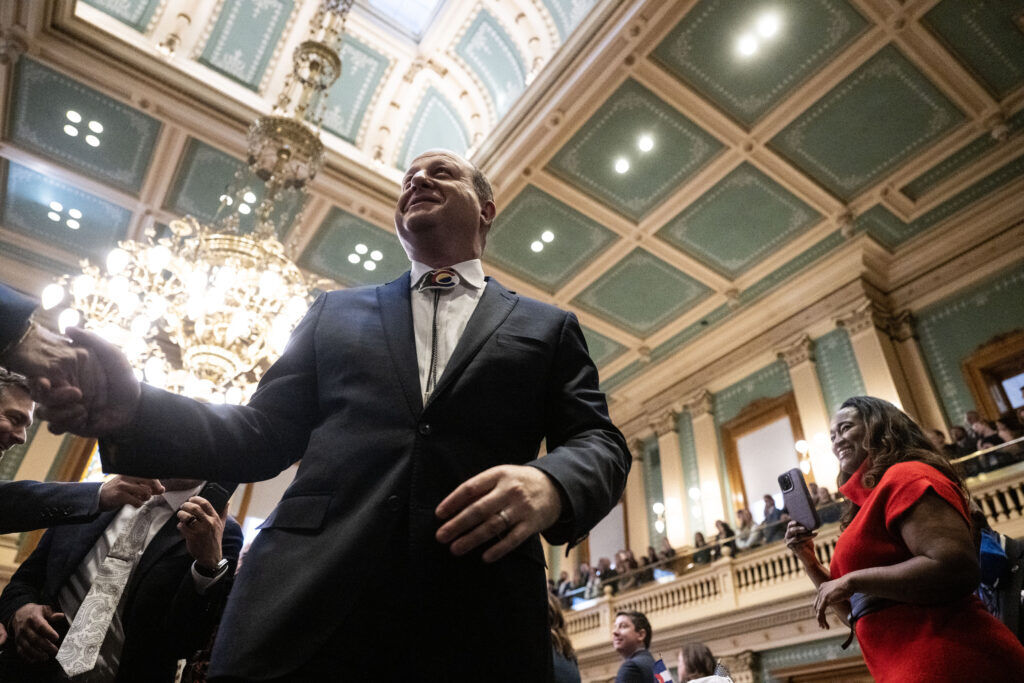
The governor convened the AI working group to “navigate appropriate and necessary changes” the 2024 law, which, at the time of its enactment, was one of the first in the nation designed to regulate “algorithmic discrimination.” It was originally set to take effect on Feb. 1, but lawmakers last year pushed it back to June 30, 2026 to give more time to find an agreement with Big Tech, consumer advocates and business interests.
The agreed-upon framework is the result of two years of negotiations among small businesses, hospitals, schools, consumer groups, venture capitalists and technology advocates.
Senate Bill 24-205 defined “algorithmic discrimination” to mean any condition in which AI increases the risk of “unlawful differential treatment” that then “disfavors” an individual or group of people on the basis of age, color, disability, ethnicity, genetic information, race, religion, veteran status, English proficiency and other classes protected by state laws.
It would impact hiring and other aspects of employment, education, medical care, housing, insurance, legal services and banking.
Under the law, developers would be required to exercise “reasonable care” to prevent discrimination when using “high-risk” artificial intelligence systems, which are defined as systems involved in making “substantial or consequential” decisions. It would require developers to complete risk assessments, implement risk management strategies, and report instances of “algorithmic discrimination” to the Attorney General within 90 days of discovery.
The law also required businesses that employ artificial intelligence to disclose the types of systems they use and notify consumers when a high-risk artificial intelligence system will be used to make “consequential” decisions.
That’s one area that caused much of the consternation among small businesses, schools, hospitals, and other groups, which claimed the law would penalize businesses for “algorithmic” bias identified in their system, even if the bias originated from an open-source system.
Adam Burrows, a partner and co-founder of Range Ventures, served as a go-between with the business and consumer groups, along with Sam Gilman of the Community Economic Defense Project.
“We were pretty skeptical at the beginning because people were so divided,” Burrows told Colorado Politics.
The compromise speaks to the power of finding common ground, he said.
Among the biggest issues that separated the two sides were liability and enforcement. That required hundreds of hours of discussion and negotiation, Burrows said.
The liability portion of the draft makes it clear that deployers and developers are responsible for what they do.
On the enforcement end, one of the biggest problems with SB 205 for critics was they described as onerous compliance and reporting requirements, which also applied to small businesses.
All those requirements are gone — a huge win for Colorado businesses and consumers, Burrows said.
The compromise is going to be functional and workable for school districts, said Roger Gose, director of technology for the Garfield County school district. He also represented the Colorado Association of School Executives and and CASE’s Colorado Association of Leaders in Educational Technology on the task force.

Gose said that small and medium-sized school districts could not comply with SB 205 because they don’t have the resources or the human staffing to do so.
The policy framework unveiled Tuesday will allow school districts to legally support it, while also providing transparency to students, families and communities, Gose said.
There was a lot of discussion about consequential decisions and what that would look like, parties to the negotiation said.
For education, the draft now includes the federal Family Educational Rights and Privacy Act.
“Instead of coming up with an extra process for dealing with parents and community members, we’ll be able to follow FERPA. It takes the high risk AI, such as a a big decision that impacts someone and their livelihood, and puts it at the forefront,” Gose added.
But most of the things school districts do will no longer trigger a lot of paperwork, he said, adding, “It has great benefits for the citizens of Colorado without bringing in unfunded mandates.”
“I’m proud of the work the group did, and I hope it proceeds without major changes. It’s significantly better than SB 205,” Gose said.
Senate Majority Leader Robert Rodriguez, D-Denver — the prime sponsor of the 2024 law and subsequent attempts to make the changes sought by the governor and attorney general — said he appreciates the work of the task force and is digging into the draft over the coming days.


Denver airport hasn’t had notice ICE agents will assist TSA yet. Wait times are short, though
Bernadette Berdychowski
bernadette.berdychowski@denvergazette.com
Updated 3 hours ago
As President Donald Trump deployed immigration agents to help U.S. airports manage hours‑long security lines during the partial government shutdown, Denver International Airport remained relatively calm on Monday. At the nation’s third‑busiest airport, TSA PreCheck lanes remained open to start...

Colorado Senate committee advances bill increasing overtime threshold for farmworkers
Marianne Goodland
marianne.goodland@coloradopolitics.com
Updated 2 days ago
The struggle to balance farmworker protections with the survival of Colorado’s family farms took center stage Thursday as senators debated two competing overtime bills. The Senate Business, Labor and Technology Committee held a rare double-bill hearing that led to a...

Colorado bill to fund mental health by raising alcohol taxes defeated in House committee
Marissa Ventrelli
marissa.ventrelli@coloradopolitics.com
Updated 2 days ago
Colorado legislators on Wednesday narrowly rejected a second measure that would raised taxes on alcohol products in order to fund mental health care treatment in the state. Proponents said the new revenue is necessary to help pay for mental health...

Proposed data center regulation in Colorado draws critics, backers
Scott Weiser
scott.weiser@gazette.com
Updated 1 day ago
A packed marathon hearing at the state Capitol in Colorado highlighted the sharp divide between two competing approaches to the effects of data centers, one of America’s fastest-growing technology sectors. Data centers are the physical facilities that host the servers,...

Conservation Colorado proposes measures aimed at oil and gas companies
Marissa Ventrelli
marissa.ventrelli@coloradopolitics.com
Updated 2 days ago
A group has introduced four ballot measures it says are meant to counter an initiative that aims to enshrine Colorado businesses and consumers’ right to purchase and sell natural gas in the state’s constitution. Filed with the Secretary of State’s...

Universities sue to block dismantling of Boulder’s NCAR
Scott Weiser
scott.weiser@gazette.com
Updated 4 days ago
A consortium of universities filed a federal lawsuit Monday, alleging the Trump administration’s plan to dismantle the National Center for Atmospheric Research is unlawful retaliation against Colorado. The group also argued that the move violates federal law. The University Corporation...
Colorado Title Board advances competing redistricting proposals, revised Pinnacol measure
Marianne Goodland
marianne.goodland@coloradopolitics.com
Updated 2 days ago
With just two meetings left before an April 15 deadline, the state’s Title Board on Wednesday pushed through a slate of ballot measures, including a revised proposal to privatize Pinnacol Assurance and dueling plans to redraw Colorado’s congressional map. The...

Democrats want to bar use of consumer data to set Colorado prices, employee wages
Marissa Ventrelli
marissa.ventrelli@coloradopolitics.com
Updated 5 days ago
A closely divided House committee advanced a bill aimed at curbing the use of personal data to set individualized prices and wages, reviving a proposal that failed last year and setting up a broader debate over how far the state...
Conducting Leadership: A novel event aimed at strengthening connections | NONPROFIT REGISTER
Joanne Davidson Special to Colorado Politics
joanne-davidson-special-to-colorado-politics@coloradopolitics.com
Updated 3 days ago
CLAYTON EARLY LEARNING Denver News: Approximately 40 leaders from Denver’s nonprofit community gathered at Boettcher Concert Hall on March 4 for a novel event whose purpose was to strengthen connections within and across organizations. It was hosted by PNC Bank and Clayton Early Learning. Invitations promoted the 4:30...

Deadline approaches for 2026 Furry Scurry early bird pricing | NONPROFIT REGISTER
Joanne Davidson Special to Colorado Politics
joanne-davidson-special-to-colorado-politics@coloradopolitics.com
Updated 5 days ago
HUMANE COLORADO Denver News: The 33rd Furry Scurry, a two-mile run/walk benefiting Humane Colorado, takes place May 2 in Denver’s Washington Park, and the cost to participate begins to increase on March 23. Through March 22, the price per adult is $50; on March 23, it jumps to $60...
PREV
PREVIOUS

Proposal to levy new fees on alcohol products in Colorado dies
The proposal to collect millions in new fees on alcohol products — dollars to be earmarked for Colorado programs aimed at addressing the behavioral and physical health effects of alcohol abuse — died on Tuesday. House Bill 1271 sought to create three separate “enterprises” and establish fees of $0.05 per gallon of beer and cider, […]

Colorado justices grill debt collector about compliance with law
The Colorado Supreme Court repeatedly pressed a debt collection company last week to explain how its lawsuit against a Boulder woman for an unpaid credit card balance complied with the specific requirements that state lawmakers have created. Portfolio Recovery Associates, LLC filed a complaint to collect on a $671 debt from the credit card account […]