

Colorado Supreme Court lifts curtain on decision-making at legal event
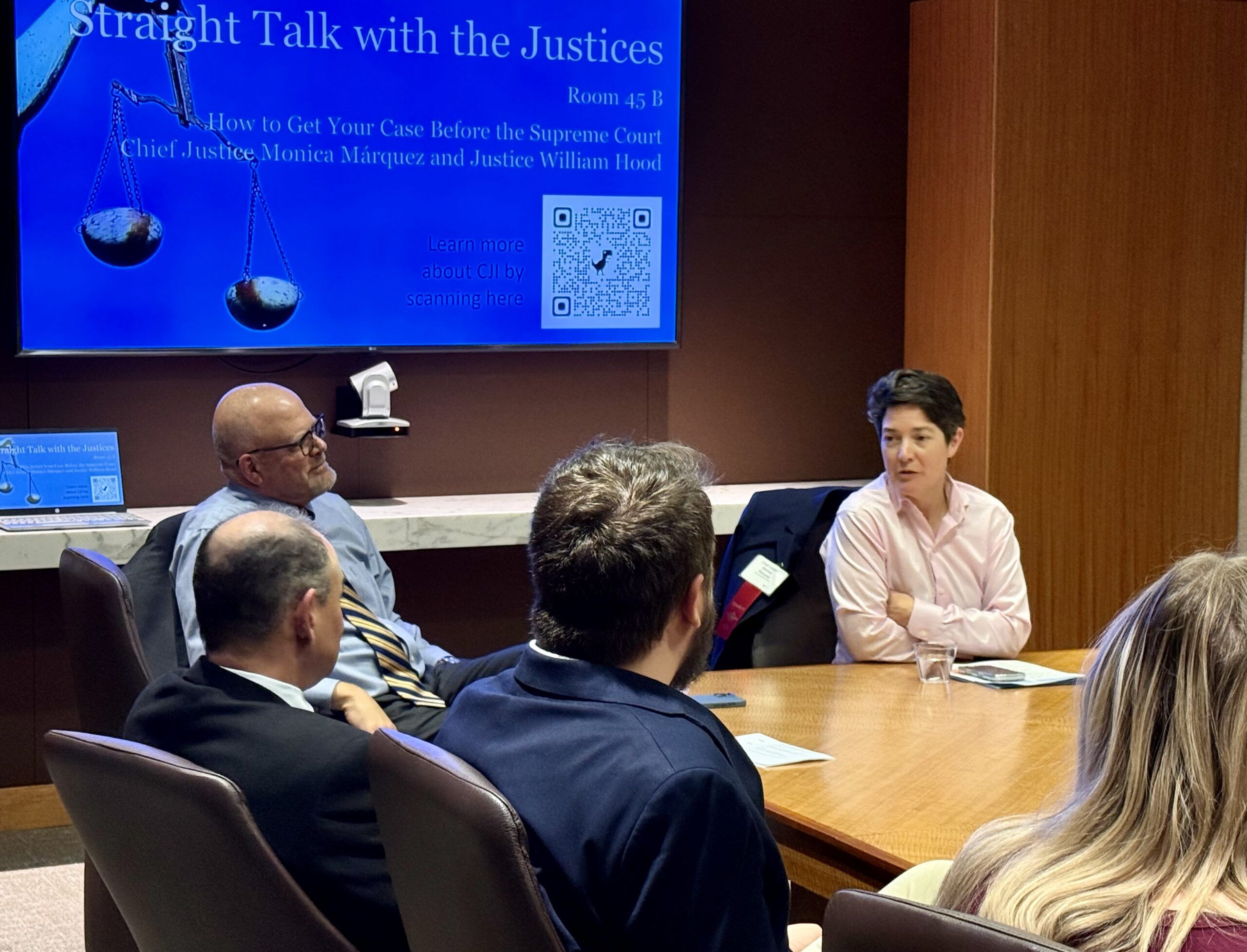
Members of the Colorado Supreme Court sat down with lawyers on Wednesday to answer questions about behind-the-scenes topics, including what happens immediately after an appeal is argued, why they might intervene in an ongoing case, and the consequence of a majority flipping from one side to the other.
“This is what happens when the court flips. The chief turns to you and says, ‘Well, Justice So-and-so, you seem to have lost the majority. So, the choices are: You can turn your majority opinion into a dissenting opinion and let someone else write the majority. Or you can change your majority opinion to get more people on board.’ Those are the choices,” said Justice Carlos A. Samour Jr.
He added that, in his eight years on the court, changes of mind that altered the outcome have only occurred two or three times.
Five of the seven justices appeared at the Denver law offices of Wheeler Trigg O’Donnell LLP at an event sponsored by the nonprofit Colorado Judicial Institute. They held a series of discussions with attorneys and fielded a wide range of questions about internal court operations. Justices Brian D. Boatright and Maria E. Berkenkotter were unable to attend.
Chief Justice Monica M. Márquez and Justice William W. Hood III spoke about the process for intervening in an ongoing trial court case, outside of the normal appellate process. Hood said that attorneys typically focus on the trial judge’s alleged error, but the justices want to know why the state’s highest court needs to step in immediately.
“Where’s the fire? Why do we need to take this now?” he said. “The argument that the trial court was just dead-bang wrong on this and I shouldn’t have to slog through this whole case, it’s not fair to my client from an economic perspective — that’s not gonna move the needle a whole lot because a lot of folks could say that.”

Márquez said that the court takes family law cases seriously, including urgent issues involving children. If a trial judge’s decision is debatable but within their authority, the Supreme Court will likely not step in.
But if there is a legal error, “that’s more likely the kind of case where we’d drop in and correct the legal error,” she said. “Or if a remedy in a child’s situation would be so far down the line that for all intents and purposes it would be meaningless.”
“Frankly, as someone who presided over domestic dockets in Denver for several years, I’d like to see more of those (cases),” said Hood, a former trial judge.
In cases the court hears through the normal appellate process, known as granting “cert,” Márquez said she considers the consequences if the court does not step in and allows a precedent-setting decision of the Court of Appeals to stand.
“I don’t think you should necessarily worry that just because we’ve granted cert, we’re inclined to reverse. We’ve granted cert because we’ve identified a legal issue that warrants our consideration and we’d like to provide guidance,” she said. “It’s not necessarily like, ‘Uh-oh.'”
Rarely, the Supreme Court will dismiss an appeal that it previously agreed to hear. In those instances, all members have to be on board with that outcome.
“If any single justice is like, ‘We’re staying in,’ then we’re all in,” said Márquez.
Samour, in his discussion group, said his law clerks may use artificial intelligence as a limited writing aid, but not expansively.
“I do know that the chief went to a conference recently, out-of-state conference, where a justice for another court was telling her there’s a program he has that can take an opinion or a draft opinion and do citation checks. And fixes all citations in, like, a minute,” he said. “We thought that’s an interesting tool that we might want to look into.”
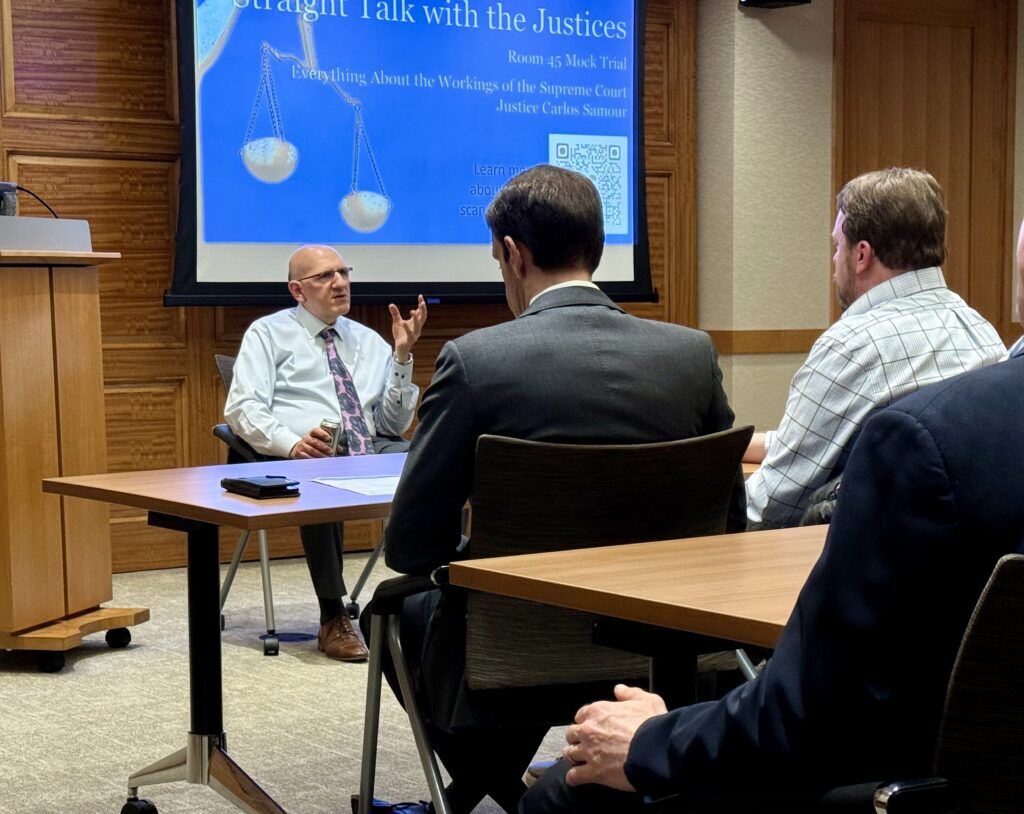
During his early years on the court, Samour said the justices would generally meet after oral arguments and vote to reverse or uphold the underlying decision, without discussing the case. Over time, the justices began to discuss the cases first. Now, Samour said, the court almost always has a discussion before voting, unless the outcome is straightforward.
“We do not talk about cases as a group before oral arguments,” he said. Although justices might have preliminary conversations, “don’t make up your mind until we get together to vote.”
After oral arguments and the justices’ discussions, Samour said that the chief justice could wait for a few days or a week before assigning the majority opinion. Her decision-making criteria could include the types of questions a justice was asking, the reasoning of the justice, the reasoning of other members, and the justice’s existing workload.
“Then the chief will come to you and say, ‘Hey, do you think you could write the majority opinion in this case? You seem to be interested or you seemed to be really worked up about this issue,'” Samour said. “And you’re not allowed to say, ‘Hey, I don’t want this opinion.'”
The protocol is that “you don’t ask for an opinion,” he continued, even though “there are some cases everyone wants.”
Samour also referenced the oral arguments that happened the day before the legal event, where he had to rearrange himself on the bench to accommodate Justice Susan Blanco, who was sworn in last week as the newest member.
“It was a little unsettling, I’ll have to tell you. Yesterday was the first time going from the right-hand side to the left side after several years. It felt a little weird,” he said.

Finally, Blanco and Justice Richard L. Gabriel spoke about their preferred tone for decisions and arguments.
“I’ve had clerks say, ‘You take all the good stuff out!” said Blanco. “I feel like it should have a neutral tone when you’re writing. I don’t know at our court if that’s the same because I’m so new. But I know at the trial court level, people want to write orders (with strong language).”
“I think judicial opinions should be very hesitant to use humor,” added Gabriel. “I’ve seen lawyers try to crack a joke. Every single time, it lands like a lead balloon. There’s awkward silence. When the judge makes a joke, then you can laugh.”
Gabriel said that sometimes, he will ask a lawyer a softball question, but not necessarily because he is advocating for a particular position in front of his colleagues.
“I think we do it less than the U.S. Supreme Court, where they’re blatantly arguing with each other. But sometimes my colleague may be on a run” of tough questioning, he said, and a lawyer is “getting a barrage of questions and they’re backpedaling a little bit. And they lose sight of, you’ve actually got a pretty good argument there.”


Federal judge: Government violated order shielding man from deportation in ‘one-off mistake’
Michael Karlik
michael.karlik@coloradopolitics.com
Updated 1 hour ago
A federal judge acknowledged on Thursday that the government violated his order by deporting a man in immigration detention during his pending court case, but it “serves nobody’s interests” to require the government to return him. On Feb. 18, Tesfami...
Colorado’s newest federal judge speaks about techniques for advancing cases
Michael Karlik
michael.karlik@coloradopolitics.com
Updated 24 hours ago
U.S. Magistrate Judge Cyrus Y. Chung described on Wednesday the various tactics he employs to resolve court cases, summing up his role with a laxative-based metaphor. “Someone told a group of us federal magistrate judges that magistrate judges are the...

Federal judge hears ICE agents’ confusion about law, injunction on warrantless arrests
Michael Karlik
michael.karlik@coloradopolitics.com
Updated 2 days ago
A federal judge heard testimony on Tuesday from U.S. Customs and Immigration Enforcement agents in Colorado, who had trouble describing the requirements of his recent injunction and the training they received on making warrantless arrests pursuant to the law. On...

10th Circuit dismisses challenge to Colorado legislature’s decorum rules
Michael Karlik
michael.karlik@coloradopolitics.com
Updated 1 day ago
The Denver-based federal appeals court concluded on Tuesday that Colorado lawmakers cannot be sued for creating and enforcing rules of decorum that circumscribe the public commentary allowed at legislative committee hearings. A three-judge panel of the U.S. Court of Appeals...
Colorado Supreme Court blocks ballot initiative defining ‘fees’
Michael Karlik
michael.karlik@coloradopolitics.com
Updated 3 days ago
The Colorado Supreme Court blocked a proposed ballot initiative on Monday that would have required voter approval for new fees above a certain threshold, while also enshrining a definition of “fee” into the state constitution for the first time. Chief...
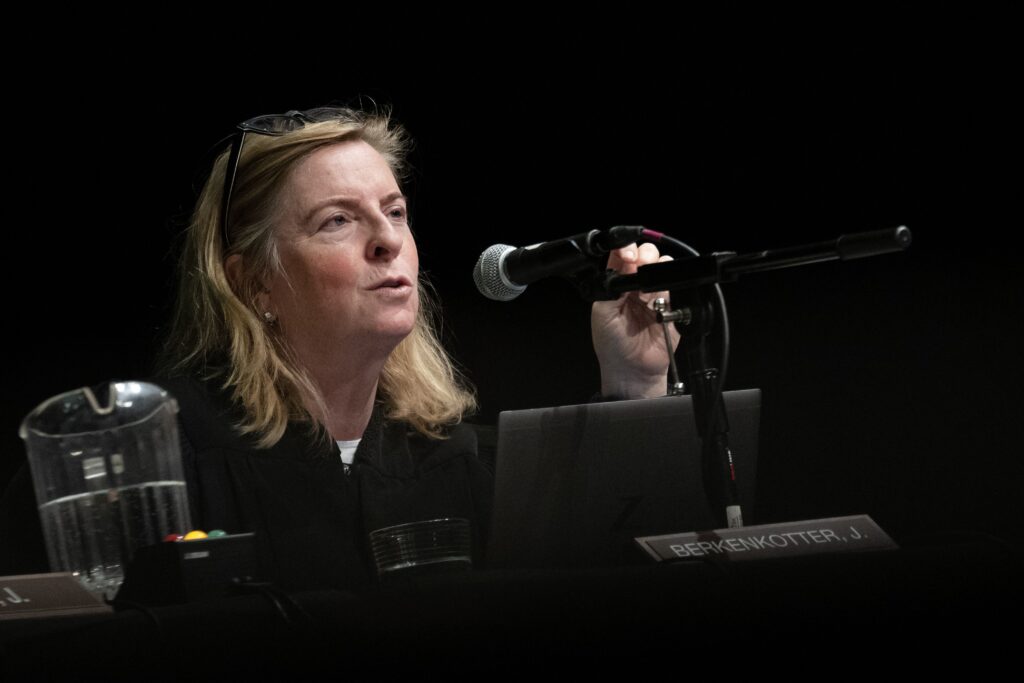
Colorado justices, by 5-2, say Longmont detective did not violate suspect’s Miranda rights
Michael Karlik
michael.karlik@coloradopolitics.com
Updated 3 days ago
The Colorado Supreme Court’s majority ruled on Monday that a Longmont detective did not coerce a suspect into talking by making references to how a judge would look at his character, and by suggesting he may get out of prison...
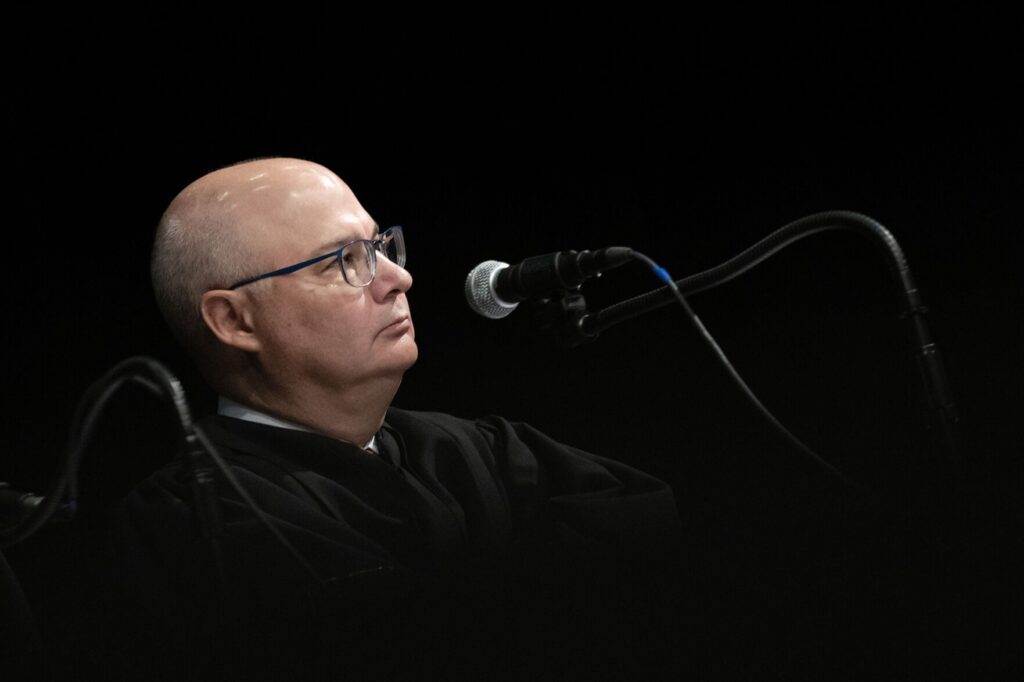
Colorado justices find Fort Collins police lacked probable cause to arrest suspect in park
Michael Karlik
michael.karlik@coloradopolitics.com
Updated 3 days ago
The Colorado Supreme Court agreed on Monday that Fort Collins police lacked probable cause to arrest a man for a child sex offense based on his presence in a public park around the time they intended to meet with their...

Supreme Court to hold oral arguments, discipline commission releases report | COURT CRAWL
Michael Karlik
michael.karlik@coloradopolitics.com
Updated 3 days ago
Welcome to Court Crawl, Colorado Politics’ roundup of news from the third branch of government. The state Supreme Court is holding oral arguments this week, plus Colorado’s judicial discipline commission released its annual report. Colorado Supreme Court news • The Supreme...
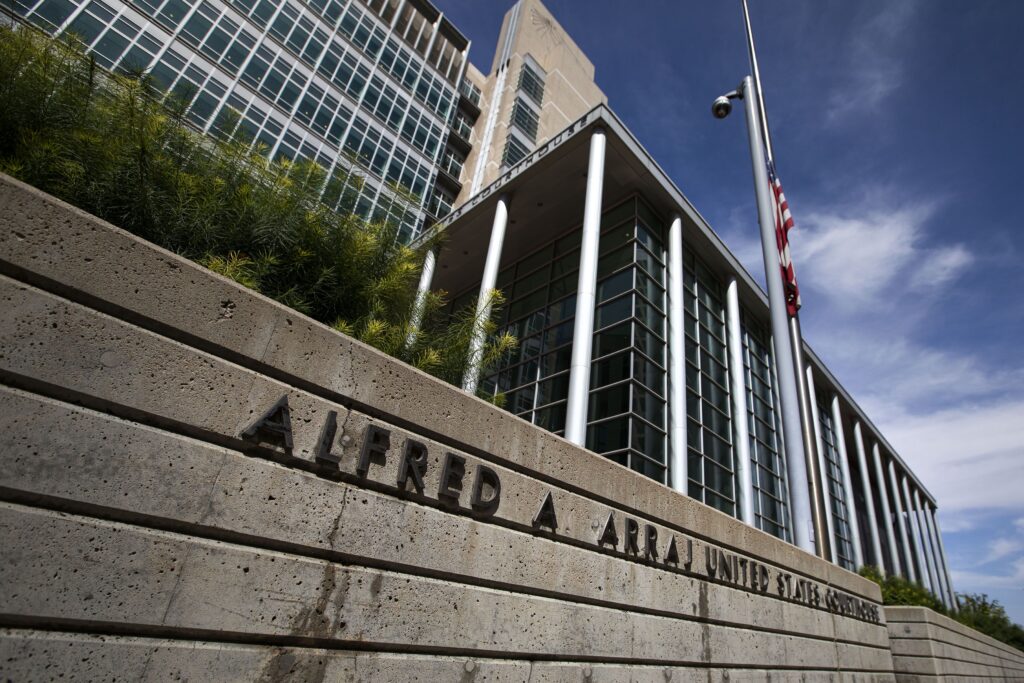
Federal judge dismisses developer’s challenge to Denver affordable housing ordinances
Michael Karlik
michael.karlik@coloradopolitics.com
Updated 6 days ago
A federal judge dismissed a homebuilder’s constitutional challenge on Tuesday to a pair of Denver ordinances that impose obligations on developers related to the affordable housing demands created by new construction. Two related companies, redT Homes and redT Capital Partners,...

10th Circuit distances itself from prior decision making it easier to toss prisoner lawsuits
Michael Karlik
michael.karlik@coloradopolitics.com
Updated 6 days ago
The Denver-based federal appeals court distanced itself on Wednesday from its own recent decision that made it easier for prison officials to end civil lawsuits by transferring incarcerated plaintiffs between facilities. A three-judge panel of the U.S. Court of Appeals...
PREV
PREVIOUS

Senate, House leaders propose bill to cut outdated Colorado regulations and expand agency oversight
A bipartisan group of Colorado’s top legislative leaders is pushing a bill that would require periodic reviews of state regulations and expand lawmakers’ ability to scrutinize agency programs during oversight hearings. Senate Bill 137, sponsored by Senate President James Coleman, D-Denver, Senate Minority Leader Cleave Simpson, R-Alamosa, Speaker of the House Julie McCluskie, D-Dillon, and […]

Colorado committee recommends rejecting alcohol, marijuana tax hike to fund mental health care
In a rare move, Colorado’s Capital Development Committee unanimously recommended that another legislative committee reject a bill asking voters to approve higher excise taxes on alcohol and marijuana to fund a new mental health hospital in Aurora. Sponsored by Rep. Bob Marshall, D-Highlands Ranch, and Sen. Judy Amabile, D-Boulder, House Bill 1301 proposes that all […]