

Colorado’s congressional redistricting proposal could flip three Republican House seats | ANALYSIS

A Democrat-backed proposal to redraw Colorado’s congressional map for the 2028 election could flip three Republican districts.
The proposal, introduced by a group called Coloradans for a Level Playing Field, is yet another development in a national redistricting debate after President Donald Trump called to redraw U.S. House districts.
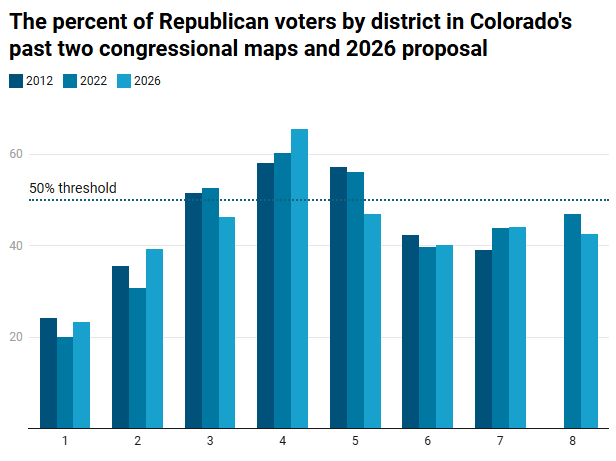
An analysis of the proposal in Colorado shows that the redrawn map could lead to flipping three Republican house seats to the Democrats’ column in the 2028 election, including in District 5, which has never voted for a Democratic representative in its long history, according to composite election data.
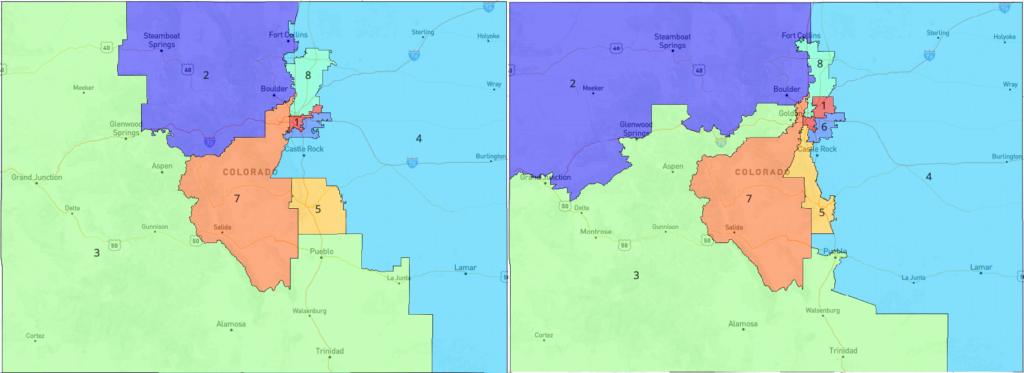
In recent elections, Colorado’s Districts 3, 4 and 5 have been more favorable to Republican candidates. District 3 covers the western half of the state, from Aspen and Glenwood Springs to Grand Junction and the Western Slope, as well as Pueblo. District 4 spans the Eastern Plains and Castle Rock. District 5 is based in Colorado Springs.
Colorado’s new map would expand much of District 2, currently represented by Rep. Joe Neguse, a Democrat, westward to the Utah border, absorbing the northwest corner of District 3 in the process. It would also see District 4, currently represented by Rep. Lauren Boebert, a Republican, taking on the eastern half of District 5, currently represented by fellow GOP member Rep. Jeff Crank, with that district absorbing District 4’s area west of Castle Rock in return.
Under the proposal, the following districts will remain relatively unchanged: District 7, currently represented by Rep. Brittany Pettersen, a Democrat; District 6, currently represented by Rep. Jason Crow, also a Democrat; and District 1, currently represented by Rep. Diana DeGette, a Democrat.
District 8, currently represented by Rep. Gabe Evans, a Republican, also appears to be relatively unchanged. It’s considered one of the most competitive seats in the country.
The proposed changes seem to disproportionately affect districts that have voted for Republican representatives in recent elections, cracking, or dividing, their voter base along precinct, rather than county, lines.
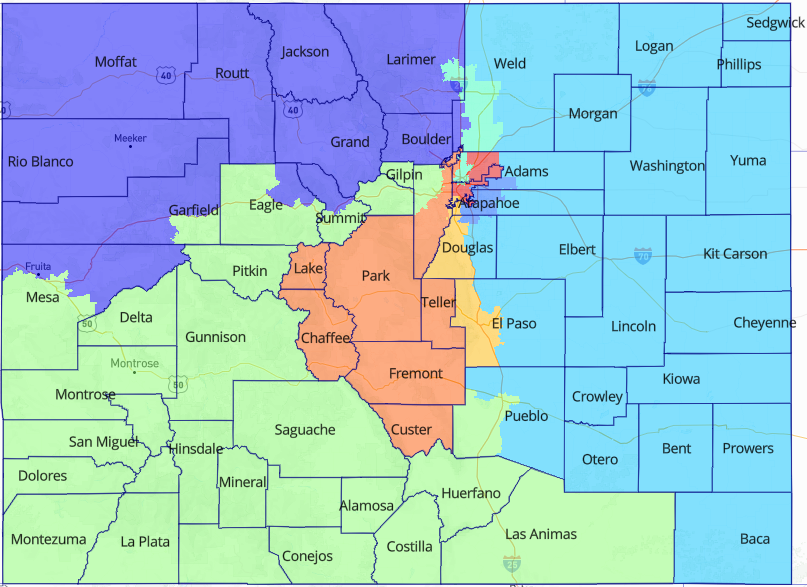
Most specifically, El Paso and Douglas counties, both Republican strongholds, are each now split in half between Districts 4 and 5. Mesa and Pueblo counties, too, are no longer wholly in one district or another.
The last time District 3 voted for a Democratic representative was when John Salazar was elected in 2008. That was the same year when District 4 elected its last Democrat, Betsy Markey, for the position. District 5, which was created in 1973, has never been represented by a Democrat in its 50-plus year history.
With the proposed congressional redrawing, three of those districts are at risk of losing their Republican favorability in 2028.
The proposal, which is backed by the House Majority PAC, has been filed in four versions of a 2026 ballot measure, all of which vary in how long the redistricted map would be used for and how it would be legally implemented in place of Colorado’s current congressional map.
Trump’s call last year to redraw U.S. House districts ahead of the 2026 elections has sparked a wave of political maneuvering among state Republicans and Democrats that continues to unfold across the country.
Texas first redrew its congressional map, passed by the Republican-led legislature, which quickly drew federal lawsuits. California responded with a referendum on new U.S. House districts. The referendum, backed by Democratic Gov. Gavin Newsom and Democratic state lawmakers, is intended to help Democrats win five additional seats in California to offset Trump’s moves in Texas aimed at gaining five Republican districts.
The U.S. House currently stands at 218 Republicans and 214 Democrats, with three vacancies. Traditionally, the president’s political party loses seats in the midterm elections.
Several states, including California, Missouri, North Carolina, Ohio and Texas, have already redrawn their congressional maps ahead of the 2026 midterm election. Of those states, California’s is the only map that favors Democrats.
Colorado Politics Reporter Marianne Goodland and The Associated Press contributed to this report.


Judge declines to block potential Boebert challenger from going through assembly process in Colorado’s 4th CD
Ernest Luning
ernest.luning@coloradopolitics.com
Updated 1 day ago
Congressional candidate Eileen Laubacher, one of the Democrats seeking to challenge Republican U.S. Rep. Lauren Boebert, can participate in the party’s caucuses and assemblies pending a court hearing later this month, a Denver judge ruled Tuesday in response to a...
Colorado Gov. Jared Polis ignites fierce debate after raising clemency questions in Tina Peters case
Marianne Goodland
marianne.goodland@coloradopolitics.com
Updated 1 day ago
Gov. Jared Polis ignited a political firestorm Tuesday night after weighing in on the prison sentences of two former Colorado officials — a Democrat and a Republican — convicted of attempting to influence a public servant. The comments quickly fueled...
Bills on ballot access, dual office ban move swiftly through Colorado legislature
Marianne Goodland
marianne.goodland@coloradopolitics.com
Updated 1 day ago
With an eye on the 2026 election cycle and mounting tensions with the Trump administration, Colorado lawmakers are fast-tracking a pair of election bills they say will protect the state’s mail ballot system and tighten rules for elected officials. The...

Colorado GOP chair Brita Horn loses ‘no-confidence’ vote, vows to refocus on ‘mending that divide’
Ernest Luning
ernest.luning@coloradopolitics.com
Updated 2 days ago
The Colorado Republican Party’s state central committee approved a resolution expressing “no confidence” in state chair Brita Horn in a landslide late Monday night near the end of an online meeting marked by rancor and confusion. Almost 80% of the...
Primary rival sues to prevent Democrat Eileen Laubacher from going through assembly in Colorado’s 4th CD
Ernest Luning
ernest.luning@coloradopolitics.com
Updated 2 days ago
Democratic congressional candidate Trish Calvarese on Monday asked a judge to prevent one of her primary rivals, Eileen Laubacher, from participating in the caucus and assembly process to seek the nomination to challenge Republican U.S. Rep. Lauren Boebert in Colorado’s...
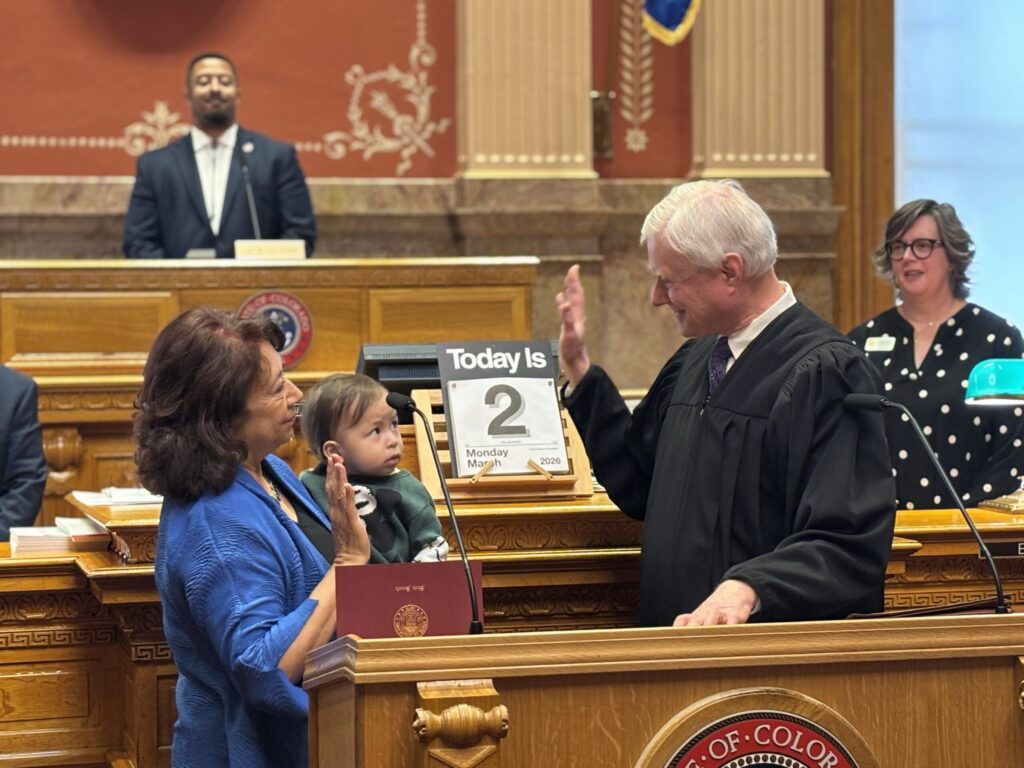
Colorado Senate swears in Adrienne Benavidez after district vacancy win
Marianne Goodland
marianne.goodland@coloradopolitics.com
Updated 3 days ago
Sen. Adrienne Benavidez, a Democrat from Adams County, was sworn in Monday to the Colorado Senate, just four days after winning a vacancy election in District 21. She was sworn in by Colorado Court of Appeals Justice Lino S. Lipinsky...

Democrat Michael Bennet turns in petitions for Colorado’s gubernatorial primary, plans to skip caucuses
Ernest Luning
ernest.luning@coloradopolitics.com
Updated 4 days ago
U.S. Sen. Michael Bennet, a Democratic candidate for governor, submitted nominating petitions for Colorado’s June primary ballot on Friday, his campaign and the Colorado Secretary of State’s Office said. Bennet plans to rely on his petitions to get on the...
Former House member picked to fill Senate vacancy in Colorado
Marianne Goodland
marianne.goodland@coloradopolitics.com
Updated 4 days ago
A vacancy committee on Thursday night chose a former House legislator to replace former Sen. Dafna Michaelson Jenet, who resigned on Feb. 13 to become the director of the David and Laura Merage Foundation for Combating Antisemitism. Adrienne Benavidez —...

Colorado delegation’s plus-one picks convey messages at Donald Trump’s State of the Union | TRAIL MIX
Ernest Luning
ernest.luning@coloradopolitics.com
Updated 6 days ago
It’s become a tradition for members of Congress to deliver messages of their own at the State of the Union address, though this year none of the Colorado lawmakers shouted at the president during the speech, nor did the delegation...

Colorado Democrat John Hickenlooper becomes first statewide candidate to submit nominating petitions
Ernest Luning
ernest.luning@coloradopolitics.com
Updated 5 days ago
U.S. Sen. John Hickenlooper on Thursday became the first statewide candidate to submit petition signatures for Colorado’s June Democratic primary, according to his campaign and the Colorado Secretary of State’s Office. Seeking reelection to a second term, Hickenlooper is facing...
PREV
PREVIOUS

Appeals court overturns Douglas County vehicular homicide conviction due to faulty jury instructions
Colorado’s second-highest court overturned a defendant’s vehicular homicide conviction and 12-year prison sentence on Thursday after determining a Douglas County judge omitted key language from the jury instructions that could have resulted in a different outcome. James Paul McDonald was driving in excess of 100 mph on Interstate 25 when he left the road and […]
U.S. House probes reports of fraud, waste in Colorado's Medicaid program
A congressional committee is probing reports of waste, fraud and abuse in Colorado’s Medicaid program, citing recent stories outlining over-billing in transportation spending and The U.S. House Committee on Energy and Commerce has sent a letter to Gov. Jared Polis and the Colorado Department of Health Care Policy and Finance, seeking, among other things, audits […]