Colorado title board OKs ballot measures to eliminate flat income tax in favor of graduated brackets

Proponents hoping to change Colorado’s income tax structure from a flat rate to graduated tiers — thereby raising taxes for some brackets — walked away from a Wednesday meeting with eight ballot measures approved by the title board.
The coalition backing the graduated income tax change now must pick which one to move onto the petition process.
It’s a big change from the group’s last visit in October, when the three-member Initiative Title Setting Review Board rejected two proposed measures for violating a rule that ballot measures may only contain a single subject. In December, the title board turned down a third proposal for the same reason.
The title board is made up of representatives from the Attorney General’s Office, Secretary of State’s Office and Legislative Legal Services for the General Assembly. Its main job is to determine if a proposed ballot measure has a single subject.
The coalition, Protect Colorado’s Future, initially suggested 12 income tax brackets. The second round of proposals submitted in December and reviewed on Wednesday are now down to six.
There are differences among the proposals and the tax brackets.
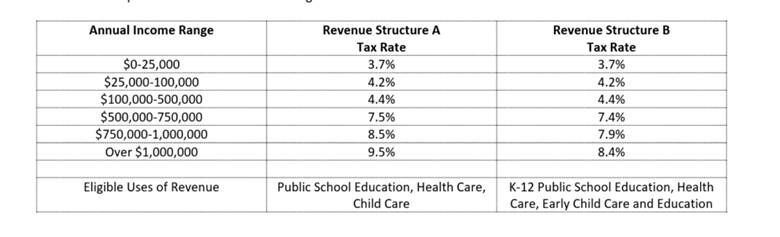
All the proposals have the same bottom line: to raise taxes from higher-income earners to pay for K-12 education, child care and health care. Some of the proposed measures also look to cover early childhood education.
The ballot measures seek to change both state law and the state Constitution, including a partial repeal of the Taxpayers’ Bill of Rights language that mandates a statewide flat tax rate.

At its core, TABOR limits the government’s ability to raise revenue. Political subdivisions must obtain voter approval for any tax increase, and it requires dollars above the TABOR limit to be refunded to residents. Numerous attempts, mostly on the litigation front, have been made to overturn TABOR. As recently as November 2020, voters rejected efforts to significantly overhaul or repeal it.
Under Amendment 71, adopted by voters in 2016, a ballot measure seeking to change the state constitution would require 55% voter approval, as well as petition signatures from all 35 state Senate districts.
However, the title board ruled on Wednesday that because the ballot measures do not seek a full repeal of TABOR, the 55% approval requirement would not apply. That provision only applies when adding language to the state constitution, not removing it, the board concluded.

The petition signatures, however, will still need to come from the state’s 35 Senate districts, with 2% of signatures from each district, according to Amendment 71 requirements.
Opponents will next appeal the title board’s decision, a hearing scheduled for Feb. 4, according to Chris deGruy Kennedy, who leads the Bell Policy Center and is the coalition’s spokesperson.
After that, the coalition will need to choose which one of the eight ballot measures to move forward to the petition phase. DeGruy Kennedy indicated there isn’t a clear leader among the proposals yet.
Once the petition has been approved, the proponents will need to collect at least 124,238 valid signatures from registered voters. Most of the time, petition collectors will try to obtain at least 200,000 or more to allow some wiggle room for invalid signatures.
That’s an expensive process that can cost as much as $1 million.
Protect Colorado’s Future has not yet filed an issue committee with the Secretary of State’s elections division. That isn’t required until the title is finalized, which normally takes place after the ballot measures have cleared the appeals process with the title board. That’s assuming the title board’s decision isn’t appealed to the state Supreme Court.
DeGruy Kennedy said getting eight measures through the title board, all unanimously, is “pretty good.” He doesn’t expect the appeals to change the outcome.
“We addressed all the single subject concerns” raised by the title board in October, he said.
Those who objected to the proposed ballot measures, including Advance Colorado’s Michael Fields, have argued that the measures still violate the single-subject law and that the additions to the proposals make them more confusing.

Colorado lawmakers want officers to conduct ‘lethality assessments’ in response to domestic violence fatalities
Marissa Ventrelli
marissa.ventrelli@coloradopolitics.com
Updated 4 hours ago
A bipartisan group of lawmakers is hoping to reduce to Colorado’s rising domestic violence fatalities through a bill that would require law enforcement agencies around the state to conduct “lethality assessments” on domestic violence victims. In early December of last...

‘The people’s lawyer should show up,’ Democratic AG candidates say as Griswold misses forum
Thelma Grimes
thelma.grimes@coloradopolitics.com
Updated 3 hours ago
Watch the forum here. Three Democratic primary candidates running for Colorado attorney general used a forum Wednesday night to call out the absence of a fourth contender at an event hosted by the Denver Press Club. In their opening statements,...

Veterans share their priorities with governor candidate Sen. Michael Bennet
Alexander Edwards
alexander-edwards@coloradopolitics.com
Updated 8 hours ago
Veterans told Sen. Michael Bennet that they want more resources for county-level support services and suicide prevention during a discussion Tuesday at the Mt. Carmel Veterans Service Center in Colorado Springs. Having served at the federal level for 16 years,...

Colorado Democrat John Hickenlooper raises over $1.1 million in 4th quarter for reelection bid
Ernest Luning
ernest.luning@coloradopolitics.com
Updated 3 hours ago
U.S. Sen. John Hickenlooper’s reelection campaign raised over $1.1 million in the fourth quarter of 2025 and finished the year with more than $3.8 million in the bank, the Colorado Democrat’s campaign said Thursday. The fundraising haul brings Hickenlooper’s total...

Fort Carson soldier’s wife could be deported
Carol McKinley
carol-mckinley@coloradopolitics.com
Updated 3 hours ago
As the country’s largest immigration enforcement crackdown continues in Minnesota’s Twin Cities, a Fort Carson sergeant is fighting a personal immigration crisis — one that may implode his family. Sgt. Tyler Garza’s wife, Jennifer Maradiaga Baca, is not a legal...

Enterprise fees surge as more of Colorado’s budget escapes TABOR limits
Marissa Ventrelli
marissa.ventrelli@coloradopolitics.com
Updated 2 hours ago
More than 30 years after Colorado voters approved the Taxpayer’s Bill of Rights, a growing share of state spending now falls outside the voter-approved limits intended to restrain government growth. A new report shows that fee-funded “enterprises” — state-owned businesses...

Colorado farmers warn U.S. Sen. John Hickenlooper tariffs and research cuts endanger agriculture
Marianne Goodland
marianne.goodland@coloradopolitics.com
Updated 24 hours ago
Northern Colorado farmers told U.S. Sen. John Hickenlooper this week that tariffs and President Donald Trump’s decision to import $40 billion worth of beef from Argentina have hurt Colorado’s agricultural industry. But the administration’s cuts to scientific research are almost...

Colorado halts wolf releases for 2026 as federal pressure mounts
Marianne Goodland
marianne.goodland@coloradopolitics.com
Updated 1 day ago
Colorado Parks and Wildlife, facing mounting criticism from the Trump administration over its management of the wolf reintroduction program, announced Wednesday they will not bring in any new wolves to the state for the 2026 winter season. CPW was turned...

Colorado wildlife officials report first wolf death of 2026 as mortality count reaches 13
Marianne Goodland
marianne.goodland@coloradopolitics.com
Updated 1 day ago
Colorado Parks and Wildlife announced late Monday that another British Columbia female gray wolf, known as 2504-BC, was found dead in northwest Colorado on Friday. No cause of death nor an exact location of where the wolf was found was...
Federal judge says prisoner cannot sue for dog-bite injury
Michael Karlik
michael.karlik@coloradopolitics.com
Updated 1 day ago
A federal judge concluded last week that a man cannot sue the government for injuries he sustained when a dog allegedly attacked him while he participated in a prison program. Kenneth M. Chandler, representing himself, was participating in the “FIDOS”...