

‘Lawyers haven’t gotten the message’: Colorado justices hear debate about proposed AI rule
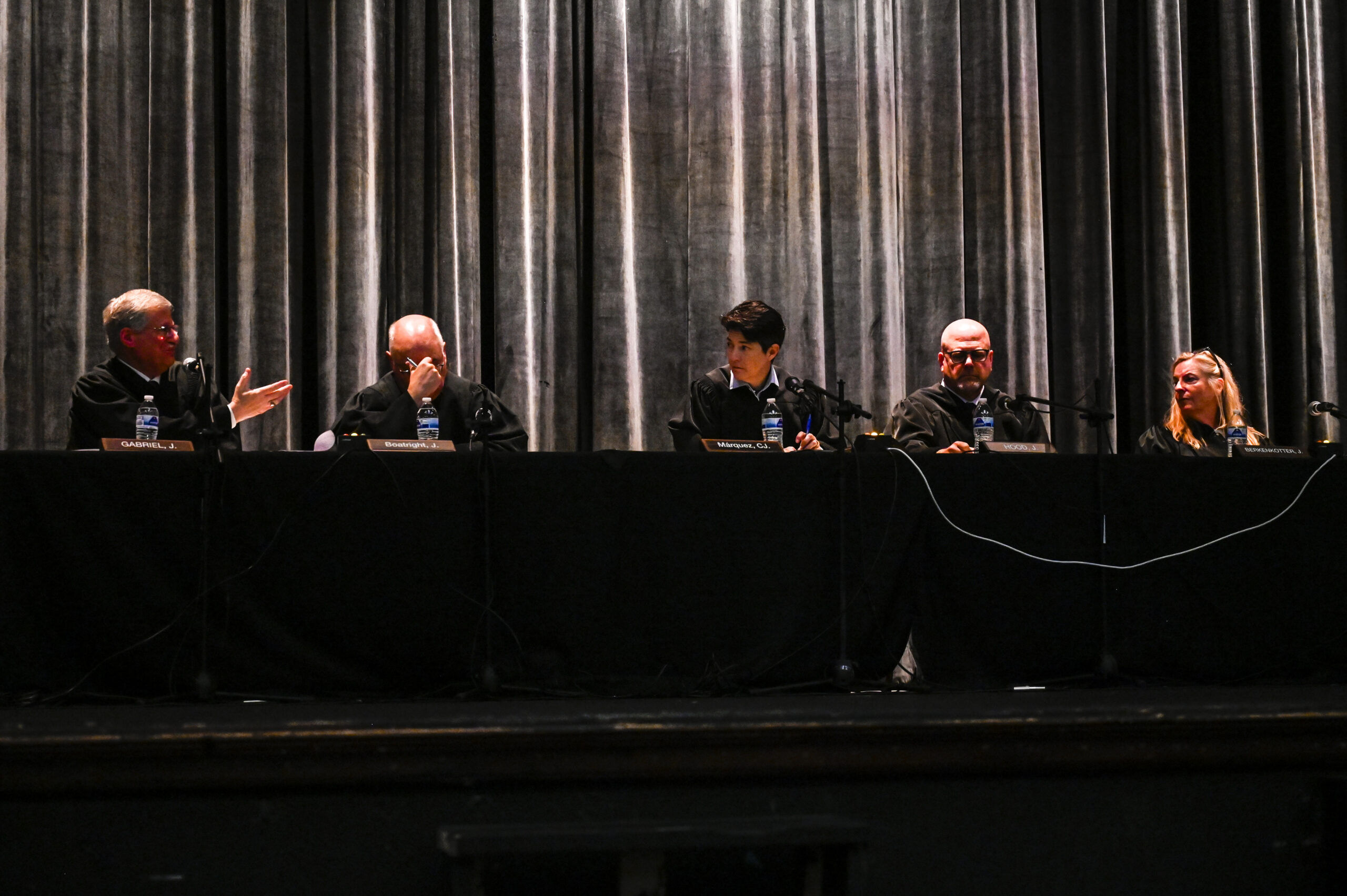
The Colorado Supreme Court heard comments from members of the legal profession last week about a proposed rule change intended to remind attorneys that misuse of new artificial intelligence tools can violate longstanding professional obligations.
Court of Appeals Judge Lino S. Lipinsky de Orlov, who chairs the Rules of Professional Conduct Standing Committee, told the justices that instances of lawyers and judges inadvertently including faulty, AI-generated references in their legal filings continue to make headlines.
“The reason why we need a rule, in the opinion of the standing committee, is that the legal profession hasn’t yet gotten the message that there are risks,” he said at the Dec. 17 hearing.
“Yes, I think it is coming. It is upon us. We need to be ready for it,” agreed Chief Justice Monica M. Márquez.
The proposal before the Supreme Court would add language to the rules of professional conduct clarifying that increased use of AI in the law “does not diminish a lawyer’s responsibilities” under the existing rules. Consequently, attorneys should be aware of “the benefits and risks associated with” such technology.
The rule change also would alert lawyers that misuse of AI could implicate the professional rules governing communication, client confidentiality, candor toward the court and use of a non-lawyer’s assistance.
“There’s not a get-out-of-jail-free card because you used a particular type of technology. The rules still apply,” said Julia Martinez, who chaired the subcommittee that produced the rule change.
She elaborated that the subcommittee did not want to discourage the responsible use of AI in a way that benefits clients, nor did it want to be so specific that technological changes would require further adjustments relatively quickly.
“These proposals, frankly, they’re modest. They don’t create new rules and new obligations,” said Martinez.
Written comments submitted in advance illustrated a divide among attorneys.
Denver attorney Casey Frank wrote that the changes are “unobjectionable because they contain no enforceable imperatives.” Frank suggested that lawyers be required in their filings to attest that they have independently verified the accuracy of output generated from an AI tool.
Already, some of Colorado’s federal judges impose that requirement, with U.S. District Court Judge S. Kato Crews having a directive in place for his cases and U.S. District Court Judge Nina Y. Wang adopting a similar policy this month.
U.S. Magistrate Judge Maritza Dominguez Braswell, who has taken the lead on AI issues in Colorado alongside Lipinsky and Justice Maria E. Berkenkotter, has also issued detailed guidance framing her approach to issues arising from negligent use of AI.
Public defender River B. Sedaka argued to the Supreme Court that the rule should acknowledge “ethical concerns triggered by the use of AI.” Those include the potential for plagiarism and the technology’s impact on water use and emissions.
“As lawyers, nuanced and critical thinking are essential to our job,” she said. “More troublingly, the increased use of AI, I believe, is encouraging our communities to abdicate that role of critical thinking and appreciating nuance because you can so easily get this whole brief essay, memo out of a machine.”
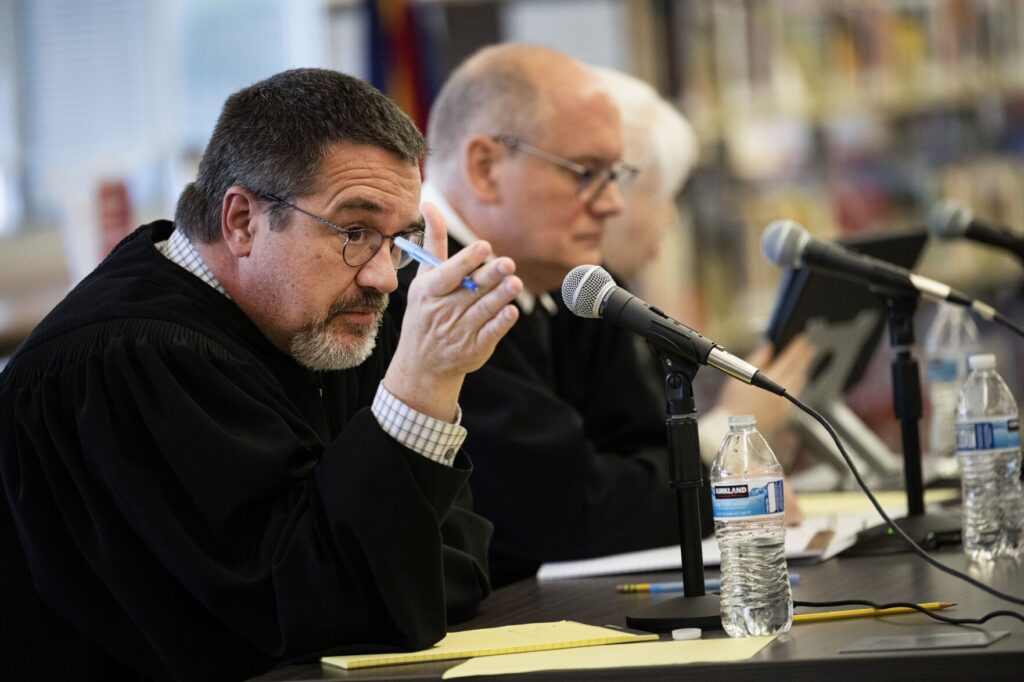
Justice William W. Hood III asked if Sedaka’s warnings about systemic impacts were appropriate to include in the rule, “given that we usually don’t showcase anything that might strike some as political in nature.”
Sedaka clarified that lawyers are capable of making their own decisions about whether to use or not use AI tools, but the rules “already require us to work to overcome the economic and social barriers for people who cannot afford” legal services.
M. David Johnson, a San Francisco-based attorney who is CEO of Modern Family Law, worried that the language could scare off attorneys from using AI for fear of violating the rules. He suggested an initiative akin to the Washington Supreme Court’s permitting of AI-based projects on a proposal-by-proposal basis.
“Why do you think it’s necessarily true that this is equivalent to taking out a billboard and saying folks should stay away from AI?” asked Hood.
“It really does look at AI as an enemy,” responded Johnson. “It’s a hammer. And a hammer can be used to build a house for the poor or it can be used to build a concentration camp. But you don’t blame the hammer.”
Lipinsky, the Court of Appeals judge, called the proposal “modest” and “a wake-up call” for lawyers about the potential dangers of relying uncritically on AI tools. He pointed to a database compiled by researcher and legal advisor Damien Charlotin that has tracked, to date, 709 cases with fake, AI-generated references in court filings worldwide.
“If Prof. Charlotin hadn’t found any cases where lawyers were misusing this technology, we probably wouldn’t be here. But the problem is the lawyers haven’t gotten the message,” said Lipinsky.
He also mentioned that in recent months, U.S. Sen. Chuck Grassley, R-Iowa, who chairs the Senate Judiciary Committee, has corresponded with two federal judges about AI-based errors in their orders.
“Now that we’re beginning to see cases where judges have issued orders or rulings that contain hallucinations, there’s a potential for erosion of public trust in that context, as well,” said Berkenkotter.
Justice Melissa Hart was not present for the hearing. She has been on a health-related leave of absence since late October and, two days after the hearing, announced she will leave the court in January.

Appeals court reinstates Garfield County arson charge
Michael Karlik
michael.karlik@coloradopolitics.com
Updated 12 hours ago
Colorado’s second-highest court reinstated a Garfield County defendant’s arson charge on Thursday, concluding a trial judge improperly credited a witness’s claim that she alone was responsible for starting the fire. A sheriff’s deputy responded to a brush fire near Parachute...
Federal judges rebuke ex-Colorado judicial discipline director for conduct in lawsuit
Michael Karlik
michael.karlik@coloradopolitics.com
Updated 13 hours ago
A pair of federal judges expressed a desire on Thursday to break the logjam on a lawsuit by Colorado’s former judicial discipline director against the state Supreme Court and related entities, while simultaneously showing little tolerance for the plaintiff’s scorched-earth...
Democratic bill would let recipients of ‘conversion therapy’ sue Colorado providers with no statute of limitations
Marissa Ventrelli
marissa.ventrelli@coloradopolitics.com
Updated 10 hours ago
Colorado lawmakers have advanced a proposal that would allow people who underwent conversion therapy to sue licensed providers for damages, moving the measure forward on a party-line vote in the House Judiciary Committee. House Bill 1322, proposed by Democratic Reps....
Federal judge refuses to authorize immediate appeal in World Cup trafficking lawsuit
Michael Karlik
michael.karlik@coloradopolitics.com
Updated 2 days ago
A federal judge declined to authorize an immediate appeal last week of a prior decision allowing companies operating out of Colorado to be sued for allegedly participating in a human trafficking venture involving Filipino laborers who constructed facilities for the...
Federal judge considers second round of sanctions against ex-Colorado judicial discipline director
Michael Karlik
michael.karlik@coloradopolitics.com
Updated 2 days ago
A federal judge ordered Colorado’s former judicial discipline director on Tuesday to explain why she should not sanction him a second time for filing documents for improper purposes, such as harassment or delay. U.S. District Court Senior Judge Kathryn H....
Colorado justices agree to review insurance question that has divided federal judges
Michael Karlik
michael.karlik@coloradopolitics.com
Updated 2 days ago
The Colorado Supreme Court granted a federal judge’s request on Friday to address an issue that has produced conflicting answers in policyholders’ lawsuits against insurance companies over unpaid benefits. “Parties (and judges) regularly spend undue time and money fighting in...
Federal judge dismisses background screeners’ challenge to Colorado law
Michael Karlik
michael.karlik@coloradopolitics.com
Updated 3 days ago
A federal judge dismissed a challenge on Friday to a portion of Colorado law that prohibits certain information from being included in consumer reports, in what seemed to be a conflict with federal law. Congress originally enacted the Fair Credit...

10th Circuit rejects ‘penalty’ for children of naturalized citizens seeking visas
Michael Karlik
michael.karlik@coloradopolitics.com
Updated 2 days ago
The Denver-based federal appeals court joined three of its peers earlier this month and determined the child of a newly naturalized U.S. citizen is not moved to a longer visa line as a result of his parent gaining citizenship, and...
Appeals court recognizes longer window to sue insurers for withholding policy details
Michael Karlik
michael.karlik@coloradopolitics.com
Updated 1 day ago
Colorado’s second-highest court split with its own prior decision earlier this month and concluded injured motorists have two years, not one, to sue insurance companies for withholding relevant information about an at-fault driver’s policy. In 2019, Colorado lawmakers enacted a measure to...

Appeals court decides free speech cases, error-prone judge reversed again | COURT CRAWL
Michael Karlik
michael.karlik@coloradopolitics.com
Updated 4 days ago
Welcome to Court Crawl, Colorado Politics’ roundup of news from the third branch of government. The state’s Court of Appeals decided multiple cases implicating free speech rights, plus Colorado’s most error-prone judge was reversed on appeal yet again. Heard on...
PREV
PREVIOUS
Arapahoe County investigators searching for suspects in $120K fairgrounds theft
Arapahoe County investigators are searching for four grinches who stole $120,000 in trucks and tools from the county’s fairgrounds on Tuesday, according to a sheriff’s office news release Wednesday. Investigators said four suspects in masks entered the maintenance shop at the Arapahoe County Fairgrounds, 25690 E. Quincy Ave. in Aurora, just before 10 p.m. Tuesday […]
'They will do just fine:' Westminster mayor steps down after 13 years
Former Westminster Mayor Nancy McNally officially stepped down from the dais on Dec. 1, marking more than 35 years in public service. “You’re our council mom,” Councilmember Amber Hott said behind tears. “What are we going to do without our council mom?” A few weeks later, multiple people stopped to shake her hand or wish […]