

Rethinking Medicare after COVID-era Obamacare subsidies | SLOAN

Congress is getting all twisted up over health care policy again, and every time they do so it is generally a polemical skirmish regarding one of two things: A) how to deal with whatever problem the government created in health care; or B) how to deal with high costs, a problem largely created by government.
At the moment, the central brouhaha is about the expiration of COVID-era Obamacare subsidies, the extension of which is generally opposed by Republicans who argue, quite reasonably, the crisis which birthed the subsidies ended nigh on four years ago and, by the way, the elasticization of the definition of “Medicaid eligible” is sort of bankrupting us.
On the other side of the ledger, the fiscal liabilities of government-provided health care are now so ineluctable they are gradually becoming clear to even the most obdurate of progressives, who nonetheless continue to clamor for the extension of the subsidies. Looking about for a less egalitarian target on which to place the blame they settle on what is probably the one segment of government health care that actually functions reasonably well: Medicare Advantage, the alternative to traditional Medicare administered by (egad!) private insurance, funded by the federal government.
It’s that “private” element which causes so much consternation among the left. It is also, not coincidentally, the element responsible for the program’s popularity and success.
The provision of medical care for the elderly is among the most perennially vexing issues in health care policy. George Will illustrated the problem most coherently when he said, “what we did in 1965 is attach the most rapidly growing segment of our population — the elderly — to our most dynamic science — medicine — as an entitlement.” In 1965 the average life expectancy in the U.S. was about 68.5 years. Sixty years later, it is around 79. Medical progress has advanced at an incredible pace, enough so it has added an element of elasticity to individual mortality — i.e. the better the medicine, the better the chances one lives longer.
The corollary to this is how more people are alive, for longer, during the most medically expensive years of their life. Add to this fact the following datum: A) as a society we recognize and agree to the need for provision of medical care to the elderly; B) overutilization of the health care system — driven mostly by the fact in nearly every case the bulk of medical care is paid for by someone other than the recipient — is the principle cause of higher health care costs; and C) the free-market strictures that would correct B), are constrained by A).
The dilemma approaches intractability. Without the discipline of the price mechanism, the trend is toward overutilization; what’s more, it creates the situation where insurers — including government plans like Medicare and Medicaid — lose money on sick people, and adjust accordingly. Consider the Canadian health care system for instance — it’s fantastic if you are healthy and don’t need it, and damn near deadly if you do.
So, under the traditional Medicare model, which was created never anticipating the extraordinary advances in pharmacology and medical science of the last half century, there is a perverse incentive to overprovide for those who don’t need it and underprovide for those who do. To put it another way, without any sort of price mechanism on which to compete there is no incentive to provide more or better-quality service.

The Medicare Advantage model addresses this problem elegantly. First, since the plans are administered by competing private insurers, it manages to avoid at least some of the bureaucratic pitfalls inherent with government-run plans. Second, under the MA risk adjustment system, if an illness is diagnosed, or another change in a patient’s health status is observed, doctors can receive higher premiums from Medicare, reflecting the anticipated increased costs. Ergo, the plans are naturally more tailored to the individual, and, unlike traditional Medicare, providers and insurance companies are actually incentivized to offer more, and higher quality, services. This is how MA plans are able to offer a cornucopia of services unavailable within the traditional, fee-for-service Medicare model, i.e. dental, fitness, vision and hearing coverage, nutrition support, greater access to in-home care, and so forth.
The ultimate proof of the efficacy of the model is in its popularity. Between Jan. 1, 2020 and Jan.1, 2024, MA enrollment increased from 24.3 million to 33.5 million, 37.5%. Darren Grubb, a spokesman for Medicare Advantage Majority, a non-profit dedicated to protecting the program, was recently on a local radio show (the Jeff and Bill Show on 710 KNUS) explaining how 53% of Colorado Medicare-eligible seniors have left traditional Medicare and signed up for MA plans, numbers consistent with the national figures. Multiple surveys have demonstrated the program’s popularity not only with recipients but caregivers. Empirical studies have quantified the savings to both seniors and to taxpayers.
No program tainted with the original sin of government funding and oversight is perfect, and MA would benefit from a few structural tweaks that could further enhance competitiveness. But Congress should resist the collectivist urge to micromanage, standardize, or defund MA in an effort to hobble it to the homogenous, lowest-common-denominator government-run model they yearn for, a model that will serve only to make us sicker, poorer, or both.
Kelly Sloan is a political and public affairs consultant and a recovering journalist based in Denver.

A path toward justice and public safety | PODIUM
Anthony Hartsook
ahartsockop@gmail.com
Updated 6 hours ago
Strangulation can be one of the most dangerous forms of assault; despite the lack of visible ailments it is accompanied by. Though strangulation leaves no broken bones, bruises or visible wounds, it is one of the strongest predictors of future...

From moving people to managing them | GUEST COLUMN
Michael Hancock
michael-hancock@coloradopolitics.com
Updated 7 hours ago
Transportation policy used to have a fairly uncomplicated purpose: move people safely, efficiently and reliably. Build roads where people drive. Maintain bridges before they fail. Add capacity where growth overwhelms the system. Provide transit where it makes sense. Infrastructure was...
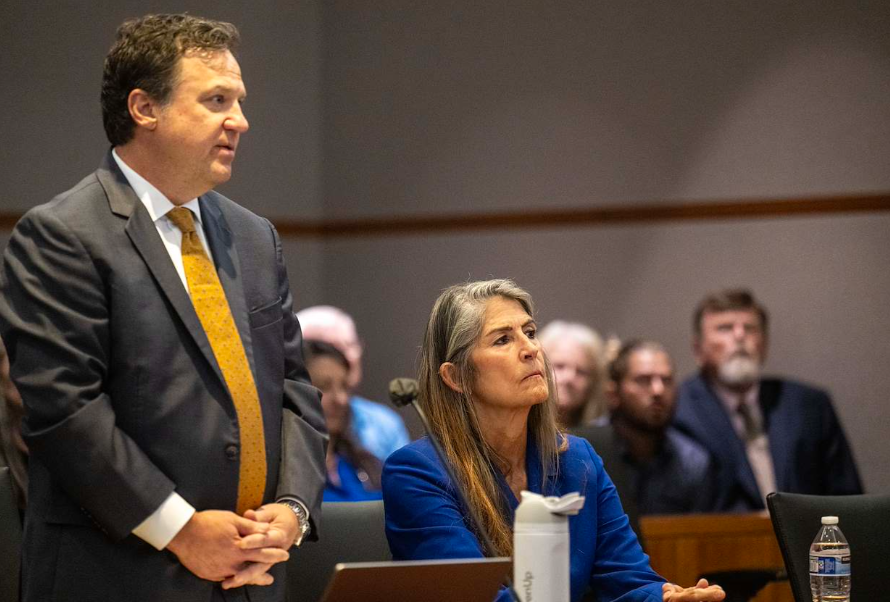
Disgraced ex-CBI analyst Missy Woods sentenced to prison in DNA scandal
Jenny Deam
jenny.deam@gazette.com
Updated 13 hours ago
A Jefferson County district court judge on Tuesday sentenced a disgraced former Colorado Bureau of Investigation DNA analyst to a decade in prison for altering and deleting data in scores of criminal cases over several years. Jefferson County District Judge...

Jason Crow endorses Democrats up and down Colorado’s ballot, chips in $100K for campaign efforts
Ernest Luning
ernest.luning@coloradopolitics.com
Updated 12 hours ago
Democratic U.S. Rep. Jason Crow on Tuesday formally endorsed more than 60 Democrats running up and down Colorado’s ballot and said he’s putting $100,000 into statewide and county campaigns and organizing programs to drive turnout in the fall election. Crow,...
Trumpicans thumb their nose at the Constitution | Hal Bidlack
Hal Bidlack
hal-bidlack@coloradopolitics.com
Updated 2 days ago
As is all too often the case, there are again too many interesting things appearing in Colorado Politics for me to comment on all of them. So let me tell you what I won’t be talking about before I get...

CoComandering? | Miller Hudson
Miller Hudson
miller-hudson@coloradopolitics.com
Updated 3 days ago
At 8 a.m., Friday morning, Aug. 28, 70 or 80 mostly bleary-eyed visitors to the Transportation Technology Center outside Pueblo packed a conference room to attend the Front Range Passenger Rail District’s (FRPRD) Board meeting. With the exception of those...

Even Dem court couldn’t abide theft of GOP seats | Dick Wadhams
Dick Wadhams
dick-wadhams@coloradopolitics.com
Updated 3 days ago
Thanks to the Colorado Supreme Court, Colorado voters will be able to reaffirm their support for the Independent Congressional Redistricting Commission after the court struck down the Democratic scheme to steal three Republican congressional seats. Billionaire-funded national Democratic groups from...

Chaotic meeting began with attempt to squelch public comment | Rachel Gabel
Rachel Gabel
rachel-gabel@coloradopolitics.com
Updated 3 days ago
When Attorney General Phil Weiser takes the governor’s office in January, he must immediately address the chaos of the latest round of appointees to the Colorado Parks and Wildlife Commission to assure stakeholders he’s willing to put pressure on the...

Graduated income tax proposal is a flat tax in disguise | Jon Caldara
Jon Caldara
jon-caldara@coloradopolitics.com
Updated 5 days ago
“Youth is wasted on all the wrong people.” That’s one of my favorite lines from “It’s a Wonderful Life.” The older I get, the less it sounds like a joke. Every generation inherits victories it did not win. Young Americans...

AI optimism vs. anxiety — podcasters debate this every night | Tom Cronin
Tom Cronin
tom-cronin@coloradopolitics.com
Updated 4 days ago
President Donald Trump, CNBC’s “Mad Money” host Jim Cramer and entrepreneurial “accelerationists” celebrate the AI revolution and the infrastructure data-center build-out. Cramer recently gushed, “I like data centers so much that I wish I lived in one.” Trump criticized any community...
PREV
PREVIOUS

Colleagues and friends remember former Colorado state lawmaker Lew Entz
Lew Entz, 94, a former Republican state senator from Hooper, died Wednesday, Dec. 10, following a long illness. A visitation for Entz is scheduled at Rogers Family Mortuary, 205 State St. in Alamosa, on Friday, Jan. 2, from 4 to 6 p.m. Funeral services will be held on Saturday, Jan. 3 at 10 a.m. at […]

Trump pardons Tina Peters, but Colorado officials say he can’t reverse state convictions | TRAIL MIX
President Donald Trump said late on Dec. 11 that he had issued a pardon for Tina Peters, the former Mesa County clerk convicted of orchestrating a scheme to breach secure election equipment, though Colorado officials and legal experts immediately countered that the president’s broad pardon powers don’t extend to state-level crimes like those committed by […]