

It’s up to Gov. Jared Polis to figure out where to cut $800 million, proposal says
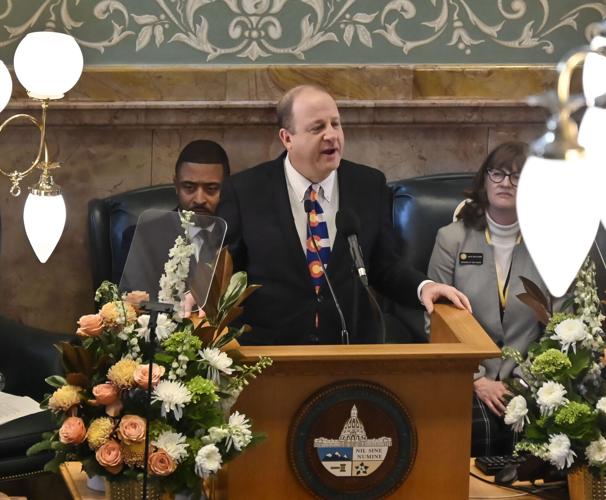
Special to Colorado Politics/John Leyba
As Colorado lawmakers attempt to wrestle down an $800 million budget deficit, legislative leaders are coalescing around the idea that, ultimately, it is up to Gov. Jared Polis to figure out where to make cuts, instead of legislators going through each agency’s budget to impose reductions.
More than two dozen bills have been introduced ahead of Thursday’s special legislative session. What’s notably absent from the proposed bills so far is any clear plan for how those cuts would be made.
Indeed, only one bill even hints at specific reductions — a proposal from Western Slope lawmakers to cut $264,000 from the state’s wolf management program and redirect that money to help pay for health insurance subsidies.
There are two bills, similar in some regards, from members of the Joint Budget Committee, that deal with Gov. Jared Polis’ authority to enact spending cuts when revenues fall short.
State analysts said the state lost $1.2 billion, mostly in corporate income tax revenue that was cut as a result of H.R. 1, the federal budget.
Democrats have blamed Colorado’s fiscal woes on the recently-signed congressional budget. Republicans have maintained that, broadly speaking, Democrats, who are in charge of the state government, are to blame for the deficit that Colorado faces, arguing the dominant party has overspent and failed to heed warnings of a looming budget crisis.
Current state law puts the authority to cut spending in times of shortfalls into the hands of the governor, as was explained to the members of the JBC about two weeks ago.
The law says the governor can determine the state has insufficient revenue to carry on the functions of the government and, by executive order, suspend or discontinue functions or services of any department, board, bureau or agency.
That declaration would go into effect on the first day of the following calendar month and can be extended for up to three months at a time.
The statute does not spell out how the governor would make that determination.
That’s where the legislation sponsored by JBC members Sen. Judy Amabile, D-Boulder and Rep. Emily Sirota, D-Denver, comes in. The bill is co-sponsored by Senate President James Coleman, D-Denver, and House Speaker Julie McCluskie, D-Frisco.
Under the proposal, the governor would maintain the existing authority, but with reporting requirements to inform lawmakers.
The bill requires the governor to notify the JBC of the executive order promptly, and as soon as possible, meet with the panel to discuss the plans for discretionary spending reductions.
The JBC can provide advice regarding those spending cuts, Amabile told Colorado Politics.
And while the bill does not give lawmakers authority to make changes in those spending plans at the time of the executive order, Amabile said she believes the governor will be open to any input from the committee.
The governor “has to tell us what he’s doing before he does it,” Amabile said.
The JBC can provide feedback on the plan, and if the committee is providing good input, “we will be listened to,” Amabile said.
However, that doesn’t necessarily mean the governor will adopt what the JBC suggests, she noted.
Suppose the JBC disagrees with the governor’s proposal, what happens then?
In that case, lawmakers will have an opportunity to make changes when the General Assembly reconvenes in January, during the supplemental process.
That’s when lawmakers “true up” the budget to account for changes, either reductions or additional spending, that state agencies propose.
“We will have an opportunity to do a correction if we feel like what the governor did was not in the best interests of the state,” Amabile said.
The second part of the bill adds the trigger for when the governor acts.
The measure says the spending reduction trigger for the governor is an updated regular quarterly revenue estimate that states that the state would need to use an amount of the reserve equal to the lesser of 2% of general fund appropriations for the fiscal year or one-half of the required reserve, or when the balance of the reserve drops to below $1 billion.
That’s close to what’s already in state law, except that the special session bill eliminates a requirement that the state must see four consecutive revenue forecasts that show a shortfall as part of the trigger.
It’s still up to the governor to come up with a plan to reduce spending, Amabile said.
“I am sure that they are doing a lot of analysis right now, and they’re meeting with all the agencies and they’re working away,” she said.
Polis has already announced a hiring freeze that goes into effect Aug. 27, and agencies have been asked to come up with 2.5% in spending cuts, with some exceptions, for 2026-27, with hopes that some of those spending cuts could be pushed into 2025-26.
Should the measure be adopted, Amabile said that, shortly after the special session is over, the governor would present the JBC with the spending reduction plan.
“That’s the responsible thing for us to do,” she added.
Amabile believes there would be enough time between the end of the special session and Aug. 31 for the governor’s office to come up with that plan, and that it could be put into effect Sept. 1.
That’s an essential date for budget purposes.
Mark Ferrandino, director of the Office of State Planning and Budgeting, has said several times that it’s less complicated to cut the budget when 10 months are remaining in the fiscal year. To save one dollar in that timeframe, policymakers would cut one dollar.
Waiting until the legislature returns in January would mean they would have to make deeper cuts to save the same dollar, since there would be less time to spread out the cuts, he said.
JBC Chair Sen. Jeff Bridge, D-Greenwood Village, estimated the amount that would have to be cut is in the range of $300 million to $400 million, with the rest of the shortfall covered by the state’s $2.3 billion general fund reserves.
He told reporters during a Tuesday news conference that, should the bill pass, lawmakers will move quickly to meet with the governor on the spending reduction plan.
A second proposal is offered by the JBC’s Republican members, Rep. Rick Taggart of Grand Junction and Sen. Barbara Kirkmeyer of Brighton.
The similarities with the Amabile-Sirota bill include requiring a meeting between the governor and the JBC as soon as possible.
Their proposal differs in that it requires the governor to update the JBC and lawmakers when the executive order is extended.
Under current law, that order has a lifespan of three months, although it can be extended for up to three months at a time.
Under the Taggart-Kirkmeyer bill, the governor would have 28 days to meet with the JBC after extending the order. The Amabile-Sirota bill does not require an updated spending plan if the executive order is extended.
The GOP bill also does not include a change in the revenue trigger, although it does use a trigger of an updated revenue forecast.
The special session is scheduled to start at 10 a.m. on Thursday.
According to House Majority Leader Rep. Monica Duran, D-Wheat Ridge, lawmakers are being told they should expect to work through the weekend.


At conservative summit, Colorado Republican leaders concede Democrats’ election edge
Marissa Ventrelli
marissa.ventrelli@coloradopolitics.com
Updated 12 hours ago
Four Republican state lawmakers told attendees at a gathering of conservative leaders on Friday they doubt their party can win statewide races, noting that Colorado’s electorate has been shifting toward Democrats but adding they see an opening in several pockets....

Colorado lawmakers start crafting strategy to manage $200 million in federal rural health funds
Marissa Ventrelli
marissa.ventrelli@coloradopolitics.com
Updated 2 days ago
Members of the Colorado legislature’s new Commission on Medicaid raised concerns Wednesday about the federal Rural Health Transformation Program created under H.R. 1. The bipartisan, bicameral commission, created in the last legislative session to guide implementation of Medicaid changes under...

Colorado’s 72-hour social media warrant law takes effect Aug. 12
Marissa Ventrelli
marissa.ventrelli@coloradopolitics.com
Updated 3 days ago
A law requiring social media platforms to respond to search warrants within 72 hours goes into effect on Aug. 12. Senate Bill 011 also requires platforms to create a staffed hotline for Colorado law enforcement agencies to contact regarding pending...

Gov. Polis celebrates Colorado’s first-place education ranking by U.S. News
Marianne Goodland
marianne.goodland@coloradopolitics.com
Updated 3 days ago
Colorado officials said they have something to celebrate this week, in addition to the state’s sesquicentennial birthday on Saturday. U.S. News & World Report on Tuesday gave Colorado its top ranking for education efforts from pre-K to postsecondary, though it...

Colorado districts prepare for school year amid mental health worries — will fewer cellphone distractions help?
Marissa Ventrelli
marissa.ventrelli@coloradopolitics.com
Updated 12 hours ago
The signs of a new school year are everywhere — buses in the shop, teachers unpacking boxes, families ticking through supply lists — and behind the familiar rituals, Colorado districts are preparing for a year defined less by routine than...

DOJ sues Colorado to overturn in‑state tuition for students living in the country illegally
Marianne Goodland
marianne.goodland@coloradopolitics.com
Updated 1 week ago
The U.S. Department of Justice has sued Colorado to dismantle a decade‑old law that grants in‑state tuition to students living illegally in the United States, setting up a high‑stakes clash over immigration policy. In 2013, after more than six tries...
Details emerge after teen motorcycle parental consent bill is set to become law in Colorado
Marianne Goodland
marianne.goodland@coloradopolitics.com
Updated 1 week ago
Gov. Jared Polis this year signed a bill that requires minors to obtain parental consent for a motorcycle instruction permit — legislation inspired by a young man who almost died in a crash last year. The measure, House Bill 26-1079,...

What to know before Colorado’s new law on semiautomatic firearms goes into effect
Marissa Ventrelli
marissa.ventrelli@coloradopolitics.com
Updated 2 weeks ago
A Colorado law passed in 2025 established new requirements for individuals planning to purchase semiautomatic weapons. Here’s what residents should know before Senate Bill 003 goes into effect on Aug. 1. From a ban to a training course For decades,...
Will Colorado Gov. Jared Polis’ independent streak define his legacy?
Marissa Ventrelli
marissa.ventrelli@coloradopolitics.com
Updated 2 weeks ago
Sometimes aligned with his party and at other times apart from it, Colorado Gov. Jared Polis has spent much of his tenure charting his own course. That independent streak carried through fights over labor policy, rural anger over wolf reintroduction...

Campaign launched to redirect $1 billion in TABOR refunds to education
Marissa Ventrelli
marissa.ventrelli@coloradopolitics.com
Updated 2 weeks ago
A coalition that includes the state teachers’ union on Tuesday launched a campaign for a ballot proposal that would reduce more than $1 billion in taxpayer refunds and spend the money on education. The measure is among several campaigns taking...
PREV
PREVIOUS

Colorado special session bills: What you need to know
Colorado legislators have begun proposing bills for Thursday’s special session, when they will need to figure out how to plug a nearly $800 million budget shortfall. Only a handful of the measures introduced so far directly deal with the deficit. Some Democrats — their party holds the majority of the Colorado General Assembly — have […]

Colorado regulators consider Xcel Energy's proposal for 5,000 MW of new generation
Colorado’s energy regulators are deliberating Xcel Energy’s request to build out new generating resources, even as business groups urged the commissioners to not “artificially” constrain the amount of power that industry experts concluded the state needs. Xcel is asking the Public Utilities Commission to build 5,000 megawatts of new capacity over the next five years. […]