

Colorado justices mull level of proof needed for crime of possessing others’ debit cards
Members of the Colorado Supreme Court considered on Tuesday whether simply having another person’s debit card amounts to the crime of possessing someone’s “financial device,” or if prosecutors must also prove the card is functional.
During oral arguments, Justice Richard L. Gabriel said he was worried about over-criminalizing conduct that, practically speaking, might not have a victim.
“Many, many people, when their card expires, they just throw it in the trashcan. And I have a bit of a concern,” he said. “Somebody finds a discarded, expired credit card, expired debit card, and we say that they’re possessing that as a crime.”
Jefferson County jurors convicted Garry Allen Hudson of multiple offenses related to his possession of counterfeit bills and other people’s identification cards. Hudson appealed his convictions and a three-judge panel for the Court of Appeals largely sided against him.
However, by 2-1, the majority overturned one of Hudson’s convictions for possession of a financial device. The underlying charge involved two debit cards belonging to other people that police found when they arrested Hudson. Law enforcement was unable to locate the owners and there was no evidence about whether the cards were active or whether there was money in the corresponding bank accounts.
Under Colorado law, committing the crime required Hudson to knowingly possess another person’s financial device, meaning “any instrument that can be used” to obtain cash or something of value. The law provides a list of included examples, and debit cards are among them.
Based on that understanding, the appellate panel’s majority vacated Hudson’s conviction because there was no proof Hudson could have actually used the debit cards for anything. Writing in dissent, Judge W. Eric Kuhn believed the explicit inclusion of debit cards in the law was sufficient to sustain a conviction, regardless of whether a specific card is “capable of use.”

“For purposes of the criminal possession of a financial device statute, it makes sense that a person is on notice that any of these common financial devices can be used to obtain a thing of value,” he wrote.
The Colorado Attorney General’s Office appealed to the Supreme Court, arguing the listed financial devices, if possessed by a defendant, should trigger a conviction without any further proof.
The Court of Appeals’ reasoning meant “a person would be absolved of criminal liability when the debit card owner cancels the card after realizing it was lost or stolen, while a person in possession of a debit card that has not been cancelled would remain subject to criminal liability,” wrote Senior Assistant Attorney General Megan C. Rasband, “despite both people committing the same act.”
“So, what if the debit card on its face is expired?” asked Gabriel during arguments.
Assistant Attorney General Joshua J. Luna explained the law in question was enacted as part of a broader push to combat identity theft, and “even an expired or an inactive debit card still presents a risk to identity theft.”
“Now you’re adding language,” interjected Gabriel. “The statute doesn’t say anything about identity theft.”

Suzan Trinh Almony, representing Hudson, argued her client was only charged with the narrow offense of possessing someone else’s financial instrument, which the law indicated must be something a person can use.
“It would seem to be the rare case then, under your view, that we would ever have a violation of the statute,” said Gabriel, noting people will cancel lost debit or credit cards. “With your theory, as long as somebody does that, we’re never gonna have a crime under this statute.”
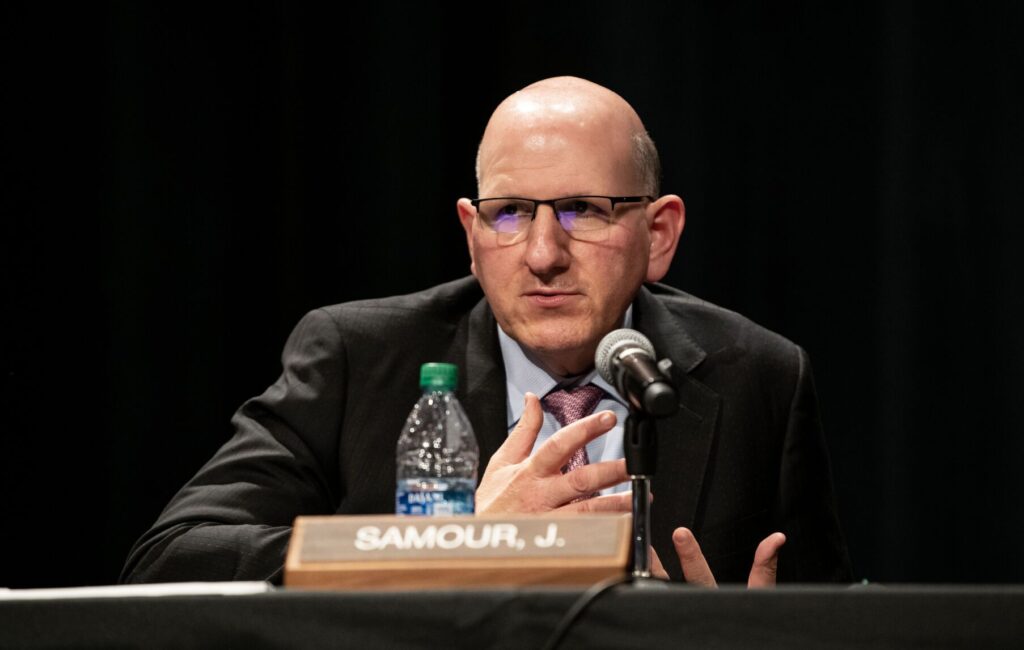
Meanwhile, Justice Carlos A. Samour Jr. was puzzled by the government’s position that the law unambiguously supported the prosecution’s reasoning.
“I’m wondering why you’re so resistant to the idea that the statute is susceptible to a couple of different interpretations,” he told Luna. “Even (Kuhn’s) dissent said, ‘Hey, I think there are two reasonable ways of reading this.'”
Chief Justice Monica M. Márquez did not attend the arguments. Justice Brian D. Boatright said she was “unavailable,” but did not otherwise explain her absence.
The case is People v. Hudson.
Colorado Politics Must-Reads:


Colorado leaders weigh next steps after Supreme Court rejects state ban on ‘conversion therapy’
Marissa Ventrelli
marissa.ventrelli@coloradopolitics.com
Updated 5 hours ago
Colorado leaders said they are weighing next steps after the U.S. Supreme Court on Tuesday rejected the state’s ban on “conversion therapy” for children, as critics and supporters cheered or lambasted the ruling. The court’s near-unanimous decision called the Colorado...

Federal judge dismisses U.S. government lawsuit against Colorado, Denver’s ‘sanctuary’ laws
Michael Karlik
michael.karlik@coloradopolitics.com
Updated 4 hours ago
A federal judge dismissed the U.S. government’s lawsuit against Colorado and Denver on Tuesday, which alleged that various local policies impermissibly infringed on federal immigration enforcement. U.S. District Court Judge Gordon P. Gallagher followed the lead of judges in Illinois...

Federal judge finds DOJ adequately searched for, disclosed records related to Bidens
Michael Karlik
michael.karlik@coloradopolitics.com
Updated 9 hours ago
A federal judge determined on Friday that the U.S. Department of Justice adequately searched for and disclosed records to a Colorado attorney in response to his request for documents related to former President Joe Biden’s son and brother. In November...
10th Circuit warns lawyers after finding fake case in filing
Michael Karlik
michael.karlik@coloradopolitics.com
Updated 3 hours ago
The Denver-based federal appeals court warned attorneys to be more careful last month after discovering one lawyer cited a fake case in his arguments. In recent months, federal and state judges in Colorado have begun cautioning lawyers explicitly about the...

10th Circuit rules cognitively impaired man’s risk of lobotomy, mistreatment in Mexico not ‘torture’
Michael Karlik
michael.karlik@coloradopolitics.com
Updated 1 day ago
The Denver-based federal appeals court concluded last month that a man’s risk of mistreatment or forced lobotomy in his native Mexico did not amount to “torture” that should shield him from deportation. A three-judge panel of the U.S. Court of...
Colorado justices side with news organizations for disclosure of high-level child abuse data
Michael Karlik
michael.karlik@coloradopolitics.com
Updated 6 hours ago
The Colorado Supreme Court ruled on Monday that the state must disclose the number of child abuse reports at individual group living facilities in response to an open records request, as the addresses are already in the public domain. The...
Divided Colorado Supreme Court finds Denver detective did not violate defendant’s Miranda rights
Michael Karlik
michael.karlik@coloradopolitics.com
Updated 1 day ago
The Colorado Supreme Court determined on Monday that a Denver detective did not improperly resume questioning of a defendant in custody after he invoked his right to counsel. By 4-3, the justices reversed a trial judge’s order that found a...

Out-of-state judges address ex-discipline director’s lawsuit, Colorado justices accept federal invitation | COURT CRAWL
Michael Karlik
michael.karlik@coloradopolitics.com
Updated 2 days ago
Welcome to Court Crawl, Colorado Politics’ roundup of news from the third branch of government. A pair of out-of-state judges got down to business in a lawsuit brought by Colorado’s former judicial discipline director, plus the state Supreme Court has...
Federal judge upholds constitutionality of Colorado campaign contribution limits
Michael Karlik
michael.karlik@coloradopolitics.com
Updated 4 days ago
A federal judge upheld Colorado’s individual campaign contribution limits as constitutional on Thursday, finding that three Republican plaintiffs failed to prove the campaign finance framework violates their First Amendment rights. U.S. District Court Senior Judge John L. Kane recognized that...

Appeals court rejects theory that existing tax revenue undermines need for new fees
Michael Karlik
michael.karlik@coloradopolitics.com
Updated 4 days ago
Colorado’s second-highest court rejected a plaintiff’s claim on Thursday that the tax revenue generated by an existing activity should prevent local governments from imposing new fees aimed at regulating the activity. The question stemmed from Colorado’s unique constraints on taxation...