

Colorado Supreme Court approves new rules for child welfare cases, with tweaks to jury trial right
The Colorado Supreme Court adopted on Monday a package of revisions to the rules governing child welfare cases, while modifying one section that governs when a parent surrenders their right to have a jury decide if their child is neglected.
Earlier this month, the justices held a hearing to evaluate the long-running group effort to revise the rules of juvenile procedure. They heard the proposed package had achieved consensus among the entities with a stake in such proceedings. The proposal reflected recent changes to state law and clarified the unique position children occupy in dependency and neglect matters — the formal name for child neglect cases.
However, the Supreme Court ended up tweaking the language that describes when parents who have requested a jury trial will forfeit that choice — a question that is swirling in several pending cases before the court.
In one appeal, the justices were asked to consider whether a parent still preserves their right if they fail to appear for the trial, but their lawyer is present. Some members of the court were sympathetic to the idea that a “party,” which is the term the current rules use, could refer to someone who appears through their counsel only.
The new rules now clear up the confusion. The court replaced the word “party” with “respondent parent,” and made clear that the respondent parent is the one who has to appear for their chosen jury trial.
On the same day the court adopted the rules, it dismissed the appeal it heard this month raising the question of whether an attorney’s appearance is sufficient. The dismissal lets stand the Court of Appeals’ decision, which found an Arapahoe County mother who was absent from her child neglect trial could not rely on her lawyer’s presence to preserve her right to a jury trial.
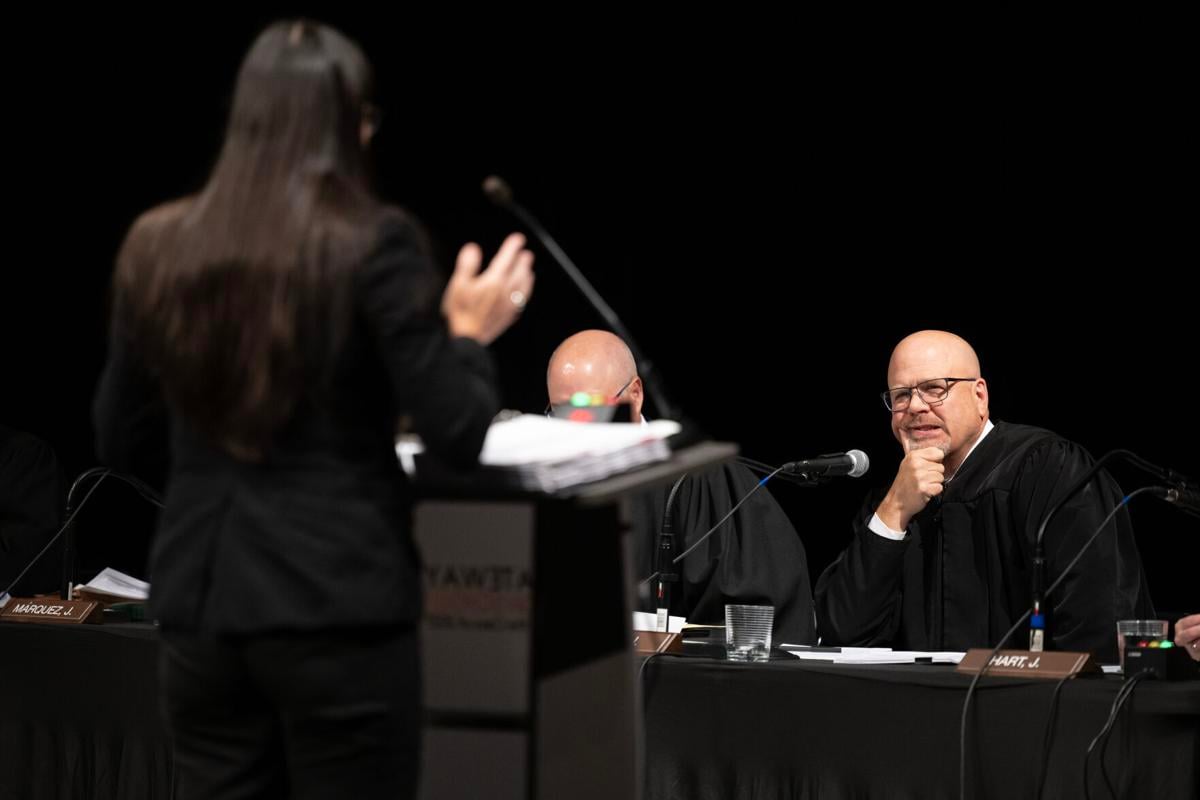
FILE PHOTO: Colorado Supreme Court Justice William W. Hood III looks on after asking a question to Assistant Deputy Jefferson County Attorney Rebecca P. Klymkowsky during oral arguments in the County of Jefferson v. Beverly Stickle case during Courts in the Community on Thursday, Oct. 26, 2023, at Gateway High School in Aurora, Colo. (Timothy Hurst/Denver Gazette)
Timothy Hurst/Denver Gazette

During the hearing on the rules package, Justice William W. Hood III wondered whether the court should incorporate language to that effect. Court of Appeals Judge Craig R. Welling, who chairs the committee on juvenile procedural rules, said the drafters had not examined that question in detail, but “I think it would be worthwhile to just go ahead and add that language.”
The Office of Respondent Parents’ Counsel, which represents indigent parents in child neglect cases, criticized the post-hearing modification.
“The ORPC is disappointed the Supreme Court chose to make substantive rule changes affecting only the rights of parents without an opportunity for further public comment,” said Melissa Michaelis Thompson, the office’s executive director.
Otherwise, the Supreme Court kept intact the portion of the draft rules enabling trial judges to rescind a parent’s chosen jury trial if they fail to appear at a pretrial conference — as long as the parent is told to appear, receives notice about the consequences and lacks good cause for failing to be there.
Historically, some judges canceled the planned jury trial if the parent did not show for the pretrial conference, but the Court of Appeals found nothing authorizes that practice currently. The Supreme Court is reviewing that issue in a separate case. While the rules change may telegraph the justices’ thinking, it will not affect the outcome of that appeal, as the new rules take effect for cases filed after July 1.

Schoolchildren’s presence at child sex-related trial did not harm Arapahoe County defendant, appeals court says
Michael Karlik
michael.karlik@coloradopolitics.com
Updated 1 day ago
Colorado’s second-highest court decided on Thursday that the presence of a group of schoolchildren on the first day of a child sexual exploitation trial did not violate an Arapahoe County defendant’s constitutional right to a fair trial. Prosecutors charged Jerry...
Appeals court cites week-old Colorado law to reinstate child neglect case at child, father’s request
Michael Karlik
michael.karlik@coloradopolitics.com
Updated 1 day ago
Colorado’s second-highest court invoked a new state law for the first time on Thursday and reinstated a child neglect case that both the child and her father wished to reopen. House Bill 1227 took effect on Aug. 12, reversing a...
Colorado Supreme Court names William Hood as next chief justice
Michael Karlik
michael.karlik@coloradopolitics.com
Updated 2 days ago
The Colorado Supreme Court has selected Justice William W. Hood III to be the next chief justice, the judicial branch announced on Friday. Hood will succeed Chief Justice Monica M. Márquez, who took over the role in July 2024. “I...

Appeals court upholds Park County trophy hunting conviction
Michael Karlik
michael.karlik@coloradopolitics.com
Updated 2 days ago
Colorado’s second-highest court clarified on Thursday that a defendant may stand convicted under the state’s trophy hunting laws if he abandons a bear carcass but returns later to remove the meat. Under Colorado law, it is a felony to detach...
Judge grants partial injunction to GEO in fight against state health inspection law
Kyla Pearce
kyla.pearce@gazette.com
Updated 3 days ago
A judge ruled Thursday that The GEO Group does not have to follow parts of a new state law requiring more frequent health and safety inspections at the U.S. Immigration and Customs Enforcement processing center in Aurora. Under the order...
Parker man faces 20 years to life for serial sexual assaults
Nicholas Fogleman
nicholas.fogleman@denvergazette.com
Updated 3 days ago
A 25-year-old Parker man who sexually assaulted three women in 2025 pleaded guilty Wednesday and will serve 20 years to life in prison. Javier Rodriguez-Andrade pleaded guilty to charges stemming from three sexual assaults involving women ages 19 to 24. ...
Divided appeals court upholds warrantless DNA collection in Colorado cold case, cautions of government overreach
Michael Karlik
michael.karlik@coloradopolitics.com
Updated 3 days ago
Colorado’s second-highest court upheld the warrantless collection of a suspect’s DNA from a discarded soda can as constitutional on Thursday, while warning about potential abuse of DNA privacy in the absence of further guardrails. By 2-1, a three-judge Court of...
Man charged in Northglenn homicide of wife
Matt Kyle
matt.kyle@denvergazette.com
Updated 3 days ago
A man has been formally charged with murder and burglary relating to a homicide last week in Northglenn. Alexei Munive-Rodriguez, 48, was arrested Sunday after he was at large following the homicide, which occurred Friday. Police were dispatched around 10:30...
10th Circuit grants immunity to officers for fatal Manitou Springs shooting
Michael Karlik
michael.karlik@coloradopolitics.com
Updated 3 days ago
The Denver-based federal appeals court ruled on Wednesday that responding officers from Manitou Springs and El Paso County cannot be held constitutionally liable for shooting and killing a man after a 20-minute standoff. Wilford Deweese allegedly pulled out a gun...
10th Circuit rejects invitation for full-court review of tax-avoidance case
Michael Karlik
michael.karlik@coloradopolitics.com
Updated 4 days ago
The Denver-based federal appeals court declined to reconsider the standards for holding entities liable for their tax-avoidance schemes, with a majority of judges voting against full-court review on Monday. In April, a three-judge panel of the U.S. Court of Appeals...