

Appeals court emphasizes claims against officers must be ‘frivolous’ for unsuccessful plaintiffs to pay
Colorado’s second-highest court ruled on Thursday that a 2020 police accountability law only contemplates that unsuccessful plaintiffs will compensate officer defendants for their costs when the claims are frivolous.
Lawmakers enacted Senate Bill 217 in the wake of protests that erupted over the May 2020 death of George Floyd at the hands of Minneapolis police. Although federal law has long enabled plaintiffs to sue state officials for violations of their rights under the U.S. Constitution, SB 217 created such a mechanism for violations of rights under the Colorado Constitution.
Normally, prevailing defendants in civil lawsuits may recover costs associated with the case, like attorney fees, filing fees and the expense of deposing witnesses. SB 217, however, allows judges to award costs to successful officer defendants for “any claims the court finds frivolous.”
Dale Waugh and a co-plaintiff filed suit against multiple Denver police officers following an August 2020 protest against city efforts to dismantle homeless encampments. Based on the physical altercation that ensued, the plaintiffs sued under SB 217.
A jury trial resulted in a verdict in favor of Waugh’s co-plaintiff and against Waugh himself on the claims of excessive force. Consequently, officer defendants Daniel Veith and Steven Anderson moved to recover their costs from Waugh.

FILE PHOTO
MattGush/iStock

Waugh argued the officers were only entitled to compensation if District Court Judge Stephanie L. Scoville deemed his claims frivolous. But Scoville disagreed that was what SB 217 envisioned.
“The statute plainly does not state that a trial court may award costs to a prevailing party only if the action was frivolous,” she wrote. “And nothing in the statute as a whole suggests that the General Assembly intended that commonly employed statutes and rules providing for the recovery of costs by a prevailing party should not apply to these types of actions.”
She awarded Anderson $12,835 and Veith $2,696 for docket fees, deposition and mediation costs, and evidence presentation, among other things.
Waugh turned to the Court of Appeals, arguing Scoville’s interpretation ran contrary to the intended purpose of SB 217.
“A plain reading of this statute would suggest that the General Assembly intended to establish rules specific to fees and costs,” wrote attorney E. Milo Schwab, “and to encourage individuals who have meritorious civil rights claims to bring them, both by providing recovery for private attorneys … and by protecting individuals from the costs of bringing unsuccessful, though non-frivolous, civil rights claims.”
A three-judge appellate panel agreed. Judge David H. Yun, in the April 24 opinion, noted the call-out of frivolous claims would be unnecessary if judges were allowed to award costs to successful defendants anyway. Moreover, testimony during the legislative hearings indicated lawmakers were aware defendants would not recover attorney fees in the absence of a frivolous claim.
“While this discussion focused on attorney fees and did not mention costs, it makes clear that the legislature understood the provision,” wrote Yun, “to mean that the court could not award such costs and fees unless the plaintiff’s claims were found to be frivolous.”
The panel indicated it was reversing Scoville’s order, but its ultimate conclusion was unclear.
The opinion noted it was overturning the “$12,835.14 in costs against Waugh.” But that dollar figure only represented the costs awarded to Anderson. The Court of Appeals made no mention of the additional $2,696 that Scoville awarded to Veith.
Schwab said he was “truly uncertain” what the appellate panel meant to do, considering the parties referred to both sets of costs during the appeal.
“I’m guessing that the Court of Appeals simply thought that the $12,835.14 was the total amount,” said Schwab, adding he is likely to file a motion asking for clarification. However, “I brought this appeal for the precedent, so this is a big win.”
The clerk for the Court of Appeals said she was unable to clarify the panel’s reasoning or conclusion.
The case is Waugh v. Veith et al.

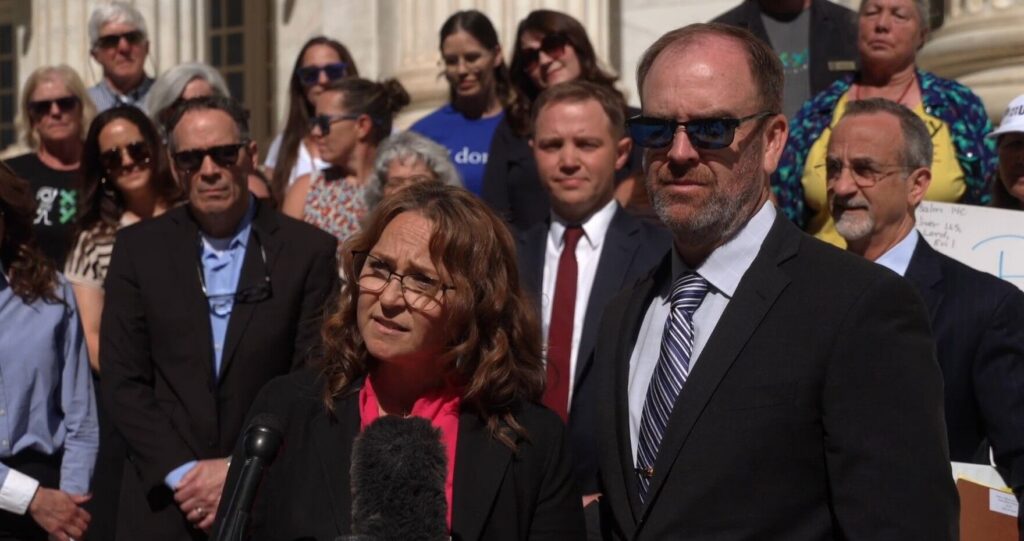
Federal judges hear arguments over Colorado school district’s gender identity rooming policy
Nicholas Fogleman
nicholas.fogleman@denvergazette.com
Updated 3 hours ago
A panel of judges at the 10th U.S. Circuit Court of Appeals heard arguments Tuesday in a lawsuit challenging JeffCo Public School’s policy of assigning students to overnight accommodations on school trips based on gender identity. The lawsuit, filed in...
10th Circuit analyzes sentencing process for probation violators in rare all-judges’ hearing
Michael Karlik
michael.karlik@coloradopolitics.com
Updated 14 hours ago
All 12 full-time judges on the Denver-based federal appeals court gathered for a rare oral argument on Monday to consider whether one of the court’s precedent-setting opinions created a process for sentencing probation violators that is out of step with...
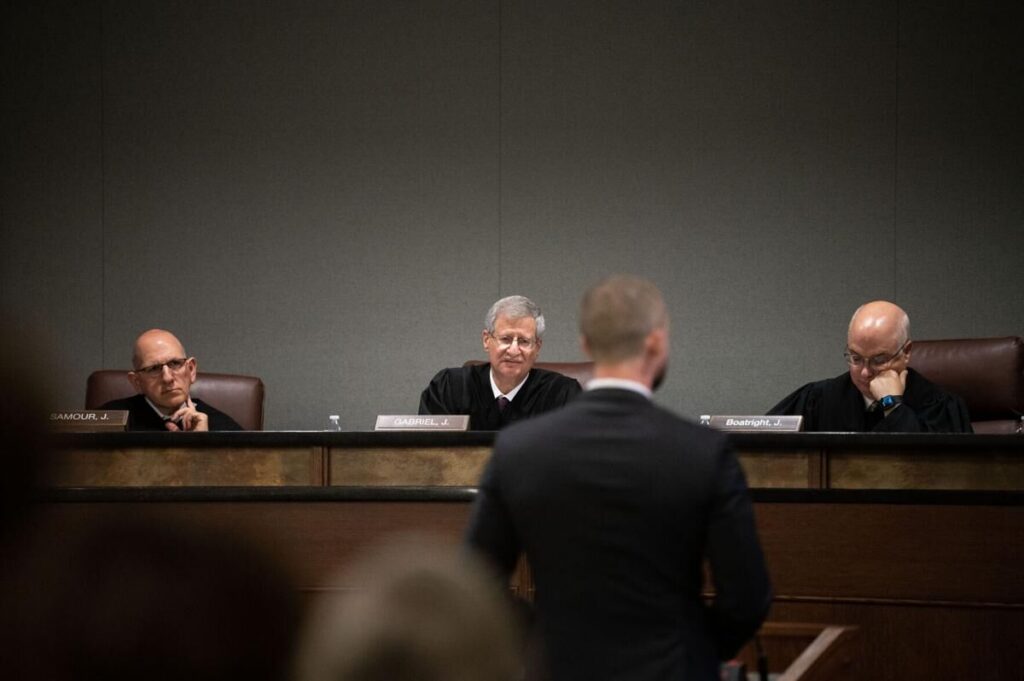
Colorado justices skeptical of defendant’s challenge to flawed jury instruction
Michael Karlik
michael.karlik@coloradopolitics.com
Updated 20 hours ago
Members of the Colorado Supreme Court appeared willing to uphold a defendant’s vehicular eluding conviction on Tuesday, suggesting that an incorrectly worded jury instruction was not an obvious and harmful error in light of the defense’s choice not to dispute...
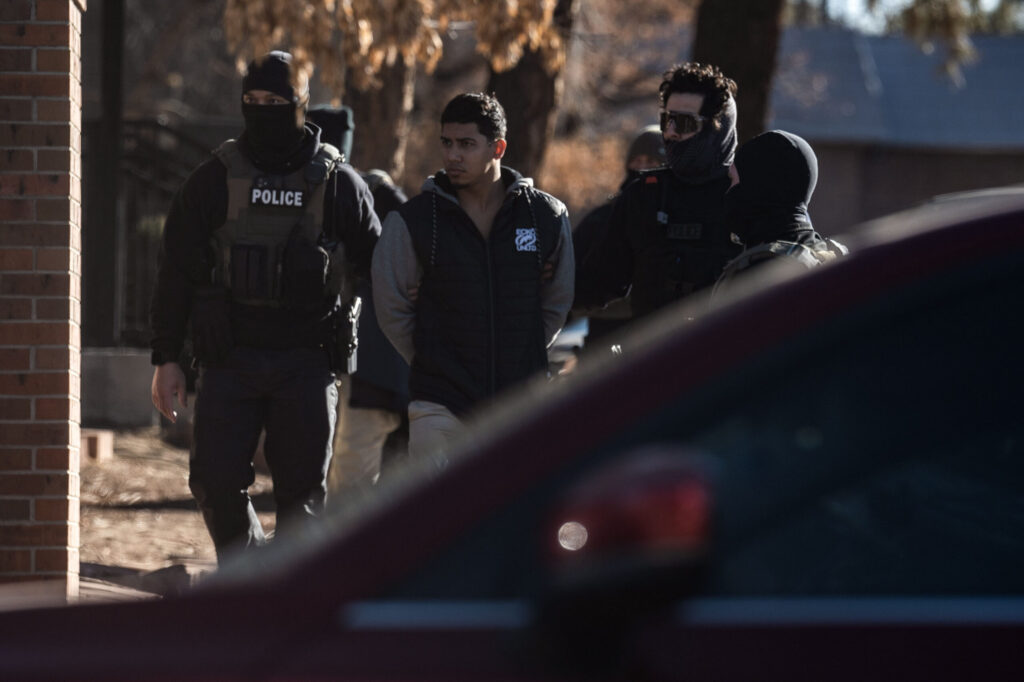
ICE ‘materially violated’ order on warrantless arrests, Colorado judge says
Michael Karlik
michael.karlik@coloradopolitics.com
Updated 14 hours ago
A federal judge ordered U.S. Immigration and Customs Enforcement on Tuesday to immediately train its Colorado employees about how to lawfully perform warrantless arrests, after the evidence showed officers had little understanding of the requirements. U.S. District Court Senior Judge...
Trump picks Daniel Domenico for 10th Circuit vacancy
Michael Karlik
michael.karlik@coloradopolitics.com
Updated 2 days ago
President Donald Trump announced on Monday that U.S. District Court Chief Judge Daniel D. Domenico is his choice to fill an upcoming vacancy on the Denver-based federal appeals court. Domenico, who is 54 this year, is Trump’s only appointee to...
Judge’s error allowing juvenile defendant to be prosecuted as adult cannot be reversed, appeals court says
Michael Karlik
michael.karlik@coloradopolitics.com
Updated 18 hours ago
Colorado’s second-highest court concluded last month that a judge’s error in allowing a juvenile defendant to be prosecuted as an adult cannot be corrected on appeal because the defendant later pleaded guilty. The case arose under unusual circumstances, after police...
Colorado justices decline to say whether man’s child prostitution conviction is unconstitutional
Michael Karlik
michael.karlik@coloradopolitics.com
Updated 17 hours ago
The Colorado Supreme Court declined to say on Monday whether a man’s conviction for an attempted child prostitution offense violated his rights under the state constitution, and only concluded that the absence of an obvious error meant his conviction should...

State Supreme Court to hold oral arguments, lawyers attend annual apellate event | COURT CRAWL
Michael Karlik
michael.karlik@coloradopolitics.com
Updated 2 days ago
Welcome to Court Crawl, Colorado Politics’ roundup of news from the third branch of government. The state Supreme Court is holding oral arguments this week, plus lawyers and judges came together for the annual appellate conference to trade tips and...
Mike Lindell’s lawyer sanctioned again over flawed case citations
Michael Karlik
michael.karlik@coloradopolitics.com
Updated 3 days ago
A federal judge financially sanctioned a lawyer for MyPillow CEO Mike Lindell for a second time on Thursday for including a “materially incorrect citation” in a case filing. U.S. District Court Judge Nina Y. Wang imposed a $5,000 fine on...
Judge tearing up during victim’s testimony does not warrant new trial, appeals court says
Michael Karlik
michael.karlik@coloradopolitics.com
Updated 3 days ago
Colorado’s second-highest court concluded on Thursday that an Arapahoe County judge’s visible display of emotion during a child victim’s testimony should not trigger a new trial for the defendant. A three-judge Court of Appeals panel found that defendant Philip Morgan...
PREV
PREVIOUS

Appeals court finds Denver judge relied on unsupported facts to restrict man's parenting time
Colorado’s second-highest court concluded last week that a Denver judge made “clearly erroneous” findings about a father’s sobriety and his request for parenting time when she imposed strict conditions on visitations with his children. Following a virtual April 2024 hearing in which both parents were without a lawyer, then-District Court Judge Jennifer Torrington issued an […]
10th Circuit allows Gross Reservoir construction to continue while trial judge sorts out project
The Colorado-based federal appeals court on Friday permitted construction to continue temporarily on Denver Water’s massive infrastructure project in Boulder County while a trial judge forges ahead with a hearing on the matter. Earlier this month, U.S. District Court Senior Judge Christine M. Arguello found that, as a result of federal law violations, the expansion of […]