

Colorado Supreme Court considers father’s window to sue over daughter’s injury, death
Facing a confusing matrix in state law, members of the Colorado Supreme Court attempted to sort out on Wednesday how long a father had to sue after his daughter was rendered unconscious and later died from a vehicle accident.
Danielle Nicola was crossing a Grand Junction street one night in November 2018 when a driver struck and seriously injured her. After spending 19 days unconscious, she died. Her father, John Nicola, settled with the driver who hit her, but he then sued the city and Xcel Energy. Those entities owned and maintained a streetlight that, according to John Nicola, was inoperable and contributed to the vehicle-pedestrian collision.
John Nicola filed suit within two years of his daughter’s death, and the Court of Appeals decided it was timely. But the parties hotly disputed that conclusion based on such factors as the date of injury versus the date of death, the legal disability Danielle Nicola experienced for 19 days and the effect of not having a legal representative until after death.
Some justices appeared uneasy about the city and Xcel’s argument that the legal representative of someone in Danielle Nicola’s shoes only has one year after her death to file suit, based her 19-day window of unconsciousness.
“If she had died at the scene, she would have a three-year statute of limitations,” said Justice Brian D. Boatright. “What’s the policy behind that? Because she lived for 19 days she gets less time to file the case?”
“That’s the public policy of the legislature,” responded attorney Franz Hardy for Xcel.
A Mesa County trial judge originally dismissed John Nicola’s claims, relying on the directive in state law that Danielle Nicola, as a person under legal disability who did not have a legal representative prior to her death, had one year following death for her father to file suit.
In reviewing that decision, a three-judge Court of Appeals panel addressed the set of interlocking provisions in the law. Contrary to what the trial judge, Grand Junction and Xcel believed, the appeals court determined the specific provision accounting for a person who dies under disability did not apply to Danielle Nicola, which would have imposed a one-year deadline to sue. Instead, the panel decided her representative — John Nicola — had two years from the date of her death to file suit.
The law as a whole is meant to “protect persons under a disability during the period of disability,” wrote Judge Jaclyn Casey Brown. Giving John Nicola just one year to sue after his daughter’s death, when a car crash victim who died instantly would have had much longer, “would contravene that purpose.”

Before the Supreme Court, Xcel and the city maintained that giving John Nicola one year to sue was logical, as the same requirement could conceivably work to the benefit of other deceased plaintiffs.
“The door swings both ways and whether you’re disabled for 19 days or 19 years,” said Hardy, “the executor or administrator gets one year from the date of death to file the survival action.”
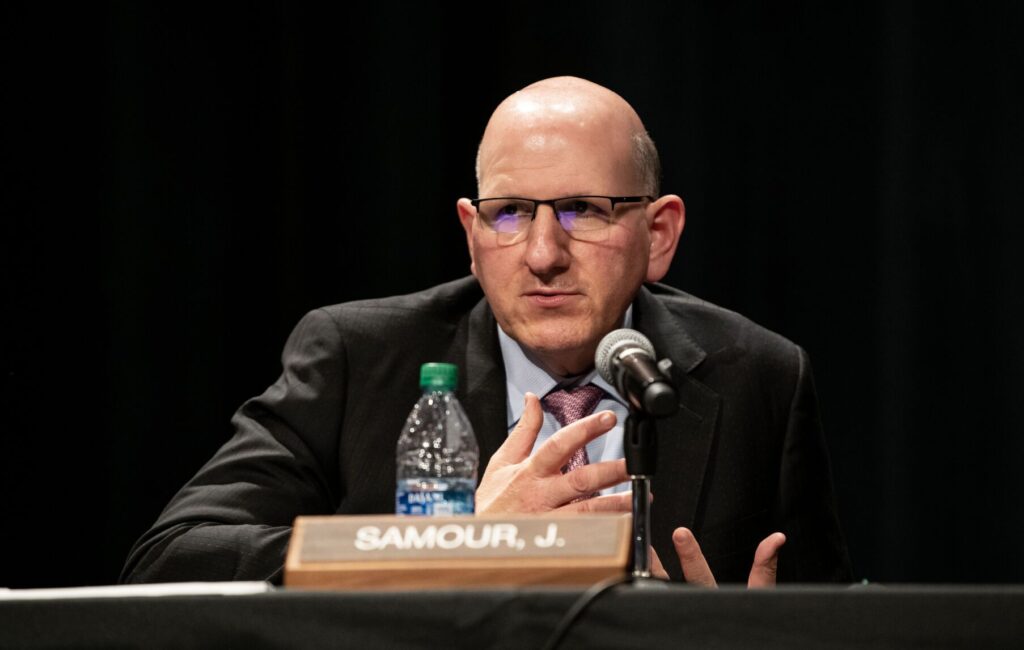
“Do we worry about your interpretation leading potentially to less time as a result of a disability?” asked Justice Carlos A. Samour Jr.
“The executor always has the same amount of time. That’s the focus,” responded Hardy.
Alternatively, the defendants argued that even if the Court of Appeals was correct about the window to file suit, it was wrong to find the clock began running when Danielle Nicola died, instead of when she was injured.
The Colorado Trial Lawyers Association wrote to the Supreme Court on behalf of John Nicola, arguing the Court of Appeals’ interpretation of the law would prevent unnecessary litigation over the deceased plaintiff’s status.
“Is a person under anesthesia ‘disabled’? Is a dying person ‘disabled’ as their heart and brain start to shut down? Is an individual ‘disabled’ when sedated by medical providers in an ambulance or in the emergency department?” the association wrote. “If this fact-specific analysis were required to be completed in every single case involving seriously injured individuals to determine the applicable statute of limitations (one, two, or three-years), it would be not only unreasonable, but manifestly absurd.”
The case is City of Grand Junction et al. v. Nicola.

Judge rules that Colorado law makes it too hard for parties to bar unaffiliated voters from primaries
Ernest Luning
ernest.luning@coloradopolitics.com
Updated 10 hours ago
A federal judge ruled in favor of the Colorado Republican Party late Tuesday, saying that a portion of the state law that allows unaffiliated voters to cast ballots in party primaries is unconstitutional because it imposes an unrealistic burden on...

10th Circuit upholds regulator’s methodology for Tri-State exit fees
Michael Karlik
michael.karlik@coloradopolitics.com
Updated 13 hours ago
The Denver-based federal appeals court upheld a regulatory agency’s methodology for calculating the fee owed by entities seeking to withdraw from Tri-State Generation and Transmission Association last week. Tri-State is a Westminster-based cooperative that provides and transmits electricity to member...
Federal judge proposes sanctions against Mike Lindell’s lawyers for continued fake citations
Michael Karlik
michael.karlik@coloradopolitics.com
Updated 14 hours ago
A federal judge is once again pursuing sanctions against lawyers for MyPillow CEO Mike Lindell for continuing to cite to court cases that do not exist, likely based on the faulty output of artificial intelligence tools. Last year, a jury...
Susan Blanco signals views on role of appellate courts in first opinion as Colorado justice
Michael Karlik
michael.karlik@coloradopolitics.com
Updated 17 hours ago
Justice Susan Blanco’s first solo opinion as a new member of the Colorado Supreme Court made clear her view of the guardrails that keep the state’s highest court tethered to the issues it is asked to decide. On Monday, the...

Colorado leaders weigh next steps after Supreme Court rejects state ban on ‘conversion therapy’
Marissa Ventrelli
marissa.ventrelli@coloradopolitics.com
Updated 1 day ago
Colorado leaders said they are weighing next steps after the U.S. Supreme Court on Tuesday rejected the state’s ban on “conversion therapy” for children, as critics and supporters cheered or lambasted the ruling. The court’s near-unanimous decision called the Colorado...
Federal judge dismisses U.S. government lawsuit against Colorado, Denver’s ‘sanctuary’ laws
Michael Karlik
michael.karlik@coloradopolitics.com
Updated 1 day ago
A federal judge dismissed the U.S. government’s lawsuit against Colorado and Denver on Tuesday, which alleged that various local policies impermissibly infringed on federal immigration enforcement. U.S. District Court Judge Gordon P. Gallagher followed the lead of judges in Illinois...
Federal judge finds DOJ adequately searched for, disclosed records related to Bidens
Michael Karlik
michael.karlik@coloradopolitics.com
Updated 2 days ago
A federal judge determined on Friday that the U.S. Department of Justice adequately searched for and disclosed records to a Colorado attorney in response to his request for documents related to former President Joe Biden’s son and brother. In November...
10th Circuit warns lawyers after finding fake case in filing
Michael Karlik
michael.karlik@coloradopolitics.com
Updated 1 day ago
The Denver-based federal appeals court warned attorneys to be more careful last month after discovering one lawyer cited a fake case in his arguments. In recent months, federal and state judges in Colorado have begun cautioning lawyers explicitly about the...

10th Circuit rules cognitively impaired man’s risk of lobotomy, mistreatment in Mexico not ‘torture’
Michael Karlik
michael.karlik@coloradopolitics.com
Updated 2 days ago
The Denver-based federal appeals court concluded last month that a man’s risk of mistreatment or forced lobotomy in his native Mexico did not amount to “torture” that should shield him from deportation. A three-judge panel of the U.S. Court of...
Colorado justices side with news organizations for disclosure of high-level child abuse data
Michael Karlik
michael.karlik@coloradopolitics.com
Updated 1 day ago
The Colorado Supreme Court ruled on Monday that the state must disclose the number of child abuse reports at individual group living facilities in response to an open records request, as the addresses are already in the public domain. The...