

10th Circuit dismisses man’s lawsuit against Arvada detective, accuser for rape accusation
The Denver-based federal appeals court agreed last week that a man had not credibly alleged he was prosecuted for rape without probable cause because, in part, he apologized for raping the alleged victim on a recorded phone call.
Gary Weidner III sued Detective Kristin Ames and his former romantic partner, identified as “Jane Doe,” after Doe’s accusation of rape resulted in Weidner being prosecuted in Jefferson County. The prosecution eventually dismissed the charges against him.
Weidner argued Ames had access to information undermining the accusations and did not conduct a reasonable investigation. But a three-judge panel of the U.S. Court of Appeals for the 10th Circuit found a key flaw with the claim that Ames lacked probable cause. Specifically, she applied for an arrest warrant by reciting Weidner’s own statements made on a recorded phone call with Doe.
“Detective Ames interviewed Ms. Doe twice, attempted to interview Mr. Weidner, and listened in on pretext calls between Mr. Weidner and Ms. Doe in which Mr. Weidner said he ‘never should have assaulted’ Ms. Doe and was ‘so sorry for raping’ her,” wrote Judge Scott M. Matheson Jr. in a March 5 order. “Armed with accounts of wrongdoing and multiple inculpatory admissions from Mr. Weidner, Detective Ames had no ‘obvious reasons for doubting the truthfulness of (Ms. Doe’s) allegations.'”
Attorneys for Doe and Weidner did not respond to a request for comment.
The case “highlights the increasing challenges and costs that municipalities face in defending their officers from baseless claims,” said Senior Assistant City Attorney Kylie Justus on behalf of Ames. “These types of cases result in significant taxpayer resources being spent to clear the names of officers who are committed to their work and the safety of our citizens.”
Weidner alleged that Doe “concocted” a plan to falsely accuse him of sexual assault during their consensual relationship. In July 2020,Doe allegedly met with Ames and reported that Weidner raped her over several months. Doe allegedly shared selective evidence to support her story and Ames declined to press for the complete text message and photograph history from Doe’s phone.
Twice, Doe recorded phone calls with Weidner, known as pretext calls, with Ames present. In her motion to dismiss the lawsuit, Ames attached the transcript of a call, in which Weidner said, among other things, “I am sorry for assaulting you,” and “I am so sorry for raping you.”
In March 2024, U.S. District Court Judge Nina Y. Wang dismissed Weidner’s lawsuit. She noted Weidner had not alleged an unreasonable level of investigation on Ames’ part, and the detective charged Weidner partly based on the probable cause he generated with his own statements.
“Here, of course, Detective Ames had far more than (Doe’s) word: she had Plaintiff’s confession,” Wang wrote.
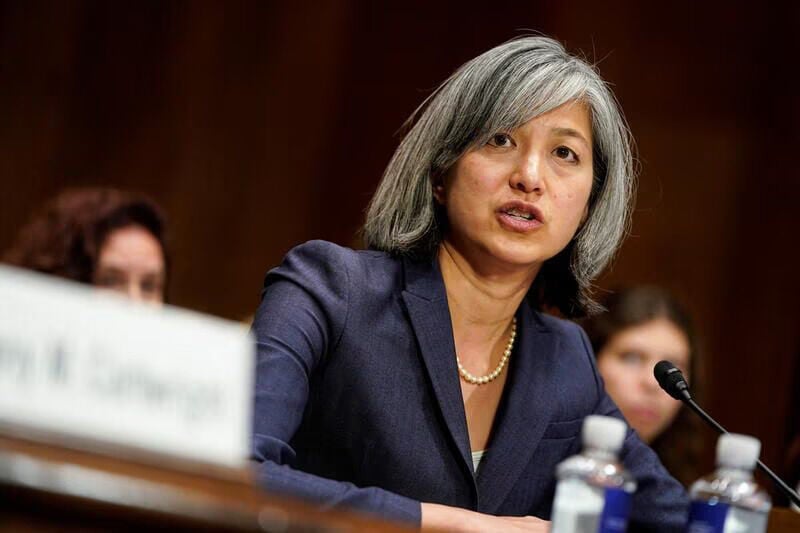
Nominee to be United States District Judge for the District of Colorado Nina Nin-Yuen Wang, testifies before the U.S. Senate Judiciary Committee during her confirmation hearing on Capitol Hill in Washington U.S., May 25, 2022.
REUTERS/Joshua Roberts

On appeal to the 10th Circuit, the judges on the panel were equally skeptical that Ames should have downplayed Weidner’s own words to his accuser.
“We don’t get from the cold transcript of the calls the essence of the calls,” said attorney Curt M. Parkins during oral arguments in January. “Our position is that taken in its entirety when you listen — that’s citing to a 10-second clip on an hour-long call.
“I get that,” responded Judge Gregory A. Phillips. “You can argue he’s just trying to get rid of her, trying to quell the storm even if it’s not true or something. But if you’re the detective and you have that ‘I’m so sorry. I’m so sorry for raping you…,’ how can that not be arguable probable cause?”
In the panel’s opinion, Matheson wrote that Ames’ lack of a more detailed investigation into the allegations may have been negligent, but it did not amount to a constitutional violation for malicious prosecution based on what she did know.
“The statements in Detective Ames’s affidavit supplied probable cause to believe Mr. Weidner was guilty of committing a crime,” Matheson concluded. “The affidavit provided a victim-witness’s account of a sexual assault along with the alleged assailant’s apology for ‘raping’ the victim.”
The case is Weidner v. Doe et al.
Editor’s note: The original 10th Circuit decision used Jane Doe’s full name. Her attorneys subsequently asked the court to reissue its order using a pseudonym. The court agreed and reissued its ruling. As a result, this story has been updated to reflect that change.

Colorado justices discuss solution to confusion from prior criminal ruling
Michael Karlik
michael.karlik@coloradopolitics.com
Updated 3 hours ago
The Colorado Supreme Court pondered the fallout on Tuesday from its nearly six-year-old decision interpreting the state’s impaired driving laws, with the justices now addressing how defendants affected by the legal change must seek postconviction relief. In contrast to other...
Colorado justices suggest father entitled to appeal of custody decision
Michael Karlik
michael.karlik@coloradopolitics.com
Updated 1 day ago
Members of the Colorado Supreme Court signaled strongly on Tuesday that a father deserved some avenue for challenging a temporary child custody order that no lower court believed it could review due to the unusual circumstances of the case. Because...

Court snuffs out challenge to Denver’s flavored tobacco ban
Deborah Grigsby
deborah.smith@denvergazette.com
Updated 4 hours ago
The smoke finally cleared in Denver’s battle over a citywide ban on flavored tobacco products when a Denver court dismissed a challenge from local vape shop owners seeking to declare the ordinance unconstitutional and block its enforcement. On Wednesday, Denver...
Colorado justices agree fraud claims belong in corporate dispute
Michael Karlik
michael.karlik@coloradopolitics.com
Updated 1 day ago
The Colorado Supreme Court decided on Tuesday that a corporate plaintiff validly pursued fraud claims over conduct that was not covered by a contract or by a set of interrelated business agreements leading up to the contract. Previously, the Court...
Colorado Supreme Court says intimate messages irrelevant to assault case
Michael Karlik
michael.karlik@coloradopolitics.com
Updated 1 day ago
The Colorado Supreme Court decided on Tuesday that a Douglas County judge acted reasonably by blocking evidence of a defendant’s BDSM-related conversations with the victim in his trial for assault and false imprisonment. While the Court of Appeals believed that...
Trump’s 10th Circuit nominee declines to name 2020 election winner, defends immigration decisions
Michael Karlik
michael.karlik@coloradopolitics.com
Updated 1 day ago
President Donald Trump’s nominee to the Denver-based federal appeals court declined to say who won the 2020 presidential election during his appearance before the U.S. Senate Judiciary Committee on Wednesday, and defended his recent rulings in immigration detention cases. U.S....
Colorado law allowing lawsuits against ‘conversion therapy’ providers takes effect July 1
Marissa Ventrelli
marissa.ventrelli@coloradopolitics.com
Updated 21 hours ago
With a new law taking effect July 1, Colorado is creating a legal pathway for people to sue licensed providers of “conversion therapy,” even as debate over the practice’s constitutionality continues in the wake of a recent U.S. Supreme Court...
Colorado justices expand ability for civil defendants to avoid participating, win after trial
Michael Karlik
michael.karlik@coloradopolitics.com
Updated 1 day ago
The Colorado Supreme Court decided on Tuesday that a civil defendant, whose non-participation in the case meant that he legally admitted to the sexual assault allegations against him, could nonetheless prevail after he showed up to testify at trial. A...
Colorado justices find ability to extend appeal deadline applies equally to prosecutors, defendants
Michael Karlik
michael.karlik@coloradopolitics.com
Updated 2 days ago
The Colorado Supreme Court decided on Tuesday that prosecutors have the same ability as criminal defendants to freeze their deadline to appeal a trial judge’s ruling when they ask for reconsideration, even though the rules do not explicitly say so....
Colorado justices confirm leaving-the-scene prosecutions require no proof of driver’s knowledge
Michael Karlik
michael.karlik@coloradopolitics.com
Updated 20 hours ago
The Colorado Supreme Court confirmed on Tuesday that its 20-year-old decision involving drivers who leave the scene of an accident remains good law and prosecutors do not have to prove that such defendants knew they were involved in an accident....