

Ahead of second Trump term, what now defines the American Dream? | HUDSON

Miller Hudson

Miller Hudson
There is more than a little irony in the fact the MAGAverse held its end zone victory dance while attending UFC fights at Madison Square Garden last week. This testosterone-fueled exhibit of masculine toxicity occurred just as Democratic pugilists were launching their own cage match, pitting progressives against moderates in the blame game. Whether moving left or better defending the merits of the middle might have produced a better result, it’s clear the struggle for addition (contrary to a Democratic presumption President-elect Donald J. Trump was subtracting supporters daily), went to the former president. The 2024 election results are indisputable — Democrats were unwittingly hemorrhaging voters.
There is ample reason to believe the nastiness of our politics is rooted in something more than partisan allegiance. Perhaps, at the extremes of the right and left existential anxiety exists. By contrast the bulk of voters who have survived half-a-century of economic, political and governing rot — democracy itself is now in doubt. Faith that the American political system operates on our behalf has slipped to between a quarter and a third of voters. The vast majority see U.S. Congress as a failure that delivers benefits unfairly to elites atop a corrupt exchange of favors for campaign contributions.
Stay up to speed: Sign up for daily opinion in your inbox Monday-Friday
Returning Trump to the White House is recognized by his voters as a calculated gamble. As Forbes magazine recently reported, Trump doubled his net worth from $2.2 billion to $4.5 billion during the past eight years. He isn’t bothering to divest his business interests during a second term and can be expected to continue sluicing riches into his family holdings. Yet, this may seem a reasonable price to pay if he proves willing to flip over the dining table and smash all the china in Washington. Certainly, Vice President Kamala Harris couldn’t be counted on to do so, any more than would have been true for Hillary Clinton. The reality, of course, is Trump will devote more energy accumulating personal wealth than he will to providing access to the American Dream for the rest of us.
There are a dozen, or more, non-profit think-tanks devoted to examining the nature of the American Dream. American University has conducted a yearly survey that asks young men and women, likely weighted toward college students, what their definitions of and expectations for achieving their American Dreams look like. There is no single, commonly accepted definition, but they usually encompass “…a set of ideals including representative democracy, rights, liberty, and equality, in which freedom is interpreted as the opportunity for individual prosperity and success, as well as the chance for upward social mobility for each according to ability and achievement through hard work in a capitalist economy…” according to Wikipedia.
Recently, a national poll offered competing visions of the American Dream. One defined it as the equal opportunity to achieve individual financial and social success through the exercise of personal skills and talents, while the other described it as the structure of a civil society in which every citizen enjoys a financially stable, comfortable standard of living and quality of life into retirement. Forty-nine percent identified with each option, while the remaining fraction were “not sure” or claimed neither to be achievable. These alternatives offer two very different views of how to organize American society. In what is now regarded as a 50-50 nation, I can’t help suspecting the Venn diagram overlaying party affiliation with these viewpoints would indicate a remarkable congruence: individual achievement equals conservative/Republican and communitarian prosperity equals Democratic/liberal.
This comparison may proffer a false distinction. There is substantial historical evidence societies that permit and encourage the full development and blossoming of individual potential are more successful and thereby benefit more members. Likewise, societies that reward all citizens fairly, if not precisely equally, create conditions which better provide opportunity for personal flourishing. We need both. These may not be competing, but rather symbiotic approaches for organizing our collective lives. Shouldn’t hairdressers, auto mechanics, security guards and other blue-collar workers command incomes that permit family vacations, the occasional frivolous expense and infrequent gourmet meals? Shouldn’t children in these families enjoy debt-free access to higher education, as was once guaranteed throughout the United States?
We seem able to treat each other with equal care and respect when disaster strikes. In the December issue of Harper’s magazine, Gary Greenberg, first selectman (mayor) of Scotland, Connecticut, (population 2,500) recounts the tale of a tornado and subsequent flood which tore through his village, destroying two bridges and stranding six homes. He describes a town meeting decision to spend all its financial reserves to reconnect these few families. He explains, “There’s one thing the Puritan preachers (in Scotland) had that I did not: a congregation held together by their conviction they all faced the same predicament and so they better do it together… the recognition that community is the correct response to the extended emergency we call life, that this must come before everything else — that we are all we have… is one thing the Puritans got right, and that we have lost in the floods of time.”
I’m not sure how we promote such agreements, but it probably starts by taking President Joe Biden’s advice to “turn down the heat on our political discourse.” Though there are extremists in both parties who desire to tear down or reconfigure our democracy, there are few Americans truly intent on destroying the nation. None that I know. The only radicalism I find among the middle majority is a desire for government to function on their behalf. Why is that difficult?
Miller Hudson is a public affairs consultant and a former Colorado legislator.

Meghan Shay on recovery, responsibility and second chances | The OpEdge Podcast
Tony Olivero
tony.olivero@gazette.com
Updated 2 hours ago
Step Denver and Step Springs CEO Meghan Shay joins The OpEdge to explore addiction recovery, homelessness, and the role of accountability in lasting change. Shay tells host and investigative columnist Jimmy Sengenberger why she believes recovery is built on personal...

The outrages mount | Hal Bidlack
Hal Bidlack
hal-bidlack@coloradopolitics.com
Updated 5 hours ago
My kindly and forgiving editors understand that, from time to time, I can’t help myself from leaping atop my rickety soapbox to vent. And, like many other political commentators have already done, I could easily fill this entire missive with...

Rural Colorado deserves a tax holiday | GUEST COLUMN
Eric Mulder
jstooksberry@gmail.com
Updated 16 hours ago
Spend enough time in Colorado’s Eastern Plains, the San Luis Valley, or the Western Slope, and you’ll see boarded-up storefronts, schools consolidating classrooms, and small rural communities stretching every dollar to keep basic services afloat. Once the backbone of Colorado’s...

Weiser’s leadership crucial for rural win-win | Rachel Gabel
Rachel Gabel
rachel-gabel@coloradopolitics.com
Updated 4 days ago
Attorney General Phil Weiser is going to win the gubernatorial election. That said, Colorado agriculture and rural communities have a 30-year track record of finding the win-win be it for species or industries or habitat. Former Governor Roy Romer possessed...

A Colorado history lesson for Victor Marx | Dick Wadhams
Dick Wadhams
dick-wadhams@coloradopolitics.com
Updated 4 days ago
Victor Marx, who narrowly won the Republican nomination for governor by one half 1% after boasting of a massive 44-point lead, is just as misguided on Colorado political history. During the primary, Marx made a clumsy attempt to denigrate his...

‘Be prepared to march in the streets’ | Miller Hudson
Miller Hudson
miller-hudson@coloradopolitics.com
Updated 4 days ago
It was early in 1974 when I first met Tim Wirth as he announced his candidacy for Congress, challenging Republican incumbent Don Brotzman. Although I had only resided in Colorado two years, I was drafted to serve as a Democratic...

‘CoCo’ would take taxpayers for a ride | Jon Caldara
Jon Caldara
jon-caldara@coloradopolitics.com
Updated 1 day ago
Colorado wants taxpayers to spend another $4.73 billion on passenger rail. Don’t worry. They have a plan. Which is a little like your brother-in-law announcing he’s launching another exciting restaurant venture after his last three restaurants ended in bankruptcy. Please....
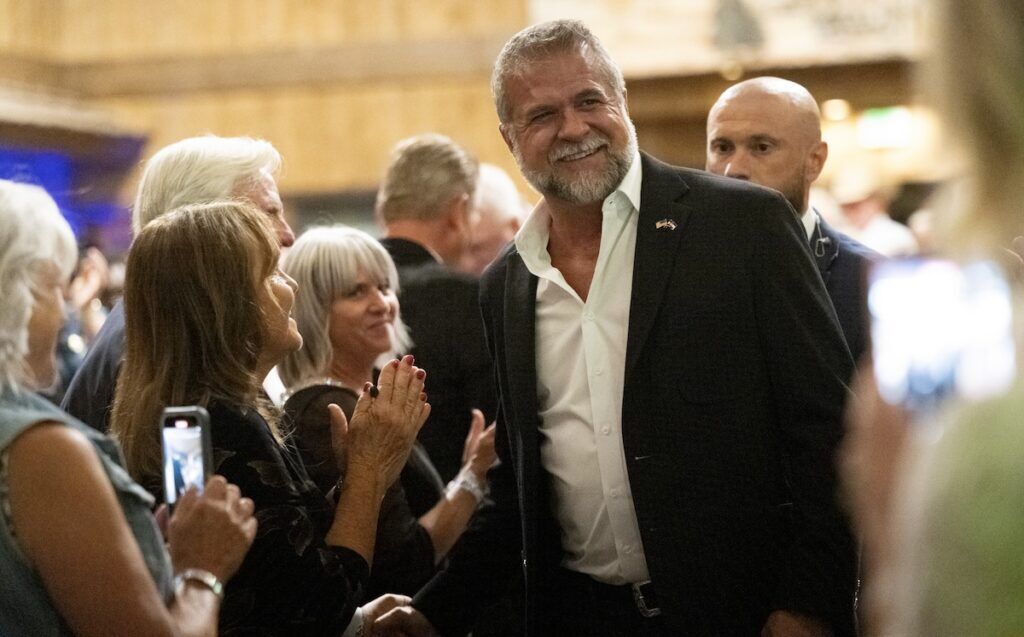
The through line from Donald Trump to Victor Marx | SONDERMANN
By Eric Sondermann
by-eric-sondermann@coloradopolitics.com
Updated 6 days ago
Over 10 years ago, before Donald Trump could ever defeat Hillary Rodham Clinton, he had to first engineer a hostile takeover of the Republican Party. Prior to his descent of that golden escalator, the previous seven Republican presidential nominees had...

Primary voters rejected big money in politics | Paula Noonan
Paula Noonan
paula-noonan@coloradopolitics.com
Updated 4 days ago
While we’re in an election campaign lull between now and Labor Day, we have time to consider the impact of $102 million in campaign contributions in the primary. In the general election, more money will fill candidate campaign coffers, and...
Colorado’s primary proved in this political climate money doesn’t buy electoral happiness | Paula Noonan
Paula Noonan
paula-noonan@coloradopolitics.com
Updated 5 days ago
To catch you up, campaign committees from this 2026 election cycle already collected and shoveled out a lot of cash: $102.64 million. That’s contributions in all forms — dollars, in kind, loans, etc. — from December 2024 to now. Total...