

Whatever happens on Election Day, adult conversations needed pre-2028 | HUDSON
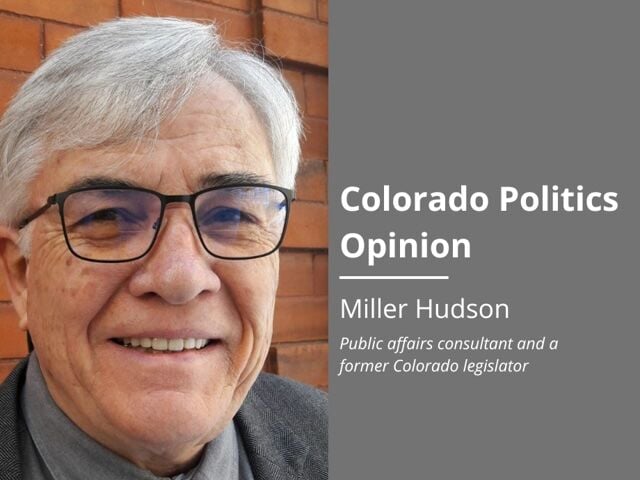
Miller Hudson

Miller Hudson
At the risk of depressing readers even more than they already are, following months of warnings regarding the most important election of their lifetimes (to be remembered as the “Democracy at Stake” ballot), it’s not too early to start considering the presidential race of 2028. Jockeying for pole positions in both parties will commence Nov. 6, fewer than 10 days away. Should the 2024 results prove close enough, such posturing could be delayed by legal squabbling until Jan. 7. The nature of these political histrionics will be markedly different dependent on which candidate emerges victorious Nov. 5. Nonetheless, we can discern a pair of issues likely to dominate the 2028 contest although they have been scarcely mentioned in 2024.
Let’s think of them as the donkey and the elephant. The donkey is climate change, primarily global warming — arriving as severe droughts, flash floods, rising sea levels and raging wildfires. Ninety-four percent of Democrats and 73% of Republicans believe the threats are real and deserving of government attention. The 2024 Republican standard bearer claims the donkey to be a myth and a hoax. There must be substantial cognitive dissonance on the right, where the world’s wealthiest man and a peddler of electric vehicles has emerged as the largest donor to a candidate who trashes the electrification of the American auto fleet. Not to mention the liberal, “early adopters,” who now regret their purchases from Elon Musk, recently revealed as a Putin whisperer.
Stay up to speed: Sign up for daily opinion in your inbox Monday-Friday
How this odd couple works out their competing visions of the future remains to be seen. Mother Nature, however, will not wait on this rapprochement. Inaction is proving to come at a hefty price. Insurance premiums are linked to risk, not opinion, and the damages keep piling up. Neither will our neighbors across the globe wait on Americans to resolve petty political disputes. They intend to act without us. As Brazilians have watched the Amazon, the world’s mightiest river, run dry this past year, procrastination appears a fool’s bargain. Paranoid claims Democrats are controlling the weather and dispatching hurricanes to strike Republican states has to sound lunatic to the majority of American voters. As one comic noted, “If Democrats could really control the weather, Marjorie Taylor Greene would have long since been fried by lightning.”
As Holly Rooper and Sagatom Saha explain in the World Politics Review, we already have a successful model for using trade agreements to achieve climate goals. The 1987 Montreal Protocol reducing Substances that Deplete the Ozone Layer has largely closed our “ozone hole.” Forty-six nations signed on to the original agreement responding to U.S. leadership. As the authors note, “What makes the treaty work is its deft leveraging of industries’ self-interest and the inclusion of disparate governments to collectively work towards environmental protection.” The Montreal Protocol was later amended nine times, incorporating new scientific findings, before being unanimously ratified by 174 members at the United Nations in 2009.
It is not the United States, but the European Union, which is taking the lead in imposing tariffs based on the carbon intensity of imports. This policy is intended “to level the playing field for carbon-efficient manufacturers,” penalizing dirty producers like Russia and China. This kind of initiative is nearly certain to advance with or without U. S. involvement. Like it or not, the human family is heading for a more electrified industrial base, including our trucks and autos. In 2028, presidential candidates will be debating how fast and how extensively we should deploy the charging infrastructure required. We can lead or we can follow, but change is coming. Sustainability is no longer the issue — survivability is on the table.
The elephant present in the political arena is our $35 trillion deficit, likely to be $40 trillion by 2028. Though Republicans have historically whined the loudest about federal debt, they are responsible for running up nearly 70% of this mind-boggling total. Democratic U.S. Sen. Paul Tsongas of Massachusetts and Republican U.S. Sen. Warren Rudman of New Hampshire established the Concord Coalition in 1992 as an advocate for balancing the federal budget and paying off the then-$4.4 billion federal debt. I’ve been a sporadic member, usually paying dues for three to four years and when seeing no progress — quitting until growing alarmed again and rejoining. Our six-time bankrupted former president is an enthusiast of walking away from debt. Democrats, with a few commendable exceptions, have found it safer not to examine the implications of galloping deficits.
The U.S. has only been able to get away with this profligacy because of the post-World War II Bretton Woods conference that established the dollar as the world’s reserve currency. The greenback has remained the world’s safest refuge for both sovereign funds and scoundrels. Preferential treatment of American currency is premised on trust — trust we will make good on our bonds by behaving responsibly. The planet is currently fermenting with adversaries, as well as the envious, who all yearn to knock us off our fiscal perch. Once again, Mr. Trump questions the wisdom of maintaining a strong dollar. If China or the BRICS yank the rug out from under the greenback, faith in our debt instruments will plummet alongside their value.
As Thomas Savidge and Ryan Yonk outline in an essay on public debt published by the American Institute for Economic Research (AIER), “When the federal government cannot pay its debts, it is faced with three somewhat practical choices: raise taxes, print money, cut spending or some combination, and one wildly impractical one: default.” Several American economists characterize a federal default as “the end of the world”. Savidge and Yonk translate their concern as, “This reality means that as the national debt continues to grow, lawmakers in Washington face the growing temptation to lean on the Federal Reserve to monetize the debt (recall ‘quantitative easing’ following the Great Recession).” Of course, as we learned from spraying checks across the economy during COVID by printing more money, our subsequent recovery, however necessary, proved inflationary.
State and local government debt has pursued a similar expansionary trajectory. Unfunded liabilities, deferred maintenance and decaying infrastructure represent an additional multi-trillion-dollar mortgage threatening the prosperity of future generations — a theft from “the kids and their kids.” Many of them will no longer be children by 2028 and they will be demanding an adult conversation regarding a return to fiscal prudence. Expect both Democratic and Republican candidates to dive behind their podiums.
Miller Hudson is a public affairs consultant and a former Colorado legislator.


We the people are no longer the government of Colorado | Jon Caldara
Jon Caldara
jon-caldara@coloradopolitics.com
Updated 3 days ago
We the people of Colorado no longer control our own state constitution. I found this out the hard way. In Colorado, a government for, by, and of the people is a fib. We lowly citizens no longer have much of...
The need for a governor to say “no” to his friends | SONDERMANN
By Eric Sondermann
by-eric-sondermann@coloradopolitics.com
Updated 3 days ago
A wise man once remarked that the real test of a governor is his willingness to turn down and reject the pleadings of political friends and allies. That gentleman knew something of what he spoke. He occupied the corner-office executive...

‘Move fast and break things’ not way to fix Colorado’s roads | GUEST COLUMN
Colorado Politics
colorado-politics@coloradopolitics.com
Updated 3 days ago
By Donna Lynne, Kelly Nordini and Rebecca McClellan This month, after the effects of federal H.R. 1 hit Colorado’s budget like a sledgehammer, Colorado lawmakers had to cut more than $1.5 billion from our state budget, leaving virtually no corner...
Amid Colorado’s new rail moment, losing digital infrastructure an economic death sentence | GUEST COLUMN
Colorado Politics
colorado-politics@coloradopolitics.com
Updated 3 days ago
By Taylor Henderson In 1867, former Colorado territorial Gov. John Evans looked at a room of Denver merchants and delivered a blunt warning: the city was “too dead to bury.” At the time, the Union Pacific Railroad bypassed Denver, and...

Common-sense guardrails for new data center development benefit people, the planet | GUEST COLUMN
Colorado Politics
colorado-politics@coloradopolitics.com
Updated 3 days ago
By Joe Antus Colorado’s business leaders are right about one thing: Colorado is at an inflection point. In a recent letter to Gov. Jared Polis, members of the technology and business community argued Colorado’s innovation economy must not only grow,...
The uncharted implications of increasing unaffiliateds ahead of Colorado’s primaries | Paula Noonan
Paula Noonan
paula-noonan@coloradopolitics.com
Updated 4 days ago
The primaries are about 60 days away. The large majority of statewide races will be decided on June 30. Those contests will be between moderate and progressive Democrats and moderate to super-conservative Republicans. Analysis of voter registrations does not look...

All Coloradans should have a say at the Public Utilities Commission | GUEST COLUMN
Colorado Politics
colorado-politics@coloradopolitics.com
Updated 3 days ago
By Emma Pinter I have a sticky note in my kitchen that reminds me of Xcel Energy’s peak hours, when they charge higher rates for electricity. From 5 p.m. to 9 p.m., I avoid running the laundry or the dishwasher...

Protect patient access to life-saving drugs | GUEST COLUMN
Colorado Politics
colorado-politics@coloradopolitics.com
Updated 3 days ago
By Leslie Herod Since its inception, Colorado’s Prescription Drug Affordability Board (PDAB) created fear among patients around effects to life-saving medicines and the negative ramifications price controls have on affordability. Five years on, those fears persist. Patients and advocates continue...

Don’t upend Colorado’s ‘healthy balance’ on stream access | PODIUM
Colorado Politics
colorado-politics@coloradopolitics.com
Updated 5 days ago
By Ashley House “The horizon is a perfect line between sky and water.” I heard this line of dialogue waft through my parents’ living room recently as they tuned into one of the newest Taylor Sheridan TV dramas, “The Madison.” As...

Colorado can’t fall behind on refocusing nutrition assistance | GUEST COLUMN
Colorado Politics
colorado-politics@coloradopolitics.com
Updated 5 days ago
By Travis Couture-Lovelady Nutrition assistance should be a safety net — not a source of chronic illness. That was the mindset behind Colorado and 21 other states pursuing waivers from the U.S. Department of Agriculture to prohibit the purchase of...