

Less money in 2024 Colorado election as state party numbers dwindle | NOONAN
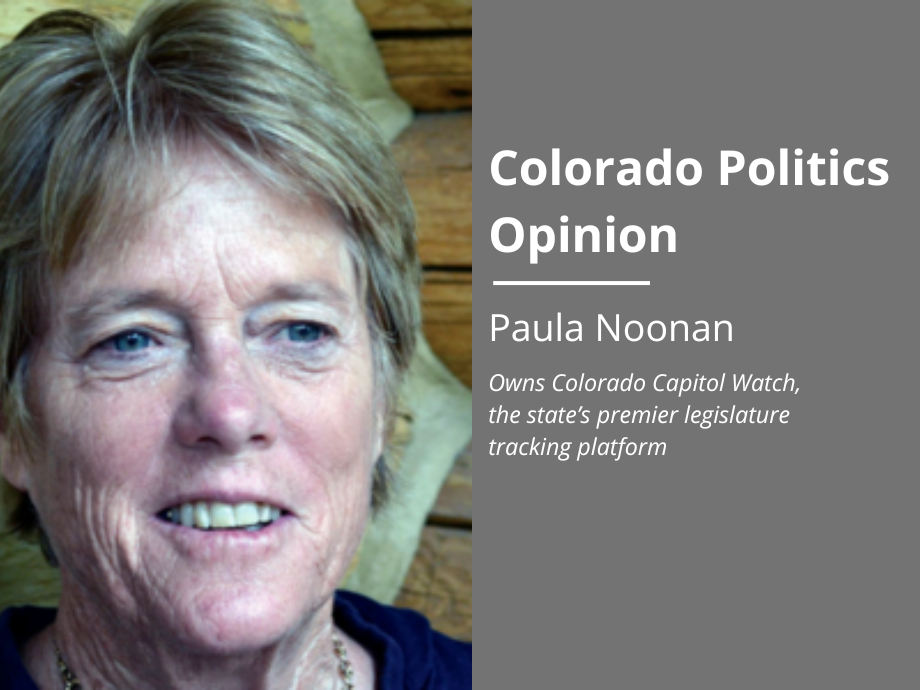
Paula Noonan

Paula Noonan
Colorado’s state elections have returned to an old-fashioned status. Individual candidates are not spending multiple hundreds of thousands of dollars to win seats that pay just more than $40,000 per year.
This is not to say money isn’t washing around. But how much individual candidates have ginned up is less this year than in elections since 2018.
One reason there’s not as much money in the general election is the cost of primary elections, especially in Democratic races. These primaries set prospective winners of the general election.
Of the 83 seats up in the general election, three Democrats running for state Senate, incumbents Janet Buckner SD-29 and Chris Hansen SD-31, and current Rep. Judy Amabile SD-18, have no Republican opponents. Hansen and Buckner had no primary opponents. Buckner missed 162 final, third-reading votes on legislation in 2024’s General Assembly, including on Public School Finance (SB24-188), Payment of Family and Medical Leave Benefits (SB24-155), and Sickle Cell Disease Community Outreach and Services (SB24-042). Even so, no one is running against her.
Five Democratic representatives have no Republican opponents. Four Republican representatives have no Democratic opponents.
Stay up to speed: Sign up for daily opinion in your inbox Monday-Friday
In sum, 12 seats in both chambers are already decided. Of the remaining seats, about 16 may be competitive either by money or voter registration. This math indicates of 83 elections, 67, and probably more, are already decided.
Races up for grabs by voter registration in the House include El Paso County’s HD-16, with incumbent Stephanie Vigil-D versus Rebecca Keltie-R, with a plus-3% GOP active voter registration spread, and HD-18 Amy Paschal-D versus James Boelens-R, with a plus-3% GOP spread and a plus-$74,000 money difference favoring Paschal. HD-26 in Steamboat Springs with incumbent Meghan Lukens-D shows a plus-4% registration advantage to GOP contender Nathan Butler, but Lukens has a $120,000 money advantage.
When it comes to getting election mail, signs and other voter contact done, money can count more than voter registration if the registration numbers are close enough. This fact will likely sink Peter Boddie-R running against Sheila Lieder in HD-28. Campaign contributions to HD-25 incumbent Tammy Story-D give her an advantage over George Mumma-R when Mumma has a 2,200 person GOP registration advantage. HD-43 incumbent Bob Marshall-D has out-raised contender Matthew Burcham-R by more than $30,000. He’ll need it to overcome a plus-5,000 person GOP registration edge.
So many non-competitive races depress voter turnout. In Colorado, even the presidential race is likely to lean heavily to Vice President Kamala Harris, given the state’s current Democratic complexion, causing too many voters to lose interest.
Proposition 131, the ranked-choice election initiative to open state primaries to all candidates with a general election run-off, will re-engage voters in both primary and general elections.
As of September, Colorado has almost 50% unaffiliated active registered voters, or 1,903,650 people. The GOP has 910,618 and Democrats have 1,022,195. In the 18-to-34 years cohort, unaffiliated voter registration soars to 64%, or 703,408 people compared to 163,084 for the GOP and 250,594 for Democrats. The trend is obvious: younger voters don’t find parties attractive. The only cohort where party affiliations exceed unaffiliated registrations is active voters 75-plus in age. Dip down to voters aged 65-to-74 and unaffiliated registrations win out.
These facts present challenges for our representative democracy. If parties don’t attract more voters, their basis as the source of candidates falls apart. Both parties, in an unusual handshake, will argue they represent the infrastructure of our political system. That claim is undercut every time a voter enrolls as unaffiliated. Since most registrations come from young people turning 18 or young adults moving to Colorado, the parties’ assertions of foundational status are weakened.
Proposition 131’s open primaries will give people who reject parties a path to run for office. Voters should have more nuanced choices as many party candidates don’t consistently support party positions. This factor appears today in how much legislators diverge from party platforms when they get to the Capitol. With ranked-choice voting, once primaries are completed and four candidates are put forward for general elections, voters can confidently make distinctions along the political scale, ranking candidates who most-to-least represent their specific values and issues.
The competition will drive candidates to be more explicit in their representations. It will be harder for moderate candidates to edge left or right and for left or right candidates to mush to the center.
In the long run, this voting methodology will produce better problem-solving processes among legislators as they will not be able to rely on party affiliation to protect them in what are today’s non-competitive districts. If incumbents want to win another term, they will have to produce accomplishments as they will be evaluated good to bad, high to low, by voters.
If parties want to hold onto their influence, they will have to work harder to produce consistent and expected results for voters. The party that does the best job for their voters will thrive and be trusted. Colorado can be a leader in rejuvenating candidate selection and election. We the people deserve elections that are not just safe and secure but are also dynamic and engaging.
Paula Noonan owns Colorado Capitol Watch, the state’s premier legislature tracking platform.


Rural hospitals don’t want special treatment, just a chance to care for locals | PODIUM
Colorado Politics
colorado-politics@coloradopolitics.com
Updated 16 hours ago
By Kevin Stansbury As chief executive of Lincoln Health, my responsibility is simple: ensure the people of eastern Colorado have access to high-quality healthcare close to home when they need it most. That mission has never been easy. Rural hospitals...
Blue states should avoid disasters | Hal Bidlack
Hal Bidlack
hal-bidlack@coloradopolitics.com
Updated 24 hours ago
Back when I was teaching political science at the U.S. Air Force Academy (and amazingly to me, a week from this column’s publication will mark 20 years since my retirement from active duty. Where the heck did that time go?)...
Right-to-hunt ballot measure’s a cruel, anti-wildlife solution to a nonexistent problem | GUEST COLUMN
Colorado Politics
colorado-politics@coloradopolitics.com
Updated 1 day ago
By Eric Washburn I love to hunt. Every year I try to hunt big game in Colorado and waterfowl in Louisiana. This year, I applied for five Colorado big game licenses — elk, deer, pronghorn, moose and bighorn sheep. I...

Jena Griswold’s record: corruption, incompetence | Dick Wadhams
Dick Wadhams
dick-wadhams@coloradopolitics.com
Updated 4 days ago
There is no statewide elected official going back decades who is as breathtakingly corrupt and incompetent as Secretary of State Jena Griswold, who is now running for attorney general of all things. And compliant ruling Democrats know it. Their silence...

Kiros exudes why Colorado’s political times are a-changin’ at annual Denver Dems gala | Miller Hudson
Miller Hudson
miller-hudson@coloradopolitics.com
Updated 4 days ago
Among Colorado’s few remaining bipartisan rituals are county and state party dinners. I was particularly intrigued by last week’s Denver Democratic Party’s 2026 Annual Gala, a “New Deal for a New Era.” Their glossy program featured an artist’s Technicolor rendering...

Livestock grazing regulations need flexible updates | Rachel Gabel
Rachel Gabel
rachel-gabel@coloradopolitics.com
Updated 4 days ago
The Bureau of Land Management last updated their livestock grazing regulations the year I graduated from high school. I am 49. Assessing rangeland health can’t be done once and not revisited. This year is a prime example that managers must...

Taxpayers donate to tax increase campaign | Jon Caldara
Jon Caldara
jon-caldara@coloradopolitics.com
Updated 6 days ago
Give the man his due. President Donald Trump has undeniable talents. Colorado politicians are learning. Chief among The Don’s skills is taking the self-serving, ethically dubious behavior of previous politicians and putting it on steroids. Or, to borrow from the...
A summertime all-you-can-eat political buffet | SONDERMANN
Eric Sondermann
eric-sondermann@coloradopolitics.com
Updated 7 days ago
We find ourselves in the doldrums of August with a complete dearth of political news. Yeah, right. These days, that train never stops moving. It is a 24/7/365 express amplified by 24/7/365 media. Let me respond with one of my...
State money diversion scheme the unsurprising downfall of ERBOCES scam | Paula Noonan
Paula Noonan
paula-noonan@coloradopolitics.com
Updated 6 days ago
Falcon School District 49, aka El Paso County School District 49, has finally cut bait, thrown the fishing pole into the lake and sunk the canoe. The longtime enabler of the Education Reenvisioned BOCES’ (ERBOCES) schemes to fund private Christian...

Steve Schuck on the ‘magic’ of school choice | The OpEdge Podcast
Tony Olivero
tony.olivero@gazette.com
Updated 7 days ago
Parents Challenge co-founder and longtime school choice advocate Steve Schuck joins The OpEdge to discuss expanding educational opportunities and ensuring parents are in charge of their kids’ education. Schuck tells investigative columnist and host Jimmy Sengenberger why he believes Colorado...