

Uncharted waters: Aurora’s unique bid for gold mine water hits head waves
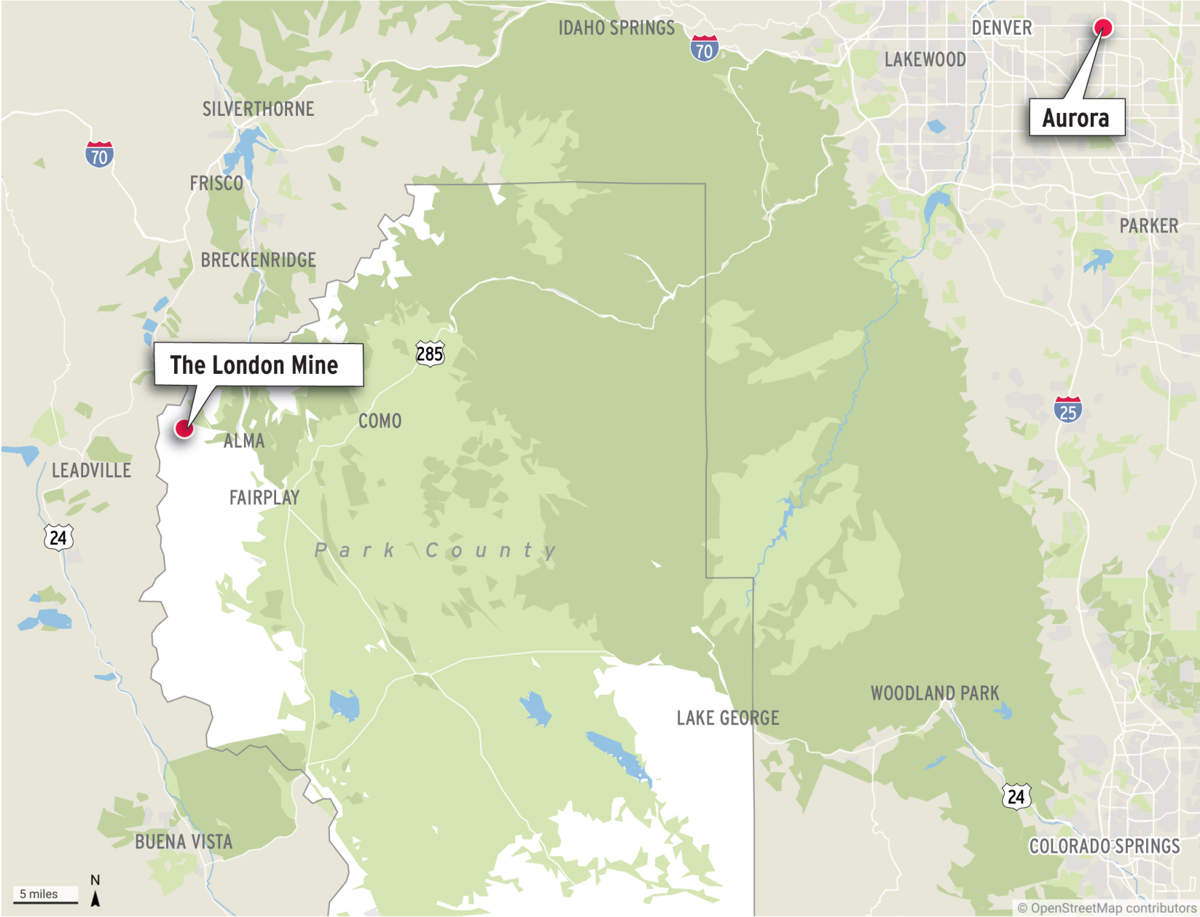
The historic London Mine, one of Colorado’s most prolific for gold and silver as well as for lead and zinc from its beginning in the 1880s to its closure in 1991, sits roughly at 11,300 feet in the high reaches of Park County beyond Fairplay.

The site is about 3,000 acres including an area known as American Flats, a largely barren landscape of rock and scree with stands of spruce and pine in the lower terrain. Mountain goat and mule deer range about and black bear and moose wander nearby.
The history of the London Mine also flags it as one of the longest single-source polluters of the South Platte River watershed with levels of cadmium and zinc and other heavy metal toxins that consistently fail state and federal water quality standards.
But fast-growing and ever-thirsty Aurora, more than 90 downhill miles away on the Eastern Plains, saw an opportunity in the storied mine. In 2018 it became the first major city in Colorado to buy water rights from a shuttered gold mine, determined to extract clean water from a historically toxic enterprise.

Ever since a public and celebrated announcement of the venture, however, troubles have stacked up like tailings.
The expense of producing and delivering clean water from the mine — and a unique aquifer beneath — has required several complex, multi-million dollar deals, some of which resulted in Aurora paying to get at water it already owned.
The deals have become so expensive — they’ve thus far cost Aurora Water ratepayers more than $50 million and have the potential to top $110 million — because Aurora two years ago turned its back on a chance to own a massive cache of water rights tied to the old gold mine for a fraction of the cost, a five-month Denver Gazette investigation has found.
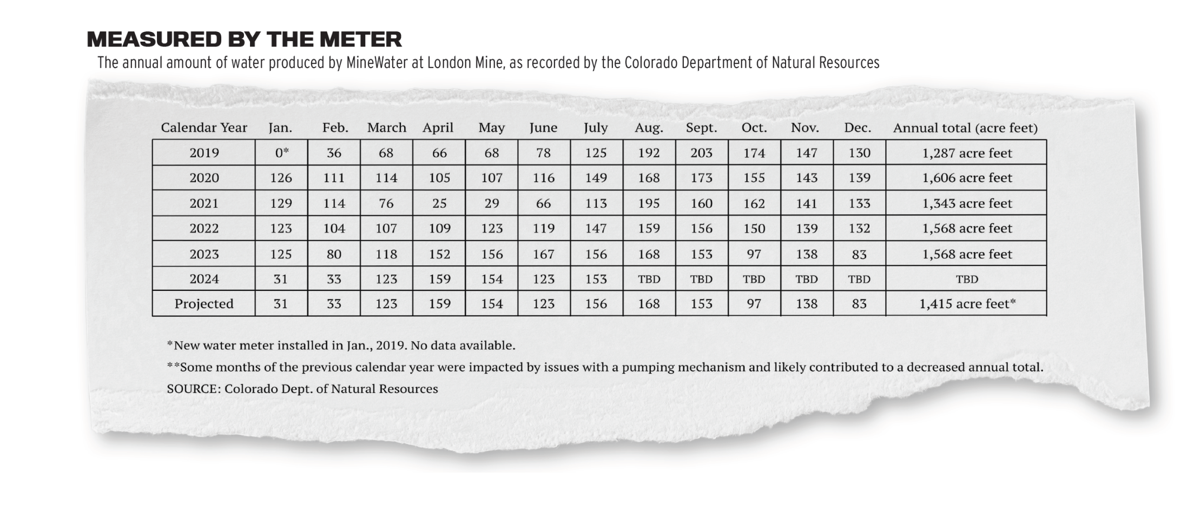
And Aurora has struggled to get as much water as initially promised from the venture, seeing just small percentages above the minimum it’s paid for in three of the last four years, state water records show. There’s been little new water developed since the original purchase despite years of assurances and millions of dollars in additional payments toward that end.

The trove of public dollars has been particularly lucrative for Greenwood Village entrepreneur Joe Harrington, who has been feverishly trying to produce the water the city purchased ever since. And despite years of problems and broken promises, Aurora continues to prop up the mine operator with a seemingly endless flow of cash for a variety of other projects that appear to have little to do with actually producing any water.
Meanwhile, some of the other players surrounding the deals have been accusing each other in a Texas court of a double-cross for cutting them out of the payday, according to thousands of pages of documents obtained and reviewed by The Denver Gazette and dozens of interviews with people familiar with the transactions.
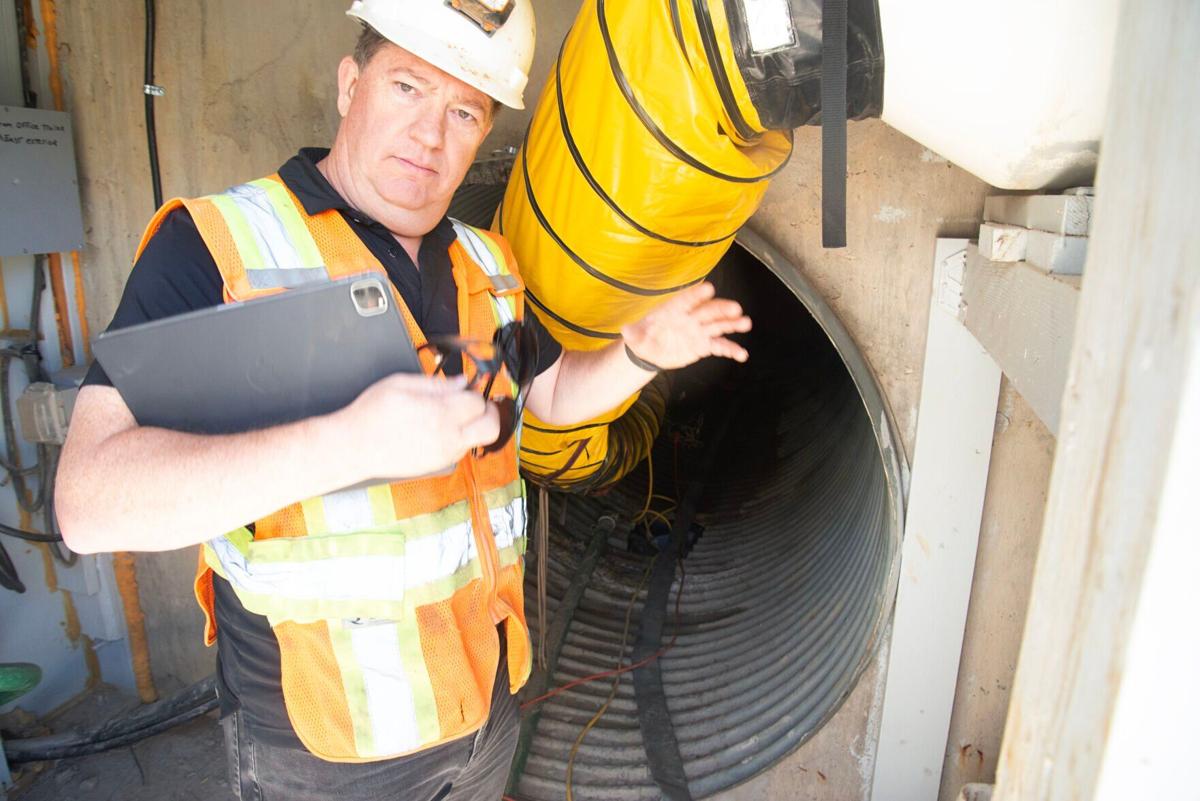
Joe Harrington points out an entrance to the defunct London Mine on MineWater's facility near Fairplay, Colo. on Thursday, June 6, 2024.
Tom Hellauer tom.hellauer@denvergazette.com

All the expensive and troubled deals are largely unknown to the general public or the citizens of Aurora. Since 2018, the myriad proposals from Aurora Water, the city utility, have quickly passed the City Council after non-public executive sessions.
Aurora Water defends the years-long transactions and insists they are purely beneficial to a growing city that’s predicted to top 506,000 in population by 2040, a staggering 32% increase over 2020, translating to a never-ending need for more-and-more precious water.
The first of the London Mine deals drew national headlines when Aurora announced in 2018 it had paid $34 million for ownership rights to some of the water there. It was a bold move because of the difficulty and expense of producing and delivering clean water from a historically toxic mine.
Much of the water that comes from the aquifer beneath the London Mine is pumped to the surface, where it mingles with outflows of other water emanating from the mine. It moves to an on-site treatment facility designed to remove suspended metals and minerals that, left alone, could poison nearby South Mosquito Creek.
The partially treated water then moves to a lined outdoor lagoon that holds enough to fill two Olympic-sized swimming pools. Called a settling pond, the minerals and metals that make it through the initial filtration settle further as the water flows to a measuring flume on the downhill side of the pond, spilling into the creek below.
From there the water mingles with other flows as it moves south toward the South Platte River watershed and eventually Aurora’s Spinney Reservoir just southeast of Hartsel.
As the years have passed, Aurora has pushed more and more money to the project’s principal, Joe Harrington, and his variety of so-named MineWater companies, as well as other entities to which he was confidentially a principal, records obtained by The Denver Gazette show.
Aurora’s reticence to simply take over the project, as it could have given the various lapses and delays, seems to hinge on a 1980 federal law that ties the cleanup, compensation and liability for hazardous substances released to the environment to the ownership of the affected land.
Simply put, Aurora wants the water, not the mine and its attendant liabilities. By keeping an arm’s distance, the city isn’t responsible for any pollution that comes out of the mine.
And it’s cost the city plenty.
Should the city foreclose or Harrington go bankrupt, both sides warn the outcome could prove even more costly, though the U.S. Environmental Protection Agency says that might not be the case.
“The elephant (in the room) is the U.S. government and EPA,” Harrington said while leading a Denver Gazette reporter, editor and photographer on a tour of the rugged London site. “The pollution has been out of control for a long time — and the city is supportive, but at a distance because if they get any closer they could have the liability.”
Without addressing the London Mine specifically, the EPA confirmed to The Denver Gazette that any unit of local government that acquires ownership or control of a hazardous waste site “in connection with law enforcement activity, or through bankruptcy, tax delinquency, abandonment or other circumstances in which the government acquires title by virtue of its function as sovereign is exempt” from the statute’s definition of liability, as long as “that government entity did not cause or contribute to the release or threatened release” of the hazards.
The EPA further qualified its response by saying all determinations are “situation specific” and that it has “enforcement discretion.”
City officials say London Mine should be seen as an asset, even as the difficulties of dealing with it have stacked up.
“Aurora has a history with the London Mine,” Councilman Steve Sundberg said in an email. “It is one of a number of unique and beneficial arrangements to obtain water within Colorado, for our growing community.”
The city’s nine other councilmembers — all of whom approved the various deals — did not respond to Denver Gazette emails requesting comment.
Harrington said he’s merely trying to clean up a long-standing operation fraught with problems, some of them his own.
“I’m not trying to screw the state, the city or contractors to make money,” he insisted. “There are about 400 other mine sites in Colorado where this type of deal might work for a municipality and we will only succeed if we make everyone happy.”
II
The intricate details of the city’s involvement with London Mine have been shepherded by Aurora Water Director Marshall Brown and Harrington. The two men and their families for years lived near each other and were part of the same church congregation.
The arrangements between Aurora Water and MineWater entities have included loans with open-ended and generous repayment terms, and, in return, promises of even more water that some experts say is unlikely to ever materialize.
One water court judge, for example, years ago concluded all the extra water at the mine probably would never be developed.
Today, Brown disagrees, saying: “We think it’s water highly likely to come out of this project.”
He couldn’t put a time frame on when that might happen.
As to his relationship with Harrington, Brown said flatly: “There is no personal relationship that tainted or influenced this in any way.”
Brown said he’s aware “it’s not a typical way for municipalities to acquire water. It’s outside the box. But the risk investment is not dissimilar to other water acquisitions if colored generally.”
Yet things have gotten so cozy between Harrington and Aurora’s water department that last year, facing likely bankruptcy from the foreclosure of a $1.5 million loan Harrington took from a hard-money lender at 18% interest, Aurora stepped up and handed him a no-bid $5.2 million contract for tons of rock from the gold mine property so he could pay off those creditors, according to interviews.
It came with the knowledge and consent of the Aurora City Council, water officials stated.
And rather than pay when the rock is delivered — Harrington estimates it will take about seven years to complete the job — the city ponied up the check long before he had a state permit to move it.
The money for the rock wasn’t the first time the city bailed Harrington out of a tenuous financial situation.
One of the city-approved transactions — on the books as a $4.2 million prepayment for future water development tied to rights the city already owns — is actually a loan from the city that Harrington is using to hunt for gold ore in piles of decades-old waste rock at the mine and does not entail producing any additional water.
City paperwork shows the money went to leasing a specialized X-ray machine from another company Harrington owns. Harrington said in interviews it was actually to lease equipment at a different gold mine he has but that city officials didn’t want to be bothered with those details.
Filings with the Colorado Secretary of State’s office show the X-ray ore sorting equipment is the only collateral for Aurora’s loan.
All of the transactions were ultimately approved by the Aurora City Council as part of consent agendas that didn’t allow for public comment, and nearly always following secret executive sessions that were conducted as “contract negotiations,” which Colorado’s open meetings law permits to be discussed outside the public view.
However, water officials frequently had already signed off on the deals by the time those executive sessions happened, documents show.
The most crucial of the transactions involved Aurora buying up all the remaining water rights tied to the London Mine after the sellers, a shrouded group in which Harrington confidentially held a financial stake, couldn’t deliver on promises to petition state water courts for so-called guaranteed water after years of delays, records show.
Up until then, Aurora had purchased only a portion of the water rights from the mine and agreed to buy more if it was ever produced.
It hasn’t been.
And the city paid top dollar on the promise it would see some of the water it bought converted into “absolute” water in state water court.
Yet rather than foreclose on the broken deal, Aurora instead quietly told the sellers it purchased from — then a short-lived group called No Name Investors — that they didn’t have to repay $8.14 million the city paid for the original water, that they could keep another $2 million in options payments the city had paid toward future water purchases, and the city tossed in an extra $1 million to complete the payday, records show.
All of that in lieu of a chance to buy all the remaining water rights tied to the mine — a purportedly sufficient volume to supply an astonishing 13,000 homes a year with water — for about $50,000, records show.
When asked to explain the transaction, Harrington said Aurora simply chose to buy out No Name Investors in order to prevent the group from selling out to any potential competitor that could complicate Aurora’s arrangement any further.
Water officials explained that foreclosing wasn’t their best option, largely because it would endanger the very entity they relied on for getting their water in the first place: Harrington.
“The city is not in the business of mining,” Brown said.
And even though Aurora now owns all of the water rights attached to the London Mine — a huge score for the city should it come to fruition — it has agreed to keep paying Harrington to actually develop the water, a double-dip potentially worth tens of millions of extra dollars that originated in a separate private contract Harrington brokered long before Aurora was ever at the table, records show.
The Players
Joe Harrington: Founder-owner of MineWater and its various off-shoots such as MineWater Finance, MineWater Holdings and MW Sorter, all of them related to his work at the London Mine, which he also owns. Known for his work on the Gold King Mine disaster cleanup.
Marshall Brown: General manager of Aurora Water, which brokered several contracts with Harrington-owned companies for millions of dollars dealing with water and other assets of the London Mine.
Dawn Jewell: Aurora Water South Platte Water resource manager.
Rich Wanty: Research professor at Colorado School of Mines.
Gregg Campbell: Water broker hired by THF to sell London Mine water rights.
Alexandria Davis: Deputy general manager of Aurora Water.
Stan Kroenke/THF: Professional sports team owner and real estate developer. Owns THF which purchased major water rights at London Mine from Coors Brewing Co. and later partnered with Joe Harrington.
Ben Wright: Deceased former owner of the London Mine and many of its water rights.
MineWater: Titular beginning to companies formed by Joe Harrington for mining and water functions at the London Mine.
Karl Nyquist: Founder of C&A Companies, a well-known water broker in Colorado, and co-founder/manager of No Name Investors.
No Name Investors: Partnership formed by Joe Harrington and Karl Nyquist to purchase London Mine water rights and quickly resell to Aurora.
2016 Cascade Water Resources: Partnership formed to finance water development by Joe Harrington at London Mine.
Tim Brittan: Cascade and No Name investor who founded Infinity Oil & Gas in Denver. Borrowed $1 million from hard-money lender Oak Savannah, pledging his ownership stake in Cascade as collateral. Harrington guarantees the note and takes ownership of Brittan’s shares in Cascade.
Marcus McCrary: Cascade and No Name investor, owner of outdoor advertising and billboard company in Texas. Harrington gives him $1 million for his stake in Cascade, but a lawsuit says it was “for seemingly no legitimate purpose.”
Harrington dubbed those remittances “success payments” should he ever actually bring the water to the surface.
Aurora Water officials said owning the water rights doesn’t dissolve their need to pay someone to get at the water, saying the effort and money is worth the risk.
“It will take a lot of engineering and a lot of time to prove this water is actually there,” said Dawn Jewell, Aurora Water South Platte Water resource manager. “But this much water … is worth it to us.”
Harrington said he’s worked hard for little actual return compared to the investment.
“We thought it was to be a hell of a lot easier than it turned out to be,” Harrington told The Denver Gazette. “I thought drilling and tunneling would be straight-forward, but none of those things are true,” he said. “Is it worth it? That’s the hindsight. Looking back over it, maybe it’s not worth it, but I believe it will be over the long haul.”
III
Mountains are inherently sponges of rain and melting snow, sucking up the moisture and bringing it either downward into the geologic rock or allowing it to run on the surface directly into creeks and streams.
The water that does permeate the subsurface can take many years, sometimes thousands, before percolating back to daylight.
The shafts and adits — they are only called tunnels if there is another way out — that make up a mining operation can bore into a mountain for many miles, each tapping a water source, often just a trickle, that nature didn’t intent to be disturbed.
The water and oxygen comingles with the exposed rock, ores and minerals and highly caustic acid develops, often to the detriment of the fish and wildlife it later contacts. That acid water drains out of the mine entrances, called portals, and sometimes collects in pits meant to contain the contamination.
“In the mining process you are taking things that are happily buried in the ground, isolated from the atmosphere and when they hit oxygen, there goes the chemical reaction,” said Rich Wanty, a research professor at Colorado School of Mines, noting the most problematic contributor isn’t zinc, copper or even gold but, rather, pyrite, or “fool’s gold.”

Courtesy of Lisa Sigler of Sigler, Inc./MineWater
Also, simply plugging a mine to stop the acidic water from flowing isn’t a lasting solution to keeping it from reaching nearby creeks.
“You can’t just put a cork in it and walk away,” Wanty said. “Any plug is there to regulate the flow, not to stop it.”
Water is a biproduct of mining and in Colorado, where any water is subject to being claimed for beneficial use, state water courts are the final arbiter of who owns how much of it.
Most of the water that usually comes from a mine is considered tributary, which means it ends up in a stream or creek, which eventually ends up in a river, lake or reservoir.
Glossary of terms
Tributary water: Water that flows along or into surface streams, creeks, ditches, lakes or reservoirs.
Non-tributary water: Water that is underground, such as an aquifer, and is not connected to any surface supply.
Conditional water: Water that is not yet developed and put to beneficial use. Owners typically must show every few years they are still trying to develop it or the water right is cancelled.
Absolute water: Water that has been diverted and is put to beneficial use.
Water rights: A legal right to divert and beneficially use water in Colorado, which can only be created by its water courts. All water rights must be put to beneficial use, such as farming or for municipal use.
Water court: Colorado is divided into seven water court divisions, each with its own water court that hears all the legal issues surrounding water ownership, the rights to Colorado water and how water is ultimately used.
Adit: The horizontal underground passages that make up a mine. Is different than a tunnel, which must have an opening at two ends.
Portal: The entrance to any mine.
Acre-foot: The measure used for large amounts of water. It is 325,851 gallons, or enough to cover an acre of land one-foot deep.
Tributary water in Colorado is divided up according to a system known as prior appropriation. Suffice to say, it’s a long complex list of claimants that can date back many decades, with the guiding principle being: “first in time, first in line.” Those with the earliest claim on the water have a “senior” right to it.
The London Mountain where the namesake mine is located is a geologic anomaly in that some of the water that seeps into the mountain is captured by an underground aquifer that — to the best of anyone’s decades-old calculations — doesn’t actually go anywhere. That’s because a long and thick wall of impermeable clay and granite, known as a fault line, blocks it from making its natural way out to any stream or creek, which at one time was believed to have been the far-away Arkansas River system.
Colorado water courts years ago determined that all that water — including anything that is captured by and comes through the London Mine adits and portals — is non-tributary and can be claimed by anyone who owns the land above it and taps into it.
Whether that designation would hold up today in water court is a matter of speculation, experts say.
“With the science of the past 50 years since the London Mine (aquifer) was declared non-tributary, it might be really easy to prove today that it’s not,” said one water court expert with ties to the mine’s water rights who was not authorized to speak publicly. “So as long as you don’t go back into water court and open (the case) up, you won’t face that risk.”
But the water courts also put a critical restriction on those water rights to preserve the aquifer beneath: It can only be tapped through bona fide mining activities. This rule adds a critical layer of complexity to the water machinations between Harrington and Aurora Water. Even though Aurora technically owns the water, you can’t just drill a hole and start pumping.
The water coming from the mine has been declared to be usable for a variety of purposes, according to court decrees as far back as the 1960s. One key distinction is the allowance for municipal use, which makes it valuable to housing developers, especially in Colorado.
That’s why THF Realty, a development company owned by sports-magnate Stan Kroenke, bought up the London Mine water rights from the Coors Brewing Company in 2003. THF owned THF Prairie Center Development, which was looking to develop a metro district of that name near Brighton and saw the water as a necessary resource.
While the development project was being planned, THF leased the water that was coming from the mine to the Centennial Water and Sanitation District. THF later bought up the remaining water rights that existed at the mine in 2016 from the estate of Ben Wright Jr., who also owned the mine itself.
That’s about when Harrington and his MineWater Finance company got involved.
Harrington, a 51-year-old microbiologist and metallurgist, had met with some success cleaning up the polluted water that exploded from the Gold King Mine near Silverton in August 2015, a sensational national news story, when more than three million gallons of toxic mine waste spewed into the Animas River, turning it an almost fluorescent yellow orange.
Harrington came up with a way to clean the water as it came out of the mine’s portal, a new approach that caught the attention of mine owners across Colorado.
THF saw Harrington as a potential solution to its London Mine polluted water troubles.
In a three-way deal, Harrington eventually purchased the London Mine and the land around it for more than $425,000 from the Wright estate, records show, and quickly signed an agreement with THF to take on the polluted water issues.
Harrington’s purchase was largely financed by a group of six investors — five of them from Texas — who called themselves 2016 Cascade Water Resources. The group eventually put up about $7.5 million for the project, according to documents reviewed by The Denver Gazette.
Colorado water rights: A complex system and pricey process
In a separate agreement with MineWater, THF said it would evenly split any proceeds with Harrington from the sale of additional water he could develop beyond the first 1,511 acre feet that was already flowing, according to that agreement.
The two would split profits on the first 354 acre-feet of additional developed water after that. Any profits from any water developed after that were all Harrington’s to keep, the agreement shows.
This arrangement would prove costly to Aurora years later.
Cascade’s investment was to obtain a percentage of the profits Harrington was to get, records show.
As part of the purchase agreement, MineWater, THF and the Wright estate in August 2016 signed a consent decree with the Water Quality Control Division of the Colorado Department of Public Health and Environment dealing with the polluted waters coming from the mine openings, according to the settlement between the private parties and the state agency. The water from the mine had been failing water quality tests for many years and several violations and unpaid penalties had been stacking up.
MineWater agreed to clean up the existing water flows and take responsibility for about $925,000 in fines, though THF still held title to the water once it hit the streams. More than $725,000 of those fines remain unpaid, records show, and are due if any new water is developed and proven in state water court.
Some of Cascade’s investment was used to cover the portion of the fine that was paid, court records show.
IV
By early 2017, THF decided it wanted out of London Mine and was aggressively looking to sell all of its water rights, circulating a price of roughly $32 million, according to copies of emails and other correspondence reviewed by The Denver Gazette.
There had been a general change in Brighton’s attitude toward developers who relied on non-renewable, non-tributary ground water to supply their projects. The desire was to move toward renewable resources and that meant tributary water.
Harrington had acquired from THF the right to make a first offer on the water, but lacked the funds needed to even consider the price Kroenke’s company wanted. Harrington was rejected when he asked THF to carry the financing on any sale to him, according to emails reviewed by The Denver Gazette.
The emails between Harrington and other investors he culled are part of a lawsuit filed in Dallas by three of the six members of the Cascade group. They sued the other Cascade members, asserting that although the transaction was not illegal, they were double-crossed and wrongly dropped from the deal by the others who eventually purchased THF’s water rights, then profited handsomely selling to Aurora.
The case is pending and none of its litigants responded to Denver Gazette requests for comment.
The profit that could come with buying and then quickly reselling the London Mine water rights was evident to the No Name investors, and the emails reflected a concern that if the group didn’t move quickly, it could blow any chance at collecting a huge payday.
Water speculation is illegal in Colorado, but only on new water rights that don’t yet exist. Buying and selling existing water rights — even before owning them — is not illegal, a report by a Colorado Department of Natural Resources working group concluded in 2021.
Despite Harrington’s right to offer first, local Denver water broker Gregg Campbell was also working to sell THF’s water, according to emails discussing the transactions that are part of the Texas lawsuit. At about that time, THF dropped its asking price by about $10 million, according to court records. It’s unclear why and several calls and emails to THF representatives were not returned.
Sources familiar with the deal separately told The Denver Gazette that Campbell had located a private buyer and was readying a sale. With the other buyer at the ready, Harrington used his right to first offer and upped the amount by $100,000, he told The Denver Gazette.
To make it work, Harrington turned to the Cascade investors and created a new group — No Name Investors — in late 2017. No Name originally included the entire Cascade group and four other people, according to documents reviewed by The Denver Gazette.
Ultimately, however, No Name Investors would have only seven members — three of them from Cascade — as well as Harrington and Karl Nyquist, the owner of C&A Companies, a well-known water broker in Colorado who was also No Name’s registered agent, according to records in the Texas lawsuit and the Colorado Secretary of State’s office.
No Name acquired its title from one of the creeks that runs near the London Mine.
The only public-facing identity of No Name Investors, however, according to dozens of documents exchanged with Aurora Water and millions of dollars paid to No Name, was Nyquist as its manager. The names of the other members — including Harrington — were not a matter of public record, although Aurora Water officials said they were aware of its makeup. No Name’s membership was only publicly divulged in the Texas lawsuit in August 2023, years after the Aurora deals were done.
The other No Name members were P. David Pretzler and Todd Lambert of Littleton, and Tim Brittan, Marcus McCrary, and Doug Hickock of Texas, according to documents filed in the Texas lawsuit.
Brittan is founder of Infinity Oil & Gas in Denver and is longtime friends with Harrington, according to people familiar with their relationship.
McCrary, an entrepreneur who owns an outdoor advertising and billboard company, and Hickock, the president of a Dallas real estate development company, are longtime golfing buddies who frequently vacation together, according to court records.
Pretzler is president of C&A Companies, which he co-founded with Nyquist. Lambert joined C&A in 2015 and eventually became a partner. Lambert had previously worked for THF.
Each No Name member was tasked with putting up earnest money that ranged from $33,333 to $50,000, according to a copy of the partnership agreement contained in the Texas lawsuit. The only member not required to pay was Harrington, who retained a 16.66% ownership interest, records show.
Having a buyer for the water rights was paramount if No Name was to purchase them from THF. No buyer meant no profit.
“Right now our focus is on educating/re-educating the market place on the London Mine water, and soliciting initial indications of interest,” Lambert emailed McCrary, Harrington and Nyquist in April 2017, according to lawsuit documents. “Thus far the responses have all been quite positive.”
Then, when THF lowered its asking price, No Name Investors was encouraged to remain in the game, as Lambert wrote.
“They are handing us an opportunity to control our own destiny,” Lambert emailed in July 2017. “At a 10M ($10 million) drop in price, they (THF) clearly want to be done.”
As No Name came closer to finding a buyer at a price they liked, the group began quietly negotiating with the other seller THF had hired: Campbell. The difficulty, according to emails, was Campbell was to get no commission on any sale if the buyer was Harrington and MineWater.
“The relationship between us and Gregg is fine,” Lambert emailed Harrington in July 2017. “But remember, in his listing agreement, he doesn’t get paid if MineWater buys the water. He gets paid if anyone else does.”
So, the investors were eager to guarantee Campbell’s commissions, according to emails.
“We drafted the side agreement to protect him (Campbell), and agreed to compensate him if MineWater buys,” Lambert wrote.
Campbell did not respond to repeated requests for comment from The Denver Gazette.
Still, with no prospective buyer, the deal looked tougher to pull together and perhaps likely to collapse — until Aurora Water showed up with a large check in hand for only a small portion of all the water rights that were available.
When Aurora came to the table in October 2017 to discuss buying the London Mine water from the one-month-old No Name Investors, the investors did not yet own THF’s water, records show. The investors and THF signed a commitment to pursue the sale on Nov. 21, 2017, a deal that allowed either side to back out for cause, according to that contract.
Aurora Water officials said they were approached about buying the water and were aware No Name Investors did not own it.
The Aurora City Council formally approved an agreement to buy 1,411 acre feet of London Mine water — about a quarter of the water rights from No Name — on Jan. 22, 2018, city records show. That happened after a closed executive session in which the deal was discussed, records show.
Four months later, No Name finalized its purchase of all the mine’s water rights from THF on April 11, 2018, according to copies of that transaction filed with Park County.
“In January 2018, the City of Aurora voted on an odd deal to purchase certain water rights associated with the London Mine from No Name Investors,” according to the Texas lawsuit. “No Name was a newly formed entity that, at the time, did not own any water rights associated with the London Mine.”
In the span of a few short months, No Name Investors essentially bought all the water rights tied to the London Mine from THF for $22.9 million relying on the $31.1 million Aurora paid for only a fraction of the same water — a tidy quick profit of nearly $10 million with an outlook for even more. (The additional $3 million Aurora paid were on options for additional water and a land agreement.)
“In other words, No Name entered into an agreement to sell (a portion of) water rights it did not own, then acquired the rights, then immediately flipped them to the City of Aurora for more than 50% more (sic) than the price No Name paid for (all of) the rights,” according to the Texas lawsuit.
In their answer to the complaint, the defendants issued a blanket denial of all allegations without specifically addressing the transaction.
The sale agreement between THF and No Name had an additional payday for Harrington’s MineWater: A $621,000 royalty for helping broker the transaction, according to a copy of that agreement.
But the real money for Harrington — for actually getting at the water — remained tucked into various parts of the original THF agreements with MineWater that Aurora would later agree to honor.
Said one water expert of the THF-to-No-Name-to-Aurora water rights transfers: “The deals go to the guys with the cash in their hands.”
Coming tomorrow: Aurora Water, the quest for old gold and a multimillion dollar purchase of rock.


The Denver Broncos are on the ballot this fall | Jon Caldara
Jon Caldara
jon-caldara@coloradopolitics.com
Updated 3 days ago
Do you want the Broncos to win the Super Bowl? Then you’d better hope Amendment 87 — which brings back Colorado’s economy-strangling “graduated” income tax — loses at the ballot box this fall. Seriously. Forget Republicans and Democrats. Forget tax...
Grand Canyon flooding threatens economy that’s still recovering from a fire | OUT WEST ROUNDUP
Ernest Luning
ernest.luning@coloradopolitics.com
Updated 3 days ago
ARIZONA Flooding slams park’s economy Deadly flooding at the Grand Canyon is damaging the area’s economy, with a washed-out pipeline severing the South Rim’s water supply and shutting down lodging at the popular tourist vista for an indefinite period. The...

Was there ever a Colorado city that required racial segregation by law? | BOB LOEVY
Bob Loevy
bob-loevy@coloradopolitics.com
Updated 2 days ago
The answer is “yes.” The Black Racial Equity Study Commission, led by Colorado Senate President James Coleman, has learned the city of Fruita had laws forbidding black people from being on the city streets at night and from being buried...

Mark Kiszla: Her name is Hope. She’s quiet, but scores loud goals for the Buffs
Mark Kiszla
mark.kiszla@denvergazette.com
Updated 14 hours ago
BOULDER – CU soccer sensation Hope Leyba speaks softly and carries a big kick. On a Colorado summer evening when the clouds hovering near the Flatirons lit up like a Monet painting at sundown, I went to watch the greatest...

Immigration reporting measure fuels debate over Colorado’s role with ICE
Marissa Ventrelli
marissa.ventrelli@coloradopolitics.com
Updated 1 hour ago
A coalition of advocacy groups and several district attorneys rallied outside the Colorado Capitol on Thursday to oppose a ballot measure that, if approved by voters in November, would require state and local law enforcement to cooperate with federal immigration...
The African roots of three Colorado leaders | SONDERMANN
Eric Sondermann
eric-sondermann@coloradopolitics.com
Updated 3 days ago
Colorado’s political transformation is measured in many ways. A once reliably red state (with asterisks) became purple and is now a rather deep blue. For better or worse, probably the latter, power is ever more consolidated along the Front Range...

Colorado Politics Calendar Sept. 14-20
Rachael Wright, Special to Colorado Politics
rachael.wright@coloradopolitics.com
Updated 4 days ago
CoPo’s weekly political calendar will help you find political and public-policy events throughout Colorado. It includes candidate and issue campaign events, public policy meetings, court hearings, state and local party conventions, assemblies, debates, rallies, parades, speaking engagements, traveling dignitary appearances,...
Federal judge green-lights civil trial against ex-Fort Collins DUI officer
Michael Karlik
michael.karlik@coloradopolitics.com
Updated 2 days ago
A federal judge ruled on Thursday that Fort Collins’ former “DUI officer” will face a civil trial for allegedly investigating a motorist for impaired driving without any reasonable suspicion to do so. In recent years, several people arrested by Officer...

Denver police reopen 13 sex assault cases after retesting Missy Woods’ CBI work
Jenny Deam
jenny.deam@gazette.com
Updated 1 hour ago
Thirteen previously closed Denver sexual assault cases have been reopened after the city’s crime lab retested DNA evidence once analyzed by former Colorado Bureau of Investigation forensic analyst Yvonne Woods. A police spokesperson told The Denver Gazette the once-closed cases...

Ballot measure aims to shift Colorado sporting goods tax revenue to land, water and wildfire projects
Marissa Ventrelli
marissa.ventrelli@coloradopolitics.com
Updated 17 hours ago
Colorado voters this November will decide whether to direct a share of sales tax revenue from sporting goods — including bicycles and skiing equipment — toward land and water conservation, wildfire prevention and expanding outdoor recreation. Supporters say the measure...