

Uranium mining in the Grand Canyon: 1,470 feet below surface
Unlike strip mines, the Pinyon Plain mine’s surface impact is only 14 acres. The geological formation containing the uranium ore body, called a “breccia pipe,” is about 250 feet in diameter and extends vertically down some 3,000 feet.
To mine the ore, a vertical shaft was drilled and blasted down into the rock to the side of the formation containing uranium. It extends down 1,470 feet.
Horizontal tunnels called “drifts” are being drilled and blasted into the breccia pipe to access the high-grade uranium ore.
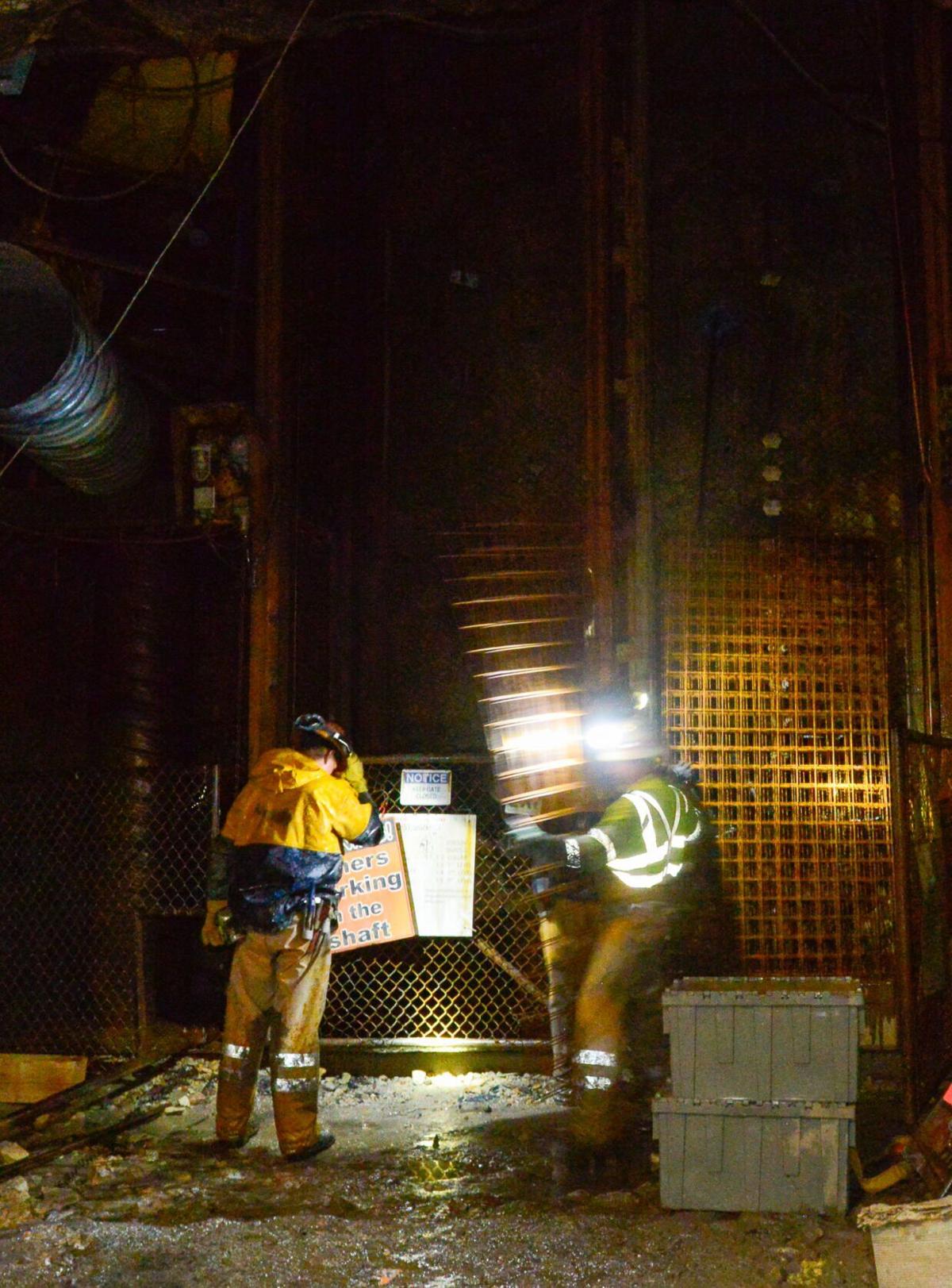
Miners at the Pinyon Plain uranium mine in northern Arizona move supplies off of the shaft hoist car 1,400 below ground in May 2024.
Scott Weiser scott.weiser@gazette.com

Miners at the Pinyon Plain uranium mine in northern Arizona move supplies off of the shaft hoist car 1,400 below ground in May 2024.
The ore is brought to the surface using a elevator suspended by a cable that is lifted and lowered by a winch on the surface.
At the surface, the ore is dumped and moved to stockpiles until it’s transported by truck to the company’s White Mesa uranium mill, the last remaining uranium mill in the United States, some 260 miles northeast, near Blanding, Utah, where it is processed into uranium oxide, also known as “yellowcake” for its bright yellow color.
Energy Fuels Resources Inc, the Colorado company mining this area, is at the frontlines in the battle over uranium mining near the Grand Canyon. The outcome of that battle offers also kinds of implications for Americans — jobs, energy, the environment, the economy, national security.
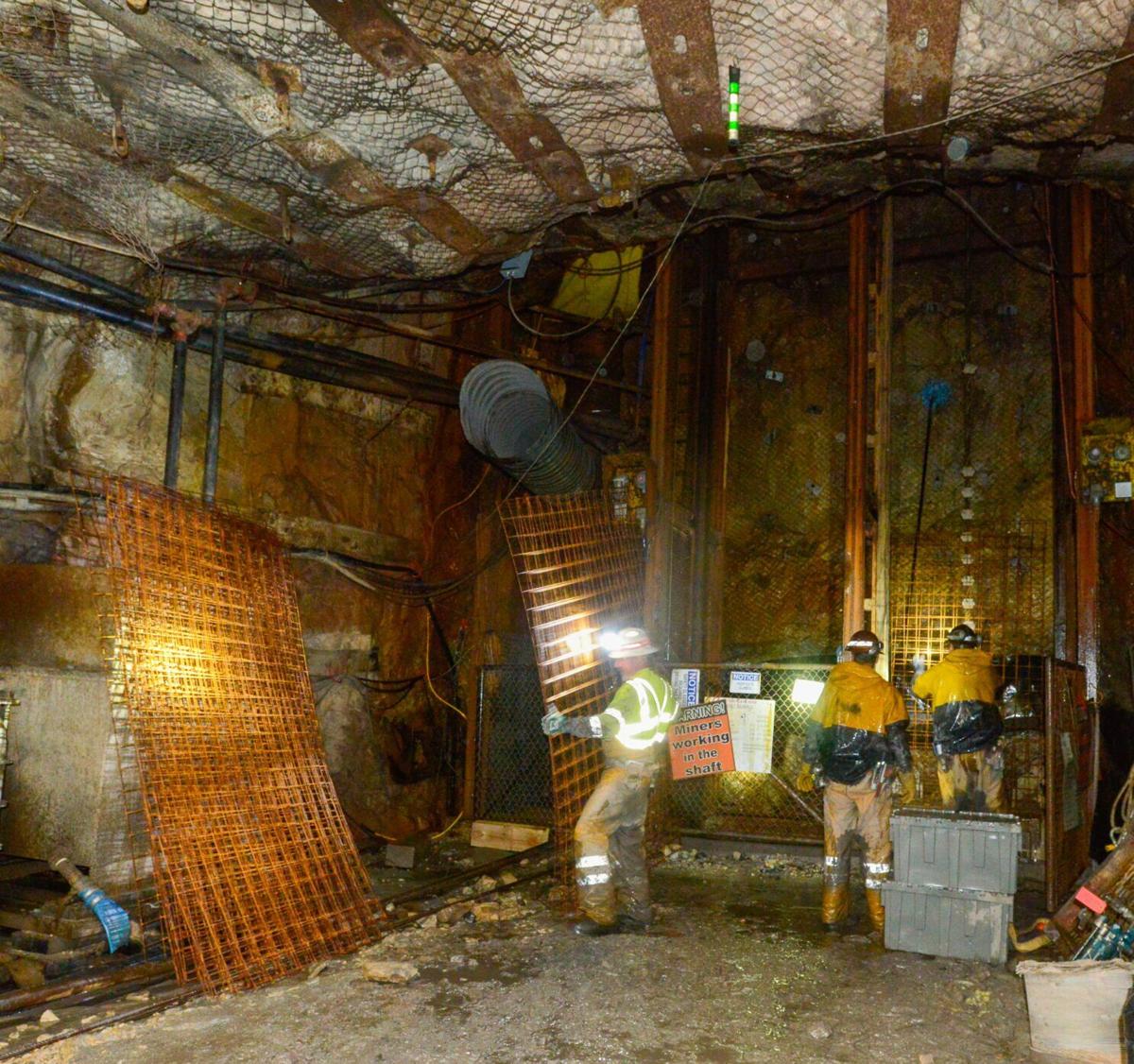
Three uranium miners unload steel grates used to stabilize tunnels and prevent falling rocks at the 1,400 foot level of the Pinyon Plain uranium mine in northern Arizona. May 2024
Scott Weiser scott.weiser@gazette.com

Three uranium miners unload steel grates used to stabilize tunnels and prevent falling rocks at the 1,400 foot level of the Pinyon Plain uranium mine in northern Arizona. May 2024
According to geologists, some of these vertical breccia pipes contain uranium at the highest concentrations in the U.S. in a very small footprint.
Other breccia pipes contain different minerals, including silver, arsenic, barium, cadmium, cobalt, copper, mercury, molybdenum, nickel, lead, antimony, strontium, vanadium, and zinc.
Many of these elements, including uranium, also occur naturally in surface soils and in rock layers, but at much lower concentrations.
The Arizona Geological Survey estimates that there are approximately 1,300 breccia pipes that have been identified in the Grand Canyon region. Only a few contain uranium. One contains 75% pure copper ore, an astonishing concentration, according to geologists.
Some contain other minerals, and some contain no concentrated minerals.
The uranium ore zone in this mine extends from 1,200 to 1,900 feet below the surface. The current plan is to mine only the top 250 feet of the ore body down to about 1,450 feet.

A new Boart-Longyear Stopemate pneumatic drill control head is delivered to the headframe by a forklift telehandler for lowering down the 1,400 foot deep Pinyon Pine mine shaft in Arizona. May 2024.
Scott Weiser scott.weiser@gazette.com

A new Boart-Longyear Stopemate pneumatic drill control head is delivered to the headframe by a forklift telehandler for lowering down the 1,400 foot deep Pinyon Pine mine shaft in Arizona. May 2024.
The state mining permit limits mining to no deeper than 1,997 feet to ensure there is at least 500 feet of impermeable rock between the bottom of the mine and the Redwall limestone aquifer, which lies nearly 3,000 feet below the surface.
These pipes are formed from layers of stone deposited over more than 300 million years, when the Grand Canyon didn’t exist and the whole central part of the U.S. was a shallow sea. Some of these layers contain uranium.
Ancient sandstone and limestone rock layers, as well as some eroded breccia pipes, can be seen in the walls of the Grand Canyon, which was created by the Colorado River as the area was uplifted by geological processes over the last 10 million years or so.
Voids created by acidic water dissolving deep limestone layers in the past caused breccia pipes to form.
As the voids formed over millions of years, the layers above collapsed sequentially into the pockets, creating sinkholes that in some cases extend to the surface.
Over geologic time the collapsed rubble was cemented into impermeable rock through deposition of minerals like calcite between rocks and particles by mineral-laden water flowing through the sinkhole.
This cemented broken rubble is called breccia, which gives the formation its name.

An example of hardened and impermeable cemented breccia after erosion of the surrounding sandstone rock layers seen in the Grand Canyon. According to the photographer, Brian Gootee, it's part of a breccia pipe in the Supai layer group. The blocks in the cemented tower are from the Coconino sandstone formation.
Courtesy of Brian Gootee and the Arizona Geological Survey

An example of hardened and impermeable cemented breccia after erosion of the surrounding sandstone rock layers seen in the Grand Canyon. According to the photographer, Brian Gootee, it’s part of a breccia pipe in the Supai layer group. The blocks in the cemented tower are from the Coconino sandstone formation.
The collapsed layers create a depression in overlying aquifers, such that water flows into the pipe as it does in a sink drain.
Natural dissolved uranium traveling through permeable sandstone aquifers over the eons is pulled into the pipe, and when it reaches strata within the broken rock containing oxides like iron pyrite, a chemical trap called a reduction zone causes the uranium atoms precipitate out of the water.
This is what creates the concentrated ore body.
The mineralization of the broken rock over millions of years eventually seals the pipe, preventing further vertical water flow and leaving the uranium trapped.
It is this cemented breccia that today prevents water from flowing into and through the pipe and carrying away the water-soluble uranium, according to Moore.
Curtis Moore, senior vice president of marketing and corporate development at Denver-based Energy Fuels Resources Inc, said that the part of the Redwall-Muav aquifer under the mine is not hydrologically connected to the part that creates Havasu Creek, nearly 40 miles distant.
Proof of this isolation, Moore added, is that the aquifer under the mine is under “nearly 150 psi of hydraulic pressure” and is at least 500 feet below the bottom of the mine.
The company insists that if the cemented breccia between the Redwall-Muav aquifer and the bottom of the mine was fractured, that pressure could not be maintained.

A course correction Canada would concur with | Miller Hudson
Miller Hudson
miller-hudson@coloradopolitics.com
Updated 2 days ago
I’ve always harbored a soft spot for Canada. My father was stationed there twice, once in the 1960s as the Atomic Energy Commission’s American liaison with the Canadian nuclear reactor program in Chalk River, Ontario and again in the 1970s...
Private property rights challenge rural Colorado communities | Rachel Gabel
Rachel Gabel
rachel-gabel@coloradopolitics.com
Updated 2 days ago
If there were ever a topic I believe deeply in, it’s private property rights. If there were ever a topic that leaves me in a moral conundrum more often than not, it’s private property rights. The northern portion of Weld...

Gazette family of papers rakes in 64 awards at 2025 Colorado Press Association Better News Contest
Elizabeth Pond
elizabeth.pond@denvergazette.com
Updated 14 hours ago
The Gazette family of newspapers won 64 awards in the Colorado Press Association’s annual Better News Contest — a whopping 36 more than the three papers collectively won last year. Colorado Politics raked in 27, The Colorado Springs Gazette took...
National park maintenance work sidelined as Trump’s Freedom 250 takes precedence | OUT WEST ROUNDUP
The Associated Press
the-associated-press@coloradopolitics.com
Updated 20 hours ago
MONTANA National park maintenance sidelined BILLINGS — The 250th anniversary of U.S. independence was just months away when National Park Service employees received a surprising directive from Washington: Maintenance projects approved for this year at sites across the nation were...

Gaylord — you never check in, but still pay | Jon Caldara
Jon Caldara
jon-caldara@coloradopolitics.com
Updated 3 days ago
I go to a lot of conferences, often in beautiful cities I never actually see. Friends hear where I’ve been and ask depressing questions like, “Did you visit the famous museum?” No. I saw Ballroom C, the lobby bar and...
Reflections on Weiser-Lopez, Crank-Killian debates | Tom Cronin
Tom Cronin
tom-cronin@coloradopolitics.com
Updated 2 days ago
Thursday night, The Gazette and KOAA TV hosted two important candidate debates. The first featured incumbent Republican U.S. Rep. Jeff Crank, who is just completing his first term representing El Paso County in Congress, and Jessica Killian, a Democrat who has...

What courageous citizenship really looks like | Vince Bzdek
Vince Bzdek
vince.bzdek@gazette.com
Updated 2 days ago
By Vince Bzdek What exactly is courage? Ernest Hemingway famously called it grace under pressure. Mark Twain wrote that “courage is resistance to fear, mastery of fear — not absence of fear.” C.S. Lewis refined that even more: “Courage is...
The coming election and mischief in the making | SONDERMANN
Eric Sondermann
eric-sondermann@coloradopolitics.com
Updated 5 days ago
America’s tribalism is such these days that we struggle to even agree on the basic rules. Elections have always been hotly contested. As the saying goes, “Politics ain’t beanbag.” The process has long involved elements of nastiness and underhanded conduct....
Tancredo in Running for Dept. of Ed. Position | A LOOK BACK
Rachael Wright, Special to Colorado Politics
rachael.wright@coloradopolitics.com
Updated 5 days ago
Forty-five years ago this week: “I know that my name has been placed before the Secretary of Education, and I know that I’m one of three or four being considered for the Department of Education’s Region 8,” said state Rep....
Colorado Politics Calendar Aug. 31-Sept. 6
Rachael Wright, Special to Colorado Politics
rachael.wright@coloradopolitics.com
Updated 5 days ago
CoPo’s weekly political calendar will help you find political and public-policy events throughout Colorado. It includes candidate and issue campaign events, public policy meetings, court hearings, state and local party conventions, assemblies, debates, rallies, parades, speaking engagements, traveling dignitary appearances,...