

Colorado River states clash over management, future of reservoirs
An unprecedented public appearance by six of the seven commissioners who are negotiating the future of the Colorado River revealed how divided they are on solutions, and just as importantly, where they agree.
The commissioners and state representatives spoke at Thursday’s 2024 Getches-Wilkinson conference on the Colorado River at University of Colorado Boulder’s law school.
The commissioners showed up together at a critical juncture — they are in the thick of the talks to come up with an agreement that would manage allocations and ensure that America’s two largest reservoirs, both located in the Southwest, don’t fall below critical water levels.
In addition, the negotiations are geared toward protecting the health of the river, which 40 million residents across several states rely on for drinking water.
That agreement is supposed to be in place starting in 2027.
One of their more striking differences is in just what defines the health of the Colorado River system.
The proposal submitted to the Bureau of Reclamation in March by the Lower Basin states wants to judge that health based on seven reservoirs in the system. In addition to Lake Powell and Lake Mead, that also includes Flaming Gorge in Utah, Blue Mesa in Colorado, and Navajo, which straddles the Colorado-New Mexico borders.
The seven reservoirs also include Lake Havasu in Arizona and Lake Mojave, which straddles Arizona and Nevada.
The Upper Basin states of Colorado, Wyoming, New Mexico and Utah want that health judged only on the two largest reservoirs — Powell and Mead, both directly on the Colorado River.
Is a seven-state solution possible?
Colorado’s commissioner to the Upper Colorado River Commission, Becky Mitchell, said a solution is not only realistic but absolutely essential.
However, she also hinted at breakdowns in the process due to the difficulty of the conversation, which frequently focuses on who gets their water, who doesn’t and by how much.
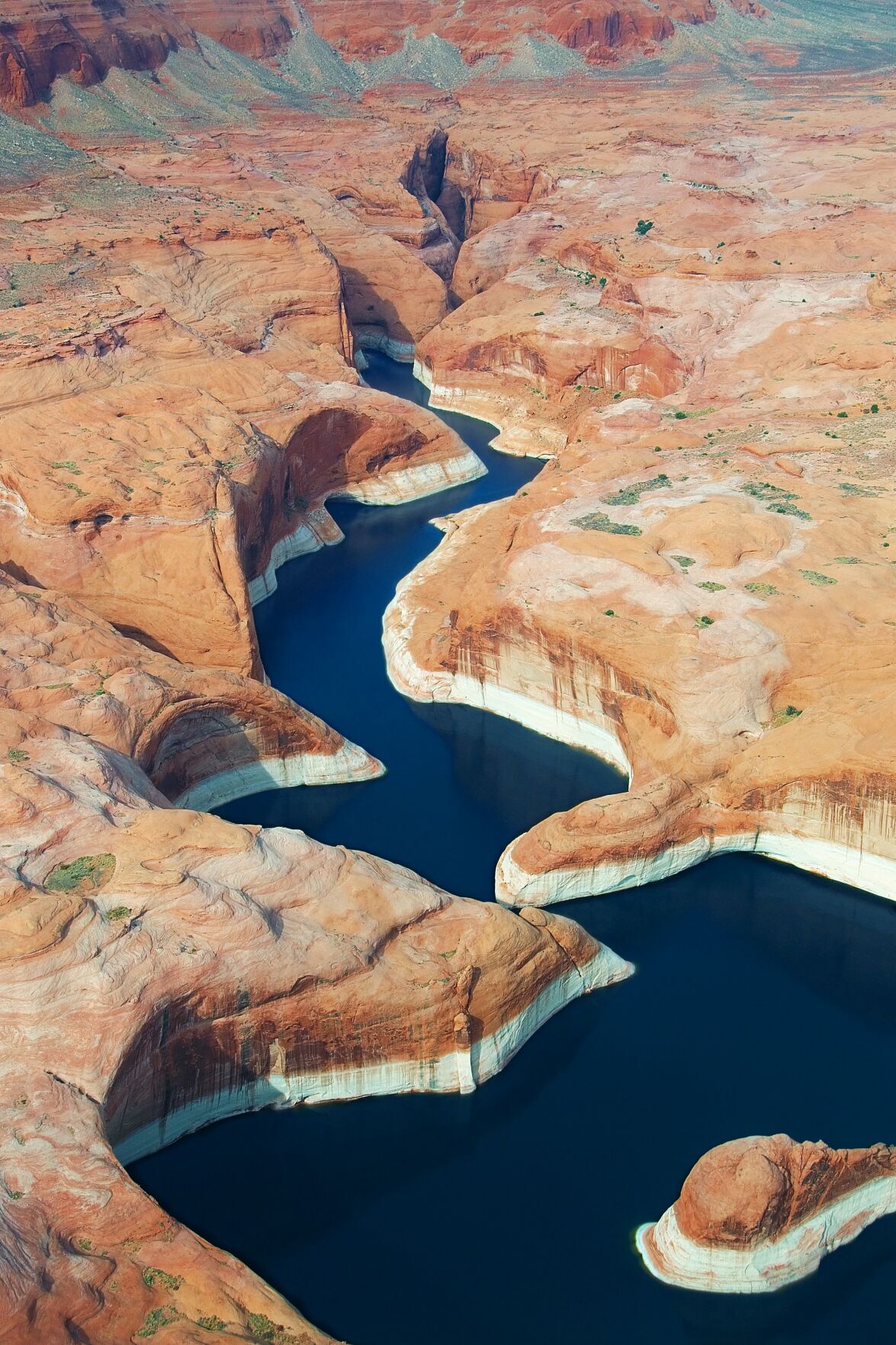
The Colorado River Basin which feeds Lake Powell and Lake Meade Reservoirs.
Rrainer Krienke

The Colorado River Basin which feeds Lake Powell and Lake Meade Reservoirs.
Mitchell acknowledged the concerns around competing proposals but said she believes there are also similarities and real opportunities within those proposals. She expressed concerns about what the federal government might do — but that’s minor issue, she said, “to what Mother Nature is telling us.”
John Entsminger, the general manager for the Southern Nevada Water Authority, noted that the conversations are now about 30 months away from the deadline, which he likened to the second or third inning of a baseball game.
One question yet to be answered is what will happen after the November election and who will be responsible for making decisions on environmental impact statements. Whether one is talking about the Upper Basin or Lower Basin solution, Entsminger said, it is important “to keep our hands on the steering wheel, and whatever the rules of the road are, come January 1st, 2027, we want to be the ones” to implement solutions.
That notably includes what everyone is doing to use less water, Entsminger said.
“We can argue all day about what triggers Lower Basin shortages, but none of that’s going to matter if we’re not (fitting) our water usage across seven states and two countries to the amount of water that that is actually available,” he said.
A realistic timetable?
Estevan López, who represents New Mexico on the Upper Colorado River Commission, said his agency would keep working toward consensus. However, he disagreed that there had been a breakdown, referring to it as a “hiatus,” which he called indicative of complex issues.
“We’ll work on it for as long as it takes,” he said.
Gene Shawcroft of the Colorado River Authority of Utah said while the challenges ahead are enormous, he agreed that all seven states are committed to a solution. He attributed the delays to the need for everyone to do their homework once the proposals from the Upper and Lower Basins were submitted.
“It’s hard enough to understand one state’s concerns if you live in that state,” he said. “It’s another thing to try to understand and have empathy and an understanding of what’s going on in the other six states. So, yes, we are talking, we, we are committed and we’ll continue to work together.”

A bathtub ring of light minerals shows the high water line of Lake Mead near water intakes on the Arizona side of Hoover Dam at the Lake Mead National Recreation Area on June 26, 2022, near Boulder City, Nev., in this file photo. The Biden administration on Tuesday, April 11, 2023, released an environmental analysis of competing plans for how Western states and tribes reliant on the dwindling Colorado River should cut their use.
(AP Photo/John Locher, File)

A bathtub ring of light minerals shows the high water line of Lake Mead near water intakes on the Arizona side of Hoover Dam at the Lake Mead National Recreation Area on June 26, 2022, near Boulder City, Nev., in this file photo. The Biden administration on Tuesday, April 11, 2023, released an environmental analysis of competing plans for how Western states and tribes reliant on the dwindling Colorado River should cut their use.
JB Hamby, chairman of the Colorado River Board of California, drew a timeline of where things stood just six months ago and noted that, while there had been pauses, there had also been progress.
“It was a very unpleasant time. You had six states versus California,” he said. “The reservoirs were on the brink of collapse. And four months later, what materialized was the largest conservation pact ever in the history of the West.
“All seven of us are in consensus about one very important critical thing,” he said, referring to the structural deficit that has pulled the river down to where it stands today, particularly when looking at the last 20 years of record-breaking drought.
“So, the fact that we have a seven-state consensus to exceed that structural deficit, come up with a plan to reduce by 1.5 million acre-feet a year, not just resolving the structural deficit, but rebuilding storage gradually, that’s a huge deal, as well,” he said.
Hamby said these examples of “sometimes contentious conflict, quickly turning around and into really productive, even exhilarating periods is a good thing,” adding he believes a solution is reachable.
How are negotiations going?
That question went to Tom Buschatzke of the Arizona Department of Water Resources.
“I think we share some really important common themes,” he said, adding that include the states controlling their destinies — and not judges or Congress deciding the fate of the states, water users, tribes and the river.
“We don’t want litigation,” Buschatzke said.
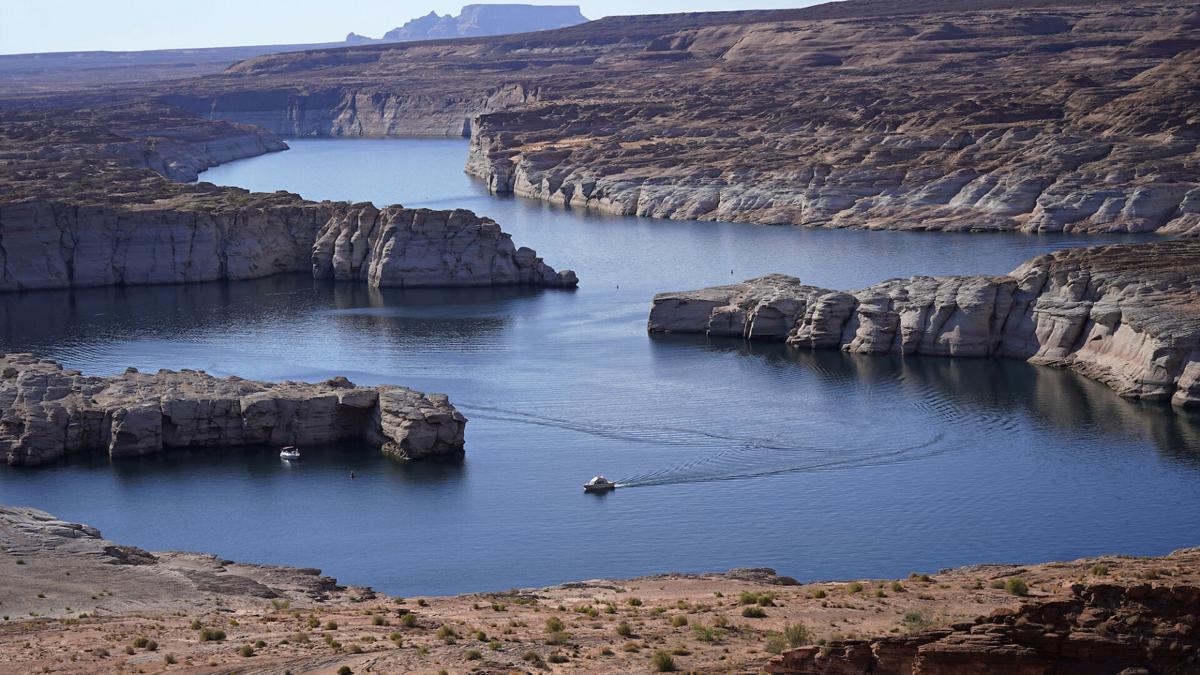
In this file photo, a boat cruises along Lake Powell near Page, Ariz., on July 31, 2021. Amid drought in the West, the Bureau of Reclamation is calling for the seven states that share the river to conserve 2 million to 4 million acre-feet of water next year to preserve power production in Lake Powell and Lake Mead.
Associated Press file

In this file photo, a boat cruises along Lake Powell near Page, Ariz., on July 31, 2021. Amid drought in the West, the Bureau of Reclamation is calling for the seven states that share the river to conserve 2 million to 4 million acre-feet of water next year to preserve power production in Lake Powell and Lake Mead.
Third, the states must live within what’s available from the river, and that’s hardest to figure out, he said. Finally, everyone must recognize the impacts of the shortages — and cuts — that everyone has taken to date and will have to take in the future. Arizona has had more cuts to its water allotment from Colorado than any of the other six states.
These are principles all seven states can hold in common, Buschatzke said.
How will the seven states address the issues of litigation, legislation and negotiation?
Colorado’s Mitchell has said previously that she wanted to avoid the U.S. Supreme Court but could not accept a plan that did not acknowledge the existing shortage in the Upper Basin states.
So, will the seven states commit to avoiding litigation?
Entsminger said that’s not a question all the panelists can decide.
If he can negotiate a good enough deal, one that would reduce Nevada’s allocation by 15%, for example, he said he could sign that.
However, if a negotiated process fails and the federal government tries to impose something viewed as unreasonable unilaterally, “we reserve our options to defend ourselves.”
Buschatzke said he is in the same place: “We have to assess the outcome and we reserve the right as well to be there if we have to.”
Entsminger added no one could guarantee that litigation is off the table.
“But our job is to not let it get there,” he said.
The ‘worst option’
Hamby said litigation “is the absolute last and worst option on the table,” adding there’s a reason interim guidelines exist.
“We’re not trying to define what the permanent future of the river is,” he said, but the basin states are making fixes and agreeing to changes, such as the 1.5-million-acre-foot reduction the Lower Basin states agreed to last year.
He explained that spending a fraction of the effort on fixing the problem, rather than what it would take to go to the Supreme Court, would be a better solution.
Colorado’s Mitchell also described litigation as a worst-case scenario, but added that every state has a responsibility to their own water users.
The proposals
The Upper Basin proposal is a supply-based operation where uses are reduced to the amount of water available, New Mexico’s López said. The Upper Basin states also want to ensure their proposal is consistent with the “Law of the River,” otherwise known as the 1922 Colorado River Compact and ensuing agreements.
However, López acknowledged the differences in how that law is interpreted.
The intent, he said, is to reduce the risk of depleting supplies to both Mead and Powell. The proposal also must address the imbalance between supply and demand. He complimented the Lower Basin states for recognizing the river’s structural deficit — more water desired than available — and their commitment to 1.5 million acre-feet reductions.
López pointed to one of the big differences between the two proposals the Upper Basins believe that Powell and Mead should measure the system’s health, and the Lower Basin states believe that it should be based on Powell, Mead, and the other five reservoirs. He said there’s little to be gained by looking at the other reservoirs, given that their levels remain relatively constant.
Entsminger said the seven-reservoir trigger had nothing to do with the operations of the Upper Basin reservoirs and instead is a “sound proxy” for how to address shortage concerns in the Upper Basin, using a three-year average of what is actually used by the Upper Basin states.
“If they’re using more, that means the river is healthier and Powell should be able to release” more water downstream,” he said.
Hamby added that California reduced its water allocation by 800,000 acre-feet per year 20 years ago and will reduce it further by 440,000 acre-feet under the more recent 1.5 million acre-feet agreement. Most of this comes out of one irrigation district, he noted.
“Climate change is going to require us all to do more. So, everyone who uses water can certainly use less,” Hamby said.
Hamby later noted that Los Angeles County has more population than all four Upper Basin states combined, so trying to get California, Arizona, and Nevada to use the same amount of water as the Upper Basin states is not practical. He also pointed out that the negotiations are not solely among the seven states and that also at the table are 30 federally recognized tribes, which all have water rights, with some more senior to any state’s.

Kenny Frost, a spiritual leader of the Southern Ute Indian Tribe, holds a bottle of water as he blesses a celebration of Colorado River Day on July 25 at Sunken Gardens Park in Denver. Photo by Ernest Luning/The Colorado Statesman

Kenny Frost, a spiritual leader of the Southern Ute Indian Tribe, holds a bottle of water as he blesses a celebration of Colorado River Day on July 25 at Sunken Gardens Park in Denver. Photo by Ernest Luning/The Colorado Statesman


Trump lowers flags to half-staff for Dolly Parton: ‘The World loves you’
Naomi Lim
naomi-lim@coloradopolitics.com
Updated 19 hours ago
President Donald Trump is honoring the life of country music legend and philanthropist Dolly Parton by ordering federal buildings across the country to lower flags to half-staff for a week. “Very sad to report that Dolly Parton, one of the...
Ted Cruz suggests GOP realignment coming after Trump leaves office
Emily Hallas
emily-hallas@coloradopolitics.com
Updated 19 hours ago
Sen. Ted Cruz (R-TX) on Monday suggested the Republican Party could embrace a directional shift after President Donald Trump leaves office, a transition that promises to leave a gaping hole in the GOP. Cruz is known as a critical ally...

2 Colorado State troopers shot near Woodland Park; suspect killed
DEBBIE KELLEY
debbie-kelley@coloradopolitics.com
Updated 18 hours ago
Two Colorado State Patrol troopers were hospitalized, and a suspect is dead after a shooting during a traffic stop Tuesday. The initial incident happened at about 7:15 a.m., when a resident reported suspicious activity in the area near milepost 286...
Aurora moves forward with data center regulations
Kyla Pearce
kyla.pearce@gazette.com
Updated 18 hours ago
The Aurora City Council approved moving forward with two new regulations on data centers and directed staff to come back at the next study session with others. At a council meeting in early August, council members directed city management to...

Aurora City Council considers stricter food truck regulations
Kyla Pearce
kyla.pearce@gazette.com
Updated 18 hours ago
The Aurora City Council is considering passing laws to limit the number of food trucks on properties in the city and how and when they operate. Councilmember Angela Lawson, who sponsored the ordinance, said she understands the importance of food...
Denver murder conviction reversed for incomplete self-defense instruction
Michael Karlik
michael.karlik@coloradopolitics.com
Updated 16 hours ago
Colorado’s second-highest court reversed a defendant’s murder conviction last week because a Denver judge gave an incomplete instruction to the jury about the man’s right to self-defense. Donald R. Gonzales and Gary McLaughlin met up in a Capitol Hill parking...
Colorado lawmaker, House leaders named in workplace-retaliation lawsuit
Marianne Goodland
marianne.goodland@coloradopolitics.com
Updated 19 hours ago
A former legislative aide has filed a lawsuit alleging she was mistreated, illegally directed to perform campaign work and harmed by a House leadership structure she charged was fragmented, politicized and ineffective at protecting employees. The lawsuit, filed by Jennifer...
Secret Service confirms awareness of Iranian state media video threatening Barron Trump’s life
The Associated Press
the-associated-press@coloradopolitics.com
Updated 24 hours ago
WASHINGTON (AP) — The U.S. Secret Service has confirmed it is aware that Iranian state media has aired a video that appears to threaten the life of Barron Trump, President Donald Trump’s youngest son. “The U.S. Secret Service is aware...
Federal judge hears arguments about Colorado’s 3-day gun purchase waiting period
Michael Karlik
michael.karlik@coloradopolitics.com
Updated 24 hours ago
A federal judge heard arguments on Monday about the constitutionality of a 2023 Colorado law that generally imposes a three-day waiting period on firearm purchases after the initiation of a background check. The test that the U.S. Supreme Court created...

Denver auditor finds oversight failures in $175.6M 16th Street project
Nico Brambila
nico.brambila@denvergazette.com
Updated 18 hours ago
Surprise historic sewer discovery delayed completion a year, cost $18M The Denver Auditor recently found significant oversight and contracting problems with the $175.6 million 16th Street Improvement Project, including an $18 million contract increase and a nearly one-year extension that...