

The 2024 session not as bipartisan as some believe | NOONAN
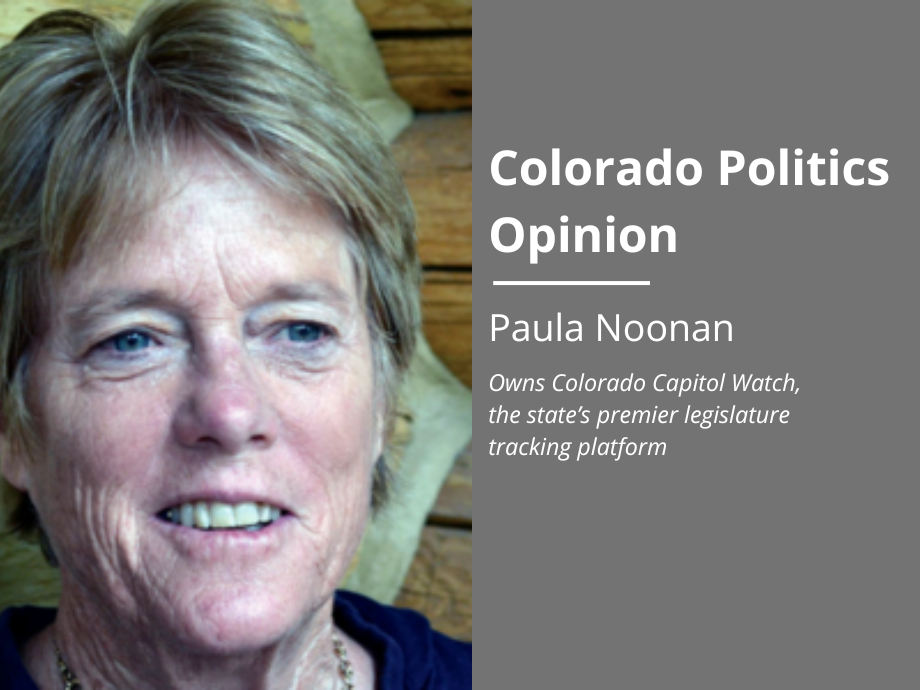
Paula Noonan

Paula Noonan
The 2024 General Assembly wasn’t as amiable as some have suggested. Not only is Gov. Jared Polis vetoing a number of important bills, separating him from some people-oriented policies of a majority of the legislature, but the two chambers diverged in how they voted on legislation. Overall, Senate Republicans provided a soft “no” on bills while House Republicans shouted their “NOs” for everyone to hear. As usual, Democrats mostly hung together.
The session didn’t have a record number of bills introduced, but it did break the high side of bill volume with 705 pieces of legislation. Of introduced bills, 525 passed both chambers and are now under Gov. Polis’s review.
Three recently-vetoed bills offer insight into the governor’s thinking. HB24-1008 on wage theft shines light on his pro-business accommodations. The HB24-1260 veto of a bill that protects workers who don’t want to listen to political or religious lectures from employers adds to his business bona fides. The veto of HB24-1010 on pharmaceutical coverage by insurance companies proves his pro-business bias plus his resistance to regulation of the health insurance industry. He’s only acted on just more than half of passed bills, so he has time to put his foot down on more legislation before the end of June.
Stay up to speed: Sign up for daily opinion in your inbox Monday-Friday
As pointed out by many sources, a majority of passed bills had bipartisan support, even if some of that bipartisanship was over the dead bodies of certain legislators. A majority of House Republicans were particularly dismissive.
Twelve House Republicans were “upside-down” on their yes-to-no votes on passed bills, with five GOPers voting NO more than 300 times. The fewest YES votes came from Rep. Stephanie Luck from the Canon City/Salida district. She only called out YES 112 times on final votes, with 354 NO votes and 55 final vote absences. Rep. Kenneth DeGraaf was just behind Luck at 113 YES votes and 331 NOs with 77 final vote absences. He’s from the north Colorado Springs area. Rep. Scott Bottoms, also from Colorado Springs, rounded out the top three NO voters, with 329 nays to 127 ayes and 65 final vote absences.
These three legislators were on the low end of bills sponsored and the high end of bills killed. Luck sponsored three bills. They bit the dust. DeGraaf didn’t pass his five sponsored bills, and Bottoms bottomed out on his four bills. Maybe they were discouraged, which accounts for their high-end number of absences on third reading or final bill votes.
Only five Republican House members voted YES on passed bills more often than NO. Rep. Rick Taggert from Grand Junction was the most supportive of passed legislation with 381 YES votes to 138 NOs. He sponsored 60 bills and passed 50. He missed only two final votes. Rep. Mary Bradfield was the House GOPer with the next-most YES votes at 290, with 222 NO votes. She only missed five final votes. She sponsored 15 bills with 14 passing. There appears to be a relationship in the House between how engaged legislators are with bipartisan work and their attendance.
Republicans in the Senate had a very different experience from their House colleagues. Ten Senators voted YES on more than half of passed bills, with only one member, Kevin Van Winkle, voting NO more than half of the time. His record shows 208 YES votes to 267 NO votes with 68 absences on final votes. He sponsored 18 bills and 12 passed. Republican Sens. Barbara Kirkmeyer from Weld County and Perry Will from southern Colorado were the most supportive of passed bills. Kirkmeyer voted YES on 375 final votes, with 150 NO votes and eight absences. Will voted YES on 365 bills, with 163 NO votes and five absences.
The Senate was lax in final vote attendance. Three senators missed more than 100 final votes: Janet Buckner at 162, Jesse Danielson at 102 and Rhonda Fields at 101. Nine more senators missed more than 50 final votes. Only 12 senators missed 10 or fewer final votes. Sen. James Coleman receives a perfect record star for not missing any final votes. Reps. Judy Amibile, Shannon Bird, Cathy Kipp, Karen McCormick, Emily Sirota, Brianna Titone, Elizabeth Velasco and Don Wilson receive perfect record stars for their perfect final vote attendance in the House.
As in previous years, Democrats in both chambers were more united in their final votes on bills. Rep. Elisabeth Epps from central Denver had the most NO votes among Democrats at 58. She sponsored some high-profile bills that were ultimately defeated, including an open meetings bill and the automatic weapons prohibition legislation. Rep. Shannon Bird from Westminster was an outlier with 43 NO votes on passed bills. Her district is tight in registration between Republicans and Democrats. As a member of the Joint Budget Committee, she sponsored 104 bills. All but eight passed.
It is true a substantial majority of bills that passed this session were bipartisan, but as these records show, many Republicans didn’t play that role. Those who kept to their partisanship didn’t achieve results in terms of completed legislation.
Ultimately, the governor may do most of the work for moderate Republicans, especially in preserving business priorities. He has about 200 more bills to sign or veto. That’s plenty of opportunity to show who’s boss of this state.
Paula Noonan owns Colorado Capitol Watch, the state’s premier legislature tracking platform.


Clock is ticking on Colorado’s new AI rules | PODIUM
Colorado Politics
colorado-politics@coloradopolitics.com
Updated 17 hours ago
By Aashis Luitel On Jan. 1, organizations using covered automated systems must begin complying with Senate Bill 26-189, Colorado’s new Automated Decision-Making Technology Act. They can identify those systems and start building the processes the statute clearly requires. What they...

Meghan Shay on recovery, responsibility and second chances | The OpEdge Podcast
Tony Olivero
tony.olivero@gazette.com
Updated 1 day ago
Step Denver and Step Springs CEO Meghan Shay joins The OpEdge to explore addiction recovery, homelessness, and the role of accountability in lasting change. Shay tells host and investigative columnist Jimmy Sengenberger why she believes recovery is built on personal...

The outrages mount | Hal Bidlack
Hal Bidlack
hal-bidlack@coloradopolitics.com
Updated 1 day ago
My kindly and forgiving editors understand that, from time to time, I can’t help myself from leaping atop my rickety soapbox to vent. And, like many other political commentators have already done, I could easily fill this entire missive with...

Rural Colorado deserves a tax holiday | GUEST COLUMN
Eric Mulder
jstooksberry@gmail.com
Updated 2 days ago
Spend enough time in Colorado’s Eastern Plains, the San Luis Valley, or the Western Slope, and you’ll see boarded-up storefronts, schools consolidating classrooms, and small rural communities stretching every dollar to keep basic services afloat. Once the backbone of Colorado’s...

Weiser’s leadership crucial for rural win-win | Rachel Gabel
Rachel Gabel
rachel-gabel@coloradopolitics.com
Updated 5 days ago
Attorney General Phil Weiser is going to win the gubernatorial election. That said, Colorado agriculture and rural communities have a 30-year track record of finding the win-win be it for species or industries or habitat. Former Governor Roy Romer possessed...

A Colorado history lesson for Victor Marx | Dick Wadhams
Dick Wadhams
dick-wadhams@coloradopolitics.com
Updated 5 days ago
Victor Marx, who narrowly won the Republican nomination for governor by one half 1% after boasting of a massive 44-point lead, is just as misguided on Colorado political history. During the primary, Marx made a clumsy attempt to denigrate his...
‘Be prepared to march in the streets’ | Miller Hudson
Miller Hudson
miller-hudson@coloradopolitics.com
Updated 5 days ago
It was early in 1974 when I first met Tim Wirth as he announced his candidacy for Congress, challenging Republican incumbent Don Brotzman. Although I had only resided in Colorado two years, I was drafted to serve as a Democratic...

‘CoCo’ would take taxpayers for a ride | Jon Caldara
Jon Caldara
jon-caldara@coloradopolitics.com
Updated 2 days ago
Colorado wants taxpayers to spend another $4.73 billion on passenger rail. Don’t worry. They have a plan. Which is a little like your brother-in-law announcing he’s launching another exciting restaurant venture after his last three restaurants ended in bankruptcy. Please....

The through line from Donald Trump to Victor Marx | SONDERMANN
By Eric Sondermann
by-eric-sondermann@coloradopolitics.com
Updated 1 week ago
Over 10 years ago, before Donald Trump could ever defeat Hillary Rodham Clinton, he had to first engineer a hostile takeover of the Republican Party. Prior to his descent of that golden escalator, the previous seven Republican presidential nominees had...
Primary voters rejected big money in politics | Paula Noonan
Paula Noonan
paula-noonan@coloradopolitics.com
Updated 5 days ago
While we’re in an election campaign lull between now and Labor Day, we have time to consider the impact of $102 million in campaign contributions in the primary. In the general election, more money will fill candidate campaign coffers, and...