

Colorado lawmakers give green light to bill prohibiting adult use of cellphones while driving
A Senate committee Monday gave approval to a measure that will require adults to use hands-free cellphone devices or face harsher penalties for talking on a cellphone while driving.
Senate Bill 65 is the latest incarnation of efforts by lawmakers who have been trying for at least 15 years to require adult drivers to keep their eyes on the road, instead of on their cellphones.
Current state law already imposes restrictions around cellphones on drivers under 18. But it’s been a much bigger hurdle to impose those same restrictions on adult drivers.
The laws affecting adults permit regular cell phone use for voice calls, although they are prohibited from sending text messages or browsing the internet while behind the wheel.
That isn’t enough, supporters insisted Monday.
People are still using cellphones while driving and that means distracted driving that causes death or serious injuries, they said.
Senate Bill 65, which Sens. Chris Hansen, D-Denver and Rhonda Fields, D-Aurora sponsored, won unanimous approval from the Senate Transportation and Energy Committee on Monday. The measure would require drivers 18 years and older to refrain from using cellphones while driving. The only exception, which applies to the general public, is when a vehicle is parked or the driver is using a hands-free device that operates the cellphone.
Specifically, the bill would prohibit physically holding or supporting a phone with any part of the body, watching a video or movie, or texting, with exceptions for using voice-to-text apps to send a message or for navigation purposes.
Violators would face a fine of $75 for a first offense to $250 for a third offense within a year. The bill says that a violation would be dismissed if a person has not previously committed a violation and produces proof of purchasing a hands-free accessory.
The bill comes 15 years after lawmakers tried in 2009 to pass a law that would mandate all drivers to stop using cellphones while operating a motor vehicle. But that 2009 bill, which was signed into law, was watered down to apply only to those under 18, with the limited restrictions for adult drivers.
According to the fiscal analysis of SB 65, between 2021 and 2023, 49 teens were sentenced for driving while using a cellphone, including one youth with a second offense. The majority, about 71%, were male, and 81% were White.
In the same time period, 50 adults were sentenced for texting while driving. About 60% were male and 88% were White.
The statistics hewed closely to the state’s racial demographics — 86% of the state is White.
The hearing drew families whose loved ones died because of a distracted adult driver, as well as survivors of accidents due to drivers using cellphones.
It also brought to the Capitol former state Sen. Lois Court, D-Denver, who worked for years to pass legislation that imposed more restrictions on cellphone use while driving. Hansen took up the cause when he succeeded Court in 2020 and has carried similar bills in the last few years.
All those who testified supported the measure, while the Colorado Criminal Defense Bar opposed it, although no one from that organization testified against it on Monday.
Backers included the Colorado Department of Transportation, various law enforcement groups, advocates for the disabled and bicycle organizations.
CDOT’s Glen Davis said states that have imposed more restrictions on adult use of cellphones in a motor vehicle have seen reductions in the number of rear-end crashes. He also noted a survey of Colorado drivers, where about half admitted they used their cellphones while driving.
Col. Matthew Packard, who heads the state patrol, offered the committee members this scenario: Imagine seeing a driver whose behavior just doesn’t look right. In the past, that might have been a drunk driver. Nowadays, that driver might reveal their head is down, looking at a cellphone.
The driving behavior for distracted drivers is similar to drunk driving, Packard said. The state patrol wants the ability to take “preemptive” action when they see someone weaving or driving in a manner that indicates that kind of distracted driving, Packard explained.
“We don’t have to wait for the bad driving to accompany the bad act of holding the device in their hand, that we can take the appropriate enforcement action, because quite frankly, lives are dependent upon our ability to do that,” he told the committee.
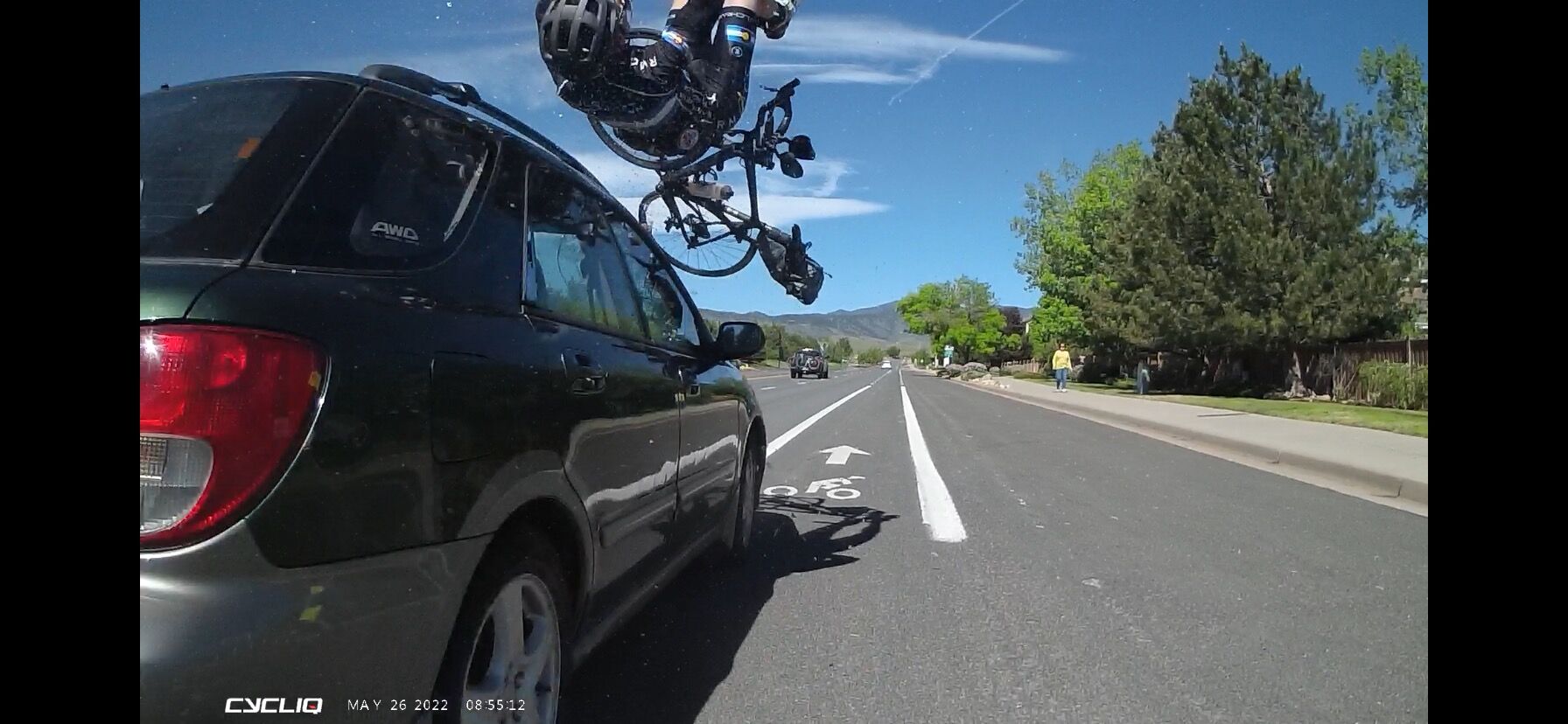
Jon Sendor showed a video of the day in 2022 when he was hit by a driver who was texting while driving. He was in the bike lane on 64th Street in Arvada when the driver drifted into the bike lane. Her vehicle hit him with such force that he catapulted over the car, tossing him “like a rag doll,” he said.
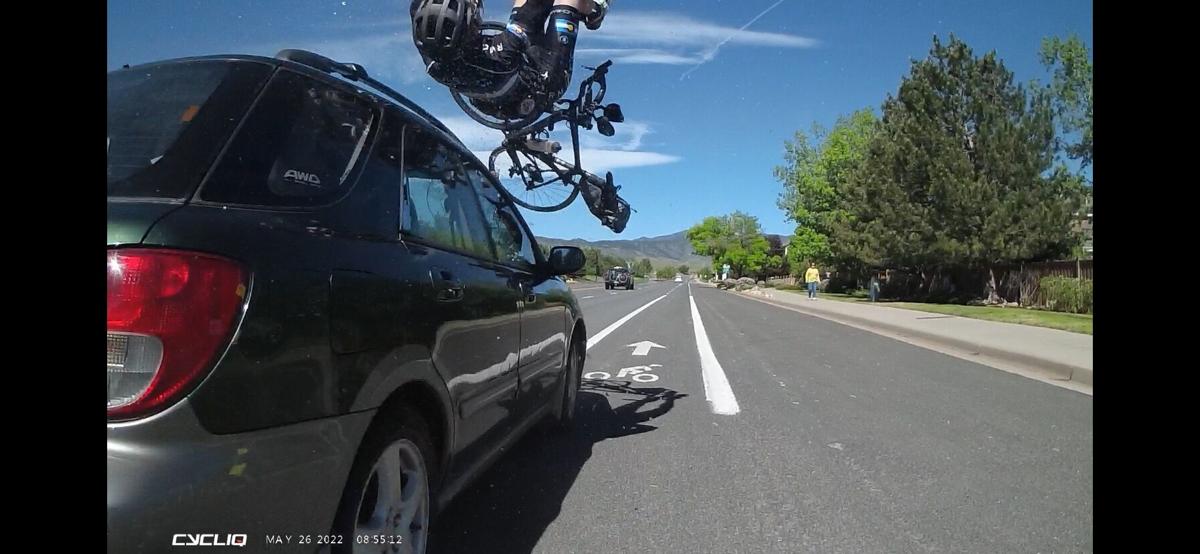
Jon Sendor, at the moment of impact when he was hit by a driver who was using her cellphone while driving. (PHOTO: Screenshot courtesy of Jon Sendor).

“There’s a part of me that feels like I died that day,” said Sendor, an avid cyclist. “Getting hit by a distracted driver left me with an extensive list of physical and mental injuries that will be with me for the rest of my life.”
His injuries included eight fractures, concussion, loss of consciousness, extensive road rash from head to toe and eight days in the hospital, he said, adding he lost an inch and a half of height due to spinal compression fractures. He also suffers from PTSD, he added.
Sendor holds a commercial driver’s license and drives semi-trucks for a living. He noted he is not allowed to use cellphones, a federal law passed in 2013.
“Distracted driving due to drivers holding their phones is a threat to everyone regardless of race, color, age, gender, it doesn’t matter,” he said, pleading for lawmakers to approve the bill.
Jerry White of Bike Colorado Springs cited information from the Centers for Disease Control and Prevention, which said that “at 55 miles an hour, sending or receiving a text is like driving the length of a football field with your eyes closed.”
“The use of these devices is clearly a serious hazard to all of us, our families, our children, our neighbors, our coworkers,” White said.
Driving is not a multitasking activity, according to Susan Dane of Coloradoans Organized for Responsible Driving. Dane told the committee she was testifying on behalf of Brian and Jackie Lenner, “who could not be here to represent themselves in person as they were killed on their motorcycle” in February 2016.
They died in a head-on collision with a woman who was reading a text message on her phone while driving on Parker Road.
“This was not an accident, it was an intentional behavior that caused the crash and their deaths,” Dane said. The couple left behind three sons and a brand new grandchild.
Distracted driving has a wide-reaching impact that affects victims, families, friends, and coworkers, she said, adding, “It seems like you have to have a personal experience with the damage distracted driving causes to get passionate about it.”
“No parent should have to suffer the loss of a child or best friend or husband due to something a hundred percent preventable like this,” said Shelley Forney, who has been a part of the 15-year effort to pass cellphone legislation since her daughter, Erica, was hit on her bicycle by someone using a cellphone while driving. Erica was 15 pedals from home when she was hit, and died two days later, on Thanksgiving Day in 2008, Forney said.
“I won’t beat around the bush,” Court told the committee. “This law has to pass. I have heard these stories too many times during the years that I carried this bill … These are laws that need to be on the books.”
The bill carries a state cost of around $6,600, so it now heads to the Senate Appropriations Committee.

Sparks fly in debate between Democrats in Colorado’s 8th CD primary
Ernest Luning
ernest.luning@coloradopolitics.com
Updated 3 hours ago
The two Democrats running for the chance to take on the Republican incumbent in Colorado’s most competitive congressional district traded blows during a feisty televised debate Monday night, sparring over their approaches to reining in the Trump administration’s immigration policies...
Jena Griswold hits airwaves with 1st major ad buy in Colorado’s Democratic attorney general primary
Ernest Luning
ernest.luning@coloradopolitics.com
Updated 6 hours ago
Democratic attorney general candidate Jena Griswold plays the greatest hits from her two terms as Colorado secretary of state in her campaign’s first TV ad, which began airing Monday, the same day county clerks began sending out primary ballots. Set...
Judge approves injunction for Colorado Springs counselor after SCOTUS rules in conversion therapy case
Michael Karlik
michael.karlik@coloradopolitics.com
Updated 7 hours ago
A federal judge last week blocked Colorado from enforcing its restriction on conversion therapy for LGBTQ children against a Colorado Springs counselor, after both sides agreed that the state will not pursue professional disciplinary action while the case proceeds. The...
Cigna to pull out of individual health market, affecting thousands in Colorado
Marianne Goodland
marianne.goodland@coloradopolitics.com
Updated 2 hours ago
Another firm is withdrawing from the individual health insurance market, including for Colorado, effective Jan. 1, 2027. The move by Cigna Healthcare is part of the company’s overall plan to withdraw entirely from the Affordable Care Act market. It will...
Primary ballots hit mailboxes in high-stakes election year in Colorado
Thelma Grimes
thelma.grimes@coloradopolitics.com
Updated 5 hours ago
County clerks began mailing primary ballots to voters on Monday, as Colorado wades deeper into a crowded election year. Voters will face a long list of choices in both the June 30 primary and the November general election. Every major...
Colorado Supreme Court to decide whether out-of-state defendant may be prosecuted for in-state crime
Michael Karlik
michael.karlik@coloradopolitics.com
Updated 3 hours ago
The Colorado Supreme Court recently announced that it will decide whether Douglas County prosecutors had grounds to pursue criminal charges against a woman in New York whose conduct occurred outside of Colorado. Erin Brennan and her children lived in New...
Colorado justices, 4-2, say defendant cannot be retried after judge rejected jury’s partial acquittal
Michael Karlik
michael.karlik@coloradopolitics.com
Updated 3 hours ago
If a jury clearly indicates that it has acquitted a defendant of certain charges while remaining deadlocked on others, judges must accept that partial acquittal verdict, a divided Colorado Supreme Court ruled on Monday. Justice William W. Hood III, in...

America 250 poll finds hope in American dream has dramatically declined in recent years
Emily Hallas, Washington Examiner
emily.hallas.washington.examiner@gazetteedit.wpenginepowered.com
Updated 9 hours ago
A poll released Monday found that confidence in the American dream continues to slip, as the United States marks its semiquincentennial. The AP-NORC America 250 survey indicated 34% believe in the American dream, reinforcing a Wall Street Journal-NORC poll released...
Government spy powers to lapse Friday unless Congress can strike deal
Hailey Bullis, Washington Examiner
hailey.bullis.washington.examiner@gazetteedit.wpenginepowered.com
Updated 4 hours ago
A key federal spy tool is at risk of sunsetting on Friday unless Congress passes an extension of the authority that allows the government to surveil foreign persons without a warrant. A Senate deal to extend Section 702 of the...
Colorado governor nixes bills on swipe fees, suing feds and firefighter benefits
Marissa Ventrelli
marissa.ventrelli@coloradopolitics.com
Updated 1 day ago
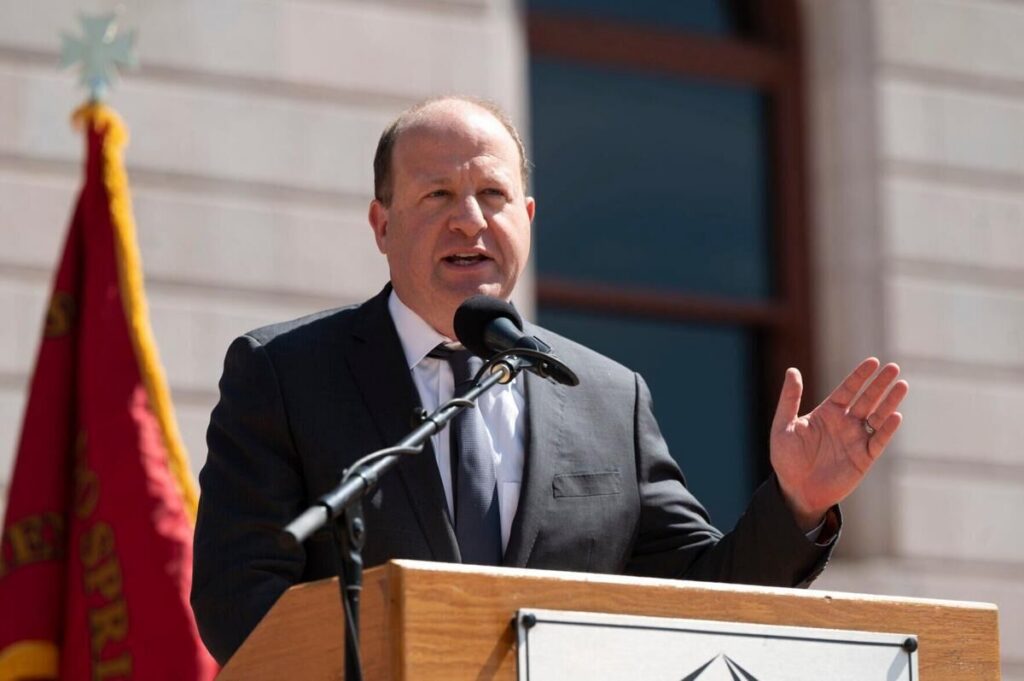
Gov. Jared Polis vetoed three bills Wednesday, rejecting measures on credit‑card swipe fees, immigration enforcement lawsuits, and firefighter cancer coverage. In doing so, the governor set a new personal record for vetoes in a single session, having now rejected 12...
PREV
PREVIOUS

Are you in the right occupational field in Colorado? Tool offers insights into future workforce gaps
A new report suggests a “misalignment” between higher education graduates and what the job market would need in just a few years. Notably, Colorado’s schools are producing graduates in some fields at rates that are “far greater” than the job market’s projected need by 2031, according to a new report from the Common Sense Institute. […]

Democratic-controlled panel OKs stricter class requirements for concealed weapons permits
A panel of House lawmakers on Tuesday approved, on an 8-3 party-line vote, a Democrat-sponsored bill that would require stricter requirements for those who hold or want to obtain concealed weapons permits. The measure from House Majority Leader Monica Duran of Wheat Ridge and Rep. Marc Snyder of Manitou Springs requires the Colorado Bureau of […]