

Colorado justices agree Jeffco not immune from parking garage slip-and-fall suit

The Colorado Supreme Court agreed on Monday that a parking garage owned by Jefferson County qualified as a “public building” and a resurfacing project that created a hazard amounted to “maintenance,” which, in combination, meant the county is not immune from liability for a woman’s slip-and-fall.
The case implicated the Colorado Governmental Immunity Act, which generally insulates public entities from liability. Its purpose was to prevent disruptions to government services and to protect tax dollars from being frequently diverted to pay injured parties.
There is an exception to the immunity, however, for the “dangerous condition of any public building,” meaning a defect caused while “constructing or maintaining” the facility.
Multiple government entities warned the Supreme Court about the financial burdens it would create by allowing Beverly Stickle to sue Jeffco over her injury in its parking garage. But the Supreme Court waved aside those concerns to find Jeffco’s faulty improvements to its garage fit the definition of dangerous condition in a public building.
The garage “falls under the ordinary definition of a ‘building,'” wrote Justice Melissa Hart in the Feb. 5 opinion.

Stickle originally sued Jefferson County for injuries she sustained on the upper level of a parking garage at the Jeffco Administration & Courts complex in February 2018. At the top landing was a dark gray walkway, with a step-down to the car lot — recently repainted the same color of gray. The change in elevation was marked by yellow paint, which was most evident when looking from the lot toward the landing.
From the walkway, however, the identical grays created an illusion, masking the step-down. Stickle fell and suffered a compound fracture in her right arm.

A view from the north parking structure's walkway, in foreground, toward the parking area. The yellow line is the dividing point, featuring a step-down. Picture from the district court order in Stickle v. County of Jefferson

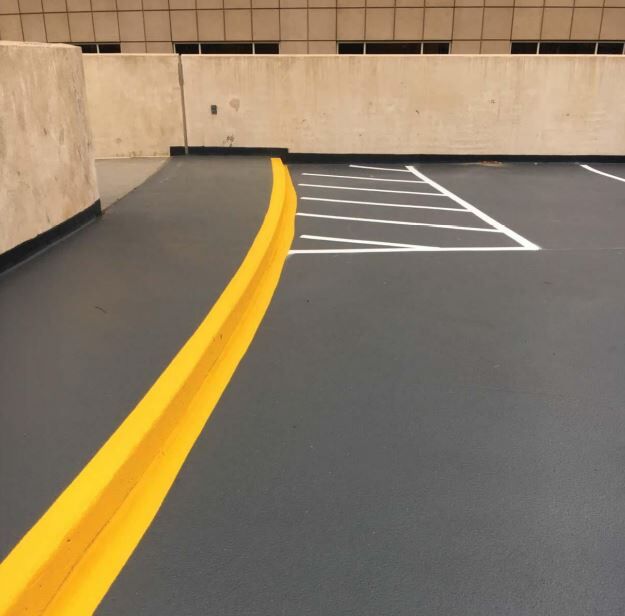
The walkway, at left, on the north parking structure, with a step-down to the parking lot. Picture from the district court order in Stickle v. County of Jefferson

In response to Stickle’s lawsuit, Jeffco invoked the Colorado Governmental Immunity Act. The county argued its parking garage was not a “building” and the resurfacing of the parking lot that created the illusion was not “maintenance.”
The state’s Court of Appeals disagreed.
“The undisputed facts establish that this topping material was added as part of the Maintenance Plan for the parking structure,” wrote Judge Anthony J. Navarro in 2022.
On appeal to the Supreme Court, the county insisted its parking garage was not a building but simply a “structure.”
“How would you define ‘building?'” asked Justice William W. Hood III.
Assistant Deputy County Attorney Rebecca P. Klymkowsky argued a building has the “capacity to contain,” providing shelter for people, animals or property. The county headquarters adjacent to the garage was the building, she explained, but not the freestanding garage.
“Leave it to lawyers and judges to struggle with the meaning of ‘building,'” Justice Carlos A. Samour Jr. quipped.
Professional associations representing Colorado’s municipalities, counties and special districts jointly wrote to the Supreme Court warning about the “new and unmanageable fiscal burden” that would result if parking garages suddenly could circumvent governmental immunity. They argued governments would also have a disincentive to upgrade their facilities through “maintenance” projects.
“For example, Denver International Airport is presently remodeling its terminal. Under the Court of Appeals’ approach, the redesign aspect of the terminal may no longer be protected under the CGIA exposing DIA to potential significant liability,” the governmental associations wrote.
The State Office of Risk Management also argued against equating “improvements that could make the facility last longer” with “maintenance.”
The Supreme Court declined to address the potential effects of its decision, noting Jeffco itself included the parking lot resurfacing as part of its major maintenance plan, intended to prevent degradation of the concrete. Hart noted that projects with even a partial connection to maintenance fall within the exception to governmental immunity.
“Even accepting the County’s position that the resurfacing with the same materials was a design decision, the decision was part of a broader maintenance process,” she wrote.
Lawyers for the various governmental entities did not respond to an email seeking comment about the decision’s impact. The state’s risk management office said it is reviewing the ruling.
The Supreme Court heard oral arguments last fall at Gateway High School in Aurora through its “Courts in the Community” program. In response to student questions, Klymkowsky disclosed the county had since fixed the step-down illusion where Stickle fell.
“Even if we don’t have a legal duty, we don’t want people to get hurt,” she said.
The case is County of Jefferson v. Stickle.


Judicial performance evaluations released, Montezuma County judge disciplined | COURT CRAWL
Michael Karlik
michael.karlik@coloradopolitics.com
Updated 12 hours ago
Welcome to Court Crawl, Colorado Politics’ roundup of news from the third branch of government. Colorado’s citizen-led judicial performance commissions released their voter narratives for the judges standing for retention in November, plus a disciplinary panel imposed consequences on a...
Federal judge holds off on dismissing formerly bankrupt medical contractor from Jeffco jail death lawsuit
Michael Karlik
michael.karlik@coloradopolitics.com
Updated 14 hours ago
A federal judge declined on Monday to dismiss the formerly bankrupt medical contractor from a lawsuit over a detainee’s death in Jefferson County jail, but indicated she would do so if the plaintiffs’ attorneys go through the process to ensure...
Federal judge green-lights excessive force, retaliation claims for trial against Fort Collins officers
Michael Karlik
michael.karlik@coloradopolitics.com
Updated 2 days ago
A federal judge green-lit a jury trial last week against multiple Fort Collins police officers on claims that they used excessive force on one man who was standing unarmed in his underwear, and retaliated against another man for exercising his...

10th Circuit revives wage violation lawsuit against Papa John’s operator
Michael Karlik
michael.karlik@coloradopolitics.com
Updated 3 days ago
The Denver-based federal appeals court on Tuesday reinstated a former Papa John’s delivery driver’s lawsuit alleging violations of federal and state wage law. Steve Mighell worked for one month at a Denver Papa John’s location in summer 2023. He alleged...
Colorado appeals judge’s delays in releasing opinions noted by performance commission
Michael Karlik
michael.karlik@coloradopolitics.com
Updated 2 days ago
The citizen-led performance commission that provides guidance to voters about whether to retain members of Colorado’s second-highest court raised concerns by judges and attorneys that Judge Elizabeth L. Harris sometimes struggles with releasing opinions promptly. Harris, who joined the Court...
Colorado judge explores sanctions against DOJ, ICE for rearresting man 4 days after release on bond
Michael Karlik
michael.karlik@coloradopolitics.com
Updated 4 days ago
A federal judge in Colorado is considering sanctions against the government after immigration agents rearrested a man four days after an immigration judge found him suitable for release on bond. On July 28, U.S. Magistrate Judge N. Reid Neureiter ordered...
Divided disciplinary panel censures Montezuma County judge after agreement reached
Michael Karlik
michael.karlik@coloradopolitics.com
Updated 3 days ago
A disciplinary panel formally imposed a public censure, suspension, and further training on Montezuma County Court Judge Ian J. MacLaren on Tuesday by a 2-1 vote. Under constitutional Amendment H, which voters adopted in November 2024, MacLaren was set to...
Colorado’s Western Slope magistrate judges describe unique role in federal judiciary
Michael Karlik
michael.karlik@coloradopolitics.com
Updated 5 days ago
Two of Colorado’s federal judges stationed on the Western Slope spoke to lawyers on Wednesday about their unique roles, the ways their workloads differ, and the need for more criminal defense lawyers to take cases outside the Front Range. “Here...
Denver sues Philip Morris, other tobacco companies over cigarette butt litter
Deborah Grigsby
deborah.smith@denvergazette.com
Updated 4 days ago
Denver is demanding that some of the biggest tobacco companies in the world pay for the cleanup of discarded cigarette butts on its streets, following a similar campaign that cities in other states have pursued. Denver’s lawsuit, filed this week...
Federal judge rules that request for bond hearing not necessary to challenge immigration detention
Michael Karlik
michael.karlik@coloradopolitics.com
Updated 3 days ago
A federal judge in Colorado ruled last week that it is not mandatory for a person to seek a bond hearing with an immigration judge before they challenge the lawfulness of their detention in federal court. For the past year,...
PREV
PREVIOUS

Colorado Supreme Court to review limits on negligence claims in case over Denver restaurant fire
The Colorado Supreme Court announced on Monday that it will review whether a judicially created rule barring certain types of negligence claims applies when a defendant acts recklessly to cause an injury. At least three of the court’s seven members must agree to take up an appeal. The justices also signaled they may intervene in […]

Colorado Supreme Court upholds Boulder bike thief's restitution to victim
The Colorado Supreme Court on Monday upheld the $2,394 in restitution a Boulder thief owed for damaging his victim’s car as he fled, rejecting the argument that the victim’s actions actually caused the damage. In the process, the justices also clarified defendants have to clear a high threshold when challenging a trial judge’s finding that […]