

A call for more thinking, rethinking and thinking anew | SONDERMANN

It was a dinner out about 18 months ago with our friends, Heather Lamm and Alex Ooms, along with Heather’s mom, Colorado’s former first lady. After settling in and ordering drinks, Alex, out of nowhere, posed perhaps the best question I had heard in a long while.
He asked, simply and directly, as to what issues the rest of us had rethought and changed our minds upon over the years.
What an inspired conversation starter. In this age of intensely-held views and give-no-quarter surety, it was an invitation to talk about those issues on which we had been wrong or where our thinking now was markedly different from our thinking back then.
Our disabled political system discourages such reflection and reevaluation in favor of an unrelenting cocksureness. Passion, dogmatism and predictable, unwavering loyalty garner cable appearances and Twitter followings in the millions. The audience for nuance and reexamination is infinitely smaller.
Moreover, a politician who acknowledges a change of mind invites an unending cacophony of attacks, labeling him a flip-flopper.
“Henry Hines can’t be trusted. As a graduate student 32 years ago, Hines wrote a paper on America’s need for stricter immigration controls to offset population growth. But last year he donated $200 to a refugee resettlement agency. How can voters trust a word Hines says?”
And on and on in the simplistic trivialization of what passes for political discourse. Might our hypothetical Mr. Hines have rethought his core values over the course of three decades? Might demographic patterns have changed and birth rates declined? Might an aging population now require an expanded workforce? Might global conditions have altered the nature of America’s obligations?
Any of those considerations would explain a change of heart over many years. But our political system is ever poised to disdain personal growth and evolving views in favor of the siren call of consistency.
Having attended one of those round-numbered high school reunions this past summer, I flashed upon those words we would often scribble in a friend’s yearbook, “Don’t ever change.”
What a disservice, even a curse, to lay on a fellow 17 or 18-year-old for whom change is about the only thing guaranteed.
So,it goes in our politics, where mindless consistency is far over-valued, even in the face of new information and changing facts on the ground, while reappraisal is under-appreciated and dis-incentivized at virtually every turn.
Back to that dinner and the superb question that paved the way for a lively and thoughtful conversation.
At the time, I answered by citing my shifting thoughts on the death penalty. Albeit with reluctance, I had long supported the practice as society’s only adequate response to some particularly heinous crimes.
Though over the last handful of years, I had come down on the other side of the issue based on both moral convictions and practical considerations. I now think that government should not be in the business of death, save for warfare. Moreover, the multiple decades of appeals are the antithesis of swift justice. And too many cases have surfaced of innocent people being condemned to death row.
The second issue I referenced was that of climate change, where I had been slow instead of outrightly wrong. For too long, I had regarded it as less than a crisis and fell back on the argument that American policy was dwarfed by the intense growth and industrialization in India, China and developing nations of all kinds.
The economic concerns remain, but any doubt long ago lapsed as to mankind’s role in climate change and the urgency of the predicament. I acknowledged being late to the dance.
Given these intervening months to reflect further on Alex’s query, I could add plenty of other topics on which my thinking today is notably removed from my views in years well past.
I was wrong about the second Iraq war and had put too much stock in the spread of democracy as the cure-all reform for much of what ails the Arab world. (Even as we recently had a Belgian Uber driver named Saddam Hussein. For real.)
Conversely, though I came of political age in the years of the Vietnam anti-war movement, I have long gauged that the Democratic Party took the wrong lessons from that war in terms of the need for American strength as a stabilizing force. Of late, it is the dominant element of the Republican Party that has succumbed to the false appeal of isolationism.
Decades back, proposals under the heading of “campaign finance reform” met with my approval as I bought into the notion that we could regulate our way to a less money-driven process. Experience, that great teacher, taught me such a pursuit is illusory and only fuels our current glut of unaccountable, non-transparent political spending.
In years well gone, I had invariably given police officers the benefit of the doubt in almost any case of alleged abuse. Today, that presumption is no longer automatic.
I grew up believing in growth caps and other similar limits on development. With maturity, I better understand such market interventions can be exclusionary and add much to the high cost of housing. Beyond that, my notion of ugly sprawl can be another person’s idea of a dream home.
And on it goes. In these quarters, to be alive is to think and rethink and think anew.
For political leaders and aspiring sorts, the test should not be that of hidebound, unshakeable, lifelong firmness. Rather, it should be about authenticity.
When such types have a change of heart or of mind, wise voters should assess whether that is a product of new information, changing conditions and intellectual honesty or whether it is simply an act of political expediency.
If a new opinion or belief seems driven by political calculation, the response should be one of suspicion abd dismissal. But when that fresh take is genuine and free of blatant political motive, it is due respect instead of derision.
“A foolish consistency is the hobgoblin of little minds,” offered the renowned thinker and poet, Ralph Waldo Emerson.
He added, “With consistency a great soul has simply nothing to do. He may as well concern himself with his shadow on the wall. Speak what you think now in hard words, and tomorrow speak what tomorrow thinks in hard words again, though it contradict everything you said today.”
Eric Sondermann is a Colorado-based independent political commentator. He writes regularly for Colorado Politics and the Gazette newspapers. Reach him at?EWS@EricSondermann.com; follow him at @EricSondermann

Ikon Pass company cuts jobs in Denver and beyond amid several changes
Bernadette Berdychowski
bernadette.berdychowski@denvergazette.com
Updated 6 days ago
As the ski resort company behind the Ikon Pass and the operator of Steamboat Springs, Arapahoe Basin and Winter Park Resort is going through a phase of changes, the Denver-based company is now cutting jobs. Alterra Mountain Co. has laid...

After a snowless winter, agents say summer is luring second-home buyers to the mountains
Mark Samuelson Special to The Denver Gazette
mark.samuelson@denvergazette.com
Updated 7 days ago
Last winter was a terrible growing season in Grand County for what arguably is its most important crop: snow. The county 60 miles west of Denver over the top of Berthoud Pass saw a record-low snowpack — poor enough that...

Signals mixed for Colorado economy halfway through 2026
Bernadette Berdychowski
bernadette.berdychowski@denvergazette.com
Updated 1 week ago
Colorado’s economy faced a mix of headwinds and tailwinds through the first half of the year. Inflation is up again, job growth is slowing and geopolitical turmoil has added the effects of high oil prices to the state’s economy. Yet,...

Denver aerospace company Voyager sees rapid growth in latest earnings
Bernadette Berdychowski
bernadette.berdychowski@denvergazette.com
Updated 2 weeks ago
A fast-growing aerospace and defense company based in Denver saw record revenues and record bookings in the latest quarter. Voyager Technologies announced it generated $52.7 million in the second quarter, according to its latest earnings report released Monday. Revenues are...

Colorado joins 2 lawsuits against Trump administration over TANF, tariffs authority
Marissa Ventrelli
marissa.ventrelli@coloradopolitics.com
Updated 2 weeks ago
Colorado has joined a coalition of states in filing two new lawsuits against the Trump administration. The first lawsuit alleges the Trump administration’s move to expand the U.S. health department’s oversight of the Temporary Assistance for Needy Families would illegally...
Federal biotech commission examines Colorado’s role in critical minerals production
Scott Weiser
scott.weiser@gazette.com
Updated 3 weeks ago
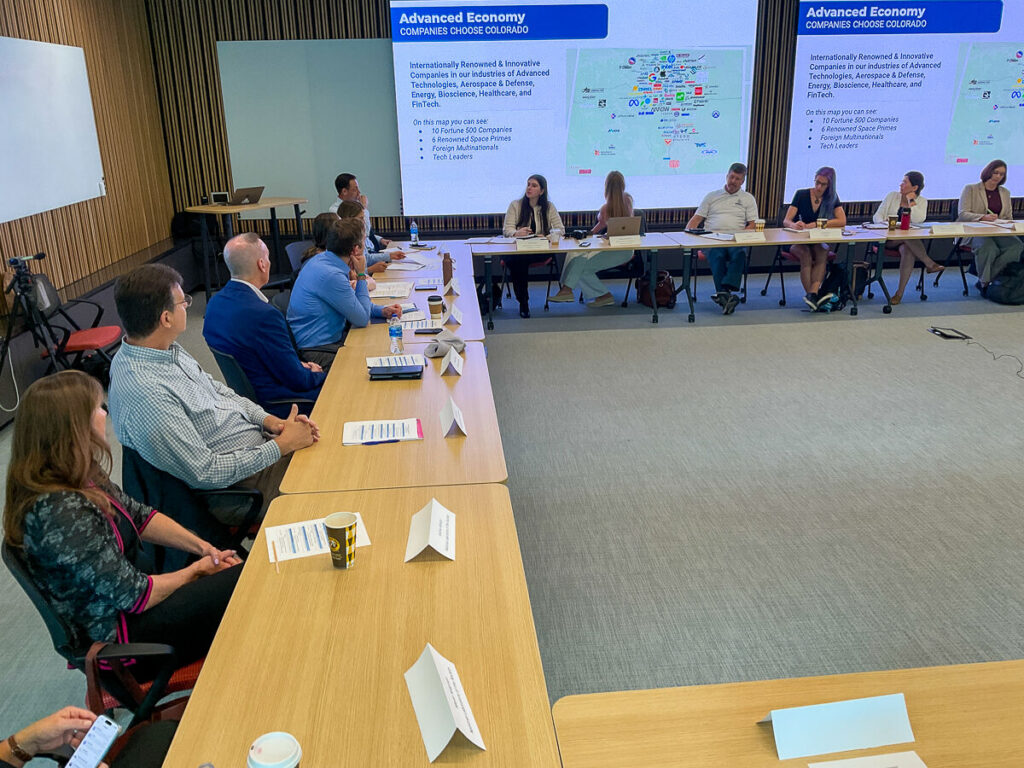
China’s dominance over critical mineral supplies has left U.S. manufacturers vulnerable. Colorado’s biotech and research community is working to ease that dependence. Leaders from the National Security Commission on Emerging Biotechnology met last week at the Colorado School of Mines...

Denver mayor promises universal childcare, housing expansion in city address
Deborah Grigsby
deborah.smith@denvergazette.com
Updated 4 weeks ago
Nearly a year after Denver cut city jobs to close a $250 million budget gap, Mayor Mike Johnston used his third State of the City address to promise universal childcare and 20,000 homes as part of a new redevelopment vision...

Colorado allows big polluters to buy credits as it mandates local engagement
Scott Weiser
scott.weiser@gazette.com
Updated 4 weeks ago
Colorado air quality regulators on Friday decided to require major industrial plants to hold in-person meetings with nearby communities and to cut certain pollutants on site. The same rules allow those plants to meet most of their greenhouse gas targets...

Record utility rate requests hit $9.2 billion nationwide in second quarter
Scott Weiser
scott.weiser@gazette.com
Updated 1 month ago
Colorado had no requests last quarter Electric and gas utilities sought a record $9.2 billion in rate increases nationwide during the second quarter, according to a new analysis by the consumer advocacy organization PowerLines, as utilities continue seeking billions for...

Colorado GDP trails direct competitor states, though slightly ahead of U.S. average
Mark Samuelson Special to The Denver Gazette
mark.samuelson@denvergazette.com
Updated 1 month ago
Colorado’s economy is marginally outperforming the national average but lags behind those of direct competitor states, such as Arizona, Texas and Utah, according to a report by a nonpartisan policy group. And while some indicators for the Centennial State appear...
PREV
PREVIOUS

Peña goes to jail, commits to visit more Denver employees | A LOOK BACK
Forty Years Ago This Week: Denver Mayor Federico Peña’s office announced that he would be the first mayor “in 20 years” to go to jail – at least, the first mayor in that time frame to venture into a jail, placing a visit to the Downtown Detention Center. Lou Schneider, Peña’s appointment scheduler, said that […]

Oklahoma Supreme Court keeps anti-abortion laws on hold while challenge is pending | OUT WEST ROUNDUP
OKLAHOMA High court keeps anti-abortion laws on hold while challenge is pending OKLAHOMA CITY – The Oklahoma Supreme Court reiterated its position on Nov. 14 in a 5-4 opinion that the state constitution guarantees a woman’s right to an abortion when necessary to preserve her life, although the procedure remains illegal in virtually all other […]