

Q&A with Jared Polis, Spencer Cox and Amy Persons | Can ‘disagreeing better’ rescue America’s political discourse?
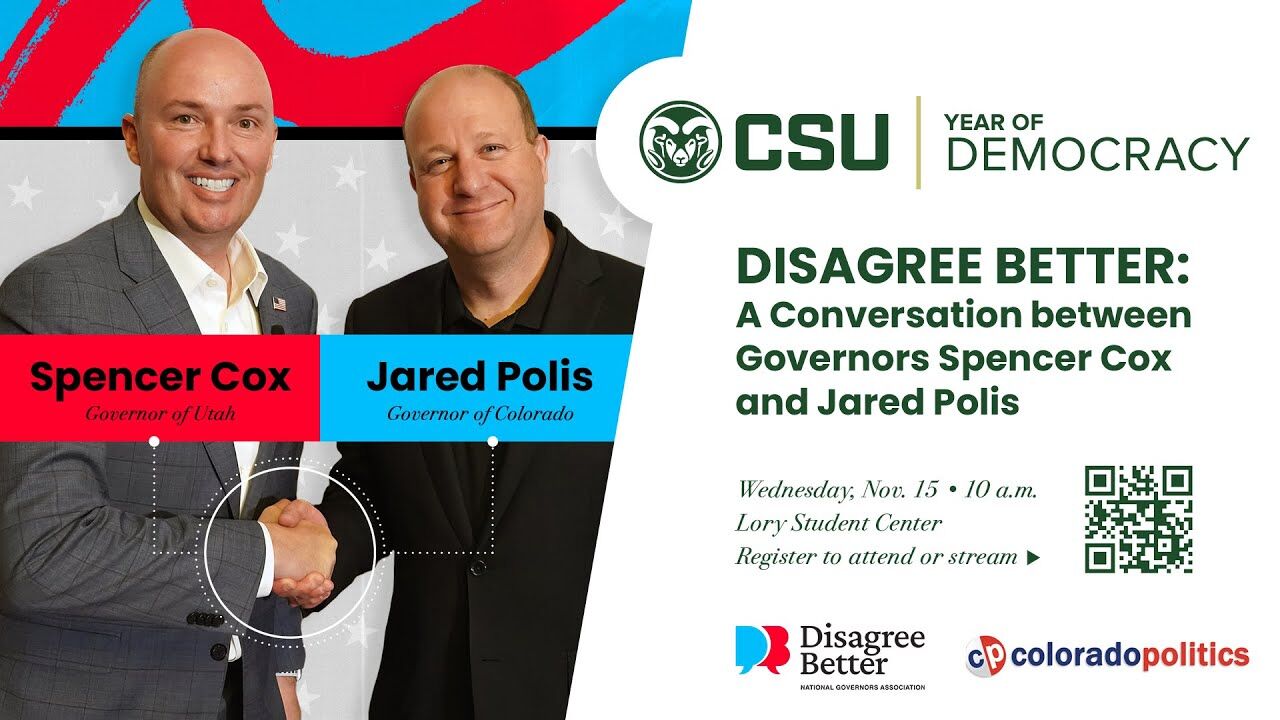
Gov. Jared Polis of Colorado and Gov. Spencer Cox of Utah have embarked on a project to rescue American politics from what they believe is a path that will lead, at its worst, to the destruction of democratic institutions.
Their pitch? Disagree better.
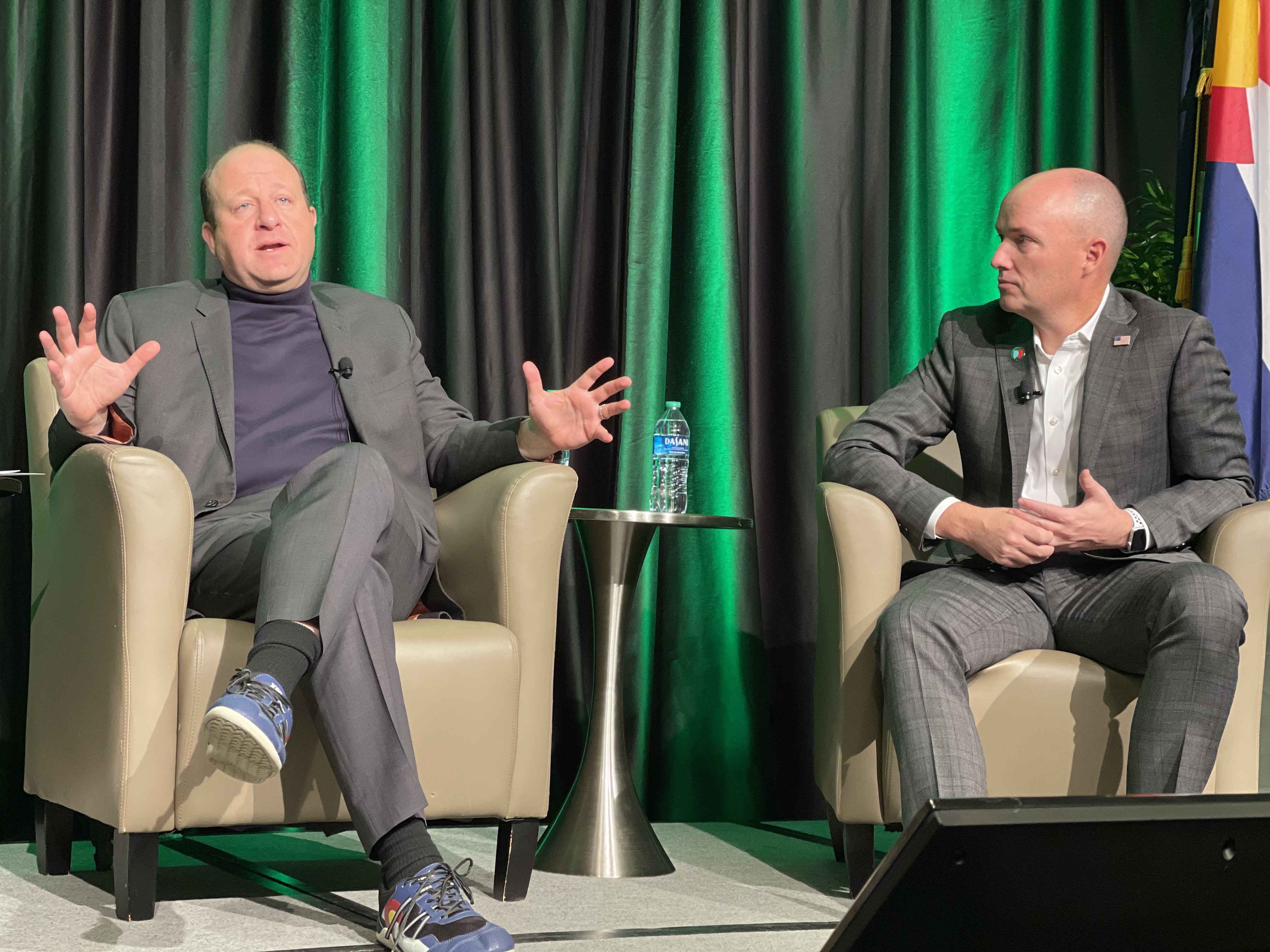
Colorado State University President Amy Parsons moderates a forum with Colorado Gov. Jared Polis (pictured) and Utah Gov. Spencer Cox on politics and civil discourse, part of the “Disagree Better” initiative of the National Governors Association, on Nov. 15 at CSU Fort Collins. Colorado Politics and Colorado State University sponsored the event.
Luige Del Puerto
luige.delpuerto@coloradopolitics.com LuigeDel PuertoEditor
luige.delpuerto@gazette.com
https://secure.gravatar.com/avatar/766fd31de2cd272e966b7901a72100e4?s=100&d=mm&r=g
The way the two governors put it, to “disagree better” doesn’t translate to being “nice” or giving up one’s principles. It means engagement in the political discourse with a sense of humility – that perhaps one does not hold all the answers and, therefore, listening to the other side is not only laudable but ultimately necessary.
Colorado State University President Amy Parsons joined the two governors in this interview following a forum the three of them hosted at CSU Fort Collins on Nov. 15.
Colorado Politics first asked Parsons about how to apply Polis’ and Cox’s axioms on political discourse to the Israel-Hamas debate that’s raging on many campuses across the country.
Colorado Politics: What did you learn from … the two governors about how to teach the students when it comes to this issue?
Parsons: When it comes to this issue or any controversial issue that comes up on a college campus from time to time, whether it’s a local issue or statewide or global issue, what I really heard from the governors’ talk today is that our primary responsibility is to foster an environment in which our students and our faculty and our community members are safe to learn about the issues and safe to express their own viewpoints and to engage in productive dialogue.
You have to remember that we have tens of thousands of young people who are arriving at our university. So, for a lot of them, it’s the first time they’re learning about these issues. It’s their first time voting. It’s their first time really paying attention to elections and to global events, sitting in classrooms of people who are very diverse and very different from them in terms of where they come from, their political backgrounds or cultural, religious backgrounds. It’s really a laboratory of democracy.
So, what I heard from the governors today is no matter what the controversial issues are of the day that are coming up, our responsibility is to foster that safe space for dialogue and understanding.
CP: What do you say to those who would argue that you’re the adult in the room – that you’re teaching these kids and among the things they have to learn (is) they have to discern what is moral or not. And you can define what is moral or not however you want to define it. But what do you think of the argument that there’s such a thing as objective morality and it’s the job of university leadership to take a moral stance on difficult subjects, like the one we’re talking about?
Parsons: Well, we have a very particular mission at a public university, at a land grant public university … and that really is access and that is embracing different views and that’s embracing the First Amendment and freedom of assembly and speech in our entire community.
So, that always has to come first. And, so, I hear what you’re saying, in that sometimes people look to university leaders to have their own voice or to say this is what the university believes. And sometimes it’s appropriate. But sometimes that can actually stifle speech on campus if we say, “Here’s what you should believe, here’s what’s the right thing to think.” Then, doesn’t that stifle speech on behalf of our students and our community and our faculty, who may then feel like they can’t express a different view? My job is to make sure that we have quality resources, we have access to speakers, to experts, to dialogue, like what you heard today, with the two governors, who are thoughtfully engaging in debate and dialogue around the issues.
CP: There’s such a thing as the (John) McCain model of politics and governance. He had his flaws, obviously, but he was also regarded as a statesman. The question is … how do you actually teach that? How do you teach statesmanship? How do you prepare (students) for leadership?
Parsons: I believe that we should be training our students on statesmanship, no matter what their discipline is here, no matter if they’re interested in going into politics, no matter what their profession is down the road. They can deploy that as leaders in their communities, in their families, in their organizations. And, so, it’s our responsibility to help them develop those skills while they are here as CSU students. I think you heard from the governors, too, that comes from the faculty, that comes from leadership, of being very deliberate in letting students know that their opinions are welcome.
CP: Very often what you see is that a department or a college will have an orthodoxy. It’s the dominant viewpoint or thought. What sometimes happens is that because it’s so dominant, it does stifle speech right away. It can be in economics, in politics, in psychological theory. Pick one. How do you make sure that doesn’t happen?
Parsons: I’m not sure I agree with the premise of the question.
CP: That’s fine.
Parsons: I believe that when we hire faculty, the faculty have academic freedom and can express themselves in the classroom. I think what I heard from Gov. Cox today was the idea that our faculty also, while they have the academic freedom to express their opinion, they do have the responsibility to tell students that they are free to express their opinions, as well, and that those are welcome. And hopefully CSU is a place that takes that very seriously, as do our faculty and our staff, and that our students are empowered to ask those questions, to challenge, and it makes them better.
Colorado Politics to Polis and Cox: You mentioned John McCain. How do you foster that kind of statesmanship?
Polis: I think you have to get at what the reward structures are for politicians. And, currently, too many of them see the easy way, where you become part of the problem and the fire-throwing. You get millions of Twitter followers. You raise tons of money. You demonize the other side. And when that’s the route that propels you to power, you generally are going to govern accordingly. Because that’s the easy thing for you to do. So, I think we have to find a way to tap into the vast majority of people. And we see, as I mentioned, with people leaving the Republican and Democratic parties, becoming unaffiliated, most fundamentally want to see their elected officials working together and finding solutions to improve their quality of life. But we have to really build that into the reward structure, which ultimately means people looking themselves in the mirror and saying, “Look, we want to be a part of healing this.” There will be politicians who lead, politicians who lag. But, ultimately, the elected officials will follow where the people of the country are.
Cox: I think Gov. Polis has hit the nail on the head with this one. It’s hard to look into institutions and how we can preserve those institutions, but ultimately, it really is about all of us. … I keep trying to tell politicians, “I wish everybody would do this just because it’s good for our country.” But I understand the political realities and so we have to make them understand that it’s also good politics.
CP: How do you do that?
Cox: We do that by trying it. If governors like Gov. Polis and Gov. Cox could get elected with messages like this, then others will start to follow. The political industrial complex is full of cowards and people who will just copy whatever works. If tearing the other side down gets you elected, then people will do that. But if we can show a different way – that, actually, (it works) treating people with respect, even if we disagree, the kind of John McCain model that you mentioned, you will see more and more people try and do that. Even better, you’ll find more and more people that want to run for office who won’t do it now because it’s too toxic.


Trump lowers flags to half-staff for Dolly Parton: ‘The World loves you’
Naomi Lim
naomi-lim@coloradopolitics.com
Updated 13 hours ago
President Donald Trump is honoring the life of country music legend and philanthropist Dolly Parton by ordering federal buildings across the country to lower flags to half-staff for a week. “Very sad to report that Dolly Parton, one of the...
Ted Cruz suggests GOP realignment coming after Trump leaves office
Emily Hallas
emily-hallas@coloradopolitics.com
Updated 13 hours ago
Sen. Ted Cruz (R-TX) on Monday suggested the Republican Party could embrace a directional shift after President Donald Trump leaves office, a transition that promises to leave a gaping hole in the GOP. Cruz is known as a critical ally...

2 Colorado State troopers shot near Woodland Park; suspect killed
DEBBIE KELLEY
debbie-kelley@coloradopolitics.com
Updated 13 hours ago
Two Colorado State Patrol troopers were hospitalized, and a suspect is dead after a shooting during a traffic stop Tuesday. The initial incident happened at about 7:15 a.m., when a resident reported suspicious activity in the area near milepost 286...

Aurora moves forward with data center regulations
Kyla Pearce
kyla.pearce@gazette.com
Updated 13 hours ago
The Aurora City Council approved moving forward with two new regulations on data centers and directed staff to come back at the next study session with others. At a council meeting in early August, council members directed city management to...

Aurora City Council considers stricter food truck regulations
Kyla Pearce
kyla.pearce@gazette.com
Updated 13 hours ago
The Aurora City Council is considering passing laws to limit the number of food trucks on properties in the city and how and when they operate. Councilmember Angela Lawson, who sponsored the ordinance, said she understands the importance of food...
Denver murder conviction reversed for incomplete self-defense instruction
Michael Karlik
michael.karlik@coloradopolitics.com
Updated 11 hours ago
Colorado’s second-highest court reversed a defendant’s murder conviction last week because a Denver judge gave an incomplete instruction to the jury about the man’s right to self-defense. Donald R. Gonzales and Gary McLaughlin met up in a Capitol Hill parking...
Colorado lawmaker, House leaders named in workplace-retaliation lawsuit
Marianne Goodland
marianne.goodland@coloradopolitics.com
Updated 14 hours ago
A former legislative aide has filed a lawsuit alleging she was mistreated, illegally directed to perform campaign work and harmed by a House leadership structure she charged was fragmented, politicized and ineffective at protecting employees. The lawsuit, filed by Jennifer...

Secret Service confirms awareness of Iranian state media video threatening Barron Trump’s life
The Associated Press
the-associated-press@coloradopolitics.com
Updated 19 hours ago
WASHINGTON (AP) — The U.S. Secret Service has confirmed it is aware that Iranian state media has aired a video that appears to threaten the life of Barron Trump, President Donald Trump’s youngest son. “The U.S. Secret Service is aware...

Federal judge hears arguments about Colorado’s 3-day gun purchase waiting period
Michael Karlik
michael.karlik@coloradopolitics.com
Updated 19 hours ago
A federal judge heard arguments on Monday about the constitutionality of a 2023 Colorado law that generally imposes a three-day waiting period on firearm purchases after the initiation of a background check. The test that the U.S. Supreme Court created...

Denver auditor finds oversight failures in $175.6M 16th Street project
Nico Brambila
nico.brambila@denvergazette.com
Updated 13 hours ago
Surprise historic sewer discovery delayed completion a year, cost $18M The Denver Auditor recently found significant oversight and contracting problems with the $175.6 million 16th Street Improvement Project, including an $18 million contract increase and a nearly one-year extension that...
PREV
PREVIOUS

Colorado lawmakers send special session bills to Jared Polis, tackle main property tax bill
The Democrats’ proposal to offer relief from soaring property taxes won party-line approval after a lengthy debate in the Senate on Sunday. The measure is headed off to the House. Meanwhile, lawmakers also sent the first two of seven bills expected to win approval to Gov. Jared Polis, who convened the legislature into a special […]
Jewish legislator rebukes pro-Palestinian protest inside state House, Trump cleared for Colorado ballot | WHAT YOU NEED TO KNOW
Today is Nov. 20, 2023, and here’s what you need to know: The Democrats’ proposal to offer relief from soaring property taxes won party-line approval after a lengthy debate in the Senate on Sunday. The measure is headed off to the House. Meanwhile, lawmakers also sent the first two of seven bills expected to win […]