

Colorado justices consider whether to uphold $9.2 million jury verdict for man’s botched surgery
After a Denver jury awarded a man $9.2 million for his severely botched surgery, a trial judge found half a dozen reasons to override the much lower limit in state law and give the plaintiff the entire amount as jurors intended.
This week, however, the Colorado Supreme Court questioned whether one of the judge’s cited explanations was faulty to the point where a new judge may need to reexamine the jury’s award and slash it closer to $1 million.
During oral arguments on Tuesday, the lawyer for Susan Ann Scholle – who is pursuing the appeal in lieu of her late husband Daniel B. Scholle – argued state law and the Supreme Court’s own decisions are clear: Even though Daniel Scholle’s insurance already paid for the massive medical costs, there were no grounds to subtract that amount from the jury’s award.
The defendants from Sky Ridge Medical Center countered that a series of provisions in state law, enacted as part of the legislature’s decades-old attempt to lower financial burdens for the healthcare industry, allegedly meant patients are not owed anything their insurance company has already paid for – labeling it “phantom damages.”
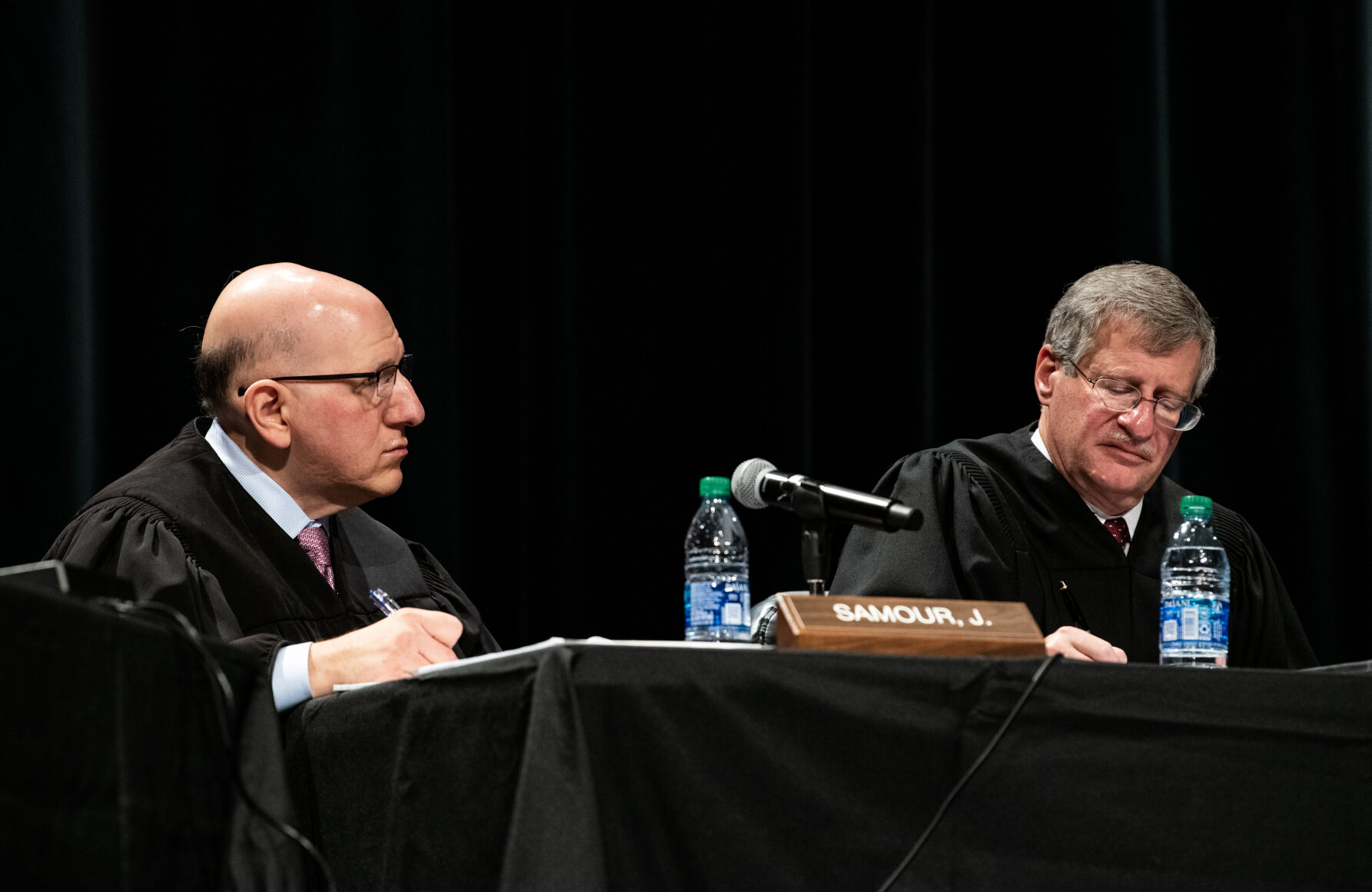
Justices Richard L. Gabriel and Carlos A. Samour Jr. were the most vocal critics of the defendants’ attempt to minimize the “contract exception,” the name for the explicit prohibition on subtracting insurance payments from medical malpractice verdicts.
“This family had insurance. We got a whole bunch of case law that said a (defendant) cannot take advantage of contracts or insurance. Doesn’t your argument do exactly that?” asked Gabriel.
“What the legislature decided is that to the extent there’s a third-party payer – but there’s a contract the plaintiff has with that third-party payer, such as an insurance contract – then that should not be held against the plaintiff because they’ve been paying premiums,” added Samour.
“They’ve been paying for that insurance. So, they should not be punished. If anyone in that case should get a windfall,” he continued, “it would be the plaintiff for that reason. Here, we have the same situation.”

Scholle, who died in 2022, incurred major injuries during his back surgery at Sky Ridge, requiring a 100-day stay in the intensive care unit. He filed a medical malpractice lawsuit against HCA-HealthONE and the two doctors who operated on him. After a 22-day trial, jurors awarded him $9.2 million, including $6 million for his past medical bills and $2.6 million for future expenses.
While a $1 million cap exists for such damages in state law, Scholle asked then-District Court Judge Robert L. McGahey Jr. to override the cap, which is permissible when there is “good cause.” McGahey cited six reasons why good cause existed, including Scholle’s inability to ever work again, increasing medical costs later in life and the severity of Scholle’s injuries.
The defendants appealed, and a three-judge panel of the Court of Appeals largely rejected their arguments, only slightly reducing the jury’s award. The judges also agreed McGahey had provided five acceptable reasons for awarding the full $9.2 million to Scholle.
However, the panel’s majority believed McGahey’s sixth reason – Scholle needed to repay the costs of his medical care – was questionable because Scholle appeared to owe nothing further on account of his insurance. The majority decided McGahey should not have considered that factor and ordered a new judge to reevaluate whether exceeding the $1 million cap was fair.
“The statute is broad and unambiguous: courts cannot reduce a verdict by any amount paid as the result of a contract,” wrote then-Judge Michael H. Berger in dissent. He added that McGahey’s five other, uncontested reasons separately justified the jury’s verdict.
To the Supreme Court, Scholle’s lawyers argued the hospital collected $1.7 million from Scholle’s insurance, and would actually profit from its negligence if it only had to pay $1 million at the conclusion of the case.
The Colorado Medical Society and the American Medical Association, writing in support of the defendants, noted state lawmakers enacted the Health Care Availability Act in 1988 to cap damages and lower the cost of business for healthcare providers.
“It simply is antithetical to the HCAA to exceed the cap to overcompensate a plaintiff for past medical expenses that he does not owe,” they wrote.
That principle, explained attorney Theresa Wardon Benz for the defendants, “provides the evidence for the trial court to consider, when making the good cause determination, how much is owed by this plaintiff.”
“Where does it say that?” demanded Gabriel. “This is a well-respected judge – my memory is he was an insurance defense lawyer – who gave six reasons for good cause here. Five of them are not contested. So, your argument is that that sixth one, even assuming he got it wrong, so overrode all the other five that we need to look at it again. I have some difficulty accepting that.”
Wardon Benz acknowledged it “does feel inequitable” if Scholle’s past medical bills were subtracted from the jury’s award, but she argued the General Assembly decided that was the desirable outcome nearly 40 years ago.
“If you’re right, ultimately, the hospital gets ($1.7 million) and the family gets $1 million. How is that fair?” Gabriel pressed. “I mean, this man died.”
The case is Scholle v. Ehrichs et al.


‘Understand people for who they are’: 2 federal judges talk about compassion in courtroom
Michael Karlik
michael.karlik@coloradopolitics.com
Updated 2 hours ago
Before taking the bench in 2022, U.S. District Court Judge Charlotte N. Sweeney was an employment discrimination attorney. While the cases could be emotionally charged, they were different from the criminal proceedings she is now handling. “It wasn’t necessarily affecting...
Denver murder conviction reversed for incomplete self-defense instruction
Michael Karlik
michael.karlik@coloradopolitics.com
Updated 19 hours ago
Colorado’s second-highest court reversed a defendant’s murder conviction last week because a Denver judge gave an incomplete instruction to the jury about the man’s right to self-defense. Donald R. Gonzales and Gary McLaughlin met up in a Capitol Hill parking...
Colorado lawmaker, House leaders named in workplace-retaliation lawsuit
Marianne Goodland
marianne.goodland@coloradopolitics.com
Updated 22 hours ago
A former legislative aide has filed a lawsuit alleging she was mistreated, illegally directed to perform campaign work and harmed by a House leadership structure she charged was fragmented, politicized and ineffective at protecting employees. The lawsuit, filed by Jennifer...
Federal judge hears arguments about Colorado’s 3-day gun purchase waiting period
Michael Karlik
michael.karlik@coloradopolitics.com
Updated 1 day ago
A federal judge heard arguments on Monday about the constitutionality of a 2023 Colorado law that generally imposes a three-day waiting period on firearm purchases after the initiation of a background check. The test that the U.S. Supreme Court created...
Colorado Supreme Court intervenes in Weld County prosecution dismissed due to Missy Woods misconduct
Michael Karlik
michael.karlik@coloradopolitics.com
Updated 19 hours ago
The Colorado Supreme Court ordered a Weld County trial judge last week to respond to the district attorney’s claim that he improperly dismissed a criminal case because of “outrageous” conduct by the Colorado Bureau of Investigation. Daniel Lee Eatinger stood...
Schoolchildren’s presence at child sex-related trial did not harm Arapahoe County defendant, appeals court says
Michael Karlik
michael.karlik@coloradopolitics.com
Updated 4 days ago
Colorado’s second-highest court decided on Thursday that the presence of a group of schoolchildren on the first day of a child sexual exploitation trial did not violate an Arapahoe County defendant’s constitutional right to a fair trial. Prosecutors charged Jerry...
Appeals court cites week-old Colorado law to reinstate child neglect case at child, father’s request
Michael Karlik
michael.karlik@coloradopolitics.com
Updated 4 days ago
Colorado’s second-highest court invoked a new state law for the first time on Thursday and reinstated a child neglect case that both the child and her father wished to reopen. House Bill 1227 took effect on Aug. 12, reversing a...
Colorado Supreme Court names William Hood as next chief justice
Michael Karlik
michael.karlik@coloradopolitics.com
Updated 5 days ago
The Colorado Supreme Court has selected Justice William W. Hood III to be the next chief justice, the judicial branch announced on Friday. Hood will succeed Chief Justice Monica M. Márquez, who took over the role in July 2024. “I...
Family of slain Lakewood teacher releases statement as murder suspect makes first court appearance
Matt Kyle
matt.kyle@denvergazette.com
Updated 2 days ago
Patrick Theodore Barnett, the Lakewood man accused of killing his wife, a Jeffco Public Schools art teacher, made his first court appearance Friday morning as his wife’s family looked on. The status conference hearing was held before District Court Judge...
Appeals court upholds Park County trophy hunting conviction
Michael Karlik
michael.karlik@coloradopolitics.com
Updated 5 days ago
Colorado’s second-highest court clarified on Thursday that a defendant may stand convicted under the state’s trophy hunting laws if he abandons a bear carcass but returns later to remove the meat. Under Colorado law, it is a felony to detach...
PREV
PREVIOUS

Senate Dems, Republicans squabble over public access to bills, special session schedule
That didn’t take long. Less than an hour into the Colorado General Assembly’s special session on property taxes, Senate Democratic and Republican leaders fought over whether the public gets enough access to the legislation being offered in the next three days. Shortly after the bills were introduced and sent off to committee, Senate President Steve […]

Primary property tax relief bill wins party-line vote in first committee
The Democrats’ main proposal to deal with soaring property taxes cleared its first committee on a party-line 4-3 vote on Friday afternoon – but not without grumbling from counties and special districts that believe they have been left out. Senate Bill 23B-001 passed the Senate Finance Committee on the first day of the Colorado General […]