

Colorado No. 1 in U.S. for West Nile
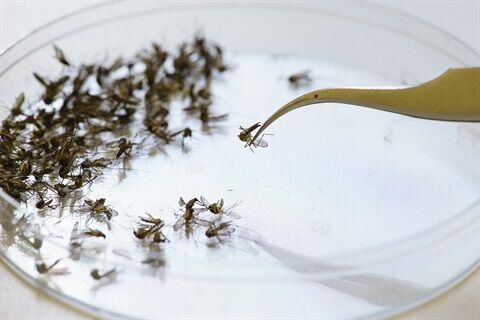
The West Nile virus stuck it to Colorado this year.
Thanks to perfect mosquito breeding conditions during Colorado’s abnormally wet spring and a dry summer, the virus hit Coloradans harder this season than it has since the illness first emerged here 20 years ago.
Since around the Fourth of July, when Colorado’s first cases of West Nile started showing up, 31 Coloradans have died from the virus. That’s compared to 20 last year and 11 in 2021.
In 2003, when the virus first appeared in Colorado, 66 people lost their lives to it.
Though Colorado has 54 different breeds of mosquito, the Culex genus is the primary West Nile carrier, which then transfers to humans via the bite of a breeding female. Mosquitoes contract the disease when they feed on birds that carry it.
“Every season is busy like this, but this year hit extra hard,” said Anna Wanek, surveillance manager for Vector Disease Control International, a lab which is responsible for trapping, counting, testing and spraying for millions of mosquitoes.
The mosquito business is booming with VDCI lab biologists racking up the overtime, spending 20-plus extra hours a week categorizing this year’s explosion of Culex mosquitoes.
We’re No. 1
In addition to an increase in deaths, Colorado is also leading the country in the total number of West Nile cases.
According to the Centers for Disease Control and Prevention, Colorado had almost three times more cases than California, the second-most affected state. As of Wednesday, the latest national data showed that Colorado had 520 cases, compared to California’s 156.
Nebraska reported 105 confirmed cases, and Arizona, usually a hot spot for West Nile, had 77. Kentucky, Pennsylvania, Washington state and Washington D.C. only had one reported case.
But those Colorado stats are low because they have not caught up to the local numbers from the Colorado Department of Health and Environment (CDPHE), which recorded more cases than reported by the CDC at 460. Those numbers were compiled on Sept. 19 and are expected to be updated soon.
Of Colorado’s CDPHE-reported cases, 316 of those required hospitalization, according to department statistics.
The current West Nile virus hot-spot is Denver county, which reported the most cases with 80, with Weld and Larimer counties rounding out the top three most affected counties.
No Cure, No Vaccine
There is no cure for the West Nile virus in humans despite 20 years of intensive laboratory and clinical research.
There is no vaccine to prevent it, either, but there is a vaccine available for horses – which are hit particularly hard by the disease. As of Sept. 22, of around 40 horses that came down with the virus, 10 died. The health department recommends a yearly equine booster.
In people, West Nile can strike any age group, but tends to hit those over 60 years of age and the risk is higher for those with medical conditions, such as cancer, diabetes, hypertension, kidney disease and transplant patients.
Eighty percent of people who are infected with West Nile are asymptomatic. Around 20% may experience West Nile fever, which feels like the flu.
Less than 1% actually die of the illness.
People behind the numbers
Though only 1% of people who contract West Nile die from it, the stories of people crippled by the virus are astounding.
Art Leis remembers when he got the bite that turned his normally vibrant lifestyle upside-down. He was on his patio biting into a hamburger.
“I’ve probably had a million mosquito bites like everybody else and I never thought twice about West Nile,” he said.
But in mid-August 2022, Leis the wrong mosquito bit him.
The 66-year-old helicopter skier and mountain climber got progressively sick, until he finally ended up in the hospital on Aug. 31, 2022, “a day or two away from not being alive.”
After a year of gradual recovery, Leis now uses a handicapped sticker, which he jokes is one good thing to come out of his West Nile experience.
His right arm is paralyzed and he only has a half the normal use of his left. Since it’s almost impossible for a layperson to tell if the mosquitos buzzing around is a Culex, he advised people not to take them lightly.
“I would just say be more careful,” he said. “Use repellant. If they’re biting, go inside.”
Randy Hunter
Throughout his life, 70 year-old Randy Hunter was rarely sick. But his good health went downhill drastically two years ago on a seemingly harmless afternoon working on the computer in the backyard.
“He never felt the bite,” said his wife, Mareena, but the illness crept on on him. Hunter began to feel tired and was suddenly sleeping a lot.
“He kept saying he didn’t feel well. We tested him for COVID and it came back negative,” Mareena said.
The next day, Hunter fell getting out of the shower. He was rushed to the ICU at Rose Medical Center, where he stayed for three weeks. For the last two years, lung complications have sent him to seven different hospitals.
Today, the former head of the risk department for a commercial real estate company is completely deaf and has just gotten to point where he can load himself into a wheelchair.
“His fingers work well enough now that he can steer it,” said his wife.
When will it end?
It takes two-to-three weeks after a bite from an infected mosquito before West Nile symptoms start to show, so the spiked numbers being reported this week are indicative of people who were bit around Labor Day.
The good news, Wanek assured Coloradans, is that West Nile will start to slow down once the nights get cooler and the Culex mosquito begins its “overwintering mode.”
“That’s when they’ll stop biting people,” Wanek said.
Leis said that his neurologists did not understand West Nile virus.
“When I asked them about a vaccine or a cure, they said they had no idea,” he said. But he wonders, even if there was a vaccine for the virus, “How many people would take it?”


Colorado justices grill debt collector about compliance with law
Michael Karlik
michael.karlik@coloradopolitics.com
Updated 14 minutes ago
The Colorado Supreme Court repeatedly pressed a debt collection company last week to explain how its lawsuit against a Boulder woman for an unpaid credit card balance complied with the specific requirements that state lawmakers have created. Portfolio Recovery Associates,...

Artificial intelligence working group agrees on framework to replace Colorado law
Marianne Goodland
marianne.goodland@coloradopolitics.com
Updated 6 hours ago
A group that has been working on artificial intelligence policy has reached an agreement on a framework that would replace the regulations adopted by Colorado legislators two years ago. The agreement has the backing of Gov. Jared Polis, who reluctantly...

Proposal to levy new fees on alcohol products in Colorado dies
Marissa Ventrelli
marissa.ventrelli@coloradopolitics.com
Updated 7 hours ago
The proposal to collect millions in new fees on alcohol products — dollars to be earmarked for Colorado programs aimed at addressing the behavioral and physical health effects of alcohol abuse — died on Tuesday. House Bill 1271 sought to...
The numbers that Republicans say show Democratic midterm targets are a ‘political hallucination’
Rob Crilly, Washington Examiner
rob.crilly.washington.examiner@gazetteedit.wpenginepowered.com
Updated 6 hours ago
Democrats keep expanding their battleground map of midterm target seats, but do they really have any chance in some of the districts they claim they can win? Of the 44 districts listed by the Democratic Congressional Campaign Committee as targets,...

Pam Bondi subpoenaed for April 14 House deposition on Epstein files handling
Kaelan Deese, Washington Examiner
kaelan.deese.washington.examiner@gazetteedit.wpenginepowered.com
Updated 8 hours ago
The House Committee on Oversight and Government Reform issued a subpoena Tuesday compelling Attorney General Pam Bondi to sit for a deposition on April 14 as part of an ongoing investigation into the Justice Department’s handling of the Jeffrey Epstein...

Capitol Police chief asks for record-breaking budget, citing 58% increase in threats to Congress
Emily Hallas, Washington Examiner
emily.hallas.washington.examiner@gazetteedit.wpenginepowered.com
Updated 8 hours ago
U.S. Capitol Police Chief Michael Sullivan on Tuesday argued sweeping threats against lawmakers justify his department’s historic budget request during a House Appropriations Committee hearing. Sullivan testified before the Legislative Branch Subcommittee on his budget proposal for fiscal 2027 funding....
After ‘winter of defeat,’ Colorado hopes for wetter summer
Marianne Goodland
marianne.goodland@coloradopolitics.com
Updated 9 hours ago
With snowpack melt already peaking in some parts of the state and drought conditions worsening compared to last year, Colorado’s water watchers are hoping for a wetter summer, though they anticipate the situation deteriorating before getting better. Meanwhile, the governor...

Colorado, Democrat states oppose proposal to require EV chargers be made with 100% domestic components
Scott Weiser
scott.weiser@gazette.com
Updated 9 hours ago
Colorado has joined a coalition of about 20 states in opposing a federal proposal that would require electric vehicle chargers funded with federal dollars to be made with 100% domestic components. The Federal Highway Administration is considering raising the domestic...
Colorado ethics panel tells legislator to attend sexual harassment training
Marianne Goodland
marianne.goodland@coloradopolitics.com
Updated 6 hours ago
Colorado’s House ethics panel admonished a Republican legislator over allegations he used a master key to access areas of the Capitol that he was not permitted to enter and that he had made sexually harassing comments to several female lawmakers....
Appeals court agrees defendant’s speech constitutionally protected against El Paso County judge
Michael Karlik
michael.karlik@coloradopolitics.com
Updated 7 hours ago
Colorado’s second-highest court agreed last week that a defendant’s critical statements toward a 4th Judicial District judge were constitutionally protected and could not form the basis of a retaliation charge. A three-judge Court of Appeals panel concluded that, in context,...